When a houseplant starts to slide, it's tempting to blame the soil first. Sometimes that's right. Often the answer is somewhere you can check quickly, as long as you check in the right order.
The trouble with a struggling houseplant is that several different problems can look alike from across the room. A wilting plant can be too dry or too wet (University of Maryland Extension, 2023d). Brown leaf tips can come from hot, dry air, watering problems, salts or insects (Kluepfel et al., 2025). So start with five checks, in this order.
If every check points back at the pot, The Root Zone has the repair: what roots need from a mix, the kinds of bagged mix, and a three-ingredient recipe. This page is about working out whether that's where you need to be.
Before You Start
Change one thing at a time. If you move the plant, repot it and feed it on the same afternoon, you'll never know which of the three helped, or which one made things worse. Make the checks first, then act on the one that turns something up.
The order runs roughly from the easiest thing to check to the most involved.
Check 1: Is It Getting Enough Light?
Indoor light is far weaker than outdoor light (Trinklein, 2016).
One common measure of light is the foot-candle, roughly the light from one candle measured a foot away, and outdoor direct sun peaks at about 10,000 of them (University of Maryland Extension, 2023b). Gardening guidance from the University of Florida says that even in winter, light outside at noon can reach over 4,000 foot-candles, while a north-facing window may never reach 400 (UF/IFAS Gardening Solutions, n.d.). Distance from the glass matters too: light falls off quickly away from a window, and a plant moved just 8 feet (about 2.4 m) back from a south window with strong direct light can end up somewhere too dim to grow (Watkins, 2026).
What low light looks like on the plant:
- Stretched stems. Stems grow long and thin with wide gaps between the leaves, as if reaching toward the light (Weisenhorn & Hoidal, 2026). Light that reaches a plant from one side can also make it lean (University of Maryland Extension, 2023b).
- Faded color and slow growth. Leaf color can fade and growth can be poor (University of Maryland Extension, 2023b). The same plant in brighter light stays more compact, branches better and keeps normal-size leaves (University of Maryland Extension, 2023b).
- Older leaves dropping, variegation fading. A plant short on light may drop leaves, especially older ones, and a green-and-white variegated plant may turn back to solid green (Weisenhorn & Hoidal, 2026). Green shoots on a variegated plant aren't always about light, though. The Royal Horticultural Society notes that the mutations behind variegation aren't always stable, so shoots can revert to plain green; it describes this mainly in garden shrubs and trees (Royal Horticultural Society, n.d.).
Did it just move?
Bringing a plant back inside after a summer outdoors can cause leaf drop and yellowing, and plants take time to adjust to the lower light in a home (University of Maryland Extension, 2023b). Weeping fig (Ficus benjamina) can drop a lot of leaves this way (University of Maryland Extension, 2023b). Plants bought from a store commonly lose a few leaves once they're indoors, most likely because they were raised in a nursery with fairly high light, and that small loss is just the plant adjusting to its new spot (Trinklein, 2016). Oklahoma State University Extension says gardeners may see Ficus shed quite a few leaves after coming indoors and calls it part of the moving process. Expect four to six weeks before they settle (Oklahoma State University Extension, 2023). That assumes the new spot suits the plant. Clemson Extension says a weeping fig will adjust, stop dropping leaves and put out healthy new growth if growing conditions are adequate (Russ & Pertuit, 2016).
What to do: move the plant closer to a window or to a brighter one, and give it a few weeks before you judge. If the move was recent and the new growth looks healthy, a few dropped leaves aren't a reason to repot.
Check 2: Is the Watering Matched to the Plant?
Too much water and too little can produce similar symptoms (Shaughnessy & Pertuit, 2024). Some plants, peace lily among them, wilt when they need water, and plants can also wilt when they've been overwatered (University of Maryland Extension, 2023d). The main sign of too much water is leaves low on the plant and toward its center wilting or turning yellow, the same symptoms as root rot or drought (University of Maryland Extension, 2023c). A houseplant that suddenly wilts is most often losing its roots, and overwatered plants often lose roots to a lack of oxygen (Trinklein, 2016).
So don't water on a schedule. A fixed calendar can hand a plant too much water or too little (University of Maryland Extension, 2023d), because plant size, pot size, light, temperature and humidity all change how fast a pot dries out (Rothenberger & Hartley, 2010). A plant sitting somewhere warm, sunny and dry needs water more often than one in a cool, dim spot (Shaughnessy & Pertuit, 2024). In winter, houseplant growth drops off and so does water uptake, so winter watering can generally be cut back significantly (Watkins, 2023). Plants near a heat source are different: they dry out faster where it's warmer and near heat sources, which is often the case in winter (Pettinelli, 2020).
Check the pot instead of the date:
- The finger test. Push a finger about 2 inches (5 cm) into the mix, and if it's dry there, the plant probably needs water (University of Maryland Extension, 2023d). Succulents and cacti are among the exceptions and need far less (University of Maryland Extension, 2023d). Clemson Extension goes by the first knuckle instead (Shaughnessy & Pertuit, 2024).
- The lift test. Potting mix gets lighter as it dries, so lift the pot now and then and compare it with how it felt right after watering (University of Maryland Extension, 2023c).
- Big pots. Push a stick or dowel all the way to the bottom and pull it out. Moist mix sticks to it or discolors it slightly (University of Maryland Extension, 2023c).
If the plant is wilting and the mix is still wet, skip ahead to the roots.
Check 3: What Do the Roots Look Like?
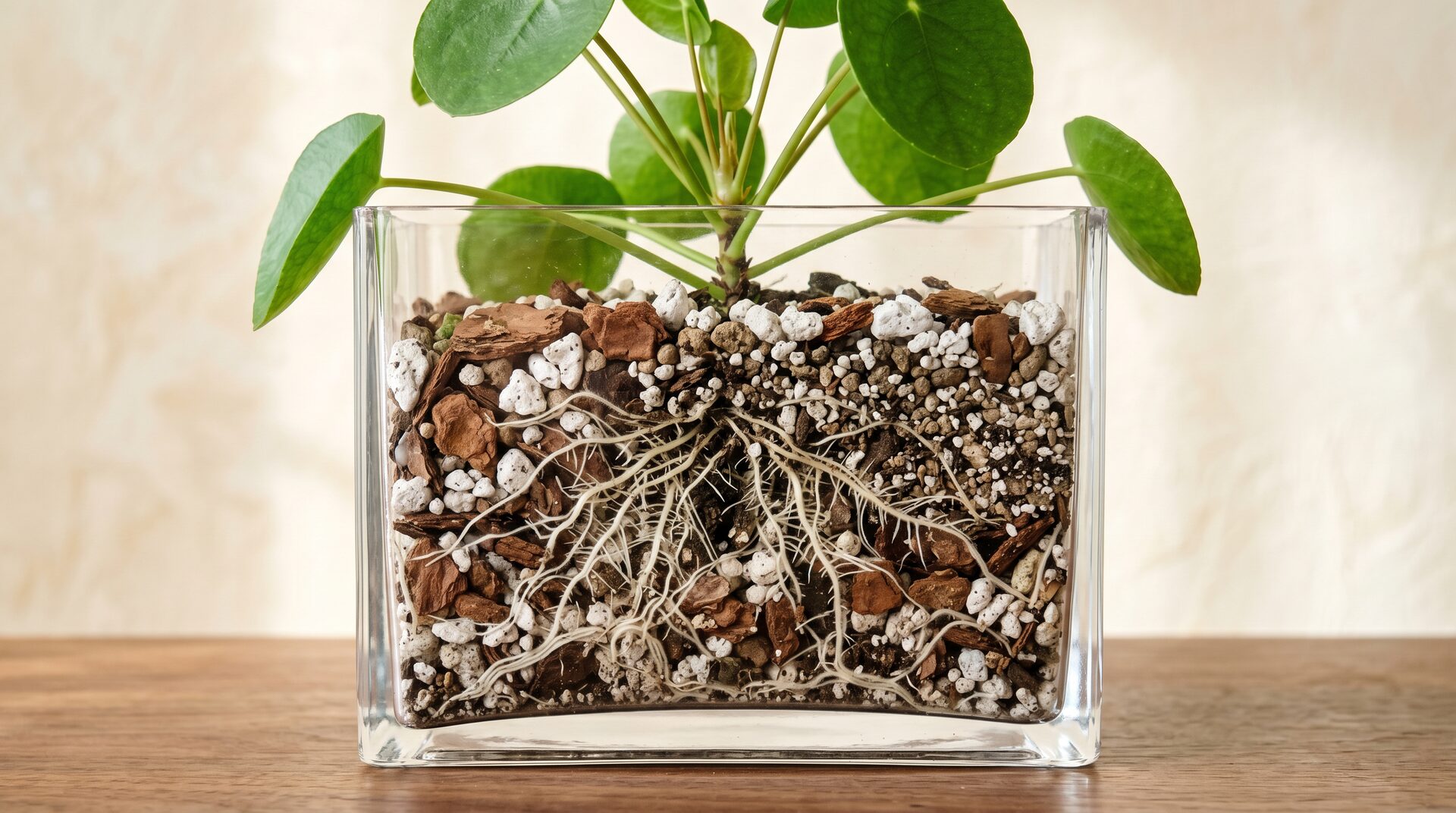
Gardeners often first notice root rot when a plant wilts even though its soil is wet (Hudelson & Jull, 2024). Slide the plant out of its pot and look at the roots. Healthy roots tend to be white and firm to the touch (Wick & Madeiras, 2019, writing about greenhouse crops). Rotting ones can look soaked through or darkened, and they may squash apart when you pinch them (Wick & Madeiras, 2019). On houseplants, rotting roots turn brown or black and can go soft (Kluepfel et al., 2025), and they may smell bad (Hudelson & Jull, 2024).
Root rots are caused by soil-borne organisms (Hudelson & Jull, 2024). The most common are Pythium, Phytophthora, Rhizoctonia solani and Fusarium (Hudelson & Jull, 2024). The first two are water molds, fungus-like organisms rather than true fungi, and in greenhouse crops they do the most harm when soil moisture is abundant (Wick & Madeiras, 2019). The other two don't follow that pattern. In greenhouse crops, Rhizoctonia is favored by middling moisture, neither too wet nor too dry (Cornell University Greenhouse Horticulture, n.d.), and in outdoor ornamental plants, Fusarium and Rhizoctonia symptoms show up in warmer, drier soil once the plant is water-stressed (Abbey, 2019). So we'd read wilting in soggy mix as pointing mainly to the water molds. The same fact sheet notes that water molds thrive in saturated conditions. A waterlogged soil holds little air, and soil made of very fine particles has few air spaces (Wick & Madeiras, 2019).
Too much water and a pot that drains poorly can both lead to root rot (Hahn & Weisenhorn, 2026). If you keep a plant with root rot, University of Wisconsin Extension's advice is to cut back on soil moisture while still giving the plant the water it needs to grow (Hudelson & Jull, 2024). If the roots are soft and brown, we'd also look hard at the mix itself, and The Root Zone covers that.
Check 4: Is Something Living on It?
Some pests are very small, so look closely (Hahn & Weisenhorn, 2026). Check both sides of the leaves for insects, eggs, webbing and holes, and pay attention to any discolored leaves, which may be a sign of pests (Hahn & Weisenhorn, 2026).
University of Minnesota Extension says a 10x hand lens is helpful when looking for pests (Hahn & Weisenhorn, 2026), and in our own test of five hand lenses a cheap 10x worked well for scouting: it picked out damage like silvery streaks and dark specks clearly. It didn't show the fringed wings of a thrips or the forked wing veins of a fungus gnat, though, and those are what tell you which pest you have. Our top two picks, a 30x pocket loupe and a 60x lit loupe, showed both.
| Pest | What you'll see | Read more |
|---|---|---|
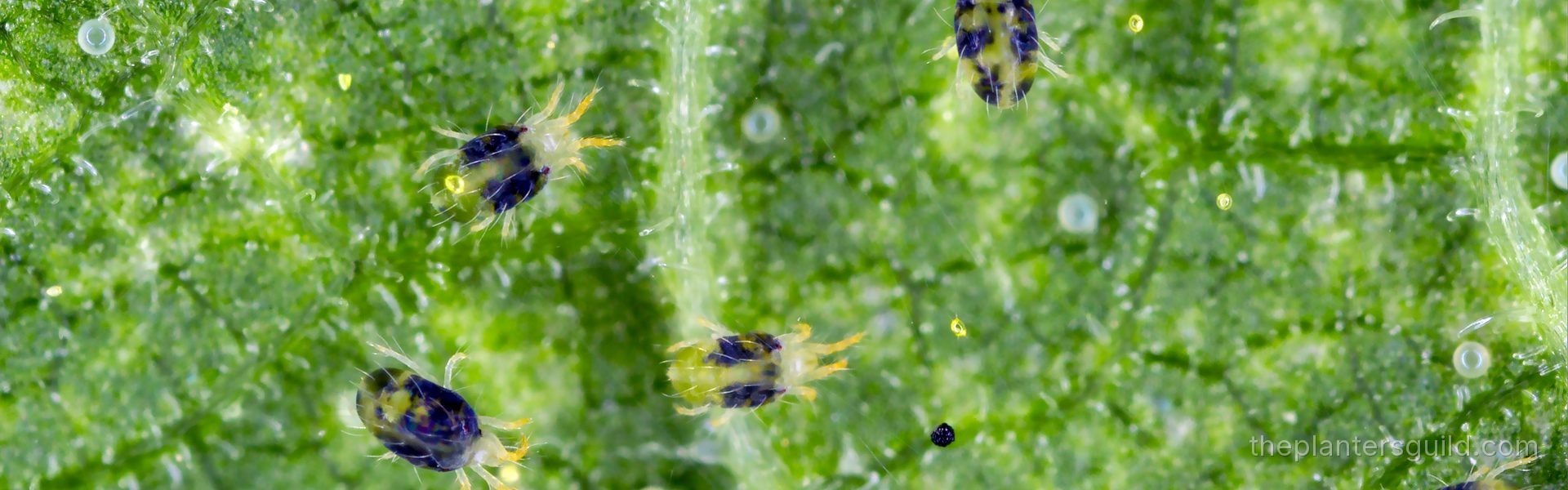
| Spider mites | Speckled or mottled leaves and fine webbing (Hahn & Weisenhorn, 2026). Badly infested leaves can look bleached (Hahn & Weisenhorn, 2026). Tap a leaf over white paper and watch for tiny moving specks (Hahn & Weisenhorn, 2026). | Spider Mites |
| Mealybugs | Slow-moving insects coated in white wax (Barrett, 2022), with white filaments along the sides and tail (Hahn & Weisenhorn, 2026). | Mealybugs |
| Scale | Heavily infested plants are often covered in small disk-like or waxy bumps, each with an insect feeding underneath (Barrett, 2022). Check stems and leaf undersides, especially along the center vein (Hahn & Weisenhorn, 2026). | |
| Thrips | Irregular silvery streaks or splotches on the leaves, sometimes with small shiny drops of excrement where feeding is heavy (Hahn & Weisenhorn, 2026). On pale foliage the streaks can look brownish instead (Barrett, 2022). | Thrips |
| Fungus gnats | Tiny, dark, fragile-looking flies (Barrett, 2022), which favor damp potting mix (Hahn & Weisenhorn, 2026). | Fungus Gnats |
Sticky leaves, or a sticky tabletop under the plant, point to honeydew, a shiny residue that aphids, mealybugs and scale insects leave behind (Hahn & Weisenhorn, 2026).
Fungus gnats deserve a separate note, because we'd read them as a clue about the pot as much as a pest. University of Minnesota Extension says they seldom, if ever, harm indoor plants, and that they prefer damp potting soil, especially a mix high in peat (Hahn & Weisenhorn, 2026). Missouri Extension says that in containers the larvae mostly eat organic matter but will also go after the roots of young plants, and that heavy infestations can make affected plants wilt (Barrett, 2022). So a pot full of gnats is a good reason to go back to Check 2.
If you find something, move that plant away from the others (Hahn & Weisenhorn, 2026). Minnesota Extension also recommends keeping any new plant apart for one to two weeks, so whatever it brought home has time to show itself (Hahn & Weisenhorn, 2026).
Check 5: Is Salt Building Up in the Pot?
When water evaporates from a pot, the salts it carried stay behind (Colorado State University Extension, n.d.). Many fertilizers are salt based, and tap water can carry salts too, softened water especially (Colorado State University Extension, n.d.). The most obvious sign is a whitish crystal crust around the rim of the pot or on top of the mix (Colorado State University Extension, n.d.). On the plant, the typical sign of too much fertilizer salt is browning at the leaf tips and edges, and it can also bring slower growth, lower leaves dropping and wilting (University of Maryland Extension, 2023a). High salt levels come from feeding too much, feeding too often, or using fertilizer concentrate incorrectly (University of Maryland Extension, 2023a).
Brown tips on their own don't prove salts. Hot, dry air, watering problems and insect feeding can all brown leaf tips and edges too (Kluepfel et al., 2025). We'd treat a white crust together with brown tips as a much stronger case than either one alone.
For a large pot, one fix is to flush, or leach, the salts out with plain water (University of Maryland Extension, 2023a). Colorado State's method runs like this (Colorado State University Extension, n.d.):
- Scrape off the white crust along with the top half inch to an inch (1.3 to 2.5 cm) of mix, more or less according to how big the plant and root ball (the roots and the mix they hold) are, and take care not to damage the roots (Colorado State University Extension, n.d.).
- Take the pot off its saucer and set it in a sink where it can drain freely.
- Make sure the drainage holes aren't blocked.
- Fill the pot to the top with lukewarm tap water a couple of times, letting it drain between rinses.
- Top the pot back up with fresh mix.
If your water goes through a softener, use unsoftened water for the flush. North Dakota State University Extension doesn't recommend softened water for houseplants, because of its sodium content (Johnson & Scherer, 2022).
In extreme cases the mix may need replacing altogether (Colorado State University Extension, n.d.), and University of Maryland Extension recommends replacing it in smaller pots (University of Maryland Extension, 2023a). After that, check the fertilizer label rate before the next feeding.
If It's the Mix Itself
Sometimes all five checks lead to the same place: the pot. The mix stays wet and the roots are soft, maybe with gnats around the surface. When we see that combination, we look at the mix itself.
Organic ingredients in a potting mix can break down over time (Owen & Lopez, 2015). As they decompose, they can produce too many small particles, which hold too much water and leave less room for air (Bilderback et al., 2005). The microbes doing the decomposing can break larger particles into fine ones, and that changes how the whole mix behaves (Owen & Lopez, 2015). Both sources are describing nursery and greenhouse containers, so read them as the mechanism rather than a timeline for your pot. Roots play a part too: in one study of small bark-filled test cores under nursery production conditions, air space tended to fall further when a plant was growing in them (Altland et al., 2011).
Next · The Substrate Library
The Root Zone
If the checks point at the pot, start here:
- The Root Zone: what roots need from a mix, the four kinds of bagged mix, a three-ingredient recipe, and when to repot
- How Substrate Actually Works: the physics of air and water in a pot, for when you want the why
The One Thing to Remember
Look before you change anything, and look in order: light, water, roots, pests, salts. Find the one that turns something up, fix that, and give the plant time before you judge.
Go deeper in the free Apprenticeship: Module II, Reading Light →
Abbey, T. (2019, July 18). Root rots in ornamental plant species. Penn State Extension. https://extension.psu.edu/root-rots-in-ornamental-plant-species
Altland, J. E., Owen, J. S., Jr., & Gabriel, M. Z. (2011). Influence of pumice and plant roots on substrate physical properties over time. HortTechnology, 21(5), 554–557. https://doi.org/10.21273/HORTTECH.21.5.554
Barrett, B. A. (2022). Least-toxic control methods to manage indoor plant pests (Publication G7273). University of Missouri Extension. (Original work published 2017). https://extension.missouri.edu/publications/g7273
Bilderback, T. E., Warren, S. L., Owen, J. S., Jr., & Albano, J. P. (2005). Healthy substrates need physicals too! HortTechnology, 15(4), 747–751. https://doi.org/10.21273/HORTTECH.15.4.0747
Colorado State University Extension. (n.d.). Leaching salts from potting mixes (PlantTalk Colorado 1339). https://planttalk.colostate.edu/topics/houseplants/1339-leaching-salts-potting-mixes/
Cornell University Greenhouse Horticulture. (n.d.). Root rot diseases. https://greenhouse.cornell.edu/pests-diseases/disease-factsheets/root-rot-diseases/
Hahn, J., & Weisenhorn, J. (2026). Managing insects on indoor plants. University of Minnesota Extension. https://extension.umn.edu/yard-and-garden-insects/insects-indoor-plants
Hudelson, B., & Jull, L. (2024). Root rots on houseplants (UW Plant Disease Facts D0096). University of Wisconsin–Madison Division of Extension. https://hort.extension.wisc.edu/articles/root-rots-houseplants/
Johnson, R., & Scherer, T. (2022). Water softening (ion exchange) (WQ1031, rev.). North Dakota State University Extension. https://www.ndsu.edu/agriculture/extension/publications/water-softening-ion-exchange
Kluepfel, M., Blake, J. H., & Williamson, J. (2025). Houseplant diseases & disorders. Clemson Cooperative Extension, Home & Garden Information Center. https://hgic.clemson.edu/factsheet/houseplant-diseases-disorders/
Oklahoma State University Extension. (2023, November 26). Don’t fear if the leaves on your Ficus are falling [Grow gardening column]. https://extension.okstate.edu/announcements/grow-gardening-columns/november-26-2023
Owen, W. G., & Lopez, R. G. (2015). Evaluating container substrates and their components (HO-255-W). Purdue University Extension. https://www.extension.purdue.edu/extmedia/HO/HO-255-W.pdf
Pettinelli, D. (2020). Watering houseplants (C. Johnson, Rev.). UConn Extension. (Original work published 2007). https://soiltesting.cahnr.uconn.edu/wp-content/uploads/sites/3514/2023/06/Watering-Houseplants.pdf (archived August 2, 2024)
Rothenberger, R. R., & Hartley, D. E. (2010). Caring for houseplants (G6510; D. H. Trinklein, Rev.). University of Missouri Extension. (Original work published 1971). https://extension.missouri.edu/publications/g6510
Royal Horticultural Society. (n.d.). Reversion in plants. https://www.rhs.org.uk/problems/reversion
Russ, K., & Pertuit, A. (2016, February 15). Weeping ficus (B. H. Smith, Rev.; HGIC 1514). Clemson Cooperative Extension, Home & Garden Information Center. https://hgic.clemson.edu/factsheet/weeping-ficus/
Shaughnessy, D., & Pertuit, A. (2024). Indoor plants: Watering. Clemson Cooperative Extension, Home & Garden Information Center. (Original work published 1999). https://hgic.clemson.edu/factsheet/indoor-plants-watering/
Trinklein, D. (2016, November 8). Houseplant acclimatization. Missouri Environment and Garden, University of Missouri. https://ipm.missouri.edu/MEG/2016/11/Houseplant_Acclimatization/
UF/IFAS Gardening Solutions. (n.d.). Light for houseplants. University of Florida Institute of Food and Agricultural Sciences. https://gardeningsolutions.ifas.ufl.edu/plants/houseplants/light-for-houseplants/
University of Maryland Extension. (2023a, March 13). Fertilizer toxicity or high soluble salts in indoor plants. Home and Garden Information Center. https://extension.umd.edu/resource/fertilizer-toxicity-or-high-soluble-salts-indoor-plants
University of Maryland Extension. (2023b, March 10). Lighting for indoor plants. Home and Garden Information Center. https://extension.umd.edu/resource/lighting-indoor-plants
University of Maryland Extension. (2023c, March 13). Overwatered indoor plants. Home and Garden Information Center. https://extension.umd.edu/resource/overwatered-indoor-plants
University of Maryland Extension. (2023d, March 10). Watering indoor plants. Home and Garden Information Center. https://extension.umd.edu/resource/watering-indoor-plants
Watkins, K. (2023, December 11). Winter considerations for houseplants. N.C. Cooperative Extension, Richmond County Center. https://richmond.ces.ncsu.edu/2023/12/winter-considerations-for-house-plants/
Watkins, K. (2026, June 30). Light considerations for indoor plants. N.C. Cooperative Extension, Richmond County Center. https://richmond.ces.ncsu.edu/news/light-considerations-for-indoor-plants/
Weisenhorn, J., & Hoidal, N. (2026). Lighting for indoor plants and starting seeds. University of Minnesota Extension. https://extension.umn.edu/planting-and-growing-guides/lighting-indoor-plants
Wick, R. L., & Madeiras, A. (2019). Root diseases of greenhouse crops [Fact sheet]. UMass Extension Greenhouse Crops and Floriculture Program. https://www.umass.edu/agriculture-food-environment/greenhouse-floriculture/fact-sheets/root-diseases-of-greenhouse-crops