Seventy percent mineral, zeolite included, and zero bark. It's the mix we pot a plant into after trimming away rotted or damaged roots, plus the aftercare we follow while it grows new ones. The extension advice we checked calls for fresh, sterile potting mix, not a special recipe. This is the mix we use.
Corrected September 2026: we've revised parts of this guide. See the correction note at the end.
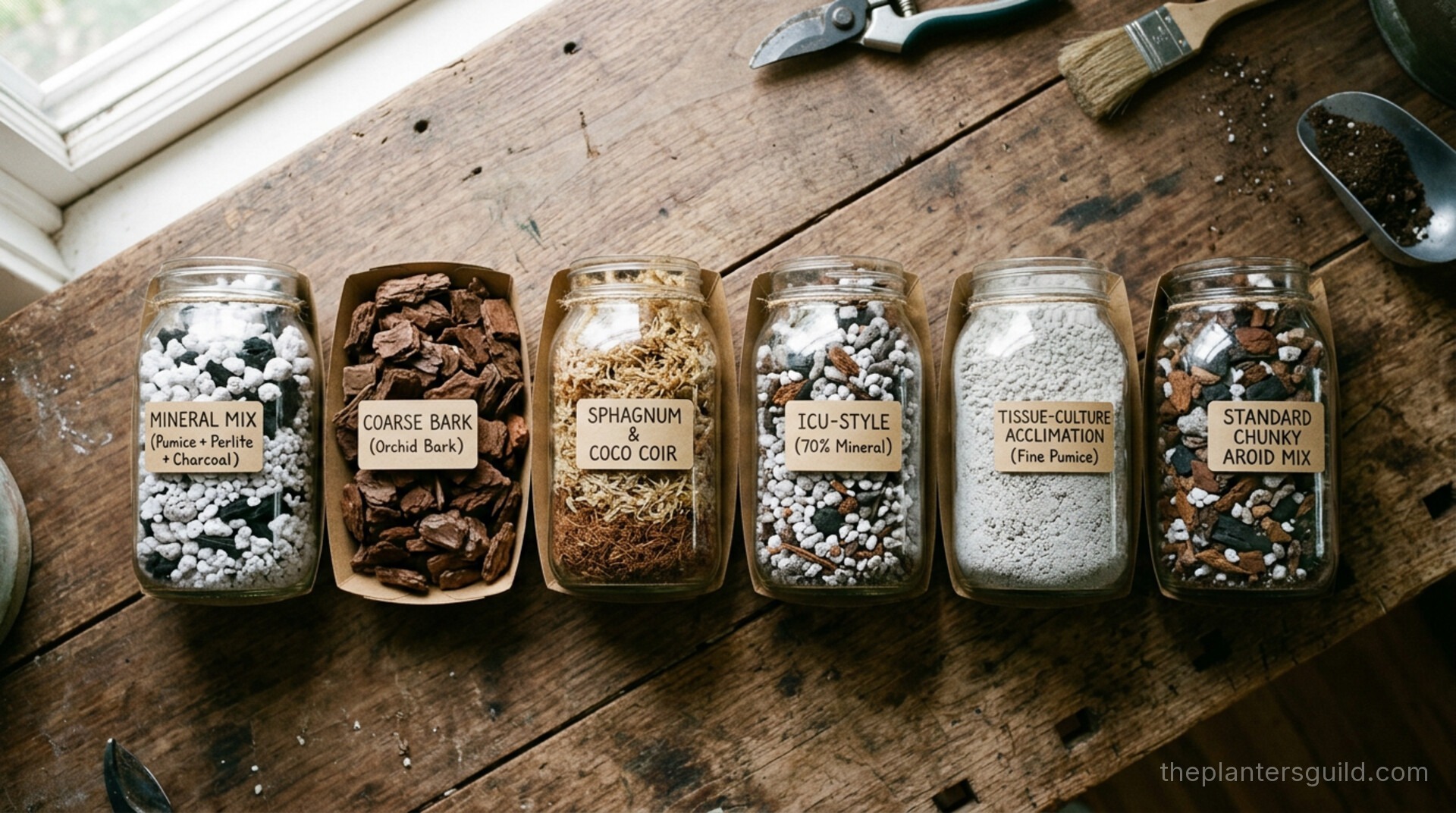
If a plant arrives with soft, brown roots, or you tip one out of its pot and find the roots falling apart, this is the mix we reach for once the damaged roots are off. It's not our everyday mix. It's for the weeks a plant spends growing new roots, and once it has them we move it to one of our standard mixes.
First, what a mix can and can't do. Root rot fungi most often attack a plant already under stress, and a potting mix that stays too wet is one of the most common stresses (Iowa State University Extension, 1994). Extension advice for a houseplant with root rot is to check whether enough healthy roots remain, repot into a clean pot with a drainage hole and new, sterile potting mix, and water less (Lang et al., n.d.). Some plants can't be saved, and one extension plant pathology guide says that throwing out a plant with root rot is often the best and cheapest option (Hudelson & Jull, n.d.). Another advises discarding badly infected plants and taking cuttings only from healthy tissue (University of Maryland Extension, n.d.-b). None of that calls for a special mix. ICU Mix is the mix we use for that step, but it isn't a requirement. And because it contains earthworm castings, it isn't sterile (see the castings section below).
The Recipe
All percentages by volume. For a 10-cup (about 2.4 L) batch:
| Ingredient | Percentage | Cups | Grade / Particle Size |
|---|---|---|---|
| Pumice | 35% | 3.5 | 6 mm (1/4 inch) |
| Perlite (coarse) | 25% | 2.5 | #3 grade |
| Buffered coir | 20% | 2.0 | Medium pith |
| Zeolite (clinoptilolite) | 10% | 1.0 | 1–3 mm |
| Earthworm castings | 10% | 1.0 | Sifted |
That's 70% mineral (pumice, perlite and zeolite) and 30% organic (coir and castings). The proportions are the Guild's own formulation, not figures from a study.
Target pH: 6.0 to 6.5, the range UF/IFAS (University of Florida Institute of Food and Agricultural Sciences) gives for commercial Anthurium potting mixes (Chen et al., 2015).
Target runoff EC (electrical conductivity), once you start feeding: 0.8 to 1.2 mS/cm (millisiemens per centimeter). EC is a measure of dissolved salts, read on the water that drains out of the pot. UF/IFAS gives this range for Anthurium kept indoors (Chen et al., 2015).
Watering: When the top inch (2.5 cm) is dry.
Root-zone heat: 70 to 75 °F (21 to 24 °C). See the first weeks, below.
Fertilizer: None until new roots and new growth show, and not for at least two weeks.
Why This Recipe
Roots need both air and water. In a potting mix, wide pores between particles let air in, and narrow pores hold water (Nemali, 2017). A plant that has lost most of its roots needs both from what little root it has left, so we build this mix to hold some water while leaving plenty of room for air. That balance is our judgment, not a measured target.
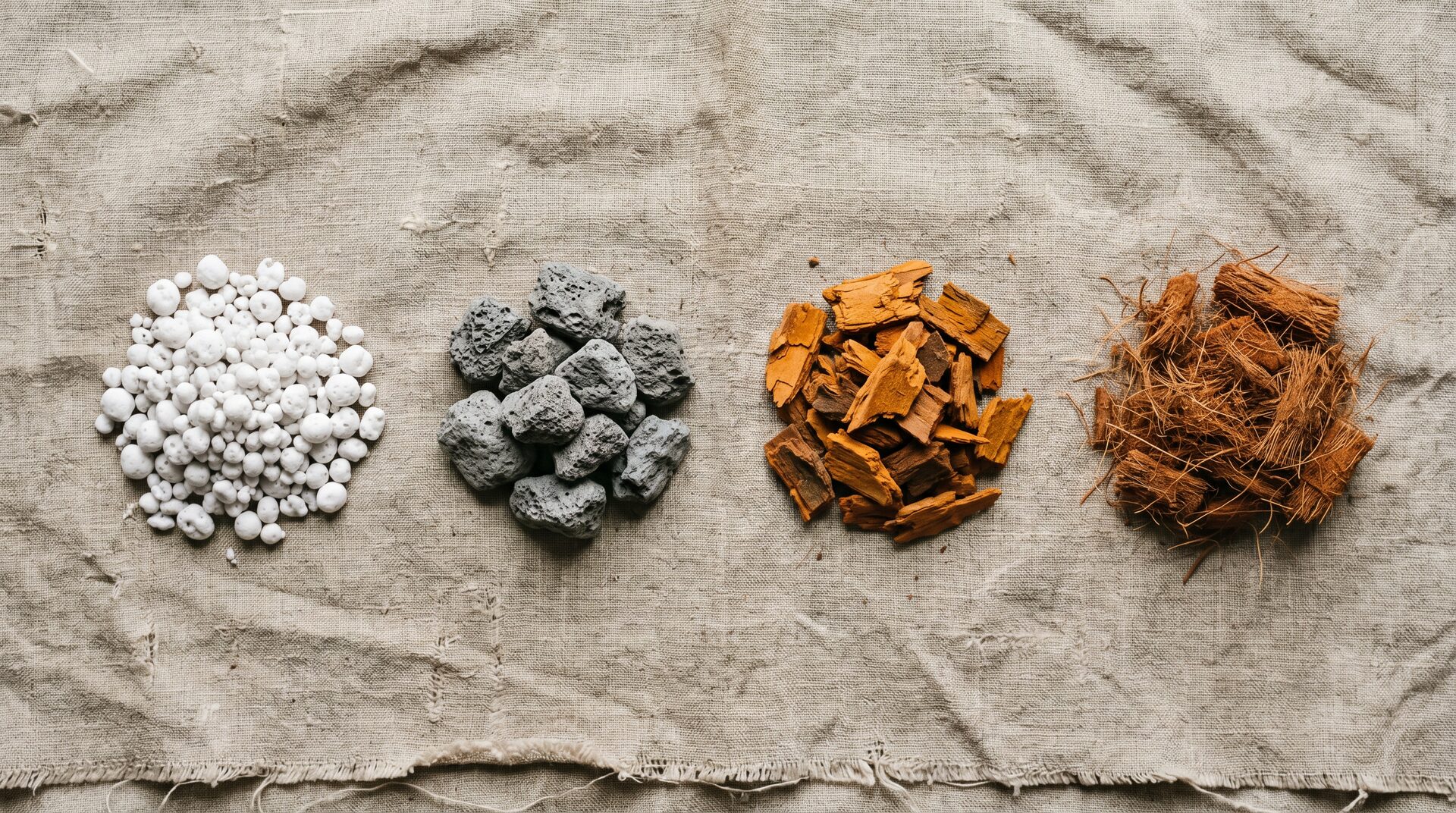
The mineral fraction (70%)
Most of the mix is pumice and perlite. Growers add perlite to potting mixes to increase the share of large pores, which cuts water-holding and raises the air space (Evans, n.d.). We go more mineral here than in our everyday Standard Mineral Mix because we want this mix to dry partway between waterings, and root-rot advice centers on reducing soil moisture (Hudelson & Jull, n.d.). The 70% figure itself is our call.
For the physics of air and water in a pot, see How Substrate Actually Works.
Quarter-inch pumice
Particle size works in both directions. In greenhouse trials on pure pumice, the coarsest grades lost water steeply as the pots drained, which lowered the overall water content in the pots. The finer grades held relatively little air, which presumably restricted growth in shallow bags (Gizas & Savvas, 2007). Those trials grew greenhouse crops in pumice alone, not houseplants in a blended mix. We use a 6 mm (quarter-inch) grade in ICU Mix and the coarser 13 mm (half-inch) grade in the Aroid Mineral Mix for climbing aroids, and both are our own picks.
Zeolite (10%)
Zeolite is the one mineral here that holds onto nutrients in a way pumice and perlite don't. Cation exchange capacity (CEC) is a material's ability to hold positively charged nutrient ions, such as potassium, calcium and ammonium, on negatively charged sites where roots can take them up later (Evans, n.d.). Perlite has almost none (Evans, n.d.). Clinoptilolite, the zeolite in this mix, has a theoretical CEC of about 2.2 meq/g (milliequivalents per gram, a measure of how many of those ions it can hold) (Grifasi et al., 2024). That's about 220 meq per 100 g. Coir runs 39 to 60 meq/100 g (Evans, n.d.), so by weight clinoptilolite can hold, in theory, roughly four to six times as much.
What it holds matters as much as how much. Exchange sites hold positively charged ions such as potassium, calcium and ammonium, but not negatively charged ones such as nitrate and phosphate, so nitrate washes out of a mix easily (Pennisi & Thomas, n.d.). Natural zeolites typically show little, if any, attraction for phosphate (Biliani & Zacharias, 2025). So zeolite can keep some potassium and ammonium in the pot between feedings, but it doesn't replace feeding. For commercial growers who feed with liquid fertilizer at every watering, the difference in CEC between coir and peat rarely calls for a change in feeding (Evans, n.d.). We read that as a sign that feeding matters more than a mix's own nutrient holding.
More isn't better. In one study of beech seedlings in a peat substrate, a small zeolite addition helped growth, while larger doses held back root development (Kučera et al., 2025). We keep it at 10% as our own choice; that study doesn't tell us how a mix like this one would compare.
Earthworm castings (10%)
Castings (vermicompost) add some nutrients and a lot of microbes. In greenhouse trials by Atiyeh and colleagues, summarized by Arancon and Edwards (2005), substituting as little as 5% vermicompost into a commercial peat-based potting mix produced large growth responses in seedlings when all the nutrients the plants needed were available. The largest shares didn't always help; the authors suggest salt content or something else may be behind that (Arancon & Edwards, 2005). We use 10% here and 15% in Standard Mineral Mix. Both figures are ours.
Composts and vermicomposts can suppress some plant diseases, but the suppression is inconsistent, which is why growers can't rely on it (Jack & Nelson, 2010). In their trials, vermicompost mixed into sand at 40% by volume held back Pythium damping-off (a seedling rot caused by a water mold) in cucumber seedlings, and heat-sterilized vermicompost gave little protection, so the effect came from its living microbes (Jack & Nelson, 2010). We don't count on castings to protect a recovering plant. Some extension advice for repotting a plant with root rot specifies sterile potting mix (Lang et al., n.d.), and castings aren't sterile. Including them is our choice.
Buffered coir (20%)
Coir holds a lot of water and still drains well (Owen & Lopez, 2015). It's the part of the mix that keeps some water near a small root system between waterings. Raw coir can carry potassium, sodium and chloride, which wash out easily (Evans, n.d.), so we buy coir sold as washed and buffered. The Ingredient Glossary covers what to look for in a bag.
How to Use It
1. Check the roots
Slide the plant out and look. Healthy roots are firm and flexible; rotting roots are soft, brown and fragile, and may smell (Lang et al., n.d.). With Pythium root rot, the roots turn brown to black and soft, and the outer layer pulls away from the core (University of Maryland Extension, n.d.-b). Cut off the rotted roots; extension repotting advice is to remove roots that are sloughing away (Sanders, 2021).
Then decide whether to go on. Some plants can't be saved (Lang et al., n.d.). Extension advice is to throw out a badly infected plant and take cuttings only from healthy tissue (University of Maryland Extension, n.d.-b). If only a few firm roots are left, or the base of the stem is soft, we take a cutting.
Disinfect your shears as you go. Wipe or dip them in 70% rubbing alcohol, ideally between cuts. It needs no soak, though alcohol may not work against every plant pathogen (Steil, n.d.).
2. Pick the pot
Size the pot to the roots that are left, not the plant's old pot. A pot that's too large leaves the roots sitting in mix that stays too wet (Criscione & Holliday-Goulart, n.d.). A clean pot with a drainage hole is the extension baseline (Lang et al., n.d.). Terracotta is our default for ICU Mix. Unglazed terracotta loses water through its walls and tends to dry the root zone faster, while plastic loses water only through the drainage holes and the top of the mix, so it stays wet longer (Criscione & Holliday-Goulart, n.d.). Either works. We like clear plastic nursery pots here, since they let you see new roots without unpotting.
3. Pot it up
Moisten the mix before potting, which is standard extension advice for any repot (Strickland, 2022). Add water until it's evenly damp but not wet: it should clump loosely in your hand and break apart when tapped.
Set the plant at the same depth it grew before, with the top of the root ball level with where it sat in the old pot, not deeper (Sanders, 2021). Firm the mix around the roots with your fingers rather than packing it (Strickland, 2022).
Routine repotting advice is to water the plant thoroughly afterward (Strickland, 2022). With a plant that has lost most of its roots, we do it differently: it goes into damp mix, and we water again only once the top inch is dry. That's our practice, following the root-rot advice to reduce soil moisture (Hudelson & Jull, n.d.).
4. The first weeks
Give it bright, indirect light, as for rooting cuttings (Relf & Ball, 2025).
Keep the root zone warm but not hot. For rooting cuttings, Virginia Cooperative Extension suggests keeping both the air and the rooting medium at 70 to 75 °F (21 to 24 °C), and says a heating pad under the container can hold that steady (Relf & Ball, 2025). UF/IFAS says bottom heat helps Syngonium cuttings if the root zone stays between 70 and 75 °F (McConnell et al., 2014). Those figures are for cuttings; we use the same range for a plant regrowing roots. Don't push it warmer. In hydroponic systems, low oxygen and warmer root zones increase Pythium problems (Williams-Woodward, 2022), so we don't go above 75 °F (24 °C), a ceiling we set ourselves.
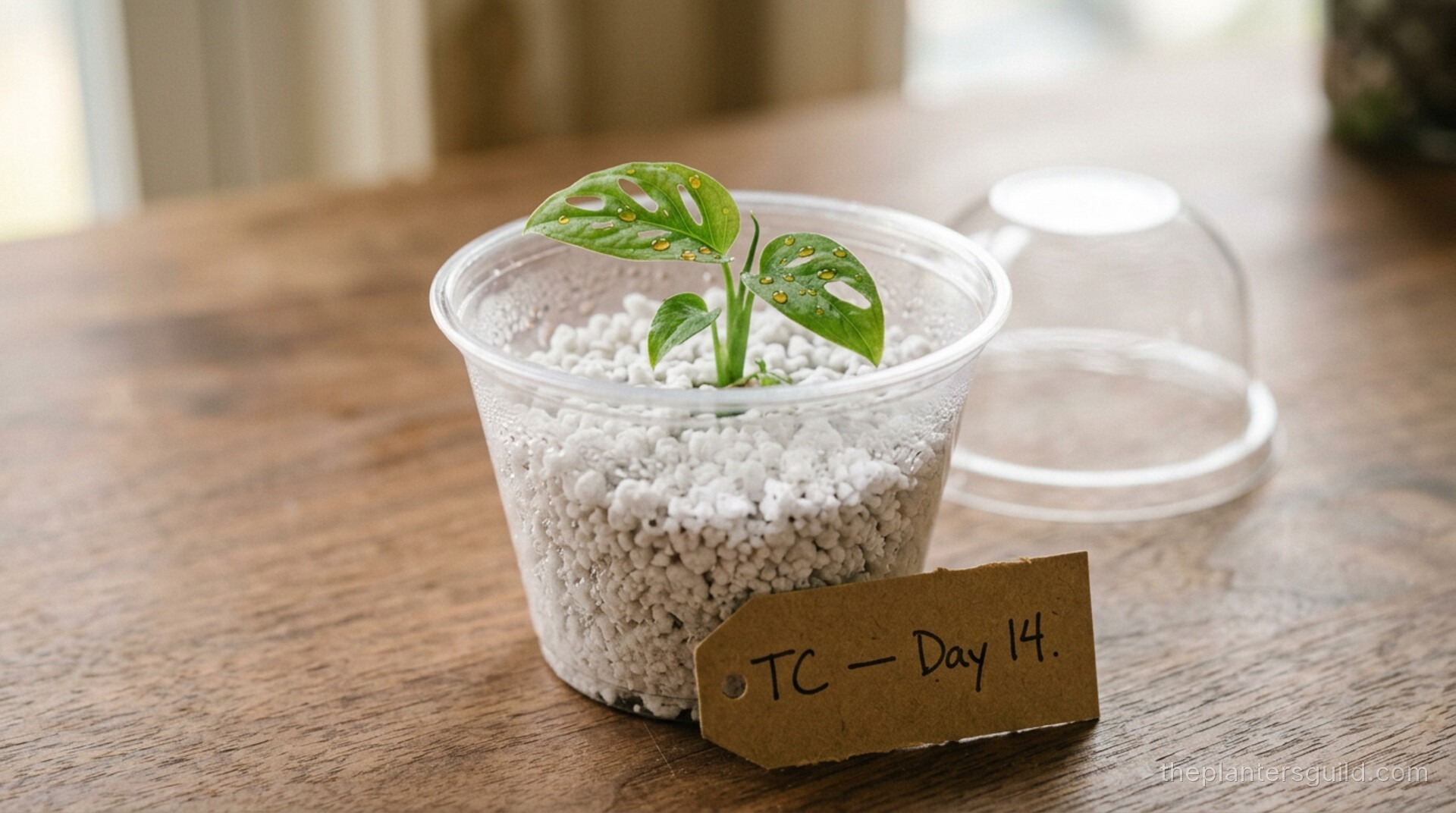
For cuttings, a perforated clear plastic cover raises the humidity and cuts water loss while still letting air circulate (Relf & Ball, 2025). We use a loose clear cover or dome the same way while a plant has few roots. Don't seal it. High humidity, crowding and poor air circulation favor bacterial leaf blight in Aglaonema (Nelson, 2009). We open or vent the cover daily.
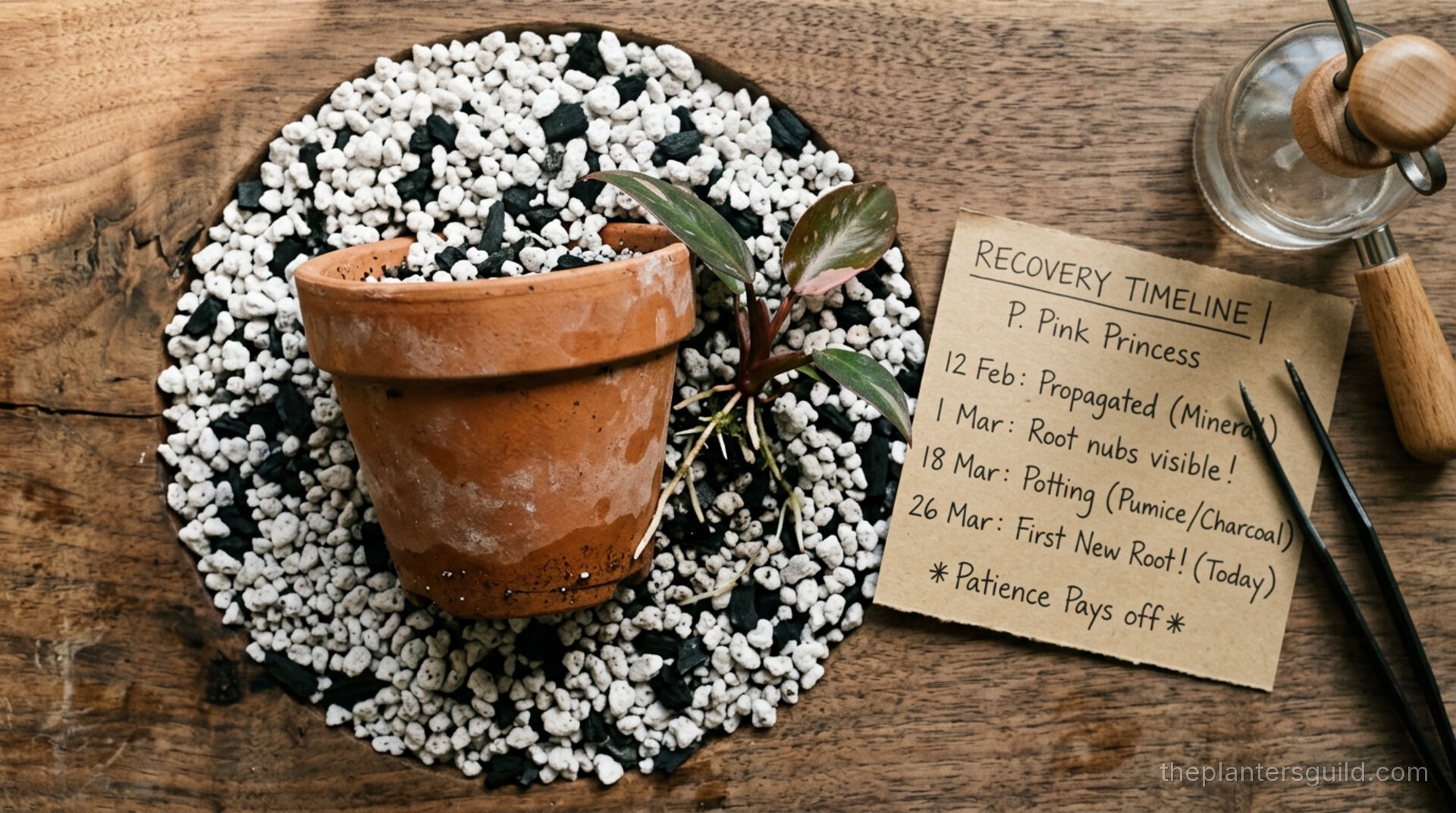
We water when the top inch is dry. Watch for new roots at the base of the stem, or through the side of a clear pot.
5. Feeding
Hold off fertilizer until the plant has new roots and is putting out new growth. Nebraska Extension says newly repotted, unrooted and wilted plants shouldn't be fertilized (Browning, 2021). A rooting medium should be low in fertilizer, because too much can damage or hold back new roots (Relf & Ball, 2025). And UConn's orchid guidance says not to fertilize diseased plants (UConn Home and Garden Education Center, 2019). Extension advice after a routine repot is to wait at least two weeks (Montana State University Extension, n.d.). For Philodendron newly moved indoors, UF/IFAS suggests about four weeks without repotting or feeding (McConnell et al., 2003). We wait at least two weeks, and longer if the plant doesn't yet have both new roots and new growth.
When growth starts, we begin at a quarter of the label strength every other watering. That's our practice. For established Anthurium kept indoors, UF/IFAS suggests 50 ppm (parts per million) nitrogen from a 20-20-20 fertilizer (the label's nitrogen, phosphate and potash percentages) once a month (Chen et al., 2015).
Common Problems
New roots turn brown and soft. We take it as a sign the mix is staying too wet, and water less often (Hudelson & Jull, n.d.), letting the top inch dry before the next watering. Pythium root rot can also cause yellowing and wilting even when moisture is adequate (University of Maryland Extension, n.d.-b), so if the roots keep failing, check the base of the stem as well.
Older leaves yellow. In Anthurium, yellowing older leaves together with damaged roots point to excess water (Chen et al., 2015). A plant short of nitrogen also usually yellows its older, lower leaves first, because it moves nitrogen to newer growth (Iowa State University Extension and Outreach, n.d.). Check the watering before anything else.
A sour smell. We take it as a sign the mix is staying too wet. We unpot, check the roots again and move the plant into fresh ICU Mix.
White fuzz on the surface. A white to gray fungal layer on moist potting mix isn't usually harmful. Let the surface dry between waterings and keep air moving around the pot (University of Maryland Extension, n.d.-a).
No new roots after three weeks. Unpot and look at the base of the stem. If it's soft or discolored, take a cutting from healthy stem above the damage and root that instead (University of Maryland Extension, n.d.-b).
Other Ways to Do It
- Fresh bagged potting mix. The extension method for root rot uses new, sterile potting mix, not a special recipe (Lang et al., n.d.). If you'd rather not make ICU Mix, we think a fresh bagged mix and careful watering is a reasonable path.
- Perlite on its own. Some cuttings will root in coarse perlite with nothing else added, though it doesn't hold much water for long (Relf & Ball, 2025).
- Sphagnum moss. For orchids, UConn advises removing the sphagnum they're shipped in, because the roots will rot if kept soggy (UConn Home and Garden Education Center, 2019). We don't use it for recovering plants.
When to Graduate Off the Mix
These are the signs we look for before moving a plant on. They're our practice, not published criteria:
- New roots are about 2 inches (5 cm) long or more
- A new leaf has fully opened and firmed up, no longer soft to the touch
- At least two weeks with no further leaf loss
- The mix is drying on a steady schedule, with no sour smell
At that point we repot into Standard Mineral Mix for most tropicals, or Aroid Mineral Mix for climbing aroids.
The Short Version
Seventy percent mineral for air, zeolite for a little nutrient holding, castings and buffered coir for some nutrients and water. Cut away the rotted roots, and replace the plant or take a cutting if too little is left. We pot into damp mix, keep the root zone at 70 to 75 °F (21 to 24 °C) and no warmer, water when the top inch is dry, and hold off fertilizer until there are new roots and new growth.
Once it shows the graduation signs above, it moves on to one of our everyday mixes.
We review our guides against the research and extension guidance available at the time, and we correct them when a source doesn't say what we took it to say or when we can't find support for a point. In this review we reframed ICU Mix as our own mix for a plant with damaged roots, not a required recipe, and corrected our repotting and aftercare steps and what we said zeolite and castings do. We also fixed points we'd credited to sources that don't make them and removed claims we couldn't source, including trials we have no record of.
Go deeper in the free Apprenticeship: Module IV, What Substrate Is →
Arancon, N. Q., & Edwards, C. A. (2005, November 16–18). Effects of vermicomposts on plant growth [Paper presentation]. International Symposium Workshop on Vermi Technologies for Developing Countries, Los Baños, Philippines. https://vermicycle.com.au/wp-content/uploads/2023/03/EFFECTS-OF-VERMICOMPOSTS-ON-PLANT-GROWTH.pdf
Biliani, I., & Zacharias, I. (2025). Natural and modified zeolites as adsorbents for nitrogen and phosphorus control in eutrophic freshwater bodies: A comprehensive review on freshwater applications of the last 10 years. Materials, 18(21), 4870. https://doi.org/10.3390/ma18214870
Browning, S. (2021, January 17). Success with houseplants: Fertilization. Nebraska Extension in Lancaster County. https://lancaster.unl.edu/success-houseplants-fertilization/
Chen, J., McConnell, D. B., Henny, R. J., & Everitt, K. C. (2015). Cultural guidelines for commercial production of interiorscape Anthurium (ENH956/EP159). University of Florida IFAS Extension. https://edis.ifas.ufl.edu/publication/EP159 (Original work published 2003)
Criscione, K. S., & Holliday-Goulart, A. (n.d.). Properly watering container houseplants (SPES-804P). Virginia Cooperative Extension. https://www.pubs.ext.vt.edu/content/dam/pubs_ext_vt_edu/spes/spes-804/SPES-804.pdf
Evans, M. R. (n.d.). Unit 7: Substrates. Greenhouse Management Online, University of Arkansas. https://greenhouse.hosted.uark.edu/Unit07/Printer_Friendly.html
Gizas, G., & Savvas, D. (2007). Particle size and hydraulic properties of pumice affect growth and yield of greenhouse crops in soilless culture. HortScience, 42(5), 1274–1280. https://doi.org/10.21273/HORTSCI.42.5.1274 [Abstract only.]
Grifasi, N., Ziantoni, B., Fino, D., & Piumetti, M. (2024). Fundamental properties and sustainable applications of the natural zeolite clinoptilolite. Environmental Science and Pollution Research, 32(48), 27805–27840. https://doi.org/10.1007/s11356-024-33656-5
Hudelson, B., & Jull, L. (n.d.). Root rots on houseplants (UW Plant Disease Facts D0096). University of Wisconsin–Madison Division of Extension. https://hort.extension.wisc.edu/articles/root-rots-houseplants/
Iowa State University Extension. (1994, December 9). Prevent root rot problems on houseplants. Horticulture and Home Pest News. https://hortnews.extension.iastate.edu/1994/12-9-1994/rrot.html
Iowa State University Extension and Outreach. (n.d.). Identifying plant nutrient deficiencies: Nitrogen. Yard and Garden. https://yardandgarden.extension.iastate.edu/identifying-plant-nutrient-deficiencies/older-leaves/effects-mostly-generalized/nitrogen
Jack, A. L. H., & Nelson, E. B. (2010). Suppression of Pythium damping off with compost and vermicompost [Final report to the Organic Farming Research Foundation]. Cornell University. https://cwmi.css.cornell.edu/organicfarmingfinalreport.pdf
Kučera, A., Volánek, J., Tomášová, G., Holík, L., Balková, M., Vichta, T., Samec, P., Rosíková, J., & Vranová, V. (2025). Substrate enrichment with clinoptilolite: Limits and possibilities for container-grown seedling propagation. Journal of Soil Science and Plant Nutrition. https://doi.org/10.1007/s42729-025-02794-1 [Abstract only.]
Lang, K., Paulsen, S., & Schnabel, C. (n.d.). Troubleshooting common problems: Houseplant how-to. South Dakota State University Extension. https://extension.sdstate.edu/troubleshooting-common-problems-houseplant-how
McConnell, D. B., Chen, J., & Everitt, K. C. (2014). Cultural guidelines for commercial production of interiorscape Syngonium (ENH993/EP244). University of Florida IFAS Extension. https://edis.ifas.ufl.edu/publication/EP244 (Original work published 2004)
McConnell, D. B., Chen, J., Henny, R. J., & Everitt, K. C. (2003). Cultural guidelines for commercial production of interiorscape Philodendron (ENH893). University of Florida IFAS Extension. https://edis.ifas.ufl.edu/publication/EP150
Montana State University Extension. (n.d.). Ask Steward: How do I repot a houseplant? https://www.montana.edu/extension/lila_extn/askstewardrepothouseplant.html
Nelson, S. (2009). Bacterial leaf blight of Aglaonema (Plant Disease PD-64). University of Hawaiʻi at Mānoa, College of Tropical Agriculture and Human Resources. https://www.ctahr.hawaii.edu/oc/freepubs/pdf/pd-64.pdf
Nemali, K. (2017, August 24). Looking through the pores of a soilless substrate. Purdue University Controlled Environment Agriculture. https://www.purdue.edu/hla/sites/cea/article/looking-through-the-pores-of-a-soilless-substrate/
Owen, W. G., & Lopez, R. G. (2015). Evaluating container substrates and their components (HO-255-W). Purdue Extension. https://www.extension.purdue.edu/extmedia/HO/HO-255-W.pdf
Pennisi, B. V., & Thomas, P. A. (n.d.). Essential pH management in greenhouse crops: pH and plant nutrition (Bulletin 1256). University of Georgia Cooperative Extension. https://fieldreport.caes.uga.edu/wp-content/uploads/2025/08/B-1256_8.pdf
Relf, D., & Ball, E. (2025). Propagation by cuttings, layering and division (SPES-683P). Virginia Cooperative Extension. https://www.pubs.ext.vt.edu/content/dam/pubs_ext_vt_edu/426/426-002/SPES-683.pdf
Sanders, S. (2021). Repotting houseplants. University of Arkansas System Division of Agriculture Cooperative Extension Service. https://www.uaex.uada.edu/counties/white/news/horticulture/20210428RepottingHouseplants.aspx
Steil, A. (n.d.). How do I sanitize my pruning shears? Iowa State University Extension and Outreach, Yard and Garden. https://yardandgarden.extension.iastate.edu/faq/how-do-i-sanitize-my-pruning-shears
Strickland, J. (2022, April 14). How to repot a houseplant. N.C. Cooperative Extension, Wayne County Center. https://wayne.ces.ncsu.edu/news/repotting-houseplants
UConn Home and Garden Education Center. (2019). Orchid care and repotting. University of Connecticut. https://homegarden.cahnr.uconn.edu/factsheets/orchid-care-and-repotting/
University of Maryland Extension. (n.d.-a). Algae and fungal growth on the soil of indoor plants. Home and Garden Information Center. https://extension.umd.edu/resource/algae-and-fungal-growth-soil-indoor-plants
University of Maryland Extension. (n.d.-b). Root rots of indoor plants. Home and Garden Information Center. https://extension.umd.edu/resource/root-rots-indoor-plants
Williams-Woodward, J. (2022). Root disease management in hydroponic systems. e-GRO Edible Alert, 7(6). https://www.e-gro.org/pdf/E706.pdf