Five recipes, three layers, no bark. An overview of the Petruscio Substrate System: which of the Guild's mixes we use for what, from plants regrowing damaged roots to tissue-culture plantlets.
Corrected September 2026: we've revised parts of this guide. See the correction note at the end.
This page is the map of the Guild's potting-mix recipes: what goes into them, what each one is for, and how they fit together. The physics behind them (how a pot holds water and air, and how ingredients hold nutrients) is in How Substrate Actually Works, and the reasoning for adapting a recipe is in Designing a Mix. You can read this page on its own; we link to the physics as it comes up.
Why Bark-Free
None of our recipes uses bark. That's the Guild's choice, not a finding that bark is a poor ingredient. Container substrates in commercial production are mostly organic material, such as peat moss or bark (Bilderback et al., 2005), and in the Pacific Northwest, Douglas fir bark makes up the largest share of most nursery substrates (Altland & Buamscha, 2008). Hoitink reported that composted tree bark suppresses many plant disease organisms in container potting media (Hoitink, 1982).
One of our reasons is dust and mold spores. Everyday jobs such as mulching the garden expose people to spores of Aspergillus fumigatus, a common mold. For most healthy people that isn't a health concern, but people who are asthmatic, immunosuppressed or seriously ill may be at risk from high levels of these spores (Minnesota Pollution Control Agency, 2005). So we chose to leave bark out. That doesn't make our mixes spore-free: coir and earthworm castings are organic too, so if you're sensitive, take the handling precautions under What You'll Need on the Shelf.
Bark is also organic, so it breaks down in the pot. As organic components decompose, they can leave an excess of small particles that hold too much water and too little air, while mineral aggregates such as pumice and perlite don't decompose, or break down only slowly (Bilderback et al., 2005). Minerals don't make a mix permanent, though. In one nursery study of Douglas fir bark mixed with up to 30% pumice, air space generally fell over time. In pots with plants growing in them, it fell in every mix, and the plants tended to make the drop larger (Altland et al., 2011).
If bark doesn't bother you, it's a legitimate substrate component. Ours is one approach, built for growers who would rather do without it.
The Three Layers
The four main mixes are built from the same three kinds of ingredient, in different proportions. The tissue-culture mix uses only the first:
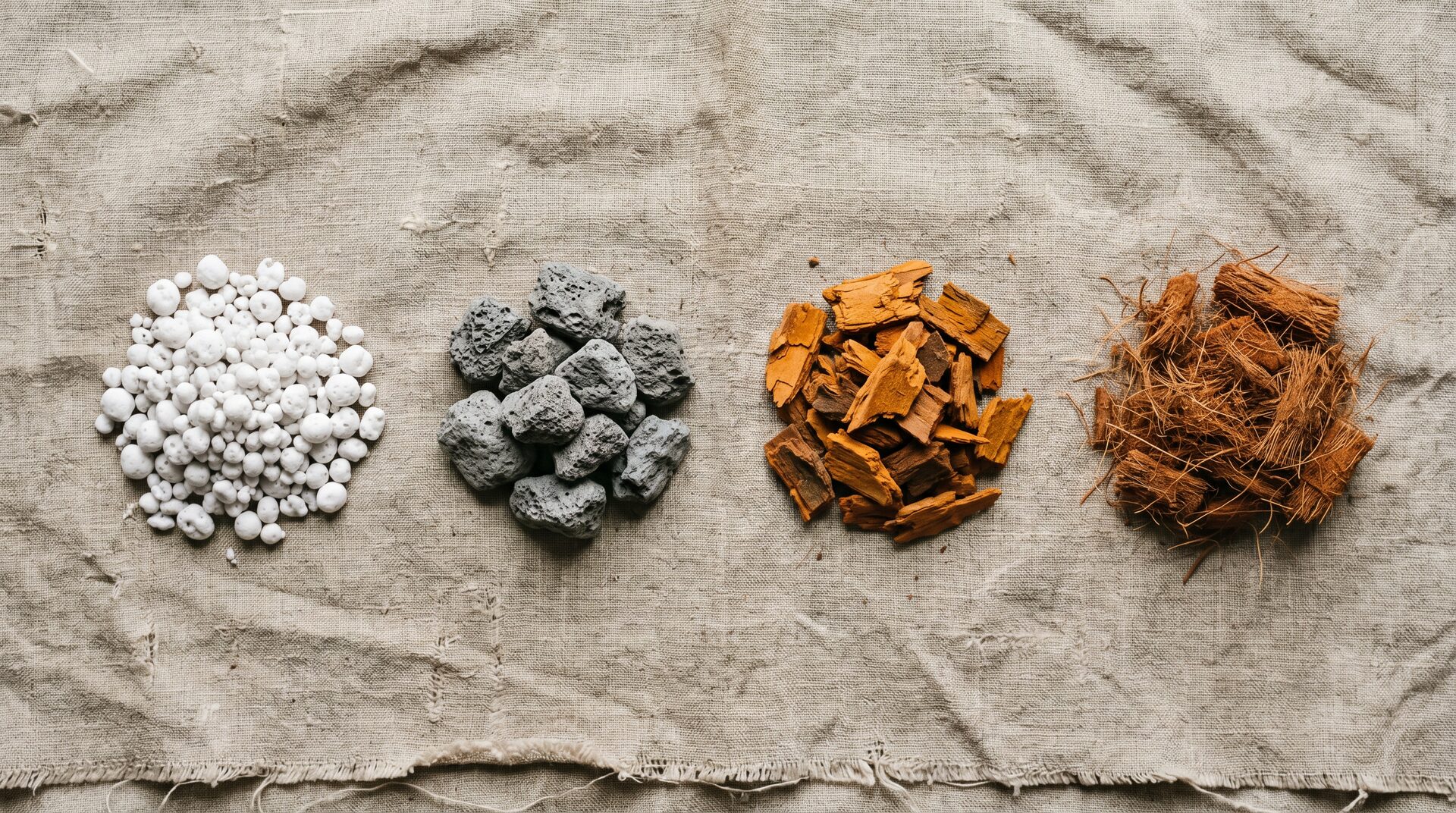
- Minerals: pumice, perlite, horticultural charcoal, clinoptilolite zeolite, calcined clay and, in the tissue-culture mix, Fluval Stratum, an aquarium substrate for planted tanks (Fluval, n.d.). They make up most of every mix. Pumice holds a small amount of water, and its relatively large particles provide drainage and air space (Evans, n.d.). We count charcoal with the minerals, as our recipe pages do.
- Coir: calcium-buffered coir (more on that under Ingredient Rules), the part of each main mix that holds water. Coir typically holds 73 to 80% of its volume in water, and it holds nutrients too: its cation exchange capacity (CEC), a measure of how many nutrient ions such as potassium and calcium a material can hold, runs 39 to 60 meq/100 g (milliequivalents per 100 grams) (Evans, n.d.).
- Earthworm castings: a small share in four of the five mixes, by our choice. Composts and vermicomposts can suppress some plant diseases, but the suppression is inconsistent (Jack & Nelson, 2010), so we don't count on it.
For how we work backward from what a plant needs to a recipe, see Designing a Mix.
Diagram 01 · The five published mixes by layer
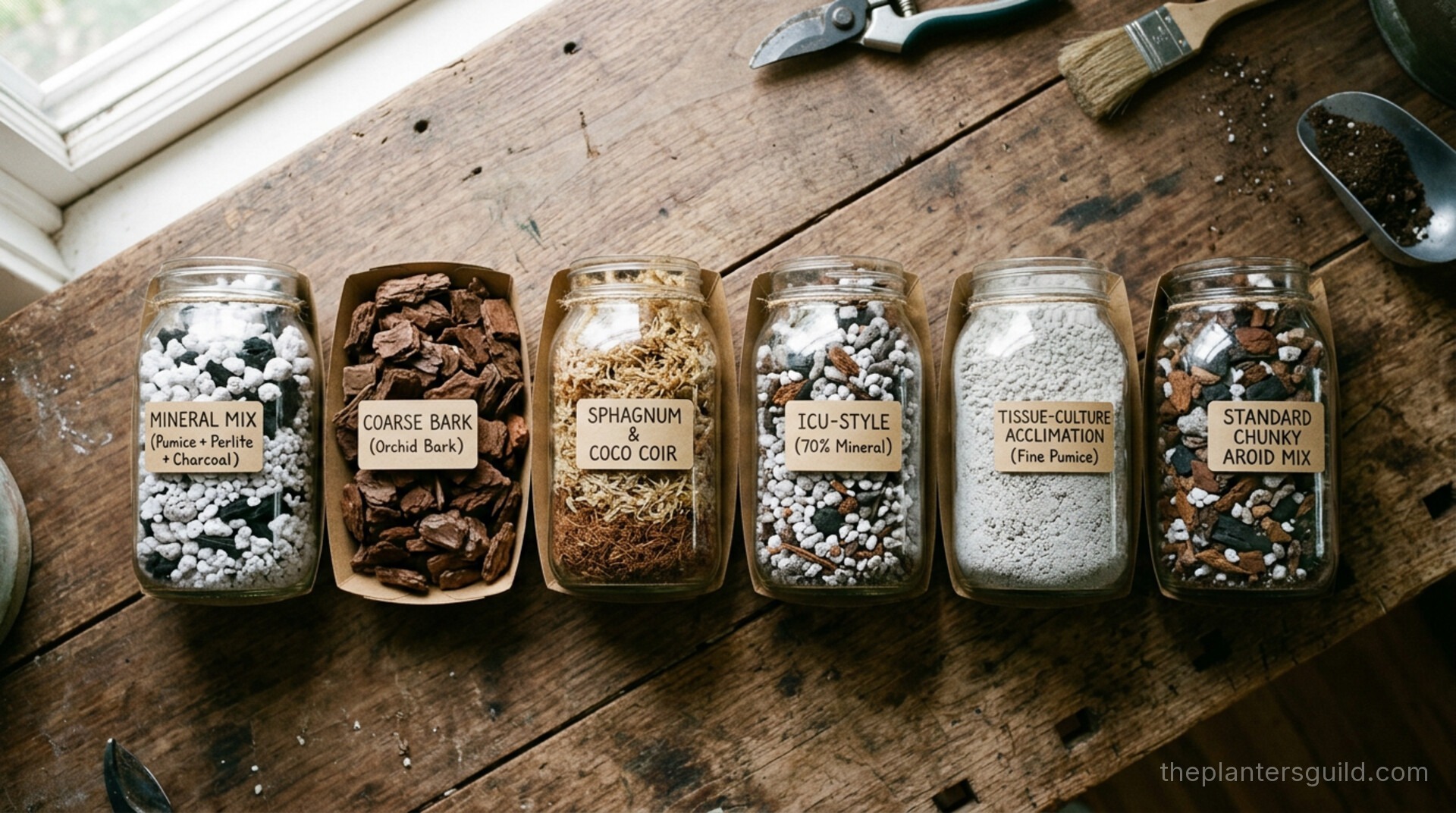
The Five Mixes at a Glance
ICU Mix v5, for recovery
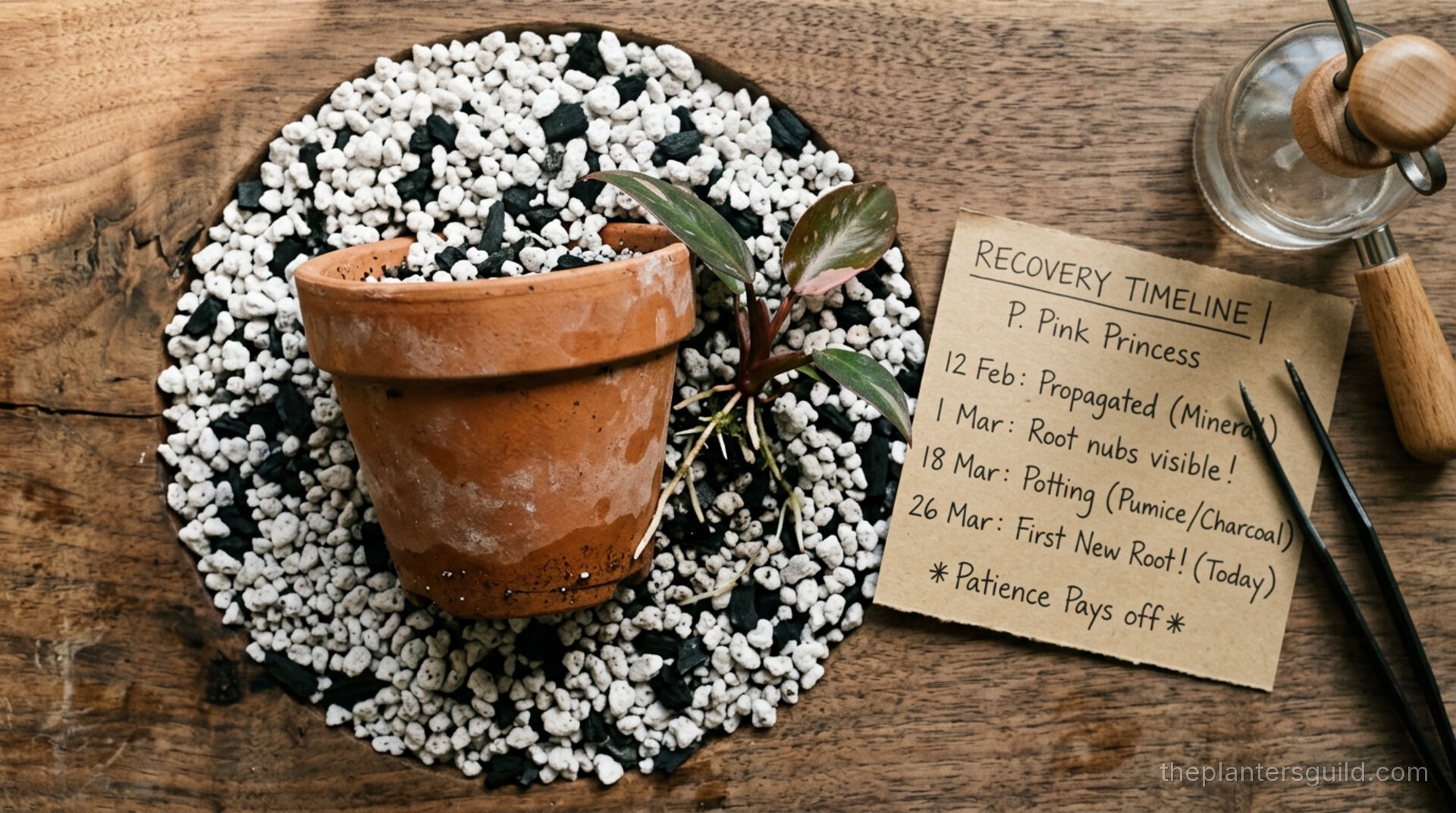
This mix is 70% mineral, zeolite included, and 30% organic: 20% buffered coir and 10% earthworm castings. It's the Guild's recovery mix, the one we pot into after a plant's rotted or damaged roots have been trimmed away. The ICU page covers when we use it, the aftercare we follow, and when a plant is better restarted another way.
Deep dive: ICU Mix v5: A Recovery Mix for Damaged Roots.
Standard Mineral Mix v5, the everyday mix
This one is 65% mineral, counting its 5% charcoal, and 35% organic: 20% buffered coir and 15% earthworm castings. It's the Guild's default mix for healthy plants that aren't climbing a pole or slab.
Deep dive: Standard Mineral Mix v5: The Workhorse Substrate.
Aroid Mineral Mix v5, for climbing aroids
This mix is 80% mineral, counting its 15% charcoal, and 20% organic. Coarse pumice (1/2 inch) and chunks of horticultural charcoal (1/4 to 1/2 inch) take the place bark would have in a conventional chunky mix. It's the mix we pot our climbing Philodendron, Monstera and Anthurium into.
Deep dive: Aroid Mineral Mix v5: The Bark-Free Mix for Climbing Aroids.
Alocasia Bark-Free Mix v1, for Alocasia
This mix is 63% mineral, counting its 3% biochar (horticultural charcoal), and 37% organic: 30% buffered coir and 7% earthworm castings, plus a teaspoon of horticultural gypsum per gallon for calcium. It has more coir than our other mineral mixes because the one Alocasia study we found favored steady moisture, and it adds calcined clay and a finer grade of pumice. It's the mix we pot our Alocasia into.
Deep dive: Alocasia Bark-Free Mix v1: A Moisture-Holding Mineral Mix.
Tissue Culture Acclimation Mix v5, for plantlets out of the flask
Our base recipe for plantlets fresh from tissue culture is half Fluval Stratum and half fine perlite, with variants for some plant groups on the tissue culture page. The substrate is only one part of acclimation. A review of woody plants notes that plantlets grown in the flask often have little of the waxy coating that protects a leaf (the epicuticular wax and cuticle), and many of their stomata, the leaf pores that open and close to control water loss, don't work properly, so they lose water fast once they're out (Grzelak et al., 2024). Humidity comes down in steps: in one published Syngonium protocol, the covers were vented gradually, lifted for several hours a day in the third week, and the plantlets moved to a greenhouse after four weeks (Paknia et al., 2026). Substrate still mattered in that study. Every plantlet survived in all six mixes tested, each of perlite with either peat moss or coir. The peat moss mixes gave the largest leaves, while the results for roots and plant weight were mixed (Paknia et al., 2026).
Deep dive: Tissue Culture Acclimation: The Mineral Substrate Approach That Works.
In development
We're working on two more mixes, one for the prayer-plant family, Marantaceae, such as Goeppertia and Calathea, and one for Ficus. Neither is published yet, so we don't give recipes for them here.
Ingredient Rules
Three rules apply across our recipes wherever the ingredient is used. They're the Guild's practice. The Aroid Ingredient Glossary covers each ingredient in more detail.
- Buy buffered coir. Raw coir carries potassium, sodium and chloride that raise its salt level, by how much depending on the source (Evans, n.d.), and it should be washed with fresh water or a calcium nitrate solution to leach those salts before it's used (Premier Tech Horticulture, n.d.). Our own habit is to check a new bag first: in an extract of one part coir to one and a half parts water, we look for an electrical conductivity (EC, a meter reading of dissolved salts) under 0.5 mS/cm.
- Use coarse perlite in the main mixes. We use #3 grade in the ICU, Standard Mineral, Aroid Mineral and Alocasia Bark-Free mixes. The tissue-culture mix uses a fine grade on purpose. Whatever the grade, perlite dust can irritate the eyes, throat and upper respiratory tract (National Institute for Occupational Safety and Health, 2019); see the handling note below.
- Use horticultural charcoal, not barbecue briquettes. Briquettes are charcoal pressed together with a binder, most commonly starch (Food and Agriculture Organization of the United Nations, 1987), and instant-light briquettes add a petroleum distillate: one brand's safety data sheet lists 10 to 15% (Kingsford Products Company, 2015). Horticultural charcoal isn't inert, either. Most biochars (the research term for charcoal made from plant material) raise the pH of container substrates, some raise salt levels, and the effects depend on the source material and how it was made (Huang & Gu, 2019). In one study, biochar added a substantial amount of potassium to a soilless substrate (Altland & Locke, 2012). After starting a new bag, check the pH and EC of the runoff, the water that drains out of the pot after watering.
What You'll Need on the Shelf
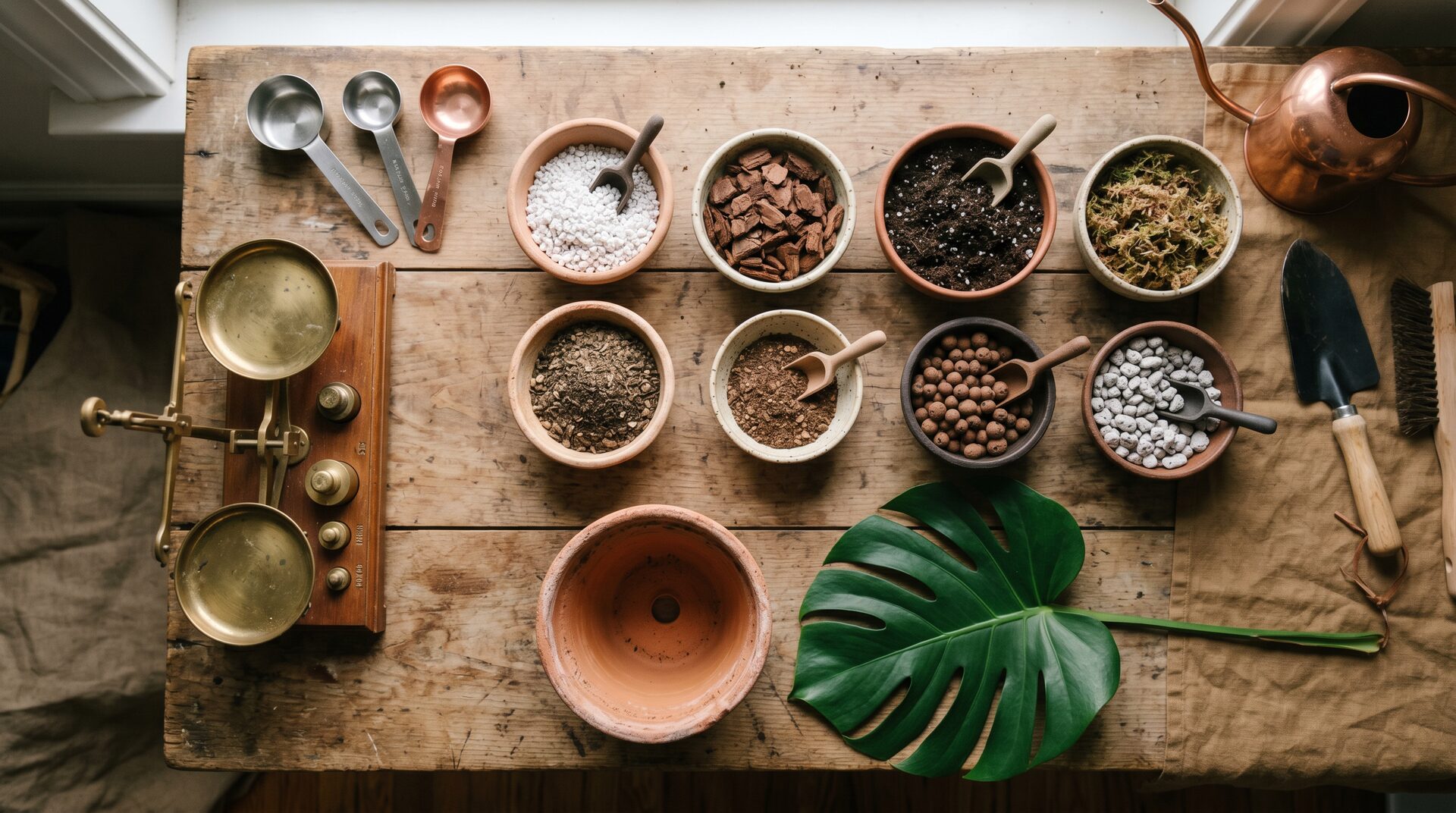
If you want to mix all five recipes yourself, the list is short, nine ingredients in all:
- Pumice, 1/8 inch, 1/4 inch and 1/2 inch grades
- Perlite, coarse (#3) and fine
- Clinoptilolite zeolite, 1 to 3 mm and 3 to 5 mm. Check the size before you buy: in our experience, much of the zeolite sold online is finer than this. We buy ours where aquarium supplies are sold.
- Horticultural charcoal, 1/8 to 1/4 inch and 1/4 to 1/2 inch grades (the Alocasia recipe lists the smaller grade as biochar)
- Calcium-buffered coir, medium pith
- Earthworm castings, sifted
- Calcined clay, for the Alocasia mix. We use Turface MVP.
- Horticultural gypsum, fine powder, for the Alocasia mix (a soil amendment, not plaster)
- Fluval Stratum, for the tissue-culture mix
Every recipe is measured by volume, so it scales to any batch size.
Handle the dusty ones with care. Our habit is to dampen the dry ingredients first, mix with good ventilation while wearing a mask, and wash our hands afterward. Perlite dust is an irritant (National Institute for Occupational Safety and Health, 2019). In a New Zealand study, exposure to compost or potting mix was a risk factor for Legionnaires’ disease caused by Legionella longbeachae. The authors suggest that taking care not to breathe in compost, and attention to hand hygiene, might prevent it (Kenagy et al., 2017).
Trade-offs
A few things to weigh before you commit:
Up-front cost. Buying nine ingredients separately means more bags, and usually more money up front, than one bag of potting mix.
Watering. Mineral ingredients hold less water than peat. Sphagnum peat holds water equal to 60 to 68% of its volume, while one horticultural grade of perlite held 38% (Evans, n.d.). Expect to check a mostly mineral mix more often than a peat-based one, and water by what the pot tells you rather than by the calendar. You'll find our starting point on each recipe page.
Feeding. Perlite has a negligible cation exchange capacity (Evans, n.d.), and a mix that's mostly mineral carries a smaller nutrient reserve than a peat-based one, so we feed these mixes regularly. Our feeding practice is on each recipe page.
Substrate is one part of care. A different mix won't make up for too little light or too much water.
Where to Go Next
Pick the page that fits the plant in front of you:
- A plant regrowing damaged roots: ICU Mix v5.
- Healthy plants that aren't climbing: Standard Mineral Mix v5.
- Climbing Philodendron, Monstera and Anthurium: Aroid Mineral Mix v5.
- Alocasia: Alocasia Bark-Free Mix v1.
- Plantlets fresh from tissue culture: Tissue Culture Acclimation.
Every recipe page has the full recipe and how we use it.
We review our guides against the research and extension guidance available at the time, and we correct them when a source doesn't say what we took it to say or when we can't find support for a point. In this review we corrected our reasons for leaving bark out (including what we said about dust and spores), when we use ICU Mix, and how we describe our mixes and ingredients, including the Standard Mineral Mix proportions. We also removed unpublished recipes and claims we couldn't source, including trials we have no record of.
Go deeper in the free Apprenticeship: Module IV, What Substrate Is →
Altland, J. E., & Buamscha, M. G. (2008). Nutrient availability from Douglas fir bark in response to substrate pH. HortScience, 43(2), 478–483. https://doi.org/10.21273/HORTSCI.43.2.478
Altland, J. E., & Locke, J. C. (2012). Biochar affects macronutrient leaching from a soilless substrate. HortScience, 47(8), 1136–1140. https://doi.org/10.21273/HORTSCI.47.8.1136
Altland, J. E., Owen, J. S., Jr., & Gabriel, M. Z. (2011). Influence of pumice and plant roots on substrate physical properties over time. HortTechnology, 21(5), 554–557. https://doi.org/10.21273/HORTTECH.21.5.554
Bilderback, T. E., Warren, S. L., Owen, J. S., Jr., & Albano, J. P. (2005). Healthy substrates need physicals too! HortTechnology, 15(4), 747–751. https://doi.org/10.21273/HORTTECH.15.4.0747
Evans, M. R. (n.d.). Unit 7: Substrates. Greenhouse Management Online, University of Arkansas. https://greenhouse.hosted.uark.edu/Unit07/Printer_Friendly.html
Fluval. (n.d.). Stratum [Product page]. Rolf C. Hagen Inc. https://fluvalaquatics.com/us/shop/product/stratum
Food and Agriculture Organization of the United Nations. (1987). Briquetting of charcoal. In Simple technologies for charcoal making (FAO Forestry Paper 41, Chapter 11). https://www.fao.org/4/x5328e/x5328e0c.htm
Grzelak, M., Pacholczak, A., & Nowakowska, K. (2024). Challenges and insights in the acclimatization step of micropropagated woody plants. Plant Cell, Tissue and Organ Culture, 159, 72. https://doi.org/10.1007/s11240-024-02923-1
Hoitink, H. A. J. (1982). Composted bark, a light weight growth medium with fungicidal properties. Journal American Rhododendron Society, 36(2). (Reprinted from Plant Disease, 64(2), 1980.) https://scholar.lib.vt.edu/ejournals/JARS/v36n2/v36n2-hoitink.html
Huang, L., & Gu, M. (2019). Effects of biochar on container substrate properties and growth of plants: A review. Horticulturae, 5(1), 14. https://doi.org/10.3390/horticulturae5010014
Jack, A. L. H., & Nelson, E. B. (2010). Suppression of Pythium damping off with compost and vermicompost [Final report]. Organic Farming Research Foundation; Cornell University. https://cwmi.css.cornell.edu/organicfarmingfinalreport.pdf
Kenagy, E., Priest, P. C., Cameron, C. M., Smith, D., Scott, P., Cho, V., Mitchell, P., & Murdoch, D. R. (2017). Risk factors for Legionella longbeachae Legionnaires’ disease, New Zealand. Emerging Infectious Diseases, 23(7), 1148–1154. https://doi.org/10.3201/eid2307.161429
Kingsford Products Company. (2015). Safety data sheet: Kingsford Match Light instant charcoal briquets. https://www.thecloroxcompany.com/wp-content/uploads/kingsfordmatchlightinstantcharcoalbriquetsjw2014-11-07.pdf
Minnesota Pollution Control Agency. (2005). Aspergillus fungus spores from yard waste compost facilities (w-sw1-01). https://www.pca.state.mn.us/sites/default/files/w-sw1-01.pdf
National Institute for Occupational Safety and Health. (2019). Perlite. In NIOSH pocket guide to chemical hazards. https://www.cdc.gov/niosh/npg/npgd0491.html
Paknia, M., Dehestani-Ardakani, M., & Meftahizade, H. (2026). Integrated in vitro regeneration and ex vitro establishment of Syngonium podophyllum ‘Pink Allusion’: Optimization of growth regulators and acclimatization substrates. BMC Plant Biology, 26, 1520. https://doi.org/10.1186/s12870-026-09563-x
Premier Tech Horticulture. (n.d.). Coir: A component of growing media. PT Growers and Consumers. https://www.pthorticulture.com/en-us/training-center/coir-a-component-of-growing-media