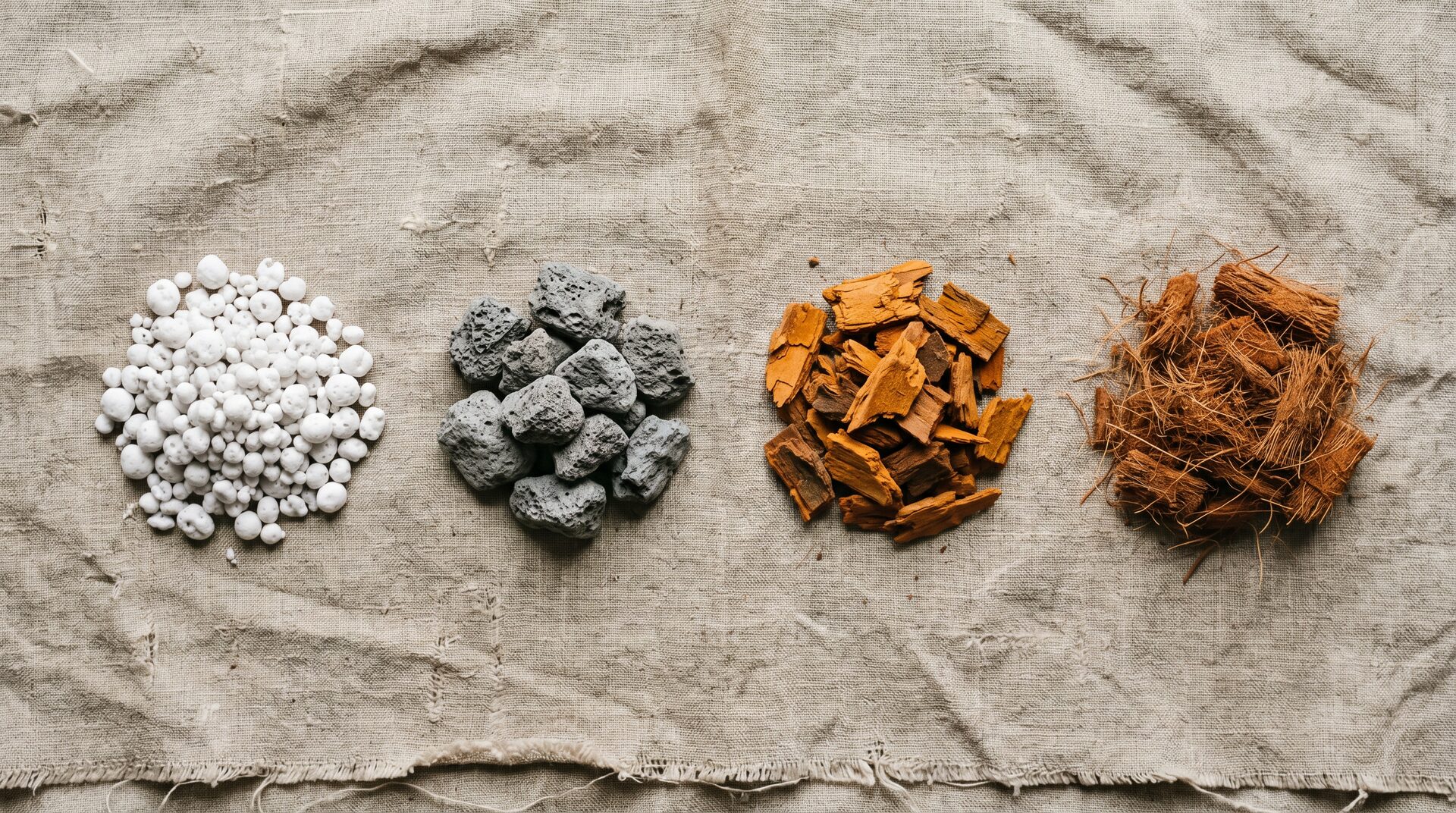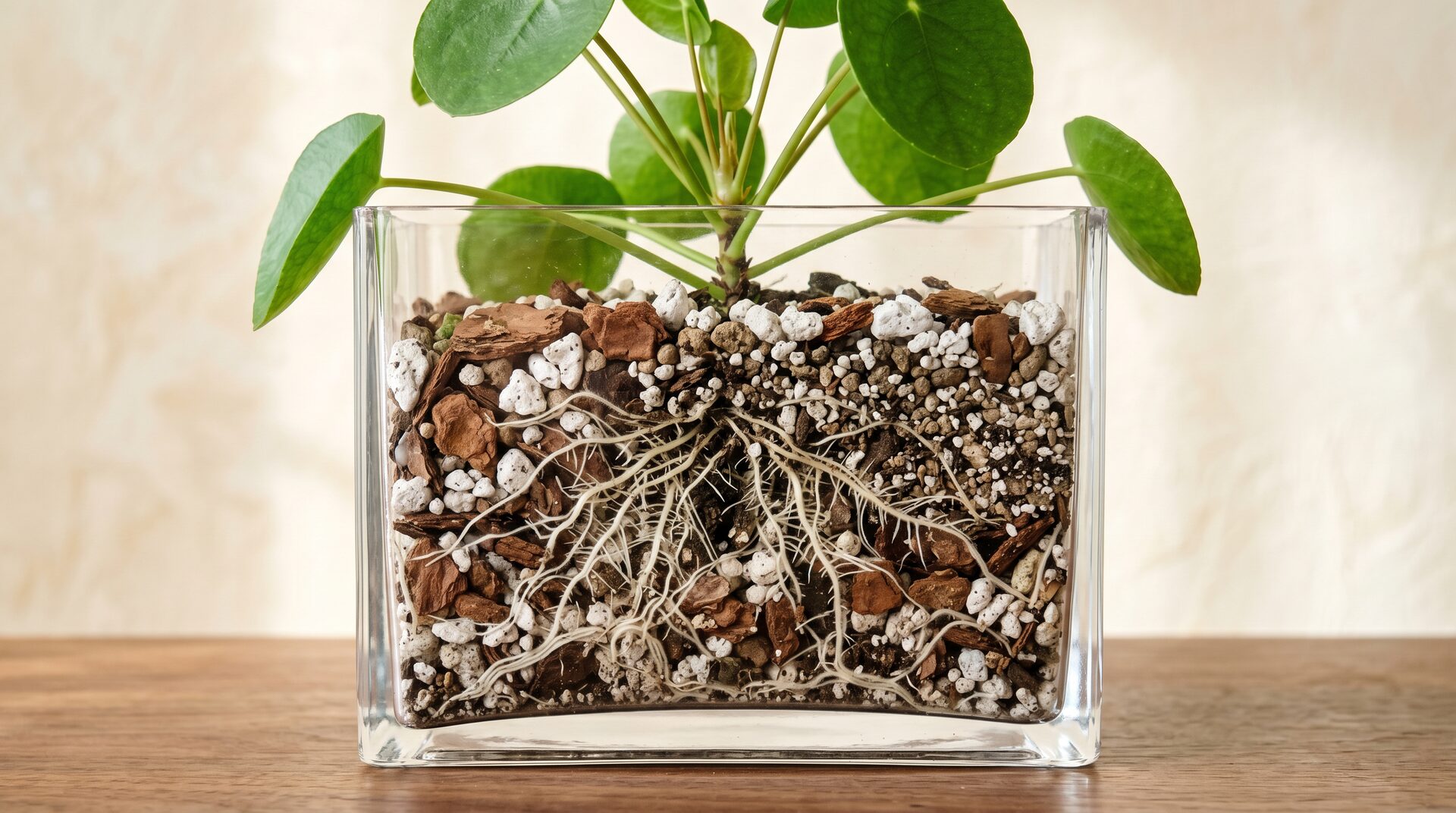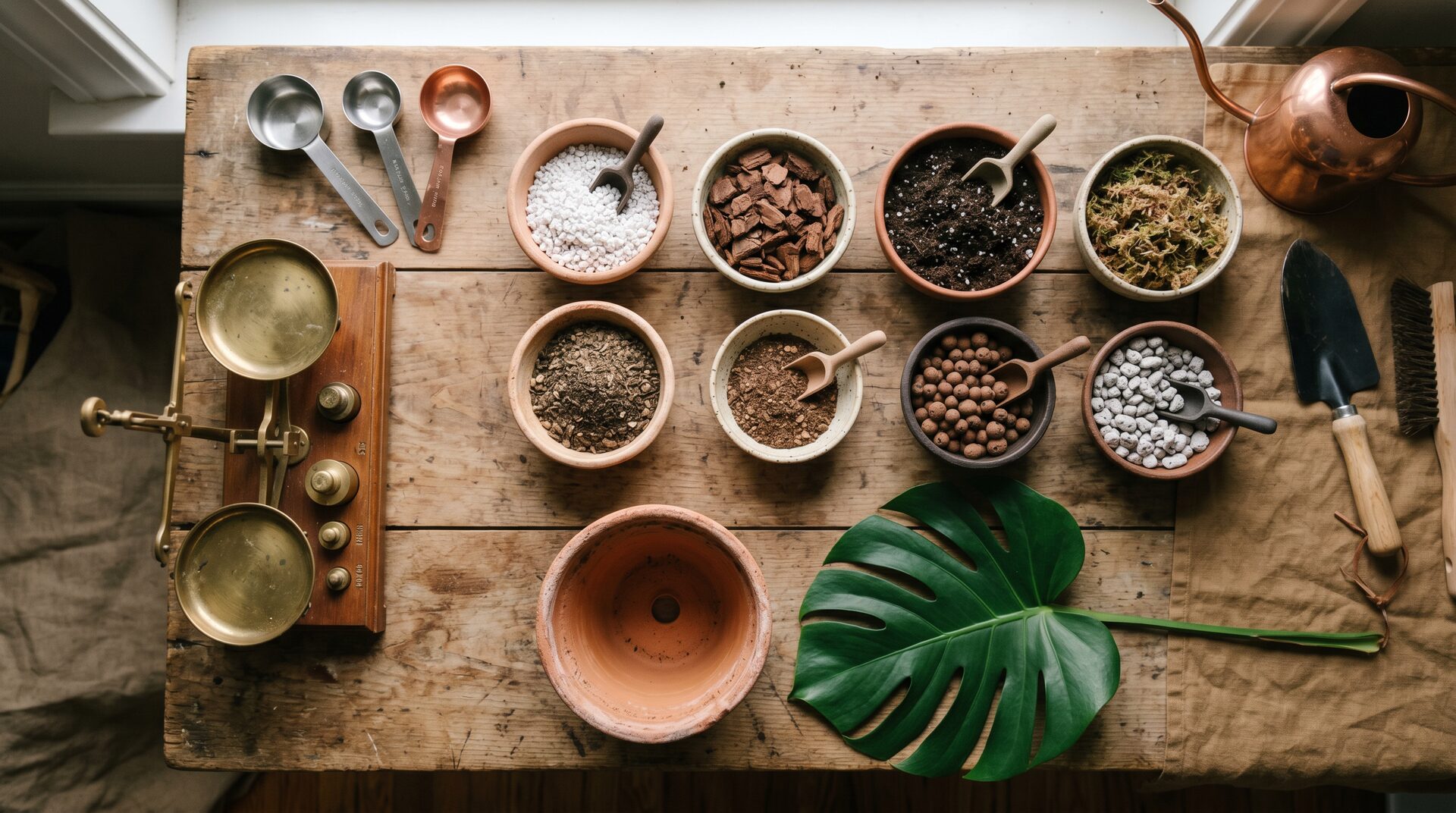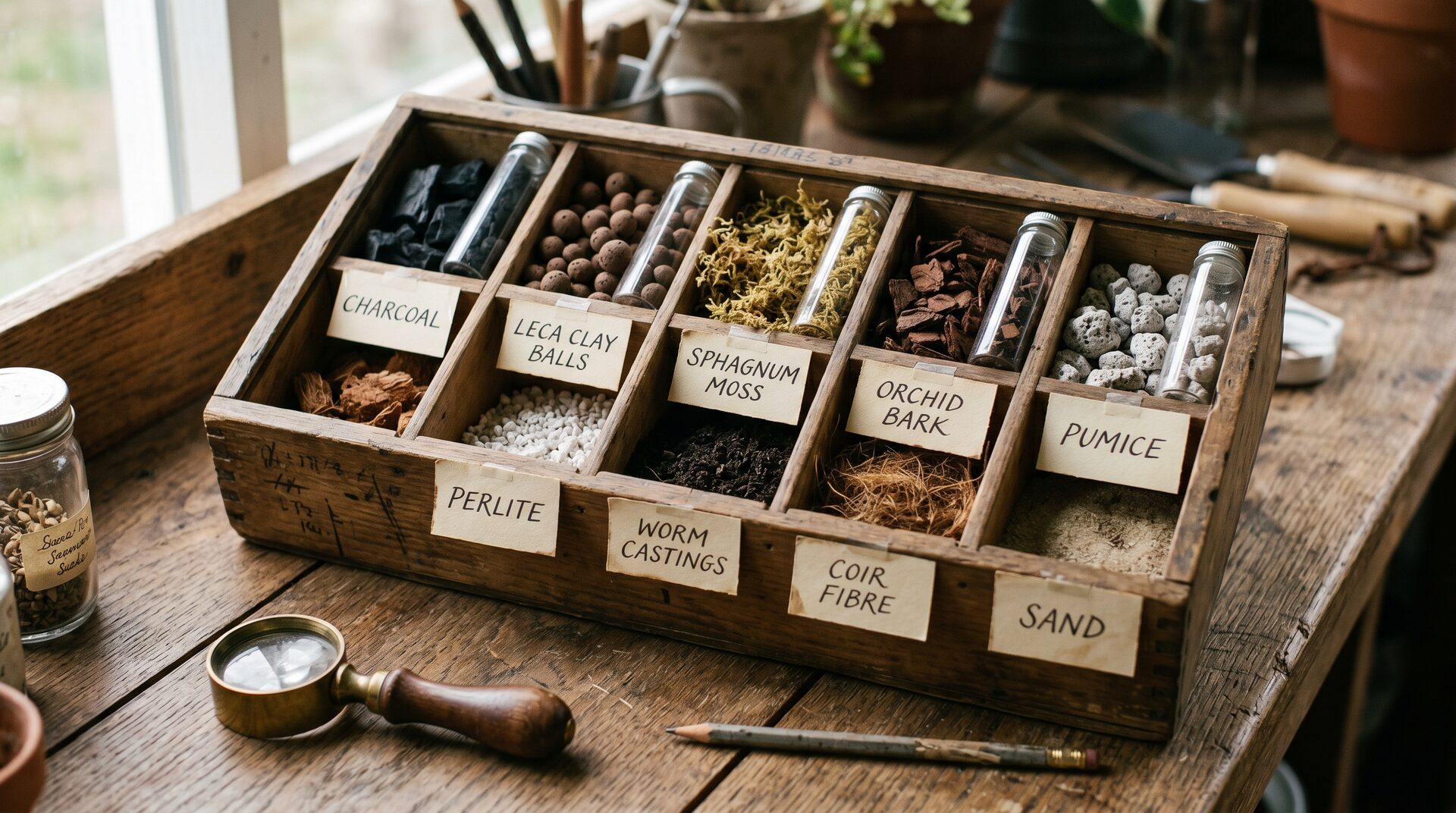
The ingredients that show up in chunky tropical mixes: what each one is, what it does in the root zone, what to buy, and where the Guild uses it or leaves it out.
Corrected September 2026: we've revised parts of this guide. See the correction note at the end.
A recipe is just percentages on paper. What's happening inside the pot is a handful of materials each doing something different. If you don't know what each one is doing, physically and chemically, every adjustment is more of a guess.
This is the article we link back to in our recipe discussions. It covers the ingredients that commonly show up in chunky aroid and tropical mixes, whether we use them or not.
Our bark-free mixes, including the Standard Mineral Mix, the Aroid Mineral Mix and the ICU Mix, leave out bark, coco chips and peat. It's our choice. As organic materials such as bark break down, they can create fines that hold more water over time (Bilderback et al., 2005), and salt levels in coconut husk vary widely from source to source (Konduru et al., 1999). Some of our other recipes do use orchid bark or coco husk chips, so all of them are in this article, along with when each might be the right choice.
How to Read Each Entry
Most entries below cover four things:
- What it is: origin, processing, what you're actually buying.
- What it does: physical (water, air, structure) and chemical (pH, nutrient holding).
- What to buy: grades, sizing, sourcing notes.
- Our verdict: use regularly, use selectively, or avoid, with our reasoning.
Two terms come up a lot. CEC, or cation exchange capacity, is the capacity of a material's negative charges to hold positively charged nutrients, such as ammonium, potassium and calcium (Owen & Lopez, n.d.). EC, or electrical conductivity, is a measure of how much dissolved salt is in a growing mix (Camberato et al., n.d.).
Structural Ingredients
Pumice
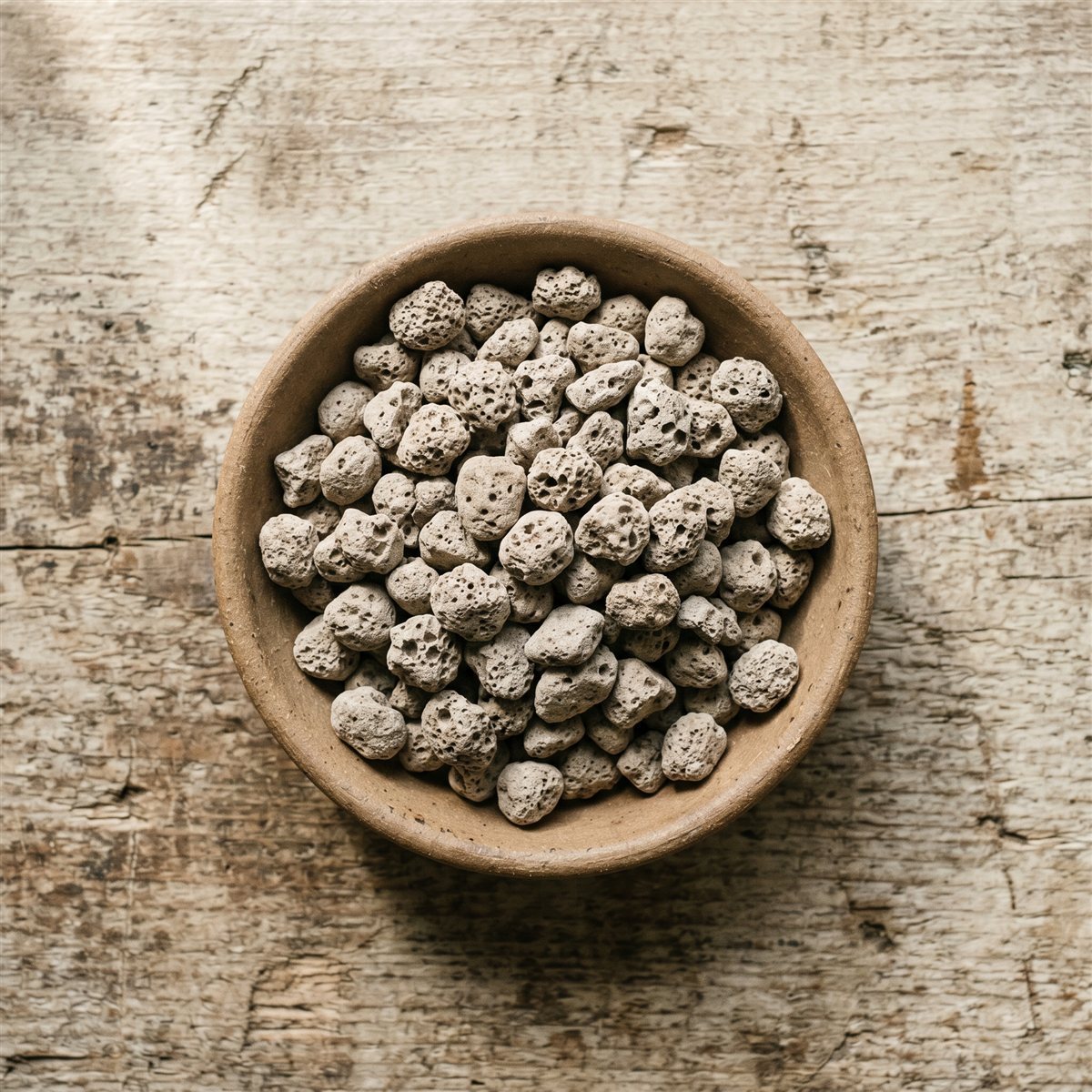
Use regularlyWhat it is. Porous volcanic glass. Its pores are bubbles left by gas escaping the magma as it erupted (National Park Service, n.d.). It's mined (Crangle, 2025) and sold in a range of particle sizes (Evans, n.d.). In the US it's mined in Oregon, California, Idaho, New Mexico and Kansas, and about 90% of imported pumice comes from Greece (Crangle, 2025).
What it does. Pumice adds air space to a mix and holds only a small amount of water. Its pH is near neutral and it has little buffering capacity, so it does little to shift the pH of a mix (Evans, n.d.). Like perlite, and unlike bark and peat, it doesn't decompose, or breaks down only slowly (Bilderback et al., 2005). In one nursery study of Douglas fir bark mixes, though, adding pumice lowered air space at the start. But in sample containers planted with coreopsis, air space fell less over 48 days as the pumice rate rose, which the authors took as some support for the idea that pumice helps preserve air space (Altland et al., 2011).
What to buy. We use three grades: 1/8 inch with the fines screened out, for our finer and establishment mixes; 1/4 inch for our standard and ICU mixes; and 1/2 inch (coarse) for our epiphytic aroid mixes and moss-pole cores. Dry Stall and Dragon Substrate are two brand examples. Buy bags that state a particle size, so you know what you're getting.
Our verdict. If we had to cut our ingredient list to three items, pumice would be first.
Perlite
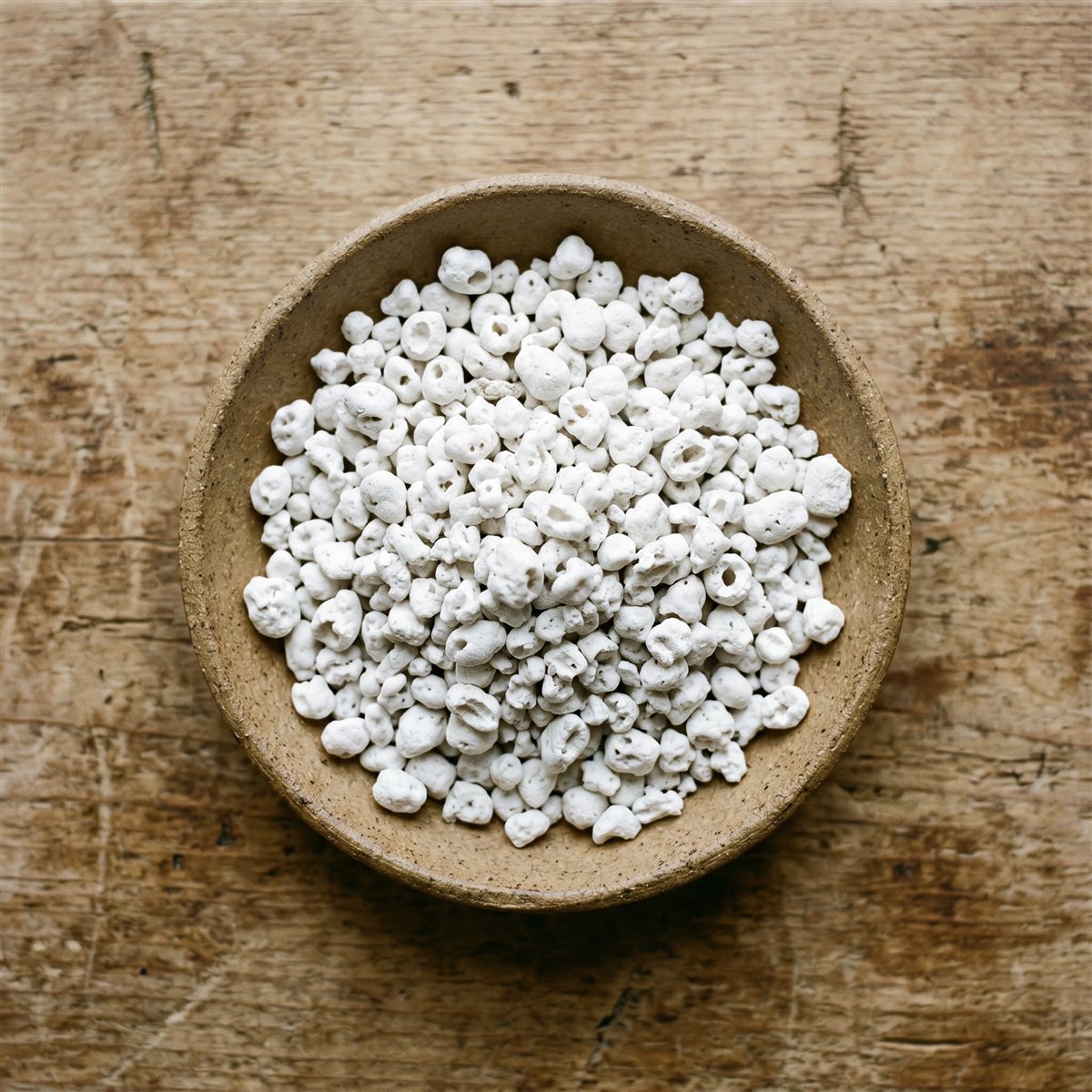
Use regularlyWhat it is. A volcanic glass that's mined as ore, crushed, and heated until the water locked inside it turns to steam and puffs each grain up, like popcorn (U.S. Environmental Protection Agency, 1995b; Perlite Institute, 2025).
What it does. Perlite adds air space and holds some water (Simmons, 2025). Its CEC is very low and its pH is about neutral (Evans, n.d.). The U.S. Geological Survey describes it as not degrading or compacting over long growing times (Simmons, 2025), though one review notes that it breaks down gradually with time and handling (Malík & Tlustoš, 2025). Pure perlite is light enough to float when heavily watered, and in a mix it tends to work its way to the top (Malík & Tlustoš, 2025; Owen & Lopez, n.d.). In full-cycle cannabis cultivation, pure perlite can float under heavy irrigation and loosen a plant's anchorage, so it's often combined with heavier media (Malík & Tlustoš, 2025).
What to buy. Buy a coarse grade. Finer grades hold more water and less air (Evans, n.d.).
Handling. Perlite dust can irritate the eyes, skin, throat and upper airways (National Institute for Occupational Safety and Health [NIOSH], n.d.). Dampen it before scooping and work somewhere with air moving. Perlite also contains fluoride, and for fluoride-sensitive plants the University of Missouri advises starting with a perlite-free mix (Trinklein, 2021).
Our verdict. Our second structural mineral, after pumice. Paired with pumice, it adds air space and keeps the mix light.
Zeolite (Clinoptilolite)
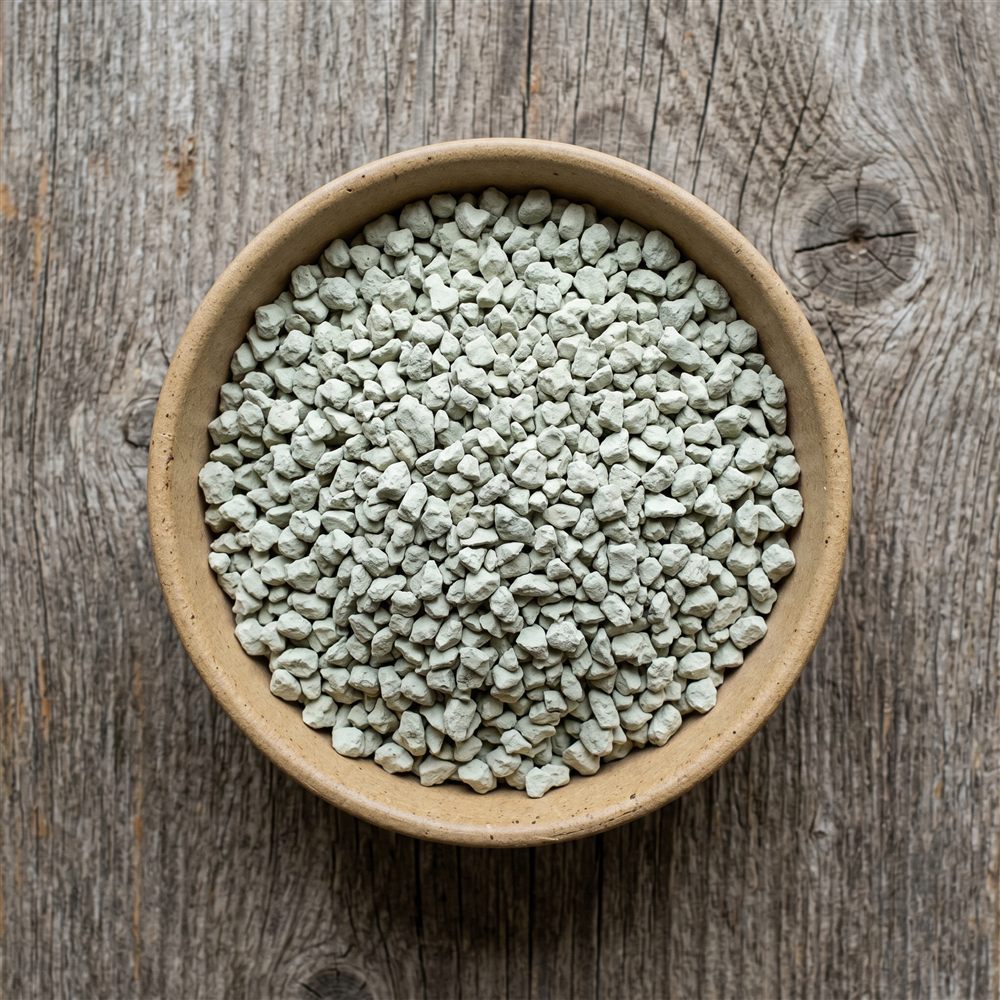
Use regularlyWhat it is. A mineral made of aluminum, silicon and oxygen, with a crystal structure full of tiny channels (Mumpton, 1999). More than 50 natural zeolites are known (Grifasi et al., 2024), and the ones used as industrial catalysts are mostly synthetic (Mumpton, 1999). This entry is about clinoptilolite. In the US, clinoptilolite comes from California, Idaho, New Mexico, Oregon and Texas (Williams, 2025), and Turkey and Slovakia are among the countries with large natural zeolite deposits (Grifasi et al., 2024).
What it does. Zeolite holds positively charged nutrients on its own exchange sites. Clinoptilolite favors potassium and ammonium, and calcium sits low on its list (Mumpton, 1999). In theory it holds about 220 milliequivalents per 100 grams (meq/100 g) (Grifasi et al., 2024), roughly four to six times what coir holds by weight (Evans, n.d.). One clinoptilolite measured pH 7.7 in water (Kučera et al., 2025). It also holds some water inside its crystal structure (Grifasi et al., 2024).
More wasn't better in one nursery study. In European beech seedlings grown in a peat-based nursery mix, 5% zeolite helped growth, while 20% impaired root development, and the seedlings ran short of potassium even though the mix held plenty (Kučera et al., 2025). We use it at 10% in our ICU Mix, and we still feed.
What to buy. We use 1 to 3 mm granules for general mixes and 3 to 5 mm for coarse aroid mixes. Zeolite also goes into pet litter and odor-control products (Williams, 2025). Check the particle size on the bag before buying for a mix.
Our verdict. We like it at a low rate for the nutrient holding it adds to a mostly mineral mix.
Horticultural Charcoal
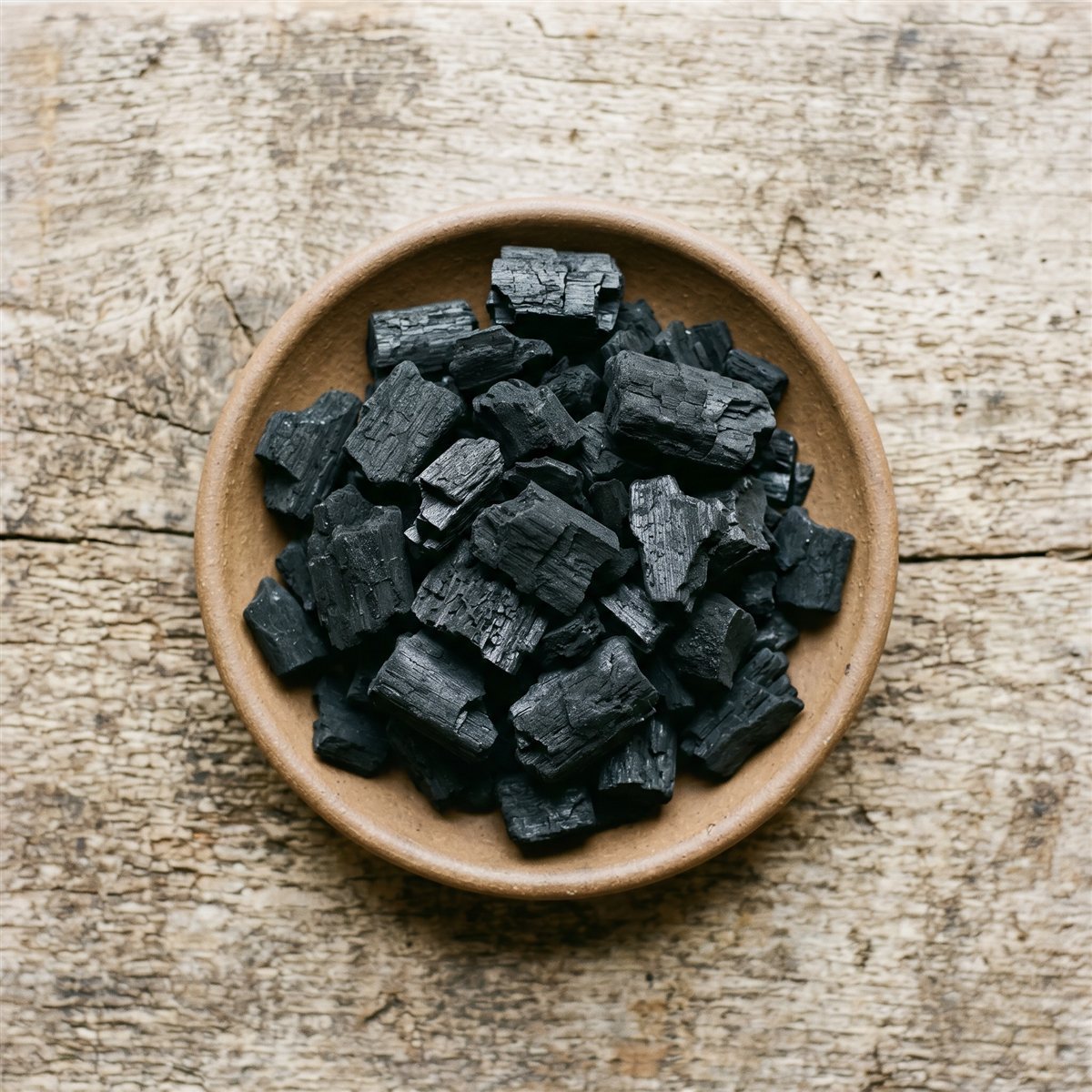
Use regularlyWhat it is. Charcoal is the carbon left after heating wood or other raw materials to drive off water and volatile compounds, and hardwoods are the main raw material (U.S. Environmental Protection Agency, 1995a). Barbecue briquettes are different: they contain a starch binder and may contain sawdust or other additives (U.S. Environmental Protection Agency, 1995a). Activated carbon is a different product, made by physical activation with gases such as steam or carbon dioxide, or by chemical activation with agents such as phosphoric acid (Neme et al., 2022). Biochar is essentially charcoal made for use in soil (Altland & Locke, 2012).
What it does. Biochars made from different materials can have very different chemical properties (Evans et al., 2017). Across biochars made from different farm materials, pH ran from 4.6 to 9.3 and CEC from very low to very high (Evans et al., 2017). In a lab test of a peat mix with no plants, one biochar added potassium and phosphate to the water draining out, though it also lowered and delayed the peaks of nitrate washing through (Altland & Locke, 2012). In a review of container studies, mixes with less than 25% biochar by volume grew plants as well as or better than mixes without it. Results at high rates were mixed. The review reports that biochar at rates as high as 100% often grew plants about as well as the standard mix. In one, though, 70% biochar with a high rate of slow-release fertilizer raised salts enough to stress plants. In another, 100% rice-husk biochar meant high pH, low air space and less available nitrogen (Huang & Gu, 2019).
Its job in our system is structural. It's the chunky particle we use in place of bark in our epiphytic aroid mixes.
What to buy. We use two grades: 1/8 to 1/4 inch for fine inclusion in our standard mix and several others, and 1/4 to 1/2 inch chunks for the Aroid Mineral Mix. RePotme, Hoffman and Black Gold are brand examples. Never use barbecue briquettes. We don't use activated charcoal in our mixes.
Our verdict. A structural ingredient we rely on in our aroid mixes, used at a modest share.
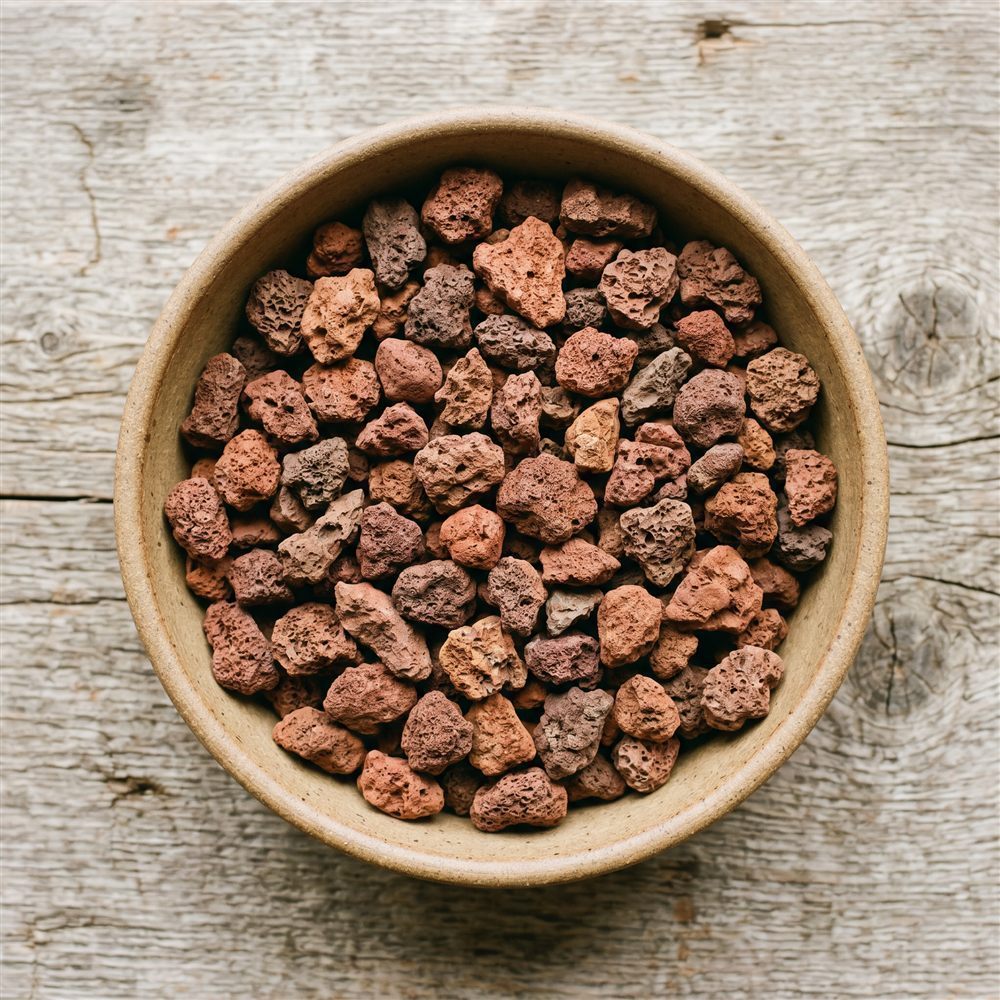
Lava Rock (Scoria)
Use selectivelyWhat it is. A dark volcanic rock so full of gas holes that the holes make up most of its volume (National Park Service, n.d.). It's related to pumice, which is usually light enough to float.
What it does. We'd use it the way we use pumice, for structure. Heavier ingredients help keep top-heavy plants upright (Evans, n.d.).
What to buy. We'd use 1/4 to 3/8 inch chunks. We'd sift landscape lava rock before using it.
Our verdict. A reasonable substitute for pumice or coarse charcoal. We don't feature it in our core recipes because pumice and charcoal do the job for us.
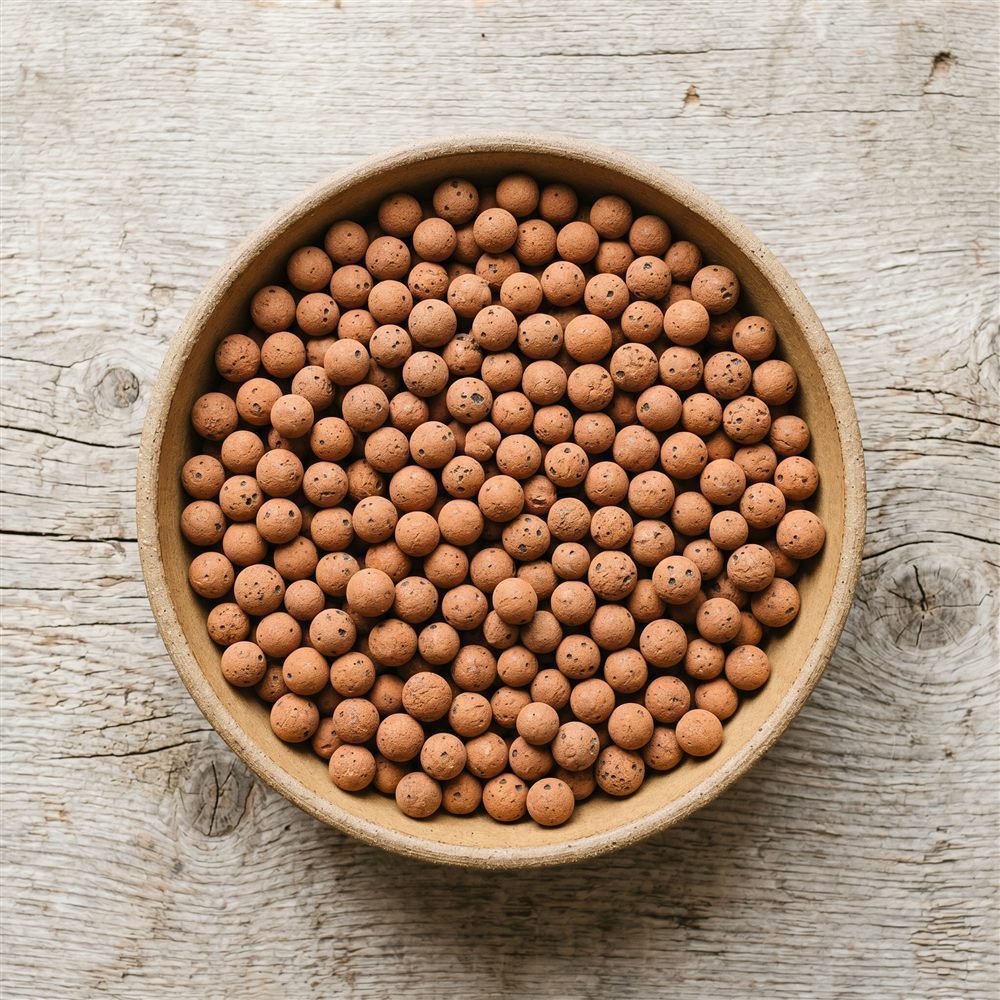
LECA (Lightweight Expanded Clay Aggregate)
Use selectivelyWhat it is. Clay pellets fired at high temperature so they expand into porous balls (Malík & Tlustoš, 2025). Expanded clay aggregate was developed in the US in the 1910s for lightweight concrete (Bremner & Ries, 2009).
What it does. LECA is near neutral (pH 6.0 to 7.0), holds almost no nutrients (CEC close to zero), and absorbs about 20 to 30% of its weight in water over a day of soaking (Malík & Tlustoš, 2025). Unlike perlite, it doesn't float to the top of a mix (Owen & Lopez, n.d.). Products differ. A German comparison of expanded clays reported that the standard salt test apparently misses some leached substances that can damage plants, and proposed testing with plants alongside the chemical analysis (Fischer & Meinken, 1995).
What to buy. We'd pick 8 to 16 mm pellets. Brand examples include Hydroton, Lecaton and Mother Earth Hydroclay. Growers commonly soak LECA before use (Malík & Tlustoš, 2025), and we'd rinse it too.
Our verdict. We don't blend LECA into our mixes, because the pellets are too large for them. We use it on its own for semi-hydro growing, which is a different system from a potting mix.
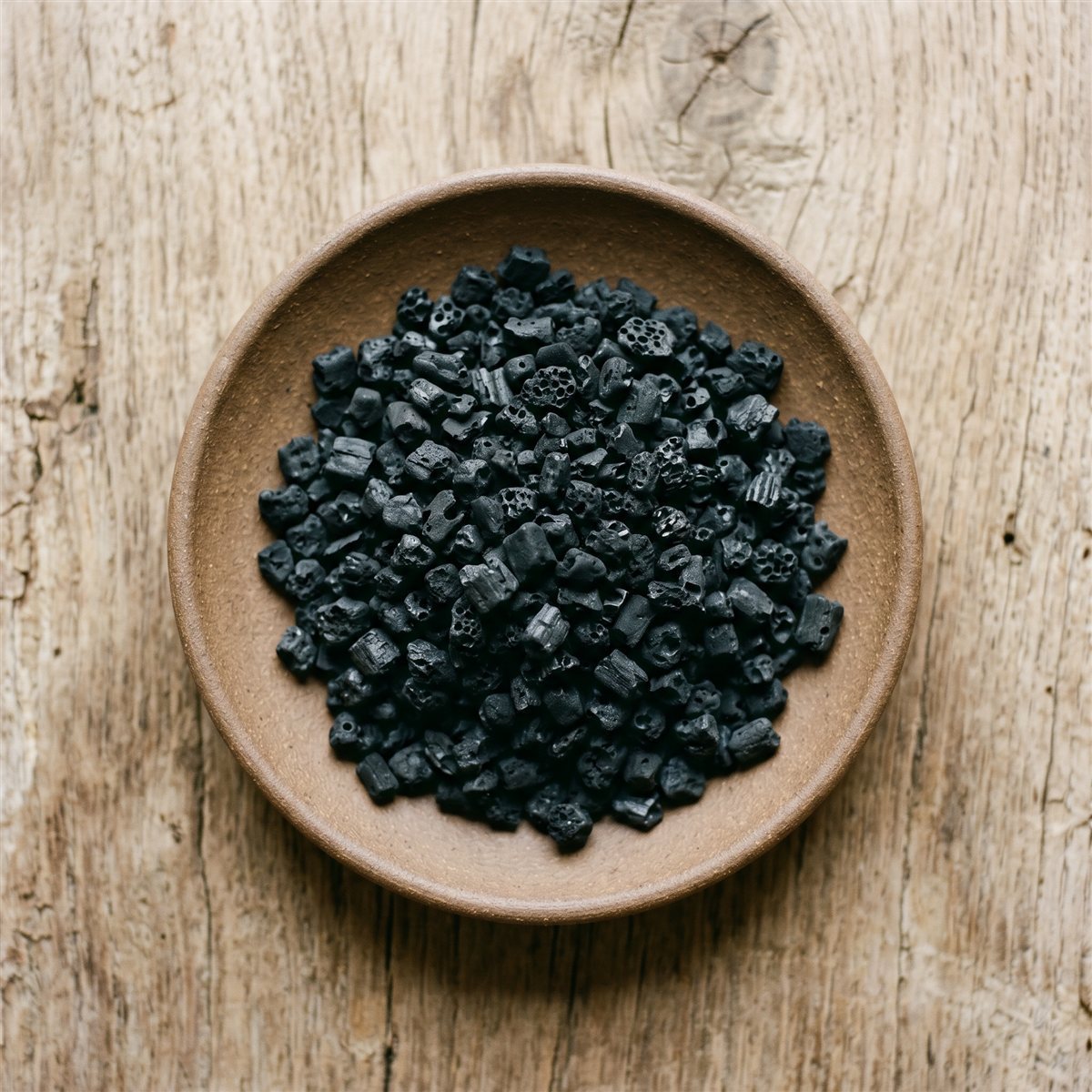
Biochar
Use selectivelyWhat it is. Charcoal made to be added to soil, the charred material left after heating biomass or manure with little oxygen (Altland & Locke, 2012; Evans et al., 2017). Its chemical properties vary a great deal with what it's made from (Evans et al., 2017).
What it does. Biochar pH is usually neutral to mildly alkaline, around 6.5 to 9.5 (Malík & Tlustoš, 2025), though some chars fall outside that range (Evans et al., 2017). The lab and container findings under charcoal above come from biochars (Altland & Locke, 2012; Huang & Gu, 2019).
What to buy. Look for biochar labeled for horticultural use, with what it was made from named on the bag.
Our verdict. We use it at a small share, 2 to 5%, in many of our recipes. It's a reasonable option if you know what it was made from.
Water-Retentive Organics
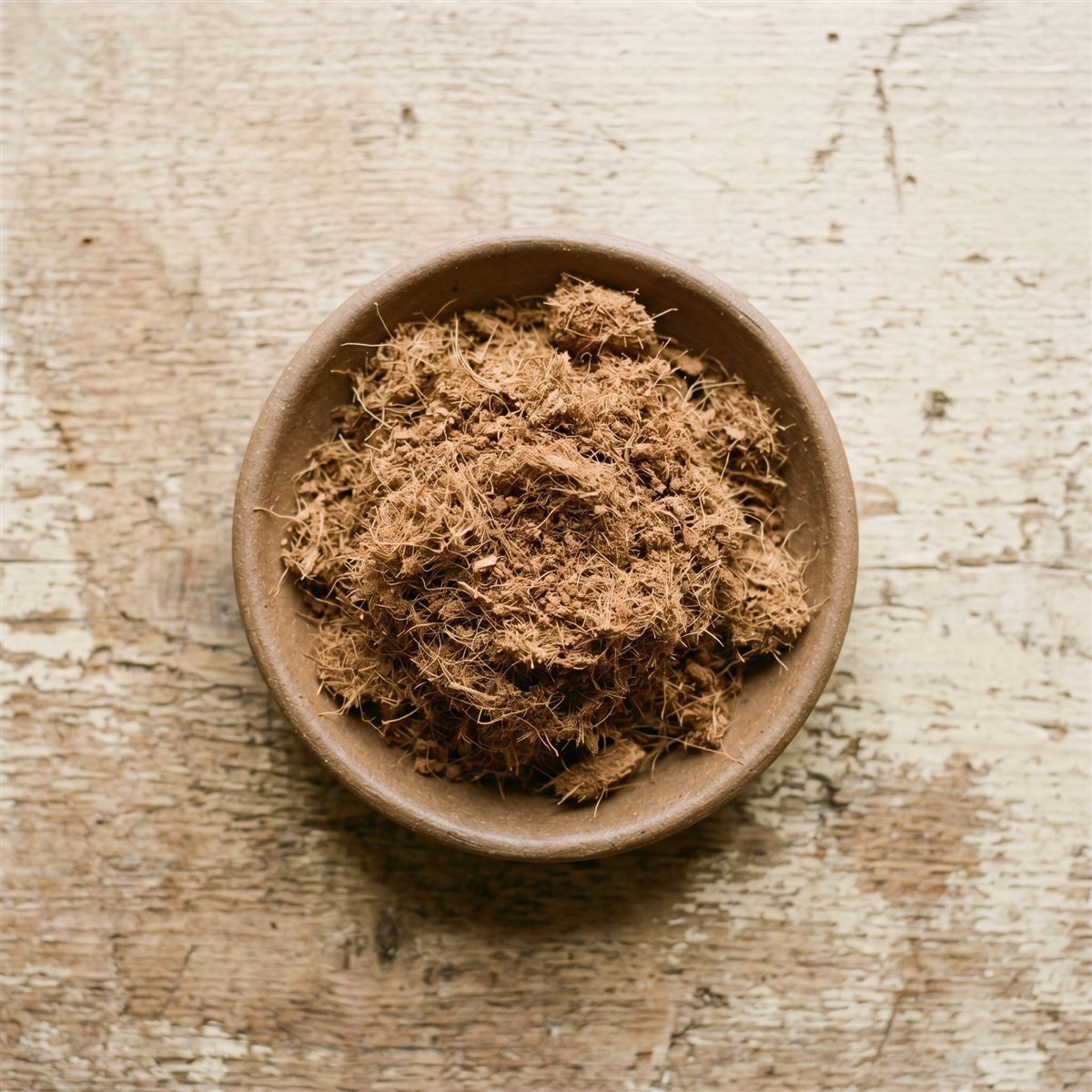
Buffered Coir
Use regularlyWhat it is. Horticultural coir, also called coir dust, is the granular pith left after the long and medium fibers are screened out of ground coconut husk (Evans, n.d.). Coconut husk can also be chopped into small cubes instead of ground (Evans, n.d.). Modern protocols leach coir with a calcium nitrate solution to remove sodium and potassium, and one protocol then buffers it by soaking it in a calcium and magnesium solution (Malík & Tlustoš, 2025).
What it does. Coir holds a lot of water. Its pH is usually 5.8 to 6.9, and its CEC is 39 to 60 milliequivalents per 100 grams, lower than sphagnum peat's (Evans, n.d.).
Buffering matters because unbuffered coir can take up calcium and magnesium from the first feeding, especially if you water with reverse-osmosis water, which carries none (Malík & Tlustoš, 2025). The extra sodium and potassium it releases can also compete with calcium and magnesium for uptake by roots (Malík & Tlustoš, 2025). Salt levels vary widely from one source of husk to another, and even unprocessed husk can carry high levels (Konduru et al., 1999). Coir dust also has a high carbon-to-nitrogen ratio and little available nitrogen (Abad et al., 2002).
What to buy. Calcium-buffered coir, in medium pith for general use and fine pith for tissue-culture transition mixes. Char Coir, Mother Earth Coco and Coco Bliss Plus are three brand examples. Before using a new bag, we'd check a sample's EC with one of the accepted methods, such as the 1:2 dilution test Purdue Extension describes (one part mix to two parts distilled water). Read the result against that method's own scale, since each method gives different numbers (Camberato et al., n.d.).
Our verdict. Our core mixes use buffered coir, and we'd check the EC of each new bag before using it.
Long-Fiber Sphagnum
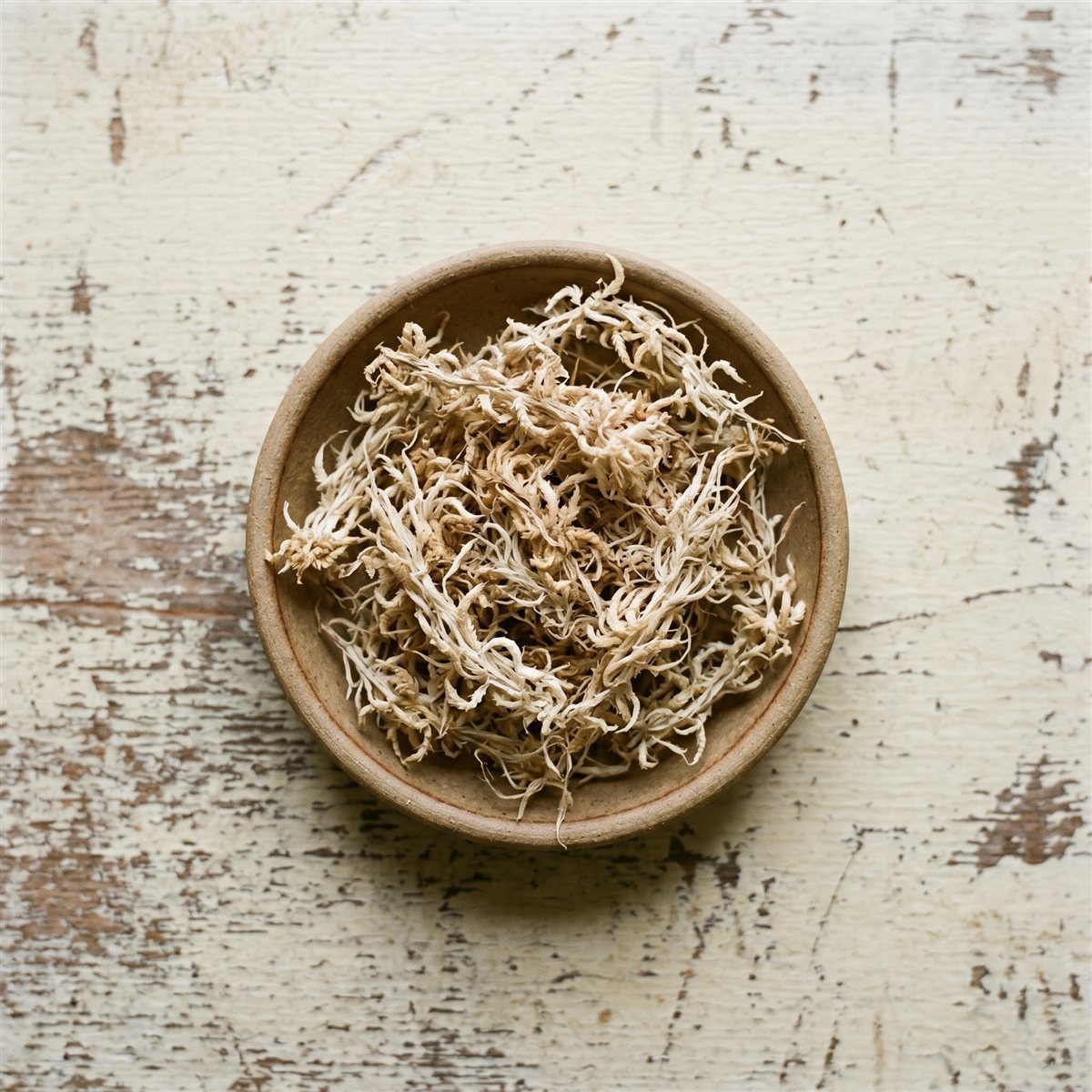
Use regularlyWhat it is. The Sphagnum moss plant itself, gathered and dried. Sphagnum peat is something else: the partly decomposed remains of the moss, dug from bogs (Evans, n.d.). New Zealand moss is of higher quality, but many phalaenopsis growers use Chilean moss because it costs less (Wang et al., 2007).
What it does. Sphagnum holds a lot of water, and in orchid pots, moss kept constantly wet can lead to root rot (Jordan, 2023). Its pH is low. In pots of phalaenopsis orchids, the root zone is often around pH 3 after a few months in moss, and that didn't appear to harm the plants (Wang et al., 2007). Fungi are common in sphagnum bogs, and farmed sphagnum processed for growing media goes through a hygienization step meant to kill most pathogens (Gaudig et al., 2018). Sphagnum was used for wound dressings in the First World War (Lindsay, 2018). Wang et al. (2007) reported that most phalaenopsis growers move young plants out of their lab flasks into plug trays of pure sphagnum.
Handling. Sphagnum can carry Sporothrix, the fungus behind the skin infection sporotrichosis. The largest reported US outbreak, 84 cases in 15 states in 1988, was traced to sphagnum moss (Rodrigues et al., 2022). The moss had been used to pack tree seedlings, and among exposed workers the risk rose with hours spent handling it (Coles et al., 1992). Wear gloves and long sleeves when you work with it.
What to buy. New Zealand long-fiber if you can get it, or Chilean. Look for moss sold for horticulture, with long strands.
Our verdict. We use it for specific jobs: tissue-culture acclimation, moss poles, our mixes for Nepenthes and jewel orchids, and anywhere we want moisture held close to roots.
Biological and Nutrient Inputs
Earthworm Castings (Vermicompost)
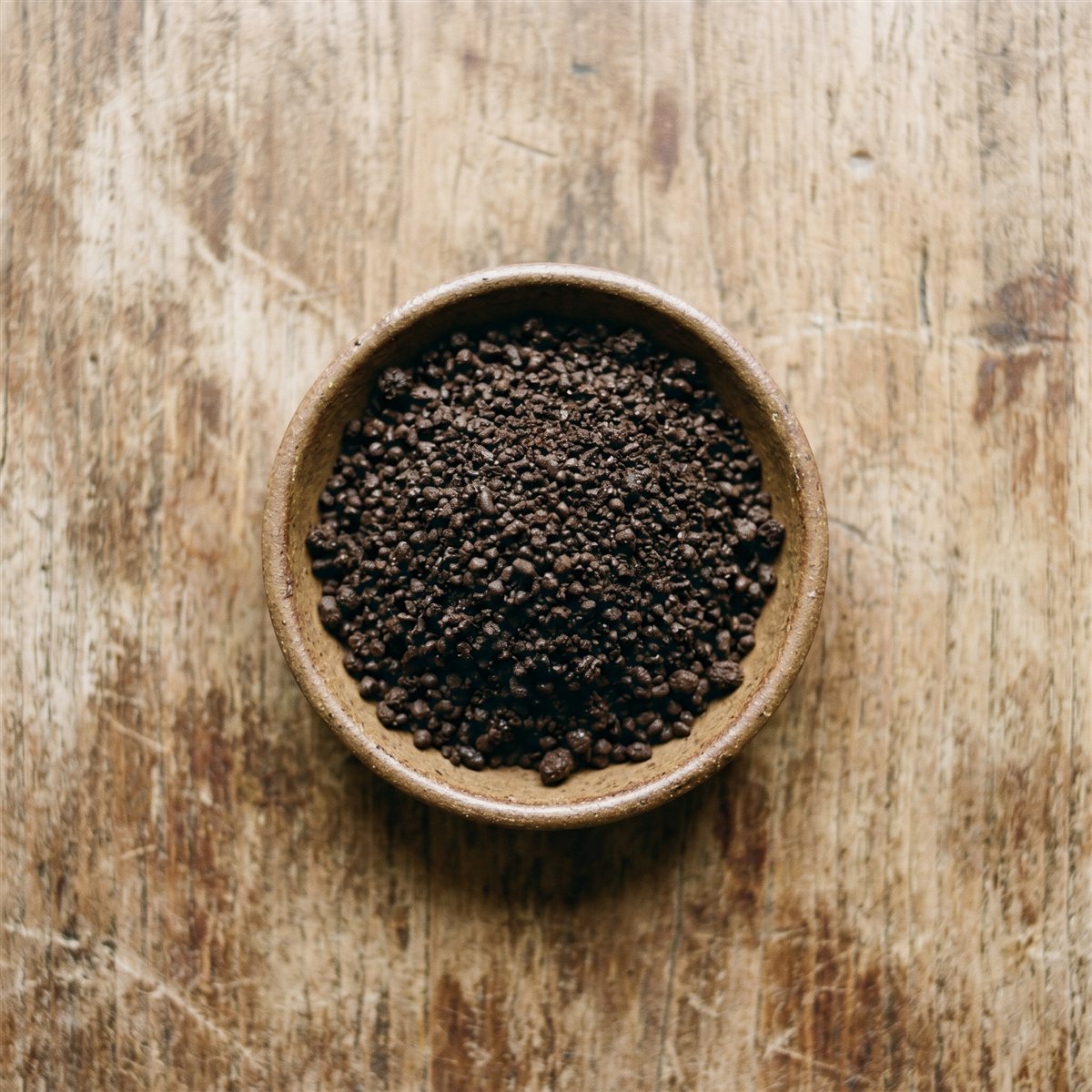
Use regularlyWhat it is. Vermicompost is a mix of worm castings and decomposed organic matter, made with composting worms, usually the red wiggler Eisenia fetida (Angima et al., 2024; Waldbillig & Brain, 2025). Oregon State University Extension notes that the gut of the red wiggler holds far more microbial life than its food (Angima et al., 2024), and worms increase the microbes in the material they process (Vuković et al., 2021). A healthy worm bin smells earthy, and a foul smell means the bin was mismanaged (Waldbillig & Brain, 2025).
What it does. Castings supply nutrients in forms plants can use, plus humic substances, growth-regulating compounds and an active community of microbes (Vuković et al., 2021). Worm composting is a cold process (Angima et al., 2024). Compost and vermicompost can suppress some root diseases, but the results have been inconsistent (Jack & Nelson, 2010), so we don't count on it. More isn't better here either. Citing earlier work by Atiyeh and colleagues, Vuković et al. (2021) report that vermicompost helped germination and growth only up to a certain share, and at 100% the seedlings were shorter, with fewer leaves and poorer germination.
What to buy. Look for fine, even castings that smell earthy, from a supplier who says what the worms were fed. Examples of brands: Worm Gold Plus and Unco Industries Wiggle Worm.
Sift before using. Screening castings separates out worms and material that hasn't broken down yet (Waldbillig & Brain, 2025). A kitchen strainer handles it.
Our verdict. We use castings at 2 to 15% depending on the mix. If a bag smells sour, we don't use it.
Ingredients We Use Sparingly or Leave Out
Our bark-free mixes and the allergen-safe versions of our other recipes leave all of these out. Some of our other recipes use orchid bark or coco husk chips, our carnivorous-plant mix uses peat, and garden soil stays out of our indoor mixes. Bark, coco chips and peat are sound ingredients; they just don't fit every mix we build.
Orchid Bark (Fir Bark)
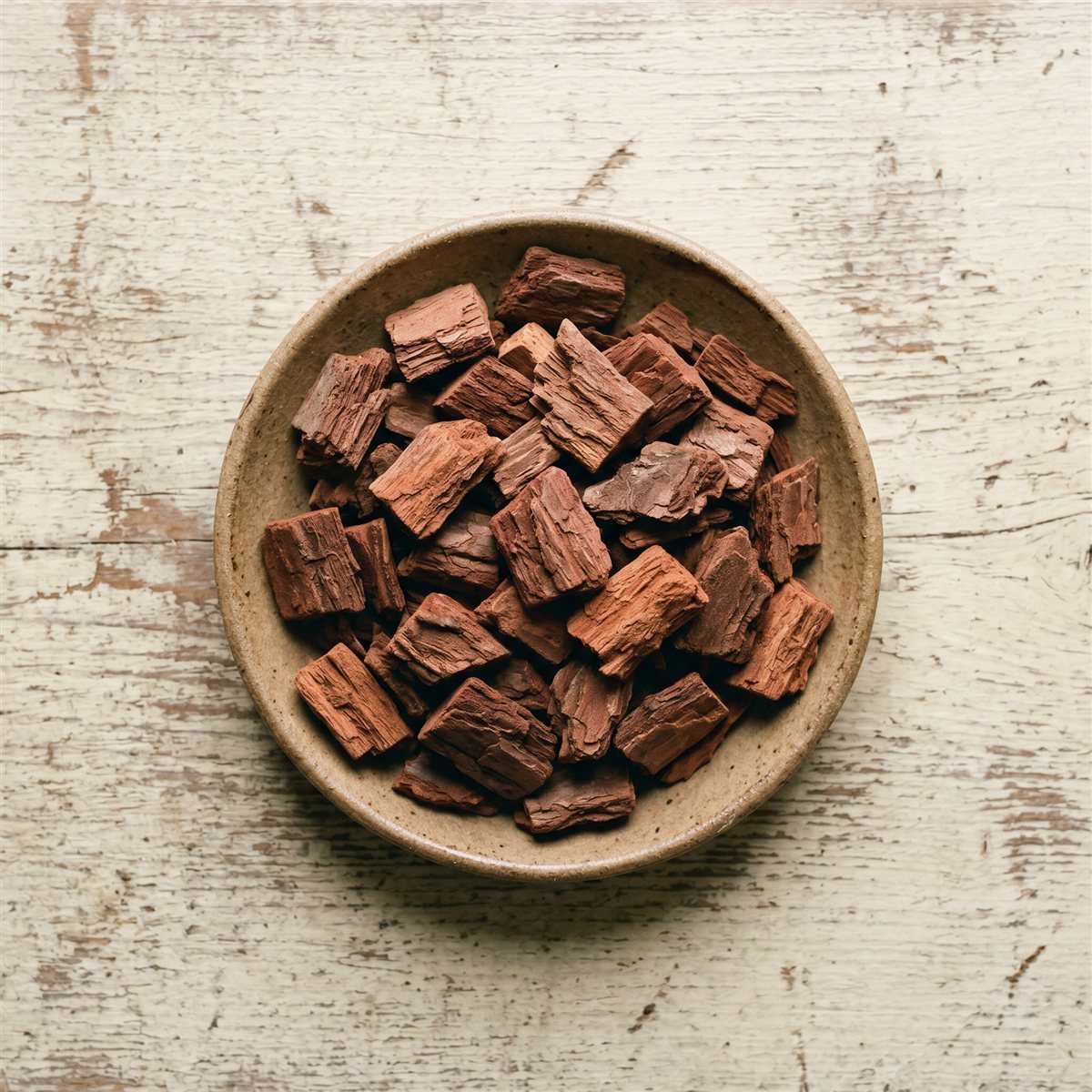
Use selectivelyWhat it is. Chunks of conifer bark. Ground Douglas fir and redwood bark have been used for orchids for more than 50 years, and most orchid mixes still contain fir bark (Wang et al., 2007).
What it does. Bark breaks down over time. Clemson Extension advises replacing orchid bark about every two years, and as it breaks into smaller pieces it holds more water (Jordan, 2023). Bacteria breaking down the bark are why bark-grown orchids get higher-nitrogen feed (Nash, n.d.). Douglas fir bark is strongly acidic, around pH 3.5 to 4.7 (Buamscha & Altland, 2008). In nursery container mixes, composted bark, mostly hardwood bark in the studies, can suppress several root diseases, though not every batch does (Hoitink, 1982). We don't count on that from the bark sold for potting.
Why our bark-free mixes leave it out. It's our choice to build bark-free mixes, for the reasons above: bark changes as it breaks down. Moldy bark can carry Aspergillus spores. Everyday garden work like mulching exposes people to them. That isn't a concern for most healthy people, but people with serious illness, asthma or a weakened immune system may be at risk from high spore levels (Minnesota Pollution Control Agency, 2005). Even so, serious lung infections have been reported in healthy gardeners after heavy exposure to moldy bark (Butler et al., 2013). If a bag smells musty, we'd skip it.
When it's still the right choice. Bark is a well-established orchid ingredient (Wang et al., 2007). If you buy fresh, graded bark and repot on a schedule, it's a sound choice. Several of our own recipes use it, and their allergen-safe versions swap it out. In our bark-free mixes, horticultural charcoal and coarse pumice take its place.
Coco Chips (Coco Husk Chunks)
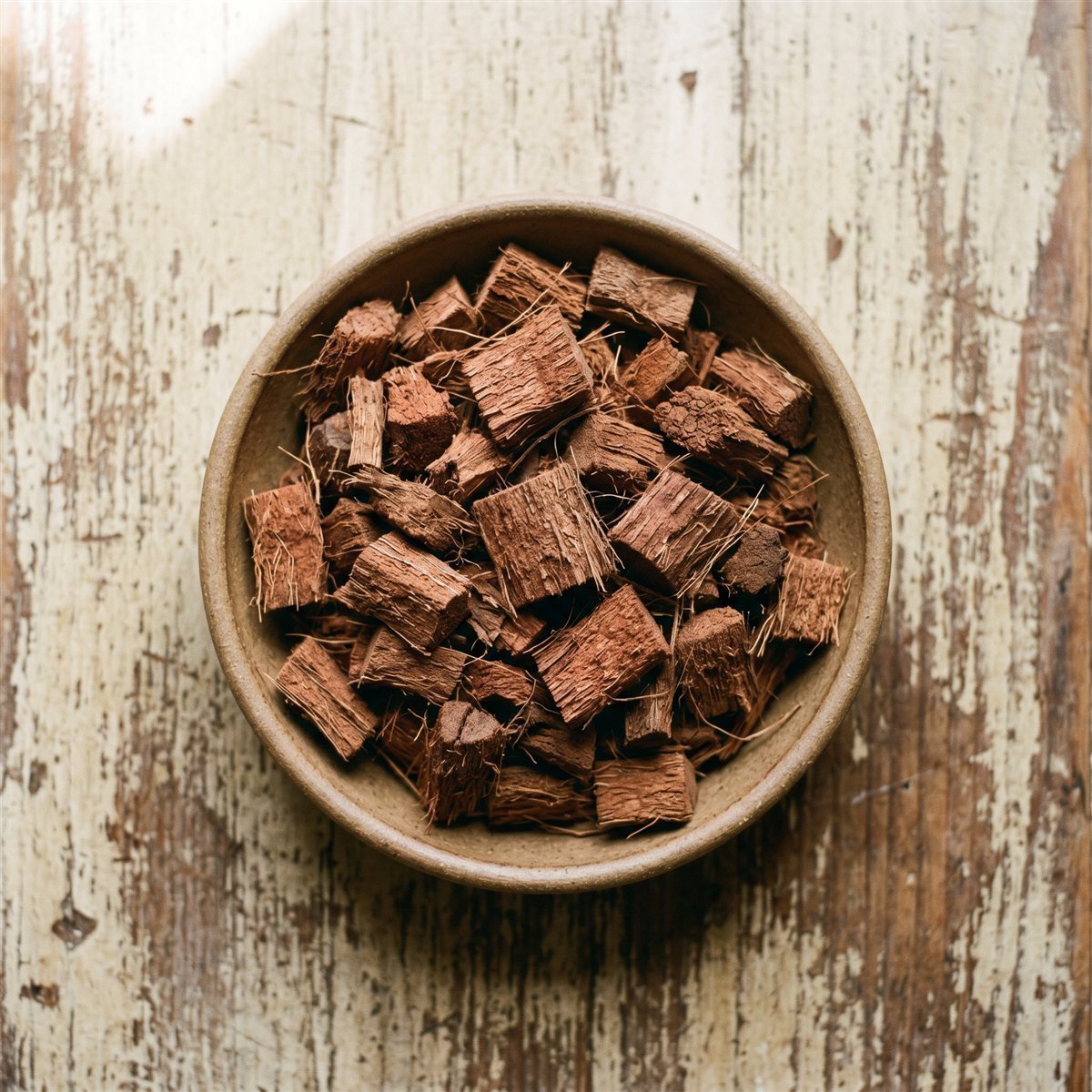
Use selectivelyWhat it is. Coconut husk chopped into small cubes, used as a substrate for plants such as orchids and anthuriums (Evans, n.d.).
Why our bark-free mixes leave it out. Salt levels in coconut husk vary widely from source to source (Konduru et al., 1999). The American Orchid Society notes that growers usually soak husk chips in clean water, changed several times, before using them (Nash, n.d.). That's one more step to manage, so our bark-free mixes skip it.
When it's still the right choice. If you're willing to soak each new lot and check the runoff EC, coco chips are a reasonable bark substitute. Some of our own mixes for hoyas, epiphytic anthuriums and Nepenthes use them.
Peat Moss / Sphagnum Peat
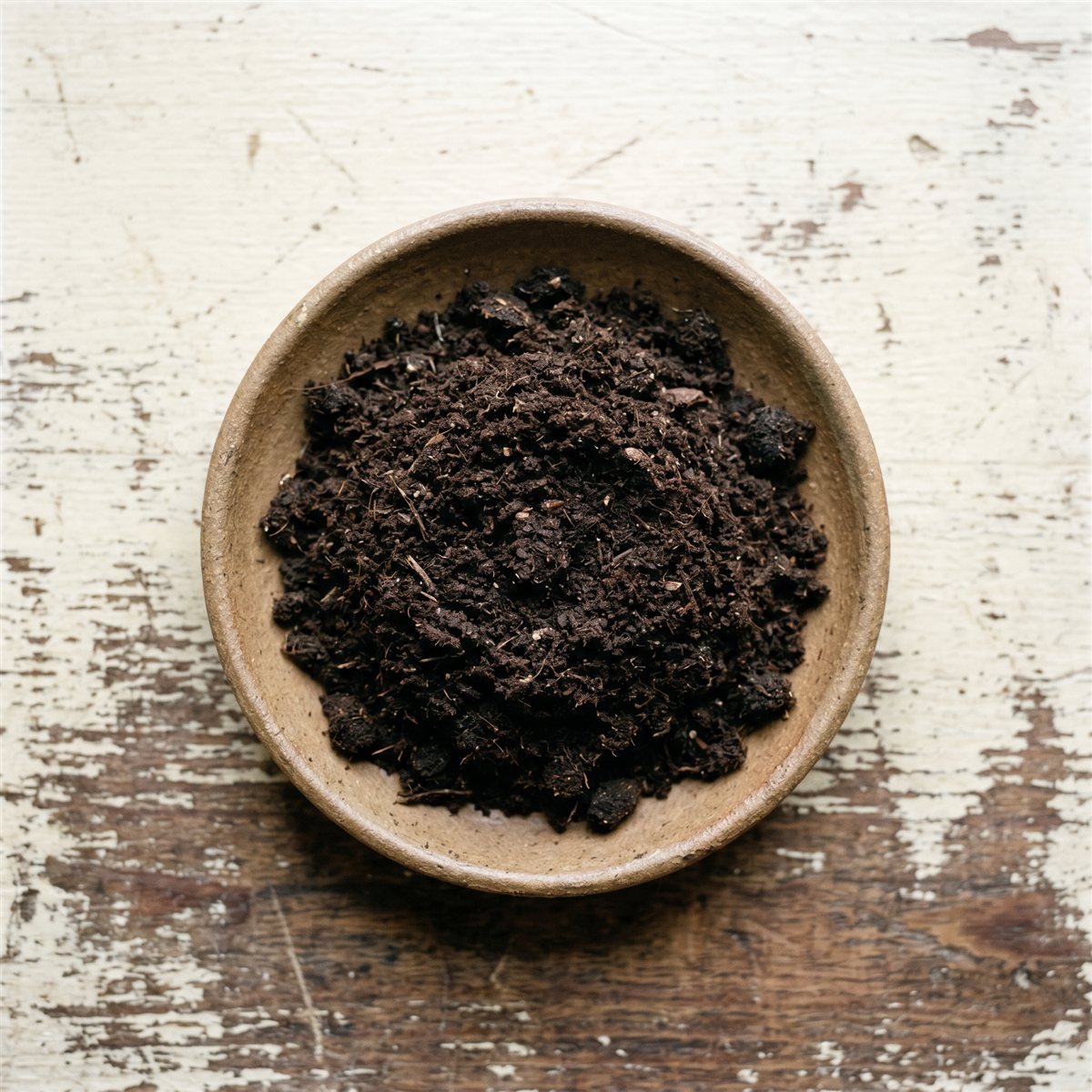
We avoidWhat it is. The partly decomposed remains of sphagnum moss, dug from bogs (Evans, n.d.), and the most widely used growing-media material there is (Altland & Bugbee, 2026). It's a different product from the long-fiber sphagnum we use.
What it does. Peat holds a lot of water, about 60 to 68% of its volume, which is a little less than coir. Unamended, its pH is 3.0 to 4.5, so for most crops it's limed before use, and its CEC is 90 to 140 milliequivalents per 100 grams. Once dry, it's hard to wet again (Evans, n.d.). Summarizing earlier work, Altland et al. (2011) report that air space in peat mixes fell over 14 months, and suggest that settling and decomposition may be more common in peat mixes than in bark mixes.
Why we avoid it. Our recipes leave peat out, apart from our carnivorous-plant mix, and that's a preference, not a scientific verdict. Drained or damaged peatlands release a large amount of carbon (International Union for Conservation of Nature [IUCN], 2021), and northern peatlands are estimated to build up about 0.01 to 0.03 inch (0.3 to 0.7 mm) of peat a year (Altland & Bugbee, 2026). Whether current North American harvesting is sustainable is disputed, and some researchers argue it is (Altland & Bugbee, 2026).
When it's still the right choice. Seed starting, where a mix can be entirely a fine grade of sphagnum peat (Evans, n.d.). It's not for our chunky mixes.
Topsoil / Garden Soil
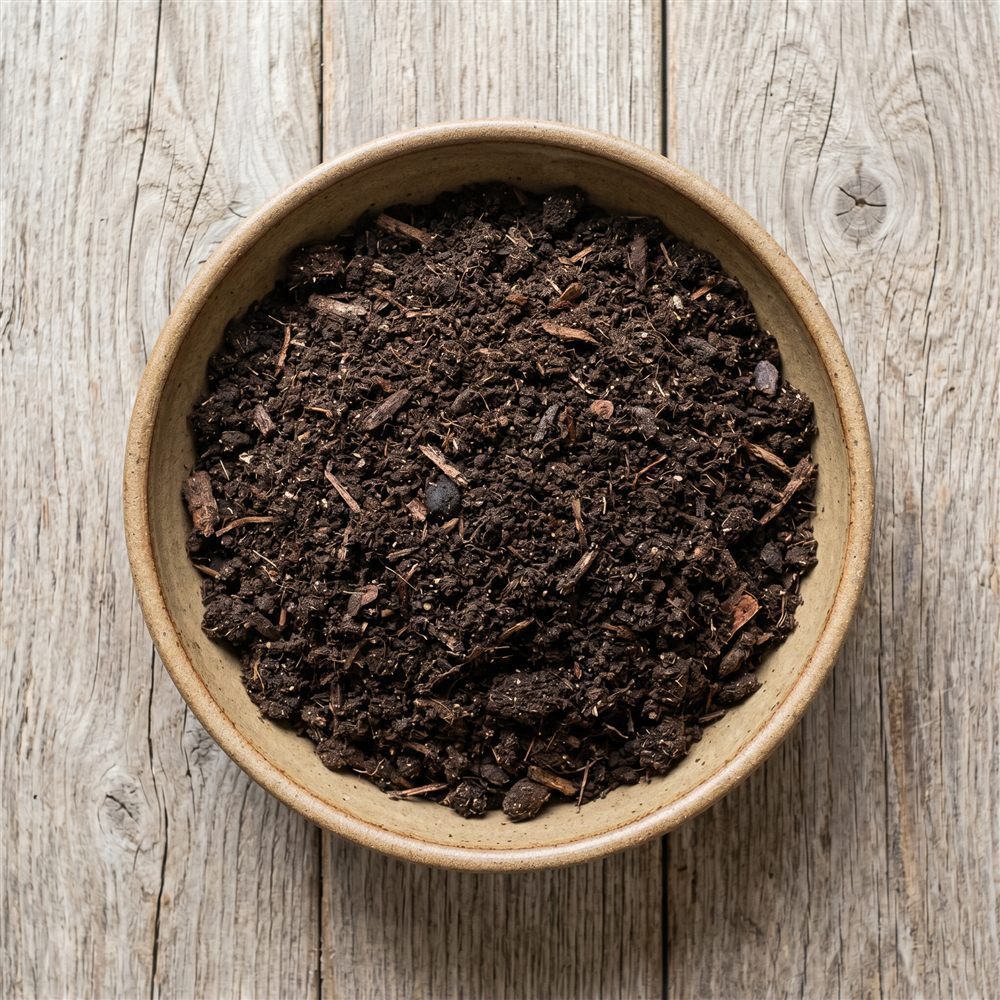
We avoidWhat it is. Soil dug from a field or a garden bed. Bagged products labeled topsoil are often largely sedge peat (University of Illinois Extension, n.d.).
What it does in a pot. Field soils often hold too much water and too little air for containers, and can harbor diseases, insects and weeds (NC State Extension, n.d.). The University of Illinois advises never using garden soil by itself in a container. If you use it, amend it, for example one part soil to one part peat and one part perlite or coarse sand (University of Illinois Extension, n.d.). Soil-based mixes made with sterilized loam, such as the John Innes composts, are a long-established option (Royal Horticultural Society, n.d.).
Our verdict. Not for our indoor mixes. We build ours from ingredients we can specify one by one.
Quick Reference Table
The grades are the ones we use. Water, CEC and pH figures come from the sources in each entry above; "No figure" means we didn't find a source we trust for that cell.
| Ingredient | Primary role | Water holding | CEC | pH | Grade we use or would pick |
|---|---|---|---|---|---|
| Pumice | Air space + structure | Small | No figure | Near neutral | 1/8″ to 1/2″ |
| Perlite (coarse) | Air space | Some | Very low | About neutral | Coarse |
| Zeolite | Nutrient holding | Some, inside the crystal | About 220 meq/100 g in theory | 7.7 in one test | 1–3 mm / 3–5 mm |
| Horticultural charcoal | Structure | No figure | Varies with what it's made from (measured on biochars) | Varies with what it's made from (measured on biochars) | 1/8″ to 1/2″ |
| Lava rock | Structure | No figure | No figure | No figure | 1/4″ to 3/8″ |
| LECA | Air space | 20–30% of its weight after soaking | Close to zero | 6.0–7.0 | 8–16 mm |
| Biochar | Structure | No figure | Varies with what it's made from | Usually 6.5–9.5 | 1/8″ to 1/4″ |
| Coir | Water holding | High | 39–60 meq/100 g | 5.8–6.9 | Fine / medium pith |
| Long-fiber sphagnum | Water held close to roots | High | No figure | Low | Whole fiber |
| Earthworm castings | Nutrients + microbes | No figure | No figure | No figure | Sifted fine |
| Douglas fir bark | (Some recipes) | No figure | No figure | 3.5–4.7 | No figure |
| Coco chips | (Some recipes) | No figure | No figure | No figure | No figure |
| Peat moss | (We avoid) | High (60–68% of volume) | 90–140 meq/100 g | 3.0–4.5 unamended | No figure |
Where This Goes Next
That's the ingredient list. The next entry, Designing a Mix: The Logic Behind the Ratios, walks through how we put these together into a recipe. With the science from the Substrate Primer and the ingredients from this article, the recipes in later entries become something you can reason about and adjust for your own conditions.
We source most of ours from Rasa Garden Supply in San Jose, a small operator we've worked with for years. If you have a local supplier, it's worth a look before you default to online.
Continue · The Substrate Library
Next: Designing a Mix.
The next entry walks through how we work backward from what the plant needs to a recipe that suits it.
- Designing a Mix: The Logic Behind the Ratios: putting the ingredients together into working recipes, and adapting any recipe for your own humidity, temperature, pot and feeding style
We review our guides against the research and extension guidance available at the time, and we correct them when a source doesn't say what we took it to say or when we can't find support for a point. In this review we corrected the properties and tests we gave for most ingredients, including how much zeolite adds to a mix's nutrient holding, and our advice on when to use or leave some out. We also added handling cautions, fixed citation errors and removed claims we couldn't source, including testing we have no record of.
Go deeper in the free Apprenticeship: Module IV, What Substrate Is →
Abad, M., Noguera, P., Puchades, R., Maquieira, A., & Noguera, V. (2002). Physico-chemical and chemical properties of some coconut coir dusts for use as a peat substitute for containerised ornamental plants. Bioresource Technology, 82(3), 241–245. https://doi.org/10.1016/S0960-8524(01)00189-4
Altland, J., & Bugbee, B. (2026). The limits of sustainability of peat as a soilless media for agriculture. Frontiers in Plant Science, 17, 1856037. https://doi.org/10.3389/fpls.2026.1856037
Altland, J. E., & Locke, J. C. (2012). Biochar affects macronutrient leaching from a soilless substrate. HortScience, 47(8), 1136–1140. https://doi.org/10.21273/HORTSCI.47.8.1136
Altland, J. E., Owen, J. S., Jr., & Gabriel, M. Z. (2011). Influence of pumice and plant roots on substrate physical properties over time. HortTechnology, 21(5), 554–557. https://doi.org/10.21273/HORTTECH.21.5.554
Angima, S., Noack, M., & Noack, S. (2024). Composting with worms (EM 9034; original work published 2011). Oregon State University Extension Service. https://extension.oregonstate.edu/catalog/em-9034-composting-worms
Bilderback, T. E., Warren, S. L., Owen, J. S., Jr., & Albano, J. P. (2005). Healthy substrates need physicals too! HortTechnology, 15(4), 747–751. https://doi.org/10.21273/HORTTECH.15.4.0747
Bremner, T. W., & Ries, J. (2009). Stephen J. Hayde: Father of the lightweight concrete industry. Concrete International, 31(8), 35–38. https://web.nationalbuildingarts.org/collections/materials/cementitious/expanded-shale-haydite/stephen-j-hayde-article/
Buamscha, M. G., & Altland, J. E. (2008). What's in your Douglas-fir bark? In R. K. Dumroese & L. E. Riley (Coords.), National proceedings: Forest and conservation nursery associations, 2007 (Proceedings RMRS-P-57, pp. 96–103). USDA Forest Service, Rocky Mountain Research Station. https://www.fs.usda.gov/rm/pubs/rmrs_p057/rmrs_p057_096_103.pdf
Butler, L., Brockley, T., Denning, D., Richardson, M., Chisholm, R., Sinha, S., & O'Driscoll, R. (2013). Acute Aspergillus pneumonia associated with mouldy tree bark-chippings, complicated by anti-glomerular basement membrane disease causing permanent renal failure. Medical Mycology Case Reports, 2, 125–127. https://doi.org/10.1016/j.mmcr.2013.06.001
Camberato, D. M., Lopez, R. G., & Mickelbart, M. V. (n.d.). pH and electrical conductivity measurements in soilless substrates (HO-237-W). Purdue Extension. https://www.extension.purdue.edu/extmedia/ho/ho-237-w.pdf
Coles, F. B., Schuchat, A., Hibbs, J. R., Kondracki, S. F., Salkin, I. F., Dixon, D. M., Chang, H. G., Duncan, R. A., Hurd, N. J., & Morse, D. L. (1992). A multistate outbreak of sporotrichosis associated with sphagnum moss. American Journal of Epidemiology, 136(4), 475–487. https://doi.org/10.1093/oxfordjournals.aje.a116521
Crangle, R. D., Jr. (2025). Pumice and pumicite. In Mineral commodity summaries 2025 (pp. 140–141). U.S. Geological Survey. https://pubs.usgs.gov/periodicals/mcs2025/mcs2025-pumice.pdf
Evans, M. R. (n.d.). Unit 7: Substrates [Greenhouse management online course]. University of Arkansas. https://greenhouse.hosted.uark.edu/Unit07/Printer_Friendly.html
Evans, M. R., Jackson, B. E., Popp, M., & Sadaka, S. (2017). Chemical properties of biochar materials manufactured from agricultural products common to the southeast United States. HortTechnology, 27(1), 16–23. https://doi.org/10.21273/HORTTECH03481-16
Fischer, P., & Meinken, E. (1995). Expanded clay as a growing medium: Comparison of different products. Acta Horticulturae, 401, 115–120. https://doi.org/10.17660/ActaHortic.1995.401.13
Gaudig, G., Krebs, M., Prager, A., Wichmann, S., et al. (2018). Sphagnum farming from species selection to the production of growing media: A review. Mires and Peat, 20, Article 13. https://doi.org/10.19189/MaP.2018.OMB.340
Grifasi, N., Ziantoni, B., Fino, D., & Piumetti, M. (2024). Fundamental properties and sustainable applications of the natural zeolite clinoptilolite. Environmental Science and Pollution Research, 32(48), 27805–27840. https://doi.org/10.1007/s11356-024-33656-5
Hoitink, H. A. J. (1982). Composted bark, a lightweight growth medium with fungicidal properties. Journal American Rhododendron Society, 36(2). (Reprinted from Plant Disease, 64(2), 1980) https://scholar.lib.vt.edu/ejournals/JARS/v36n2/v36n2-hoitink.html
Huang, L., & Gu, M. (2019). Effects of biochar on container substrate properties and growth of plants: A review. Horticulturae, 5(1), 14. https://doi.org/10.3390/horticulturae5010014
International Union for Conservation of Nature. (2021). Peatlands and climate change [Issues brief]. https://iucn.org/sites/default/files/2022-04/iucn_issues_brief_peatlands_and_climate_change_final_nov21.pdf
Jack, A. L. H., & Nelson, E. B. (2010). Suppression of Pythium damping off with compost and vermicompost [Final report to the Organic Farming Research Foundation]. Cornell University. https://cwmi.css.cornell.edu/organicfarmingfinalreport.pdf
Jordan, J. (2023, March 9). Repotting your orchid. Clemson Cooperative Extension Home & Garden Information Center. https://hgic.clemson.edu/repotting-your-orchid/
Konduru, S., Evans, M. R., & Stamps, R. H. (1999). Coconut husk and processing effects on chemical and physical properties of coconut coir dust. HortScience, 34(1), 88–90. https://doi.org/10.21273/HORTSCI.34.1.88
Kučera, A., Volánek, J., Tomášová, G., Holík, L., Balková, M., Vichta, T., Samec, P., Rosíková, J., & Vranová, V. (2025). Substrate enrichment with clinoptilolite: Limits and possibilities for container-grown seedling propagation. Journal of Soil Science and Plant Nutrition, 25(4), 10299–10312. https://doi.org/10.1007/s42729-025-02794-1
Lindsay, R. (2018). War and peat: How bog moss helped save thousands of lives in World War I. The Conversation. https://theconversation.com/war-and-peat-how-bog-moss-helped-save-thousands-of-lives-in-world-war-i-106630
Malík, M., & Tlustoš, P. (2025). Soilless growing media for cannabis cultivation. Agriculture, 15(18), 1955. https://doi.org/10.3390/agriculture15181955
Minnesota Pollution Control Agency. (2005). Aspergillus fungus spores from yard waste compost facilities (Fact sheet w-sw1-01). https://www.pca.state.mn.us/sites/default/files/w-sw1-01.pdf
Mumpton, F. A. (1999). La roca magica: Uses of natural zeolites in agriculture and industry. Proceedings of the National Academy of Sciences, 96(7), 3463–3470. https://doi.org/10.1073/pnas.96.7.3463
Nash, N. (n.d.). Coconut husk [Orchids Q&A]. American Orchid Society. https://www.aos.org/orchids/orchids-question-answer/coconut-husk.aspx
National Institute for Occupational Safety and Health. (n.d.). NIOSH pocket guide to chemical hazards: Perlite. Centers for Disease Control and Prevention. https://www.cdc.gov/niosh/npg/npgd0491.html
National Park Service. (n.d.). Pyroclasts and pyroclastic rocks. U.S. Department of the Interior. https://www.nps.gov/subjects/volcanoes/pyroclasts.htm
NC State Extension. (n.d.). Chapter 18: Plants grown in containers. In Extension gardener handbook. North Carolina State University. https://content.ces.ncsu.edu/extension-gardener-handbook/18-plants-grown-in-containers
Neme, I., Gonfa, G., & Masi, C. (2022). Activated carbon from biomass precursors using phosphoric acid: A review. Heliyon, 8(12), e11940. https://doi.org/10.1016/j.heliyon.2022.e11940
Owen, W. G., & Lopez, R. G. (n.d.). Evaluating container substrates and their components (HO-255-W). Purdue Extension. https://www.extension.purdue.edu/extmedia/HO/HO-255-W.pdf
Perlite Institute. (2025). Everything you need to know about the origins of perlite [Industry publication]. https://www.perlite.org/wp-content/uploads/2025/10/Everything-You-Need-to-Know-About-the-Origins-of-Perlite.pdf
Rodrigues, A. M., Gonçalves, S. S., de Carvalho, J. A., Borba-Santos, L. P., Rozental, S., & de Camargo, Z. P. (2022). Current progress on epidemiology, diagnosis, and treatment of sporotrichosis and their future trends. Journal of Fungi, 8(8), 776. https://doi.org/10.3390/jof8080776
Royal Horticultural Society. (n.d.). John Innes compost. https://www.rhs.org.uk/soil-composts-mulches/john-innes-compost
Simmons, K. J. (2025). Perlite. In Mineral commodity summaries 2025 (pp. 132–133). U.S. Geological Survey. https://pubs.usgs.gov/periodicals/mcs2025/mcs2025-perlite.pdf
Trinklein, D. (2021, January 25). Leaf tipburn on houseplants. Missouri Environment & Garden. University of Missouri Integrated Pest Management. https://ipm.missouri.edu/MEG/2021/1/leafTipburn-DT/
U.S. Environmental Protection Agency. (1995a). Charcoal (AP-42, Section 10.7). In Compilation of air pollutant emission factors (5th ed.). https://www.epa.gov/sites/default/files/2020-10/documents/c10s07.pdf
U.S. Environmental Protection Agency. (1995b). Perlite processing (AP-42, Section 11.30). In Compilation of air pollutant emission factors (5th ed.). https://19january2021snapshot.epa.gov/sites/static/files/2020-10/documents/c11s30.pdf
University of Illinois Extension. (n.d.). Soil. In Container gardens. https://extension.illinois.edu/container-gardens/soil
Vuković, A., Velki, M., Ečimović, S., Vuković, R., Štolfa Čamagajevac, I., & Lončarić, Z. (2021). Vermicomposting: Facts, benefits and knowledge gaps. Agronomy, 11(10), 1952. https://doi.org/10.3390/agronomy11101952
Waldbillig, H., & Brain, R. (2025). Vermicomposting (Rev. by S. Kent & R. Brain McCann). Utah State University Extension. https://extension.usu.edu/yardandgarden/research/vermicomposting
Wang, Y.-T., Blanchard, M., Lopez, R., & Runkle, E. (2007, February). Growing the best Phalaenopsis, part 2: Media, transplanting, water and nutrient requirements. Orchids, 106–111. https://secure.aos.org/media/Content-Images/PDFs/GrowingtheBestPhalaenopsisPart_2.pdf
Williams, J. R. (2025). Zeolites (natural). In Mineral commodity summaries 2025 (pp. 200–201). U.S. Geological Survey. https://pubs.usgs.gov/periodicals/mcs2025/mcs2025-zeolites.pdf