A potting mix has a few jobs to do for a root: hold water, leave room for air and hold on to nutrients. Once you know how those play out in a pot, choosing a mix, or fixing one, gets a lot simpler.
Corrected September 2026: we've revised parts of this guide. See the correction note at the end.
A potting mix has four jobs: hold the plant up, hold water, hold nutrients and leave room for air (Owen & Lopez, 2015).
This is the foundation entry of the Substrate Library. The entries after it go deeper into single ingredients and into the Guild's own recipes.
A Pot Is Not a Piece of Ground
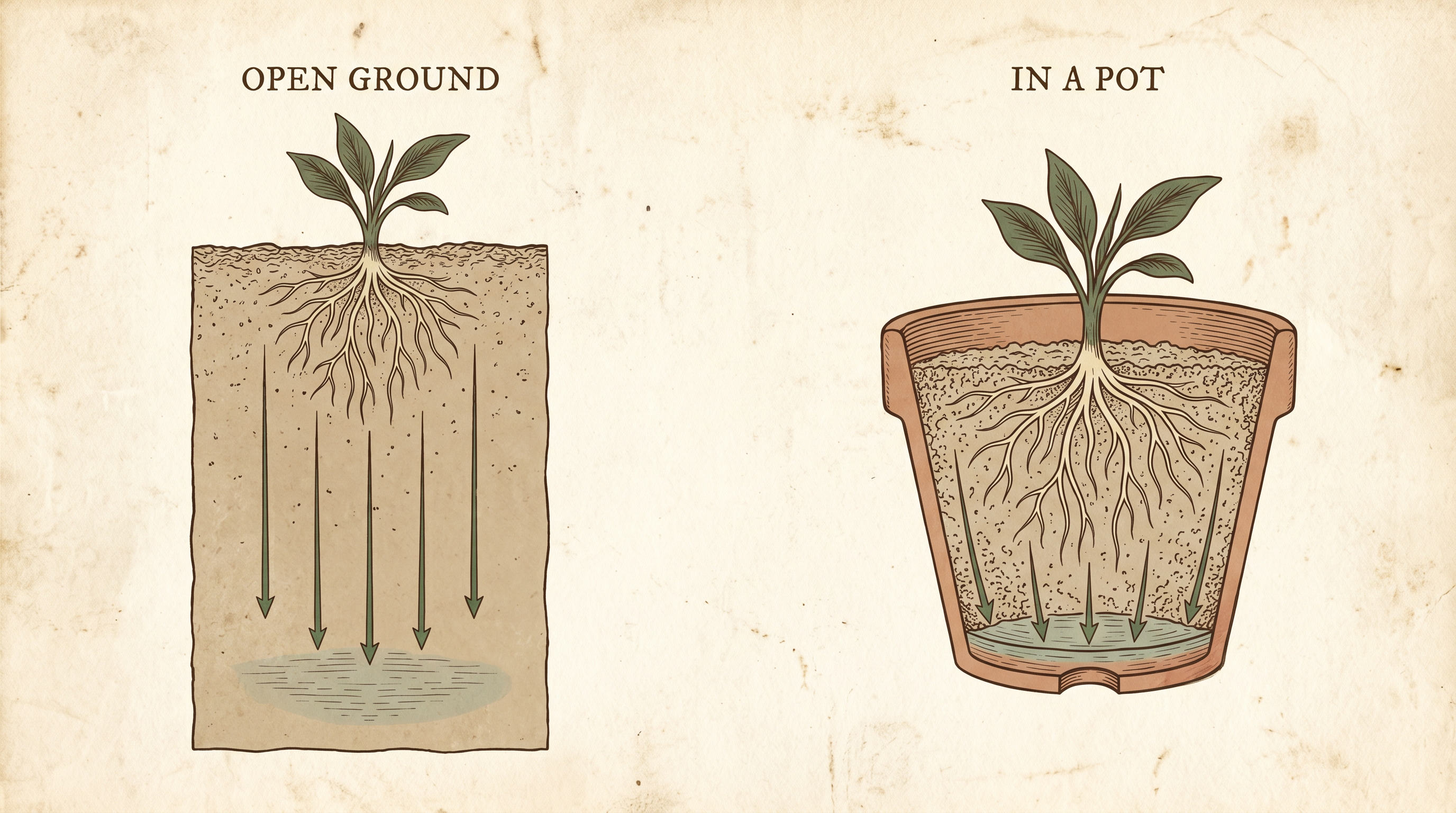
Soil in a container doesn't behave the way it does in the ground, a difference Rowe (2025) describes as widely recognized. When soil scientists measure how much water a field soil holds after it drains, they measure it over a column more than 3 feet (1 m) deep (Argo, 1998). A typical pot is a watertight container with a few holes in the base, filled with a single, uniform mix (Rowe, 2025).
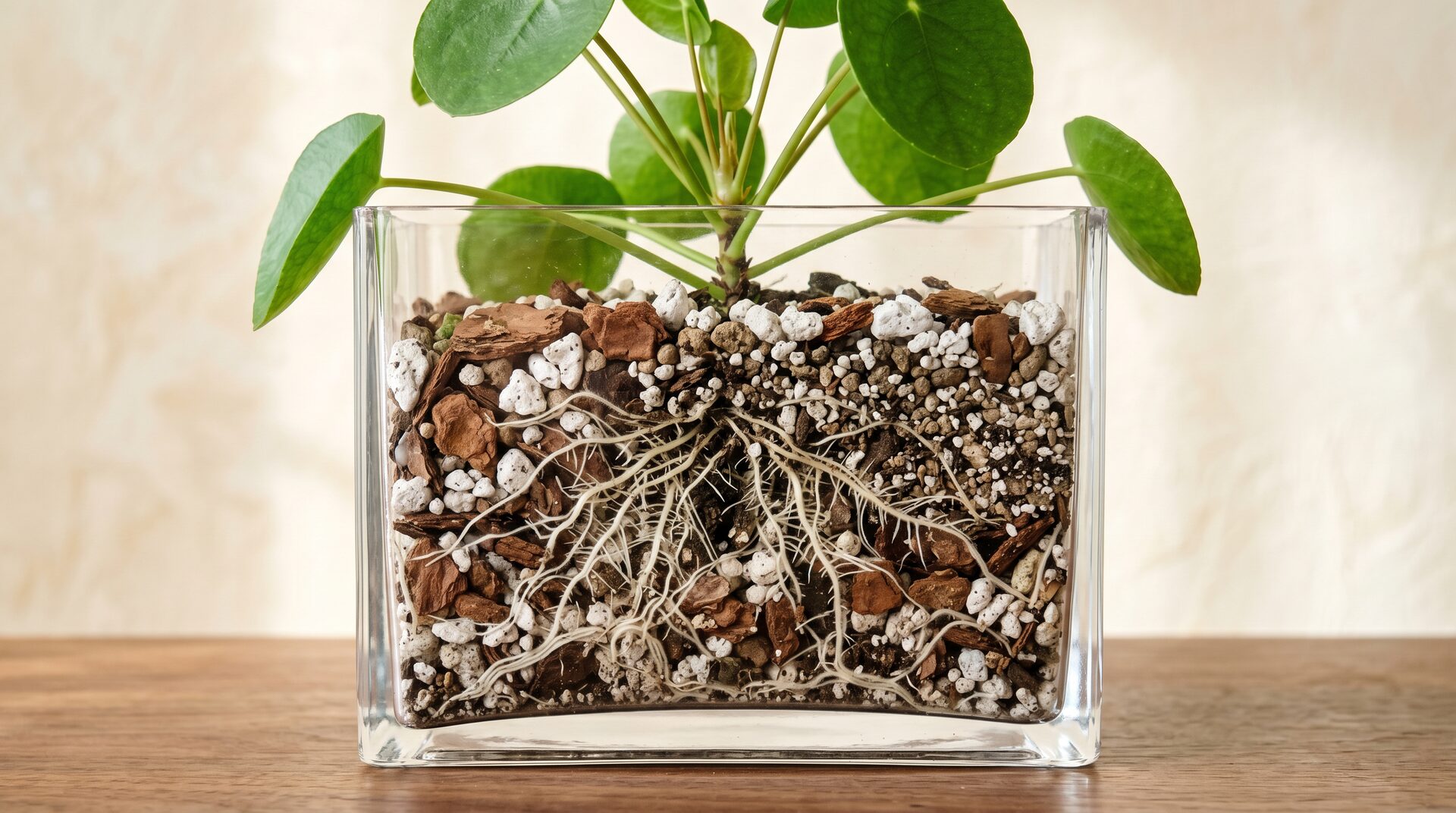
Inside that pot, water drains out of the large pores under gravity, while narrow pores hold water against gravity by capillary action (Nemali, 2018). After watering, a layer of mix at the bottom of a pot filled with one substrate doesn't drain and stays saturated (Fonteno et al., 1995). Argo (1998), drawing on earlier work, calls this the perched water table. Purdue Extension notes that this zone has virtually no air space (Nemali, 2018). Pot height matters here: the shorter the container, the larger the share of it that wet layer takes up (Nemali, 2018).
The trouble with a saturated root zone is air. Excess water cuts the oxygen in the mix, and that damages fine roots (University of Maryland Extension, n.d.-b). The Royal Horticultural Society (RHS, n.d.-g) explains that waterlogging limits the oxygen reaching roots, so their function slows or stops. As roots start to fail, rots and decay organisms move in (Royal Horticultural Society, n.d.-g). Oxygen isn't the only problem: waterlogged soil also builds up harmful substances, including some forms of manganese and iron, and organic acids (Zhang et al., 2025).
That's why the same plant can go well in one mix and badly in another: the substrate, the container and how you water all change how much air and water the root zone holds (Fonteno et al., 1995).
Potting mix doesn't stay the same. When container mix is reused year after year, its organic matter breaks down into smaller particles with less pore space, so it drains and breathes less well (Mays et al., 2022). Iowa State Extension lists old, broken-down, compacted mix as one reason a pot stays wet, and repotting in fresh, well-drained mix as the fix (Steil, 2024b).
What Roots Need From a Mix
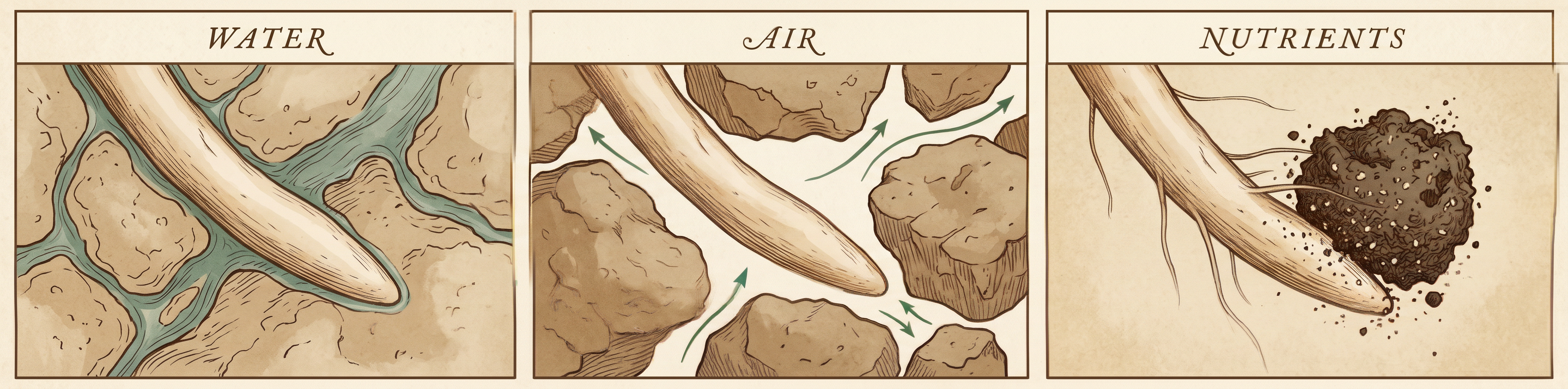
Water. The water roots can take up most easily usually sits in the narrow pores of a mix, held there by capillary forces (Nemali, 2018).
Air. In an ideal potting mix in a 6-inch (15 cm) tall pot, pores wider than about 0.3 mm (0.01 inch) keep only a thin film of water after watering, and those are the pores that supply air to the roots (Argo, 1998). When every pore is full of water, there's no room for air, and roots need air to grow (Nemali, 2018).
Nutrients. Some ingredients hold on to fertilizer between waterings. Peat moss, coir (coconut fiber) and vermiculite have a high cation exchange capacity (CEC): they hold positively charged nutrients such as ammonium, potassium, calcium and magnesium on their surfaces, which keeps those nutrients from washing out (Owen & Lopez, 2015). Perlite and sand have a low CEC, and a mix low in CEC needs more frequent fertilizing (Owen & Lopez, 2015).
A good mix balances air space against water space (Nemali, 2018). Push too far toward water and the roots run short of air; push too far toward air and the mix dries out fast.
What causes rot. Root rot is a disease. In houseplants it's caused by soil-borne fungi, most commonly Pythium, Phytophthora, Rhizoctonia solani and Fusarium, and most of these organisms prefer wet soil (Hudelson & Jull, 2024). Clemson Extension names several of the same groups as causes of root and stem rot in houseplants (Kluepfel et al., 2025). A mix that stays saturated gives them the conditions they do best in.
What's in the Bag
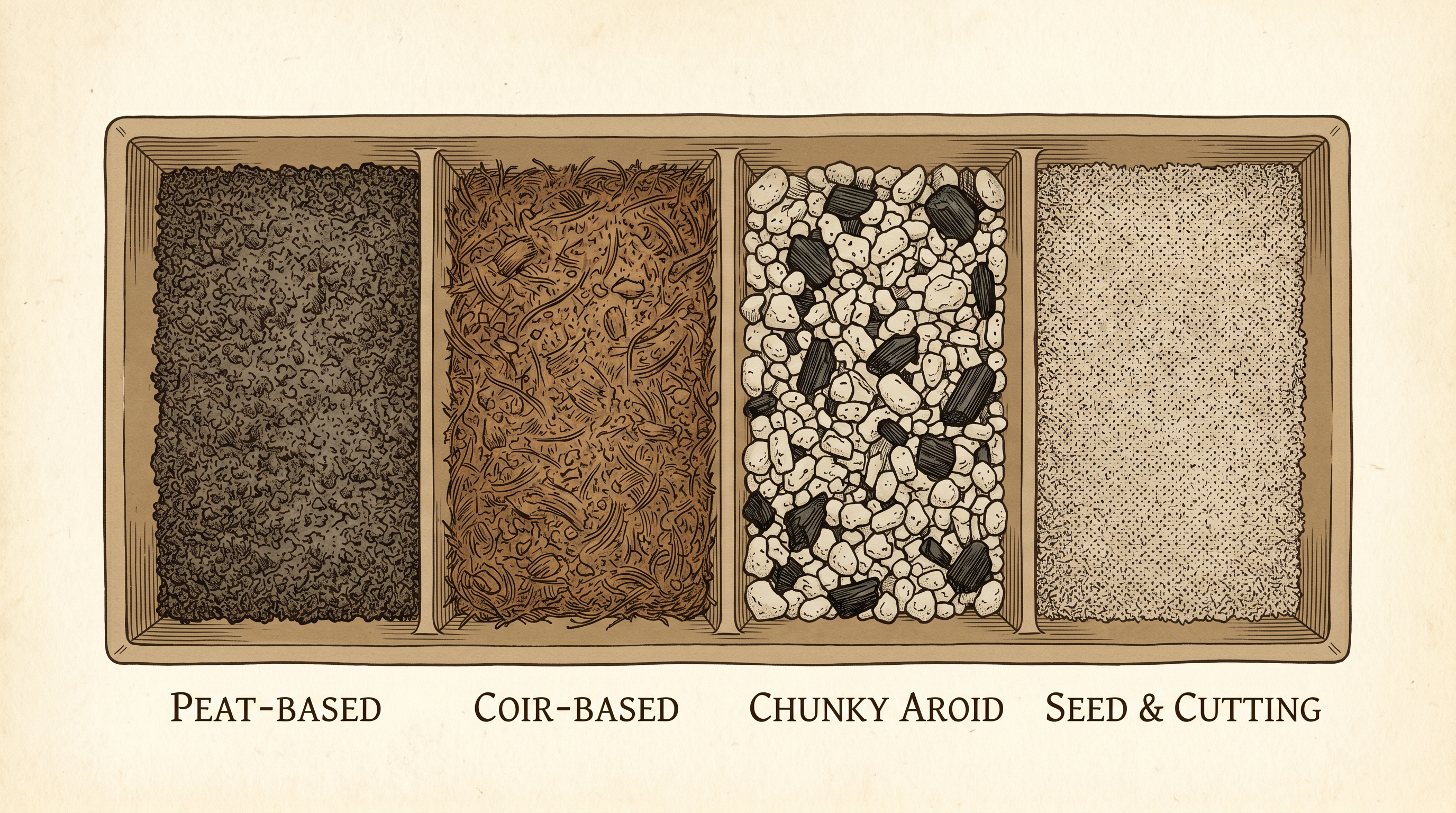
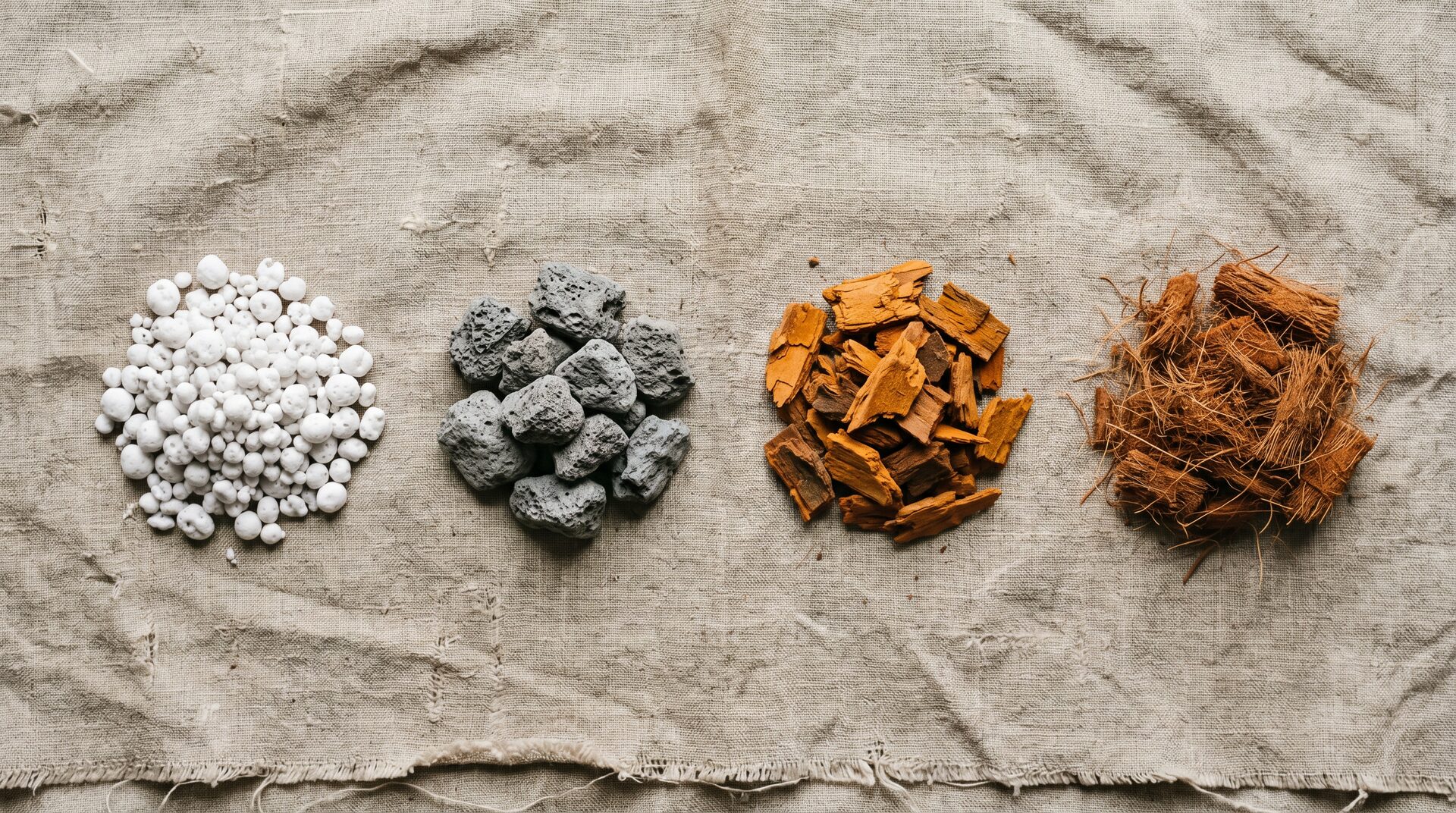
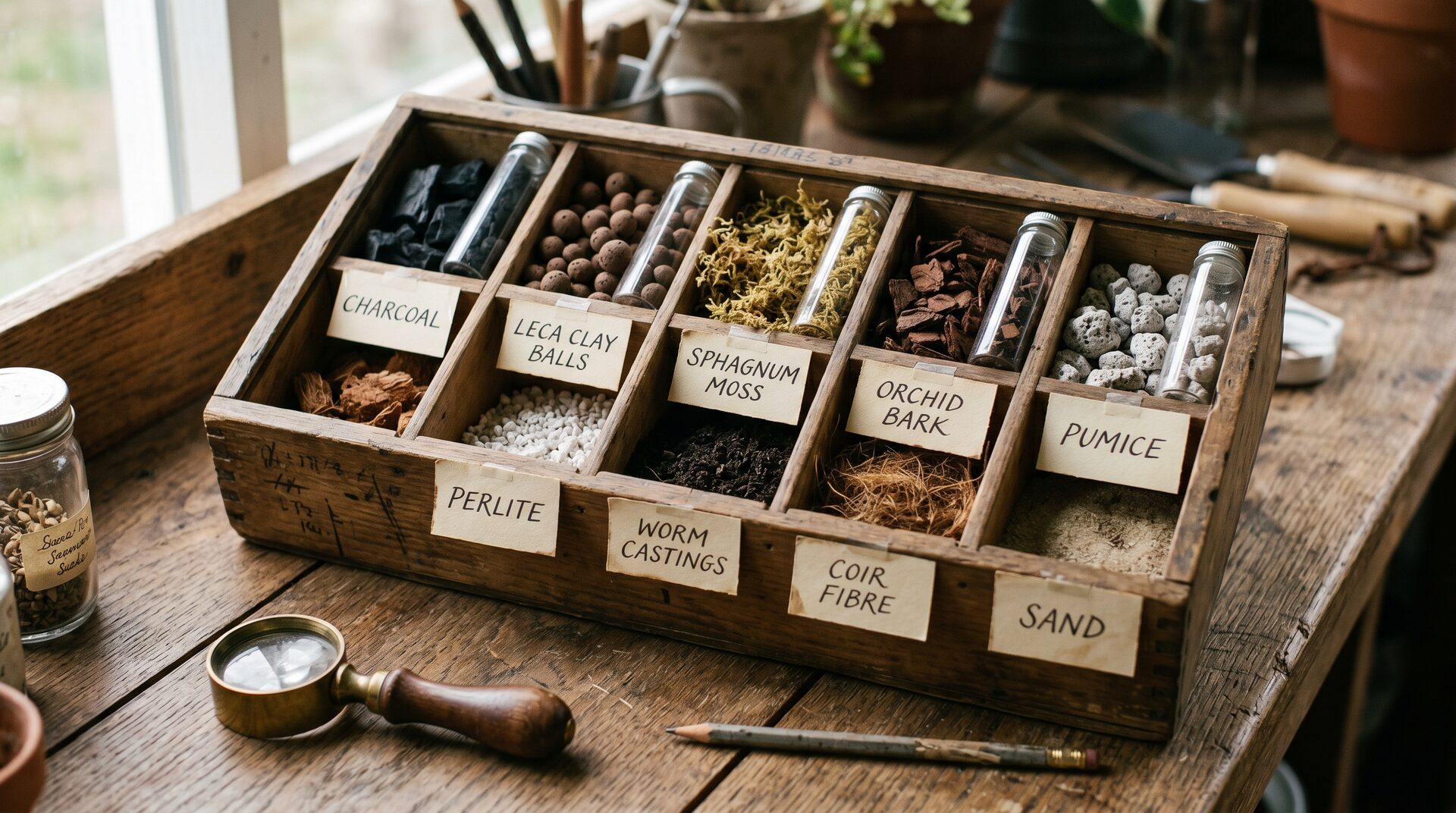
Bagged potting mixes, also called soilless mixes, usually blend some of these: peat moss, coir, pine bark, vermiculite and perlite (Smith & Cox, 2015). Here's what extension guidance says about the common kinds.
| Kind of mix | Typical ingredients | What the sources say |
|---|---|---|
| General potting mix | Peat moss, pine bark, coir, perlite, vermiculite (Smith & Cox, 2015) | University of Missouri Extension calls many commercial peat-lite mixes "ideal for houseplants" (Rothenberger & Hartley, 2010). Dry peat repels water, which is why peat mixes carry a wetting agent (Owen & Lopez, 2015). |
| Cactus and succulent mix | About one-third organic material and two-thirds mineral, such as perlite, coarse sand, pumice or fine gravel (Steil, 2022) | Iowa State Extension calls commercial cactus and succulent mixes a good choice for people new to growing succulents indoors (Steil, 2022). Sand and perlite have a low CEC (Owen & Lopez, 2015). |
| Orchid or bark mix | Pine bark, alone or with sphagnum moss, perlite or charcoal (Owen & Lopez, 2015) | Bark aerates well but dries out faster than peat moss (Smith & Cox, 2015). Orchids need excellent drainage, and UMass Extension says most general potting soils are too wet for them and short on air space (Smith & Cox, 2015). |
| Seed-starting mix | Peat moss with vermiculite or perlite (Lerner, n.d.) | Germination mixes use finer ingredients than general peat or bark mixes (Owen & Lopez, 2015). UMass Extension advises against bark for starting seedlings because it ties up nitrogen (Smith & Cox, 2015). |
Which mix for which houseplant?
Here's what two plant references say about common houseplants. In the RHS guides cited here, "compost" means potting mix, not garden compost.
| Plant | Missouri Botanical Garden, Plant Finder | RHS or extension guidance |
|---|---|---|
| Monstera (Monstera deliciosa) | "A peaty soil-based potting mix" | One part peat-free ericaceous (acidic) compost to two parts orchid compost; roots rot easily in mix that drains poorly (Royal Horticultural Society, n.d.-f) |
| Pothos (Epipremnum aureum) | "A peaty potting mix" | Fine in a peat-free houseplant compost, though a blend of acidic compost, grit and orchid bark is better (Royal Horticultural Society, n.d.-a) |
| Heartleaf philodendron (Philodendron hederaceum) | "A soil based potting mix" | Philodendrons prefer a loose, free-draining compost (Royal Horticultural Society, n.d.-d) |
| Peperomia (Peperomia obtusifolia) | A peaty potting mix | Loose and free-draining, such as two parts peat-free acidic compost to one part each of perlite and orchid bark, or houseplant compost with added perlite; succulent species need cactus compost (Royal Horticultural Society, n.d.-c) |
| Snake plant (Dracaena trifasciata) | "A well-draining potting mix" | A free-draining, peat-free cactus compost, or two parts peat-free loam-based (soil-based) compost to one part grit or fine gravel (Royal Horticultural Society, n.d.-e) |
| ZZ plant (Zamioculcas zamiifolia) | Medium-moisture, well-drained soil | Any well-drained peat- or bark-based potting soil (Henny & Chen, 2016) |
| Wax plant (Hoya carnosa) | "A standard, loamy, well-drained potting mix" | Sharply draining and well aerated, such as equal parts orchid bark, peat-free multipurpose compost and coarse perlite, or cactus compost with added perlite (Royal Horticultural Society, n.d.-b) |
The Plant Finder column is quoted from each plant's entry (Missouri Botanical Garden, n.d.). Read across the rows and the common thread is drainage, not chunkiness. Some of these references do add drainage: the RHS suggests grit for pothos and snake plant, cactus compost for snake plant and the succulent peperomias, and a sharply draining mix for hoya, whose example mix is one-third orchid bark. Clemson Extension reprints two mixes developed at Cornell University for commercial growers, which it says adapt easily to home use. One is equal parts finely ground fir bark, sphagnum peat and perlite, listed as suitable for monstera, philodendron, hoya and peperomia. The other is half peat, listed for snake plant (Shaughnessy & Pertuit, n.d.-a). UConn's Home & Garden Education Center puts it bluntly: "almost any soil can work for almost any plant provided that the watering is controlled" (Lisy, 2025).
The Guild's own recipes lean toward chunkier mixes, with more bark and perlite, for aroids. That's our preference, not something the evidence requires. Our own mixes also leave peat out; the notes under the recipe below say why.
Does a layer of gravel or rocks at the bottom of a pot help a mix drain? Rowe (2025) weighed the water held in test pots of three potting mixes, each over layers of four coarse materials at two depths, 24 combinations in all. The layers usually reduced the water the whole container held, sometimes made no difference, and were very unlikely to increase it. One combination held more: John Innes compost (a loam-based potting mix) over 1.2 inches (30 mm) of expanded clay pebbles (Rowe, 2025). Rowe concludes that drainage layers can be "a potentially useful tool" for reducing how much water a mix holds, and found a 2.4-inch (60 mm) layer of coarse sand the most consistently effective across all three mixes (Rowe, 2025). Rowe's study didn't test living plants.
We still fill our own pots with one mix, top to bottom, because a layer uses depth the roots could grow into. That's our preference; the study doesn't settle it. If a pot stays too wet, a coarser mix is one way to add air (Argo, 1998), and in a taller pot the wet layer takes up a smaller share (Nemali, 2018). Full detail in Myths Demystified No. 02.
Our Starting Mix
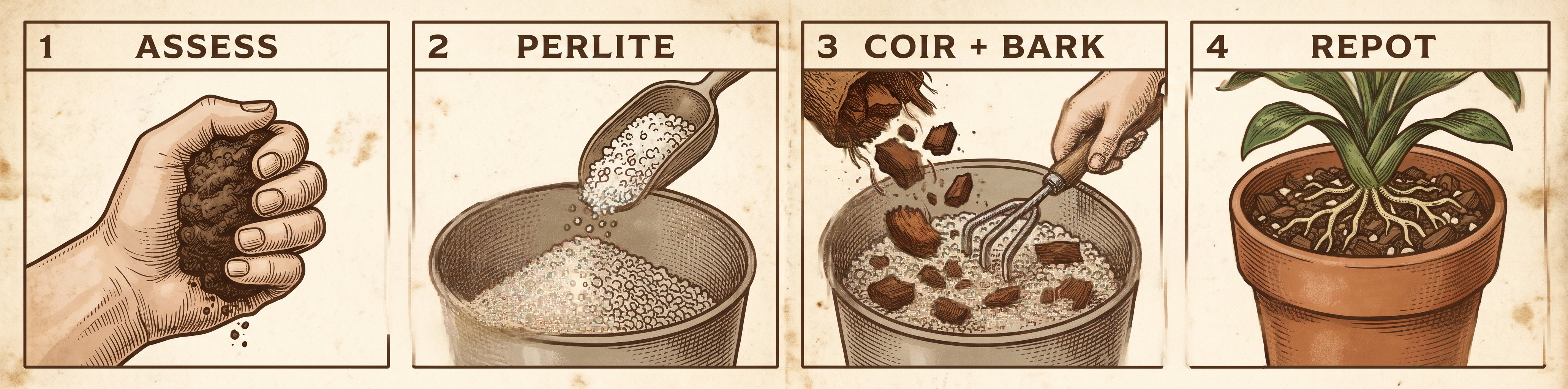
Fresh, well-drained potting soil is Iowa State Extension's fix for mix that has broken down (Steil, 2024b), and you can buy it. If you'd like to make your own, this is the Guild's starting recipe for houseplants. It's our formulation, not a tested standard, and we adjust it plant by plant.
Recipe · Guild formulation
Foundation Houseplant Mix
- 3 parts coarse perlite (the chunky grade, not the fine dust)
- 2 parts coir or peat-free potting mix
- 1 part orchid bark or horticultural charcoal
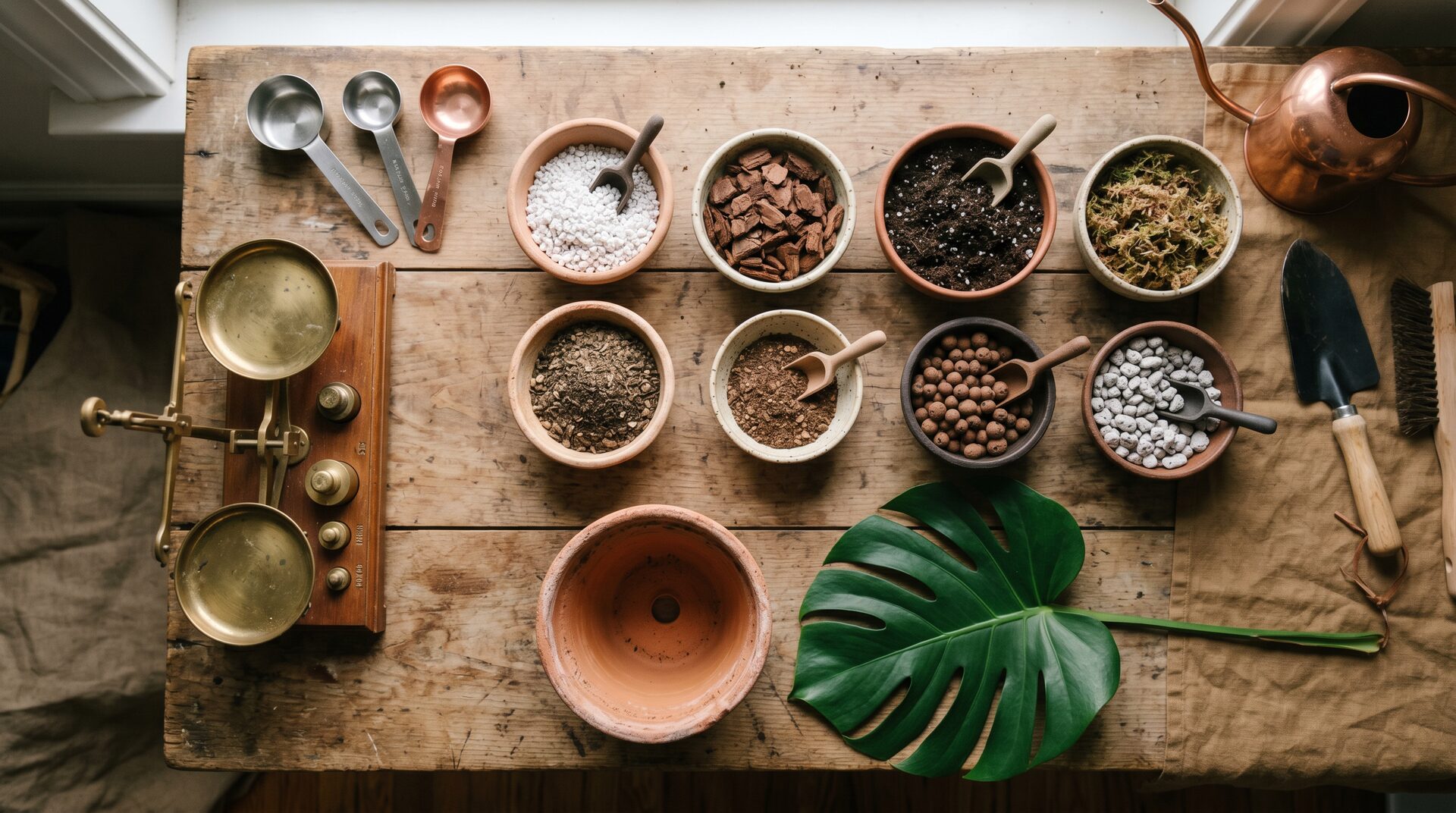
Mix it in a bucket and repot. Water when the mix feels dry about 2 inches (5 cm) down, the finger test University of Maryland Extension uses for most houseplants (University of Maryland Extension, n.d.-c). You don't need a measuring cup: handfuls work.
A few things to know about these ingredients:
- Feeding. Perlite has a negligible cation exchange capacity (Evans, 2014), and mixes low in CEC need more frequent fertilizing (Owen & Lopez, 2015), so feed a perlite-heavy mix regularly. Iowa State University Extension and Outreach (n.d.) says to mix a fertilizer made for houseplants at the label's concentration. University of Missouri Extension says feeding once a month is enough for most houseplants in active growth, with none in winter when there's no new growth (Rothenberger & Hartley, 2010).
- Coir. Coir carries salts, mainly potassium, sodium and chloride, and they wash out easily (Evans, 2014). Rinsing coir through with water before you mix it is a reasonable precaution.
- Peat. We leave peat out of our own mixes. By one estimate, sphagnum peat in northern peatlands builds up only about 0.01 to 0.03 inch (0.3 to 0.7 mm) a year, so replacing 3.3 feet (1 m) of it taken from one spot would take 1,400 to 3,300 years, and harvesting it means draining the peatland and removing its surface plants (Altland & Bugbee, 2026). Drained and damaged peatlands account for almost 5% of the world's human-caused carbon dioxide emissions (International Union for Conservation of Nature, 2021). Altland and Bugbee also argue that Canadian peatlands are accumulating peat faster than it's harvested for horticulture, and from seven life-cycle studies they conclude that several alternatives have as large an environmental impact as peat, or larger (Altland & Bugbee, 2026). So leaving peat out is our preference, not a finding that peat-free mixes are always greener.
- Perlite. Perlite contains some fluoride, and NC State Extension advises leaving it out of mixes for fluoride-sensitive plants such as spider plants and dracaenas (Mays et al., 2022). The same handbook warns against breathing perlite dust and says to "wear a dust mask or wet the perlite down" (Mays et al., 2022).
- Charcoal. We found container research on biochar, a related charcoal product, rather than on horticultural charcoal itself. Biochar can raise a mix's pH. In a review of container studies, one mixed hardwood biochar measured pH 10.8 to 11.8, and the reviewers report positive, neutral and negative effects on growth (Yu et al., 2023).
- Your hands. Wash your hands after handling potting mix. In a New Zealand study, exposure to compost or potting mix was a risk factor for Legionnaires' disease caused by Legionella longbeachae (Kenagy et al., 2017).
- Fit to the plant. A moisture-loving calathea prefers a moist, well-drained mix high in organic matter (North Carolina Extension Gardener Plant Toolbox, n.d.), so it may want less perlite than this recipe has. String of hearts prefers a well-drained, sandy potting soil (North Carolina Extension Gardener Plant Toolbox, n.d.).
Checking the Mix
When a plant is struggling, the mix is one thing to check, alongside light, watering, pests and disease. Houseplant problems often come from several factors at once rather than one (Rodriguez Salamanca & Steil, 2022).
- Push a finger about 2 inches (5 cm) into the mix. If your finger can't get that deep, University of Maryland Extension (n.d.-c) says the plant may need a more porous mix or may be root-bound.
- Still wet long after watering? A heavy, fine-textured or peat-heavy mix holds more water than a loose mix of bark, sand and perlite (Shaughnessy & Pertuit, n.d.-b), and old, broken-down mix holds more water and less air (Steil, 2024a). How fast a pot dries also depends on humidity and temperature (University of Maryland Extension, n.d.-c).
- White crust on the surface? That's salts, which can come from the mix, from fertilizer or from salty irrigation water (Colorado State University Extension, n.d.-b). University of Maryland Extension suggests running at least three times the pot's volume of fresh water through the mix every 4 to 6 months and letting it drain completely (University of Maryland Extension, n.d.-a).
- A sour, rotting smell? The RHS describes blue-black roots as a typical sign of waterlogging, sometimes with a sour, rotting smell (Royal Horticultural Society, n.d.-g), and roots with root rot are soft and brown and may smell bad (Hudelson & Jull, 2024). If enough healthy roots remain, South Dakota State University Extension says to rinse them off, repot into a clean pot that has a drainage hole, using fresh sterile potting soil, and cut back on watering (Lang et al., n.d.).
- Lift the pot. A drying mix gets lighter, so compare its weight now with right after watering (University of Maryland Extension, n.d.-b).
- Roots circling the inside of the pot? That's the plant becoming root-bound after a long time in one container (Colorado State University Extension, n.d.-a), and Penn State Extension says it's time to repot (Concklin & Marquesen, 2026).
When to Repot
- Best timing: while the plant is actively growing, typically spring or early summer (University of Illinois Extension, n.d.). The roots then grow into the new mix (Concklin & Marquesen, 2026).
- Root rot: if rot is the problem and enough healthy roots are left, repot in fresh mix (Lang et al., n.d.). We wouldn't wait for spring to do it.
- No fixed schedule: some plants need repotting every year and others not for many years (University of Illinois Extension, n.d.), and a plant whose roots have outgrown its pot is due (Rothenberger & Hartley, 2010). Advice varies here: UConn's Home & Garden Education Center recommends repotting houseplants every spring, even when they go back into the same size pot (Lisy, 2025).
Going Deeper
Continue · The Substrate Library
The Substrate Library
Three deeper entries that pick up where this one ends:
- How Substrate Actually Works: air-filled porosity, capillary water, the physics
- The Aroid Ingredient Glossary: the ingredients that go into a chunky mix, and why
- Designing a Mix: working backward from what the plant needs to the recipe
The One Thing to Remember
A root needs to reach water, find air and have nutrients on hand, and plenty of mixes manage that, bagged or homemade, peaty or chunky. When a plant is struggling, the mix belongs on the list of things to check.
A good mix drains, holds enough water and leaves room for air. There's more than one way to get there.
We review our guides against the research and extension guidance available at the time, and we correct them when a source doesn't say what we took it to say or when we can't find support for a point. In this review we corrected the guide's central advice: the reference we cited for a chunky mix recommends peaty or soil-based mixes for several common houseplants, and the extension guidance we checked treats the mix as one of several things to look at. We also updated our root-rot and feeding advice and removed claims we couldn't source.
Go deeper in the free Apprenticeship: Module IV, What Substrate Is →
Altland, J., & Bugbee, B. (2026). The limits of sustainability of peat as a soilless media for agriculture. Frontiers in Plant Science, 17, 1856037. https://doi.org/10.3389/fpls.2026.1856037
Argo, W. R. (1998). Root medium physical properties. HortTechnology, 8(4), 481–485. https://doi.org/10.21273/HORTTECH.8.4.481
Colorado State University Extension. (n.d.-a). 1316 - Houseplants: Repotting. PlantTalk Colorado. https://planttalk.colostate.edu/topics/houseplants/1316-houseplants-repotting/
Colorado State University Extension. (n.d.-b). 1338 - Whitish crust on potting mixes. PlantTalk Colorado. https://planttalk.colostate.edu/topics/houseplants/1338-whitish-crust-potting-mixes/
Concklin, M., & Marquesen, S. (2026, February 23). Repotting houseplants. Penn State Extension. https://extension.psu.edu/repotting-houseplants
Evans, M. R. (2014). Unit 07: Substrates [Greenhouse management online course]. University of Arkansas. https://greenhouse.hosted.uark.edu/Unit07/Printer_Friendly.html
Fonteno, W. C., Bailey, D. A., & Nelson, P. V. (1995). Properties of greenhouse substrates. N.C. Flower Growers' Bulletin, 40(4). https://hortscans.ces.ncsu.edu/uploads/p/r/properti_53ed0ad57a574.pdf
Henny, R. J., & Chen, J. (2016). Florida foliage house plant care: ZZ plant (ENH1219). University of Florida IFAS Extension. https://edis.ifas.ufl.edu/ep480
Hudelson, B., & Jull, L. (2024). Root rots on houseplants (UW Plant Disease Facts). University of Wisconsin-Madison Division of Extension. https://hort.extension.wisc.edu/articles/root-rots-houseplants/
International Union for Conservation of Nature. (2021). Peatlands and climate change [Issues brief]. https://iucn.org/resources/issues-brief/peatlands-and-climate-change
Iowa State University Extension and Outreach. (n.d.). How often should I fertilize houseplants? Yard and Garden. https://yardandgarden.extension.iastate.edu/faq/how-often-should-i-fertilize-houseplants
Kenagy, E., Priest, P. C., Cameron, C. M., Smith, D., Scott, P., Cho, V., Mitchell, P., & Murdoch, D. R. (2017). Risk factors for Legionella longbeachae Legionnaires' disease, New Zealand. Emerging Infectious Diseases, 23(7), 1148–1154. https://doi.org/10.3201/eid2307.161429
Kluepfel, M., Blake, J. H., & Williamson, J. (2025). Houseplant diseases & disorders (HGIC 2251). Clemson Cooperative Extension Home & Garden Information Center. https://hgic.clemson.edu/factsheet/houseplant-diseases-disorders/
Lang, K., Paulsen, S., & Schnabel, C. (n.d.). Troubleshooting common problems: Houseplant how-to. South Dakota State University Extension. https://extension.sdstate.edu/troubleshooting-common-problems-houseplant-how
Lerner, R. (n.d.). Starting seed indoors (HO-14-W). Purdue University Extension. https://ag.purdue.edu/department/hla/extension/extension-publications-library/ext-pubs/ho-14-w.html
Lisy, M. (2025, March 24). Potted plant paradise. UConn Home & Garden Education Center. https://homegarden.cahnr.uconn.edu/2025/03/24/potted-plants/
Mays, D., Richter, K., Bradley, L. K., Sherk, J., Kistler, M., & Neal, J. (2022). Plants grown in containers (Chapter 18). In K. A. Moore & L. K. Bradley (Eds.), North Carolina extension gardener handbook (2nd ed.). NC State Extension. https://content.ces.ncsu.edu/extension-gardener-handbook/18-plants-grown-in-containers
Missouri Botanical Garden. (n.d.). Plant Finder [Database; entries for Monstera deliciosa, Epipremnum aureum, Philodendron hederaceum, Peperomia obtusifolia, Dracaena trifasciata, Zamioculcas zamiifolia and Hoya carnosa]. https://plantfinder.mobot.org/
Nemali, K. (2018). Understanding the pores of a soilless substrate (HO-287-W). Purdue University Extension. https://www.extension.purdue.edu/extmedia/HO/HO-287-W.pdf
North Carolina Extension Gardener Plant Toolbox. (n.d.). NC State Extension. https://plants.ces.ncsu.edu/
Owen, W. G., & Lopez, R. G. (2015). Evaluating container substrates and their components (HO-255-W). Purdue University Extension. https://www.extension.purdue.edu/extmedia/HO/HO-255-W.pdf
Rodriguez Salamanca, L. M., & Steil, A. (2022). Diagnosing houseplant problems. Iowa State University Extension and Outreach, Yard and Garden. https://yardandgarden.extension.iastate.edu/how-to/diagnosing-houseplant-problems
Rothenberger, R. R., & Hartley, D. E. (2010). Caring for houseplants (G6510; D. H. Trinklein, Rev.). University of Missouri Extension. https://extension.missouri.edu/media/wysiwyg/Extensiondata/Pub/pdf/agguides/hort/g06510.pdf
Rowe, A. (2025). Effect of drainage layers on water retention of potting media in containers. PLOS ONE, 20(2), e0318716. https://doi.org/10.1371/journal.pone.0318716
Royal Horticultural Society. (n.d.-a). How to grow epipremnum. https://www.rhs.org.uk/plants/epipremnum/growing-guide
Royal Horticultural Society. (n.d.-b). How to grow hoya. https://www.rhs.org.uk/plants/hoya/how-to-grow
Royal Horticultural Society. (n.d.-c). How to grow peperomia. https://www.rhs.org.uk/plants/peperomia/how-to-grow-peperomia
Royal Horticultural Society. (n.d.-d). How to grow philodendron. https://www.rhs.org.uk/plants/philodendron/growing-guide
Royal Horticultural Society. (n.d.-e). How to grow sansevierias. https://www.rhs.org.uk/plants/sansevieria/growing-guide
Royal Horticultural Society. (n.d.-f). How to grow Swiss cheese plants. https://www.rhs.org.uk/plants/swiss-cheese-plants/how-to-grow-swiss-cheese-plants
Royal Horticultural Society. (n.d.-g). Waterlogging and flooding. https://www.rhs.org.uk/soil-composts-mulches/waterlogging-flooding
Shaughnessy, D., & Pertuit, A. (n.d.-a). Indoor plants - soil mixes (HGIC 1456). Clemson Cooperative Extension Home & Garden Information Center. https://hgic.clemson.edu/factsheet/indoor-plants-soil-mixes/
Shaughnessy, D., & Pertuit, A. (n.d.-b). Indoor plants - watering (HGIC 1459). Clemson Cooperative Extension Home & Garden Information Center. https://hgic.clemson.edu/factsheet/indoor-plants-watering/
Smith, T., & Cox, D. (2015). Bagged potting mixes and garden soils for home gardeners [Fact sheet]. UMass Extension Home Lawn & Garden. https://www.umass.edu/agriculture-food-environment/home-lawn-garden/fact-sheets/bagged-potting-mixes-garden-soils-for-home-gardeners
Steil, A. (2022). Growing succulents indoors. Iowa State University Extension and Outreach, Yard and Garden. https://yardandgarden.extension.iastate.edu/how-to/growing-succulents-indoors
Steil, A. (2024a). Diagnosing houseplant problems from improper environmental conditions. Iowa State University Extension and Outreach, Yard and Garden. https://yardandgarden.extension.iastate.edu/how-to/diagnosing-houseplant-problems-improper-environmental-conditions
Steil, A. (2024b). Diagnosing houseplant problems related to poor culture. Iowa State University Extension and Outreach, Yard and Garden. https://yardandgarden.extension.iastate.edu/how-to/diagnosing-houseplant-problems-related-poor-culture
University of Illinois Extension. (n.d.). Repotting. In Houseplants. https://extension.illinois.edu/houseplants/repotting
University of Maryland Extension. (n.d.-a). Mineral and fertilizer salt deposits on indoor plants. Home and Garden Information Center. https://extension.umd.edu/resource/mineral-and-fertilizer-salt-deposits-indoor-plants
University of Maryland Extension. (n.d.-b). Overwatered indoor plants. Home and Garden Information Center. https://extension.umd.edu/resource/overwatered-indoor-plants
University of Maryland Extension. (n.d.-c). Watering indoor plants. Home and Garden Information Center. https://extension.umd.edu/resource/watering-indoor-plants
Yu, P., Qin, K., Niu, G., & Gu, M. (2023). Alleviate environmental concerns with biochar as a container substrate: A review. Frontiers in Plant Science, 14, 1176646. https://doi.org/10.3389/fpls.2023.1176646
Zhang, Y., Chen, X., Geng, S., & Zhang, X. (2025). A review of soil waterlogging impacts, mechanisms, and adaptive strategies. Frontiers in Plant Science, 16, 1545912. https://doi.org/10.3389/fpls.2025.1545912