
A pot doesn't behave like open ground. Water settles at the bottom, air has to find room between the particles, and the mix and the pot together decide how much of each your roots get. This primer walks through the handful of properties that explain why one potting mix stays airy and another stays wet, so any recipe you read makes more sense.
Corrected September 2026: we've revised parts of this guide. See the correction note at the end.
A potted plant lives inside a small container you chose, filled with ingredients you picked, and water moves through that container differently from the way it moves through open ground. Nursery growers rarely measure how much air and water their potting mixes hold (Bilderback & Fields, 2008), yet those two properties go a long way toward explaining why one pot stays wet and another dries quickly.
This entry sits one level deeper than The Root Zone, and our recipes lean on the ideas in it. There's no math beyond a little division.
A Pot Doesn't Drain Like Open Ground
As Rowe (2025) notes, it's widely recognized that "soil in a container behaves differently from soil in the field." In a pot, water that isn't held by the mix drains out the hole at the bottom.
A pot keeps a perched water table at its base: a layer of mix at the bottom that stays soaked after the rest has drained. In the small pores of a mix, capillary forces (the pull that holds water in narrow spaces) hold water against gravity; in the large pores, gravity wins and the water drains out (Nemali, 2017). The pot drains until those forces balance, then stops. After watering, a portion of the substrate (the potting mix) at the bottom of the container doesn't drain, and its pores stay full of water (Bilderback et al., 2013).
Most substrate decisions follow from this. The nursery guide puts it this way: the water in a container "must be balanced with air space to prevent root rot," and the right balance can vary with the plant (Bilderback et al., 2013).
Where Water Lives in a Pot

Once a watered pot has finished draining, it's useful to think of the water and air in the mix as sitting in three places.
Inside the particles. Some ingredients hold water within the particles themselves. Composts and sphagnum peat moss soak it up much like a sponge (Bilderback et al., 2005). Porous minerals take it in too: in a study of pumice used in concrete, larger pieces absorbed more water than smaller ones, as a share of their weight (Lura et al., 2004). How much a given pumice holds depends on its grade and how it was wetted, so we don't put a single number on it.
In the narrow gaps. Water fills the narrow gaps between particles, held there against gravity by capillary forces. This is where most of the water roots use sits. Water in small and medium pores is generally available to roots, while water in the very finest pores is held so tightly that roots have difficulty extracting it (Nemali, 2017). The more coarse particles in a mix, the more air space it has and the less water it holds (Bilderback et al., 2013).
In the larger gaps. Between bigger particles, the gaps are wide enough that gravity pulls the water out (Nemali, 2017). They fill with air. The share of the mix taken up by these air-filled gaps right after draining is called air-filled porosity (or air space), and nursery researchers call it a very important physical property of a container substrate (Bilderback & Fields, 2008).
The balance between those last two is what makes a mix feel wet or airy. Finer isn't automatically better: smaller particles don't necessarily improve a mix's air and water balance, and can make it worse (Fonteno et al., 1995).
The Perched Water Table, and the Drainage-Rocks Question
The saturated layer at the bottom of a pot is taller in a fine mix than in a coarse one, because larger particles make larger pores (Bilderback et al., 2013).
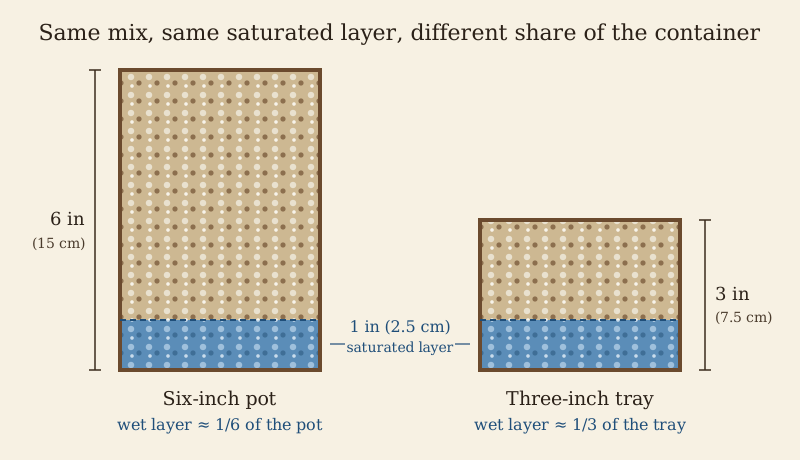
For a given mix, that layer is about the same height in a short pot as in a tall one, so it takes up more of the short pot. In one nursery example, a typical bark-filled one-gallon pot six inches (15 cm) tall might have a perched water table about one inch (2.5 cm) tall, one-sixth of the pot's volume. The same bark in a three-inch (7.5 cm) tray would still have a one-inch layer, which fills a third of it (Bilderback et al., 2013; see Diagram 02).
So do drainage rocks help or hurt? A common warning goes like this: put gravel under the mix, and the saturated zone rises higher in the pot. It echoes field-soil research, which found that water moving down stops at a boundary between soils of different porosity until the soil above is nearly saturated (Hsieh and Gardner, as summarized in Rowe, 2025). A 2025 study by Avery Rowe tested it in pots by weighing the water they held. Drainage layers usually reduced the water a container held, sometimes made no difference, and almost never increased it. One condition, a layer of clay pebbles under a soil-based potting mix (what the paper calls loam-based compost), did hold more water than the mix alone. Rowe concludes the warnings about a raised perched water table "should be considered inaccurate", and calls drainage layers "a potentially useful tool" for reducing how much water a potting mix holds (Rowe, 2025).
In one of the study's photos, an approximately 2.4-inch (60 mm) layer of expanded clay pebbles 2 to 4 mm across (the paper calls it grit), under a coarse mix of coir, perlite and bark, took the saturated zone out of the mix entirely, leaving a low wet layer in the pebbles instead. Coarser soilless mixes lost the most water-holding capacity when a drainage layer went in, and fine soil-based mixes the least. Of the layers tested, about 2.4 inches (60 mm) of coarse sand (grains 1 to 2 mm across) worked most consistently across all the mixes tested, and Rowe gives it as the single best option for growers who want more drainage (Rowe, 2025).
Our own practice is different, and it's a preference rather than a finding. We don't add a drainage layer. We fill the pot with one well-aerated mix down to the drainage hole, and when a pot stays wet, we change what's in it. That gives the full depth of the pot to the roots. Particle size is one lever for a shallower wet zone; by Rowe's results with soilless mixes, a drainage layer is another.
Air-Filled Porosity: How Much Air Is Enough
Air-filled porosity is the share of the substrate's total volume taken up by the large pores that drain after watering (Bilderback et al., 2013). There's no single target that fits every plant and pot. What published guidance offers are ranges, each written for a particular kind of production:
- For container substrates in commercial nursery production, the Southern Nursery Association's best-practice guide recommends air space of 10 to 30% of the substrate volume after irrigation and drainage (Bilderback et al., 2013). An earlier review gives the same range as easiest to manage for most commercial potting substrates (Bilderback et al., 2005).
- For Aglaonema, an aroid, a University of Florida guide to commercial production describes quality growing media as having air space of 10 to 20% and a moisture content of 50 to 75% (Chen et al., 2003).
Treat any figure like these as a rough guide. The same mix reads differently in a different pot. In one comparison, five commercial potting mixes averaged 19% air in a six-inch (15 cm) tall pot and 13% in a four-inch (10 cm) tall pot (Argo, 2004). A mix that's airy in a tall pot can be much wetter in a short one.
Measuring it at home. You can get a working reading with a pot, a watertight liner, a second watertight container and a measuring cup. Line the pot so it holds water, fill it with the mix, and slowly add water until the mix is saturated, keeping track of how much you add. Then puncture the liner at the bottom, let the pot drain for 10 to 15 minutes, and measure the water that drains out (Nemali, 2017). That drained water came from the pores that will now hold air. Divide it by the volume of mix in the pot to get the air space as a share of the substrate (Bilderback & Fields, 2008). Because the result depends on the height of the container you test in, run it in the pot the plant will actually live in.
Air space doesn't stay fixed. In peat substrates tracked over 14 months, air space fell and easily available water (the water roots can take up most readily) rose (Allaire-Leung and colleagues, as summarized in Altland et al., 2011). Perlite, pumice and other mineral aggregates don't decompose, or break down only slowly (Bilderback et al., 2005). That's one reason mineral-heavy mixes hold their structure longer, and it's why the Guild's recipes lean on pumice and perlite. We don't publish air-space figures for our own mixes, because we haven't measured them.
Cation Exchange Capacity, in Plain English
A substrate holds water and air. It can also hold some nutrients. Cation exchange capacity (CEC) is a substrate's ability to absorb and release positively charged nutrient ions (cations), such as potassium, ammonium, calcium and magnesium. That helps keep the mix's pH and nutrient levels from swinging quickly (Argo, 2004).
Different ingredients hold very different amounts, and the numbers shift with the source and the test method. Figures below are per unit of weight, in milliequivalents per 100 grams (meq/100 g), a unit chemists use for amounts of electrical charge. A higher number means the ingredient can hold more of those nutrient ions.
- Perlite: very low. One extension guide describes it as having almost zero capacity (Pennisi & Thomas, 2015).
- Pumice: low, as measured in the study described below.
- Coir: moderate. One extension course gives 39 to 60 meq/100 g, lower than a typical sphagnum peat (Evans, n.d.).
- Horticultural charcoal: it varies. A review of biochar, the charcoal made for soil and growing-media use, notes that its physical and chemical properties vary substantially with the feedstock, the production temperature and the method (Zulfiqar et al., 2022, summarizing Yu and colleagues). So we don't give one figure.
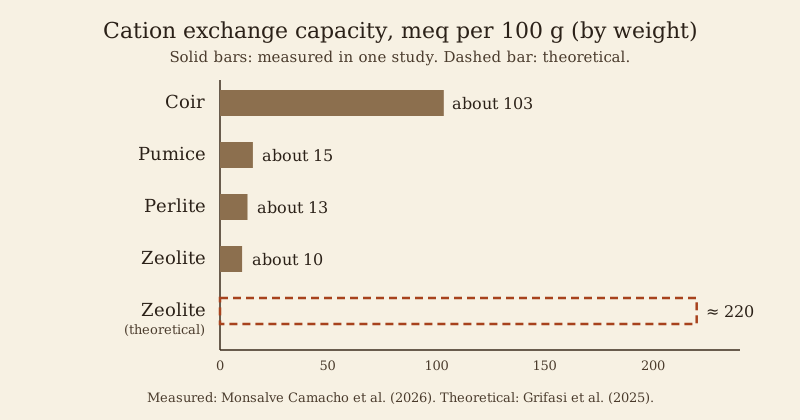
- Zeolite (clinoptilolite): high in theory. In theory it holds roughly 220 meq/100 g, which would be about four to six times coir's by weight (Grifasi et al., 2025; Evans, n.d.). Measuring the capacity of natural zeolite is difficult, because impurities and other minerals in it vary with where it was mined and how it was processed (Grifasi et al., 2025).
One study measured all four the same way, after a 24-day rooting trial, and got a different picture: pure coir came to about 103 meq/100 g, pumice about 15, perlite about 13 and the zeolite it tested about 10. Mixing any of those minerals into coir, at 25% or more, lowered the mix's measured capacity compared with coir alone. At each proportion the zeolite mixes averaged lower than the pumice or perlite mixes, though not every one of those gaps was statistically significant (Monsalve Camacho et al., 2026). That's a single study with one zeolite, but it's a reason not to count on zeolite to raise a mix's capacity by a set amount.
What CEC does, and doesn't do, in a pot. A higher CEC helps a mix hold some potassium and ammonium between feedings and evens out swings in the nutrient supply (Monsalve Camacho et al., 2026). But research has shown that in peat, coir or bark-based container substrates, CEC has little effect on supplying nutrients (Argo, 2004). Most commercial greenhouse growers feed with every watering instead of relying on the substrate to store nutrients, and rockwool, a growing medium with almost no exchange capacity, holds nutrients only in the solution it soaks up (Evans, n.d.). A mix built mostly from pumice and perlite can still work as long as you keep feeding it. It will lean on your fertilizer more than on the mix.
Zeolite is one ingredient growers add for its exchange capacity. It holds positively charged ions such as ammonium and potassium on its own exchange sites, and natural zeolite holds little phosphate (Biliani & Zacharias, 2025). It isn't dry filler, either: zeolite frameworks can hold up to 30% of their weight in water (Grifasi et al., 2025). We use zeolite in some of our recipes as our own choice, for its hold on potassium and ammonium. We don't claim it raises a finished mix's exchange capacity or air space by any set amount.
pH, EC, and Your Tap Water
Two more measurements tell you whether the nutrients in the pot are actually available to your plant.
pH affects how available each nutrient is. The University of Florida's guides to commercial production put Philodendron, Anthurium and Aglaonema at a growing-medium pH of 6.0 to 6.5 (McConnell et al., 2003; Chen et al., 2003, 2015). In soilless mixes, a pH above about 6.2 can lead to iron deficiency in sensitive plants (Bailey et al., n.d.), which shows up as yellowing between the veins, especially on new leaves (Lopez et al., 2010). At the other end, a low pH combined with high iron and manganese can make those metals toxic to some plants (Bailey et al., n.d.). Our own recipes aim for about 5.8 to 6.3; that's our target, not a measurement.
EC (electrical conductivity) measures the dissolved salts in the root zone, which tells you how much fertilizer is available or whether salts are building up (Camberato et al., 2009). The number you get depends on how you test, so match any target to its method. The Anthurium, Aglaonema and Calathea figures come from guides that use the pour-through method, where you pour water through the pot and test what drains out. For Anthurium indoors, a pour-through reading of 0.8 to 1.2 millisiemens per centimeter (mS/cm) should be appropriate (Chen et al., 2015), and for Calathea indoors the guide gives 1.0 to 1.5 (Chen & McConnell, 2006). The Philodendron guide, which doesn't name a test method, says not to fertilize when soluble salts reach 2.0, and that above 3.0, running water through the mix may help reduce leaf and root damage (McConnell et al., 2003).
Tap water brings its own dissolved salts and alkalinity before you add any fertilizer, and water sources differ. Check your supplier's annual water quality report for yours. For substrate pH, the figure to look for is alkalinity (a measure of the water's capacity to neutralize acids), not the water's pH. Purdue's guide compares watering with high-alkalinity water to adding lime to the mix: over time, it pushes the pH up (Lopez et al., 2010).
Some houseplants are sensitive to fluoride, including Calathea, Ctenanthe and Dracaena (Everett & Nelson, 1996). For Calathea, the University of Florida guide links spots along the leaf edges to fluoride and advises avoiding water and fertilizer that contain it (Chen & McConnell, 2006). Treating fluoridated water with reverse osmosis (a type of water filter) can reduce the problem (Pscheidt, 2024).
An inexpensive pH and EC meter lets you run both checks yourself.
Oxygen at the Root Zone
Roots respire: they take in oxygen and give off carbon dioxide. In waterlogged soil, oxygen moves through the water-filled pores much more slowly than through air, so the supply soon falls short of what roots need (Sha et al., 2026). In most soils, the oxygen around the roots can run out within hours through root and microbial respiration (Sha et al., 2026).
Roots short of oxygen are easier to infect. A review of Pythium root rot in hydroponic strawberries describes how, under low oxygen, roots can release more sugars and amino acids, which can feed opportunistic organisms such as Pythium (Scott & Villouta, 2026). Another review, summarizing earlier flooding studies, notes that flooding for as little as 24 hours has left plants more open to infection by root-rot organisms (Martínez-Arias et al., 2022). Root-rot organisms such as Pythium and Phytophthora favor wet, poorly drained mixes and infect plants that are already under stress (Saalau, 2014). Overwatering is a common route to root rot in houseplants (University of Maryland Extension, 2023b). It isn't the only one; high fertilizer rates also favor Pythium root rot (Pundt, 2019).
That's why our recipes lean on coarse mineral ingredients. We want the pot to keep air in its pores after watering. As University of Maryland Extension puts it in a guide to winter problems with houseplants: "The number one reason for dying plants is usually overwatering" (University of Maryland Extension, 2023b).
Check the Substrate Before You Blame the Plant
When a plant starts to struggle and the cause isn't obvious, these are the checks we run on the mix first:
- Is it still wet a couple of inches down? Push a finger about two inches (5 cm) into the mix. If it's still wet well after watering, hold off on watering. If you can't get your finger in two inches, the mix may need to be more porous, or the plant may be root-bound (University of Maryland Extension, 2023a).
- Does it smell sour or rotten? We treat that as a sign the mix is staying too wet. Make sure the pot isn't standing in water, and if the pot drains poorly, repot into a fresh, better-draining mix (University of Maryland Extension, 2023a).
- Is there a crust on the surface? A crust of salts at the soil line is a sign of salt buildup; remove the crust by hand, then leach the pot, flushing water through it to carry salts out (University of Maryland Extension, 2023a). For leaching, guidance for ornamental growers says one container volume of low-salt water run through the pot removes most of the soluble salts, with a second leaching a day later if levels stay high (Johnson & Cabrera, 2014).
- Is the pot still heavy? Lift it. A pot with dry mix weighs much less than one that still holds plenty of water (University of Maryland Extension, 2023a). If it stays heavy for a long time, the mix may be too water-retentive for the plant and pot.
- Have you checked pH and runoff EC? For a pour-through test, water the plant as usual and let the pot drain for 30 to 60 minutes, then pour enough distilled water over the mix to collect a small sample of runoff, and test that (Camberato et al., 2009).
- How old is the mix? Peat substrates have been shown to lose air space as they age (Allaire-Leung and colleagues, as summarized in Altland et al., 2011). If yours has been in the pot a long time and is holding more water than it used to, it may be time to repot.
If the substrate checks out, look next at light, temperature and pests; those are topics for other entries.
What Comes Next
That's the model. Water sits in and between the particles, and after watering a saturated layer sits at the bottom of the pot. Air space after draining is worth knowing, and it depends on the pot as well as the mix. Exchange capacity holds some nutrients, but regular feeding does most of the work. pH affects whether nutrients are available, and EC shows how much fertilizer is there. And roots need oxygen, which a waterlogged mix can't supply for long.
Continue · The Substrate Library
Two entries pick up where this one ends.
Once these properties are familiar, recipes are easier to read:
- The Aroid Ingredient Glossary: Particle by Particle: the ingredients that commonly show up in chunky tropical mixes, one entry each, including the ones we don't use.
- Designing a Mix: The Logic Behind the Ratios: how the Guild combines ingredients into recipes, and how to adjust any published recipe for your own conditions.
We review our guides against the research and extension guidance available at the time, and we correct them when a source doesn't say what we took it to say or when we can't find support for a point. In this review we replaced air-space targets our cited references don't give with published ranges, and corrected our advice on bagged mixes, drainage layers, watering, root rot, pH, salts and nutrient holding. We also replaced two diagrams, fixed points we'd credited to sources that don't make them and removed claims we couldn't source, including testing and observations we have no record of.
Go deeper in the free Apprenticeship: Module IV, What Substrate Is →
Altland, J. E., Owen, J. S., Jr., & Gabriel, M. Z. (2011). Influence of pumice and plant roots on substrate physical properties over time. HortTechnology, 21(5), 554–557. https://doi.org/10.21273/HORTTECH.21.5.554
Argo, B. (2004). Understanding pH management and plant nutrition, Part 4: Substrates. Journal of the International Phalaenopsis Alliance, 13(3). https://staugorchidsociety.org/PDF/IPASubstrates.pdf
Bailey, D. A., Nelson, P. V., & Fonteno, W. C. (n.d.). Substrate pH and water quality. North Carolina State University. https://eit-wagpress-prod.s3.amazonaws.com/media/documents/Substrate-pH-and-Water-Quality.pdf
Bilderback, T. E., Warren, S. L., Owen, J. S., Jr., & Albano, J. P. (2005). Healthy substrates need physicals too! HortTechnology, 15(4), 747–751. https://doi.org/10.21273/HORTTECH.15.4.0747
Bilderback, T., & Fields, A. (2008). Measuring air-filled porosity for container substrates. Combined Proceedings International Plant Propagators’ Society, 58, 129–131. https://ipps.org/wp-content/uploads/2025/03/58_021.pdf
Bilderback, T., Boyer, C., Chappell, M., Fain, G., Fare, D., Gilliam, C., Jackson, B. E., Lea-Cox, J., LeBude, A. V., Niemiera, A., Owen, J., Ruter, J., Tilt, K., Warren, S., White, S., Whitwell, T., Wright, R., & Yeager, T. (2013). Best management practices: Guide for producing nursery crops (3rd ed.). Southern Nursery Association. https://americanhort.org/research/southern-nursery-association-best-management-practices/
Biliani, I., & Zacharias, I. (2025). Natural and modified zeolites as adsorbents for nitrogen and phosphorus control in eutrophic freshwater bodies: A comprehensive review on freshwater applications of the last 10 years. Materials, 18(21), 4870. https://doi.org/10.3390/ma18214870
Camberato, D. M., Lopez, R. G., & Mickelbart, M. V. (2009). pH and electrical conductivity measurements in soilless substrates (HO-237-W). Purdue Extension. https://www.extension.purdue.edu/extmedia/ho/ho-237-w.pdf
Chen, J., & McConnell, D. B. (2006). Cultural guidelines for commercial production of interiorscape Calathea (ENH1030). University of Florida IFAS Extension. https://journals.flvc.org/edis/article/download/116741/114917
Chen, J., McConnell, D. B., Henny, R. J., & Everitt, K. C. (2003). Cultural guidelines for commercial production of interiorscape Aglaonema (ENH957). University of Florida IFAS Extension. https://journals.flvc.org/edis/article/download/109137/104298/152240
Chen, J., McConnell, D. B., Henny, R. J., & Everitt, K. C. (2015). Cultural guidelines for commercial production of interiorscape Anthurium (ENH956; original work published 2003). University of Florida IFAS Extension. https://edis.ifas.ufl.edu/publication/EP159
Evans, M. R. (n.d.). Substrates, Section 5: Common substrate components [Greenhouse management online course]. University of Arkansas. https://greenhouse.hosted.uark.edu/Unit07/Section05.html
Everett, T. L., & Nelson, P. V. (1996). Does perlite play a role in fluoride toxicity of floricultural crops? N.C. Flower Growers’ Bulletin, 41(4). https://hortscans.ces.ncsu.edu/uploads/d/o/does_pea_53ff9244b7e3a.pdf
Fonteno, W. C., Bailey, D. A., & Nelson, P. V. (1995). Properties of greenhouse substrates. N.C. Flower Growers’ Bulletin, 40(4). North Carolina State University.
Grifasi, N., Ziantoni, B., Fino, D., & Piumetti, M. (2025). Fundamental properties and sustainable applications of the natural zeolite clinoptilolite. Environmental Science and Pollution Research, 32(48), 27805–27840. https://doi.org/10.1007/s11356-024-33656-5
Johnson, J., & Cabrera, R. (2014). Monitoring and managing soluble salts in ornamental plant production (Fact Sheet FS848). Rutgers NJAES Cooperative Extension. https://njaes.rutgers.edu/fs848/
Lopez, R. G., Mickelbart, M. V., & Pasian, C. (2010). Alkalinity management in soilless substrates (HO-242-W). Purdue Extension. https://www.extension.purdue.edu/extmedia/HO/HO-242-W.pdf
Lura, P., Bentz, D. P., Lange, D. A., Kovler, K., & Bentur, A. (2004). Pumice aggregates for internal water curing. In Concrete science and engineering: A tribute to Arnon Bentur (pp. 137–151). RILEM.
Martínez-Arias, C., Witzell, J., Solla, A., Martin, J. A., & Rodríguez-Calcerrada, J. (2022). Beneficial and pathogenic plant-microbe interactions during flooding stress. Plant, Cell & Environment, 45(10), 2875–2897. https://doi.org/10.1111/pce.14403
McConnell, D. B., Chen, J., Henny, R. J., & Everitt, K. C. (2003). Cultural guidelines for commercial production of interiorscape Philodendron (ENH893). University of Florida IFAS Extension. https://edis.ifas.ufl.edu/publication/EP150
Monsalve Camacho, O. I., Luque Sanabria, N. Y., & Sánchez Rodríguez, L. Á. (2026). Nutrient chemistry in coconut-mineral mixed substrates for soilless culture. Advances in Horticultural Science, 40(2), 165–180. https://doi.org/10.36253/ahsc-18670
Nemali, K. (2017, August 24). Looking through the pores of a soilless substrate. Purdue University Controlled Environment Agriculture. https://www.purdue.edu/hla/sites/cea/article/looking-through-the-pores-of-a-soilless-substrate/
Pennisi, B. V., & Thomas, P. A. (2015). Essential pH management in greenhouse crops: pH and plant nutrition (Bulletin 1256). University of Georgia Cooperative Extension. https://fieldreport.caes.uga.edu/wp-content/uploads/2025/08/B-1256_8.pdf
Pscheidt, J. W. (2024). Fluorine toxicity in plants. In Pacific Northwest plant disease management handbook. Oregon State University. https://pnwhandbooks.org/plantdisease/pathogen-articles/nonpathogenic-phenomena/fluorine-toxicity-plants
Pundt, L. (2019). Root rot diseases of greenhouse crops. UConn Extension Integrated Pest Management Program. https://ipm.cahnr.uconn.edu/wp-content/uploads/sites/3216/2022/12/2019rootrotsgreenhousecropsfinal2-1.pdf
Rowe, A. (2025). Effect of drainage layers on water retention of potting media in containers. PLOS ONE, 20(2), e0318716. https://doi.org/10.1371/journal.pone.0318716
Saalau, E. (2014, February 14). Root rots of houseplants. Iowa State University Extension and Outreach. https://yardandgarden.extension.iastate.edu/article/2014/02-14/rootrot.html
Scott, S., & Villouta, C. (2026). Dissolved oxygen limitation and Pythium root rot in strawberry NFT systems: Mechanisms, research gaps, and prospects for substrate-free production. Frontiers in Plant Science, 17, Article 1829367. https://doi.org/10.3389/fpls.2026.1829367
Sha, S., Zeng, C., Shang, X., Zou, B., Sun, T., & Yang, Y. (2026). Root morphogenetic responses to waterlogging stress in plants: From structural reconfiguration to molecular regulatory mechanisms. Frontiers in Plant Science, 17, Article 1823032. https://doi.org/10.3389/fpls.2026.1823032
University of Maryland Extension. (2023a, March 10). Watering indoor plants. https://extension.umd.edu/resource/watering-indoor-plants
University of Maryland Extension. (2023b, December 12). Winter indoor plant problems. https://extension.umd.edu/resource/winter-indoor-plant-problems
Zulfiqar, F., Moosa, A., Nazir, M. M., Ferrante, A., Ashraf, M., Nafees, M., Chen, J., Darras, A., & Siddique, K. H. M. (2022). Biochar: An emerging recipe for designing sustainable horticulture under climate change scenarios. Frontiers in Plant Science, 13, Article 1018646. https://doi.org/10.3389/fpls.2022.1018646


