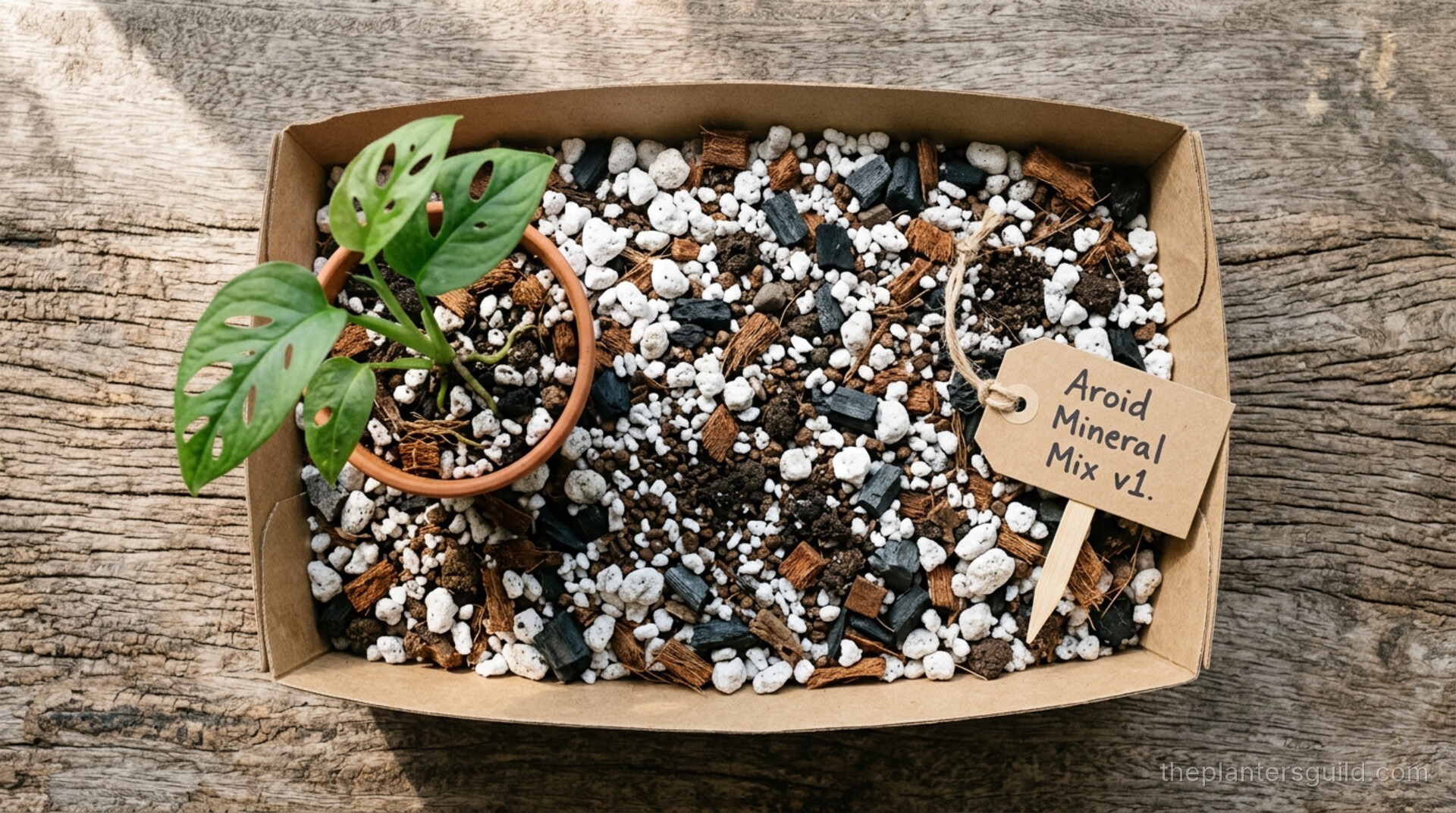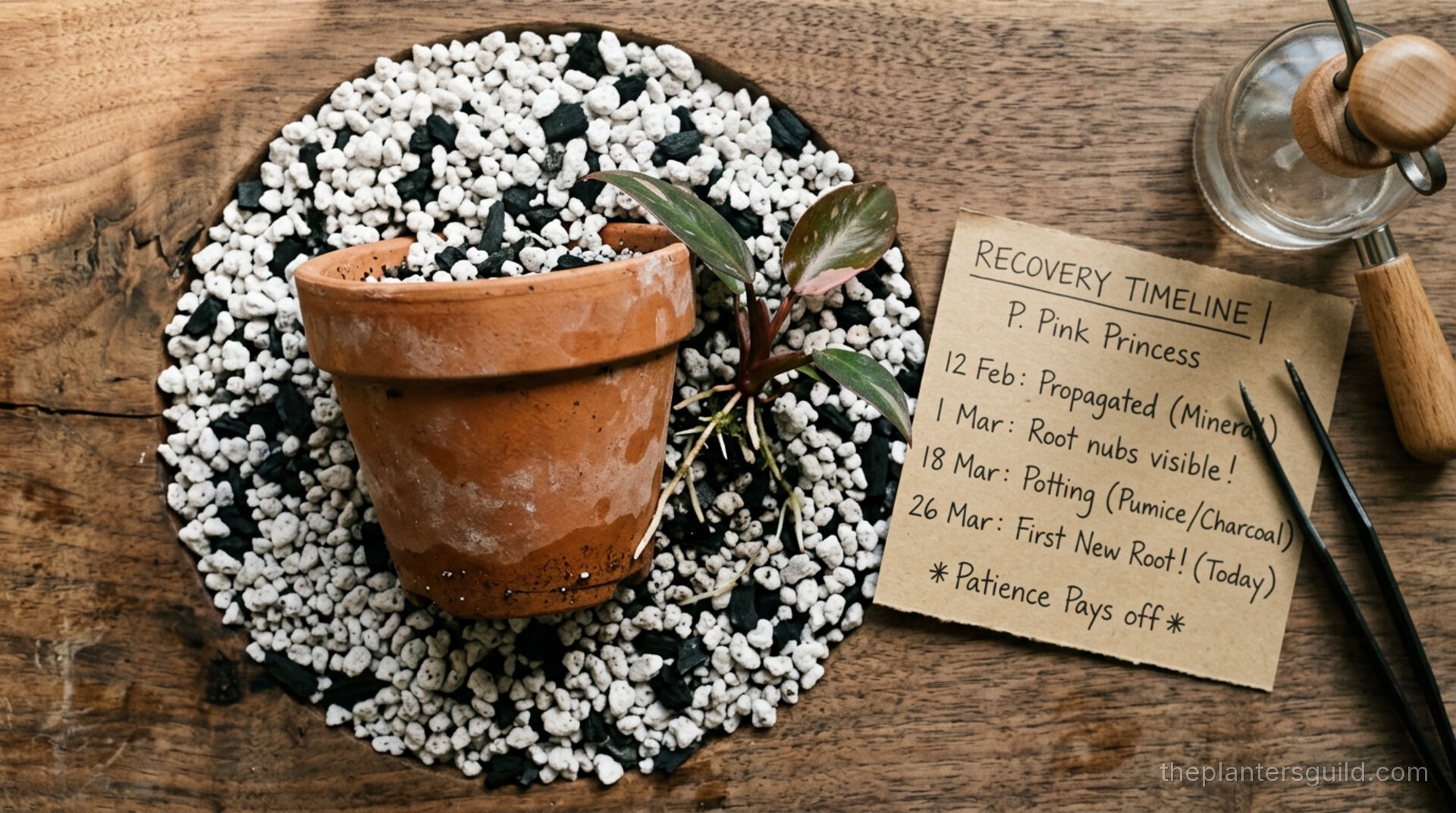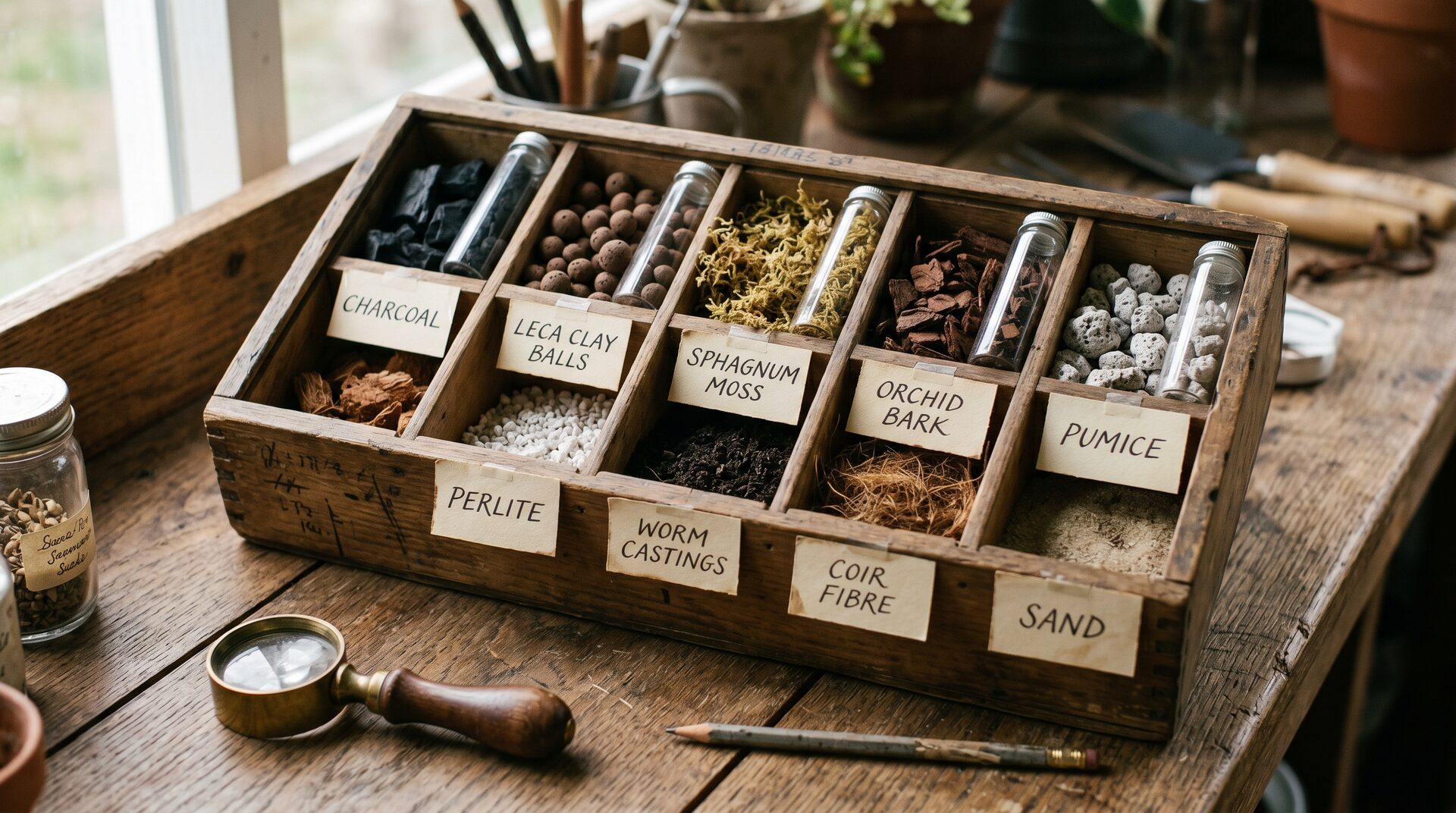
If you've spent any time in the Substrate Library, you already know we use ICU Mix for plants in recovery and Aroid Mineral Mix for climbing epiphytes. This is the third mix in the system: the one a plant moves to once it's healthy, growing and not climbing a moss pole. It's the mix we reach for by default. That's what "workhorse" means.
Corrected September 2026: we've revised parts of this guide. See the correction note at the end.
It's also the mix most likely to draw opinions from other collectors. Sixty-five percent mineral puts it between two camps: growers who prefer a grittier mix will find it too organic, and growers who use bagged mix will find it too mineral. Other mixes work too. University of Florida IFAS Extension (UF/IFAS) guidelines for commercial Syngonium production, for example, list mixes of peat, pine bark, vermiculite and perlite (Chen et al., 2004). This is the one we've settled on, and the rest of this guide explains why, ingredient by ingredient.
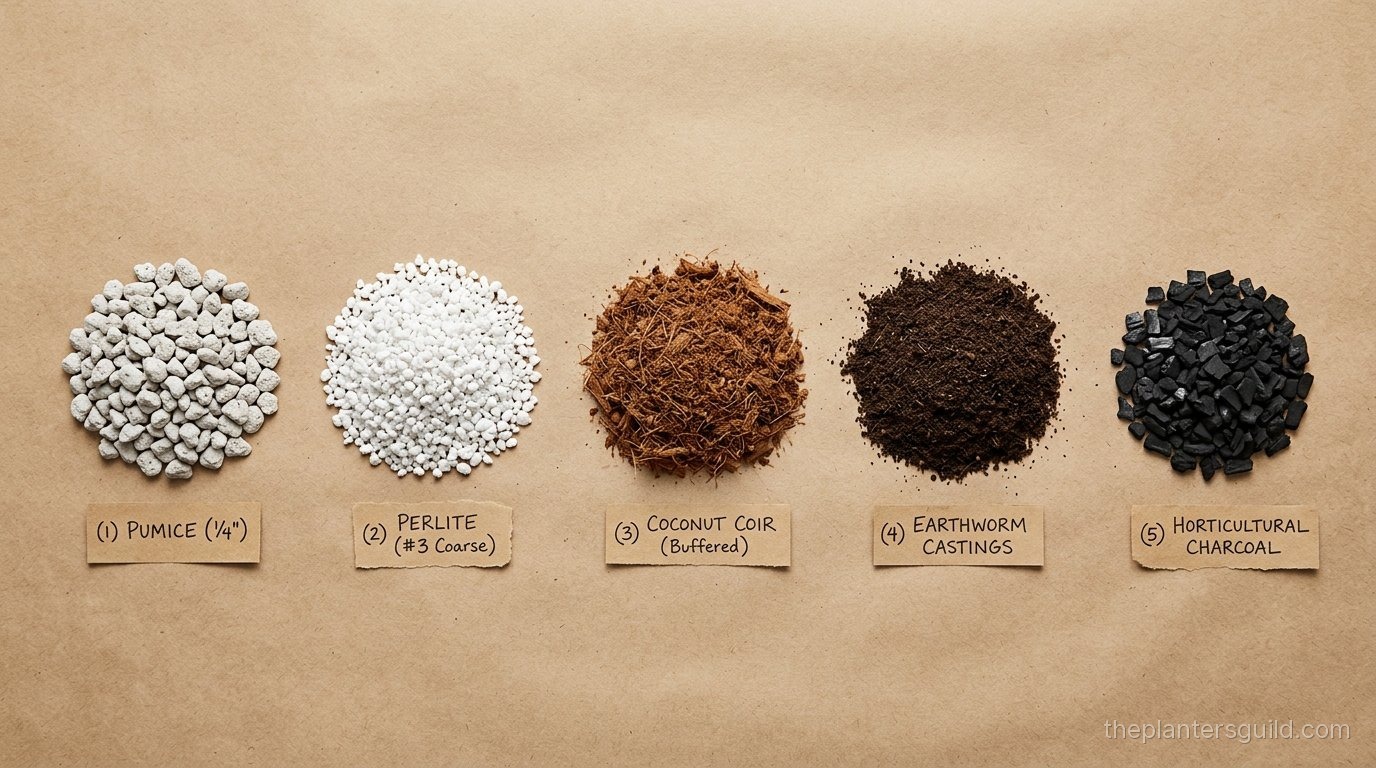
The recipe
All percentages by volume. For a 10-cup batch:
| Ingredient | Percentage | Cups | Grade / Particle Size |
|---|---|---|---|
| Pumice | 35% | 3.5 | 1/4 inch |
| Perlite (coarse) | 25% | 2.5 | #3 grade |
| Buffered coir | 20% | 2.0 | Medium pith |
| Earthworm castings | 15% | 1.5 | Sifted, screen out clumps |
| Horticultural charcoal | 5% | 0.5 | 1/8 to 1/4 inch |
We count charcoal with the mineral fraction, as on our other recipe pages, which makes this mix 65% mineral (pumice, perlite and charcoal) and 35% organic (coir and castings).
Target pH: 6.0 to 6.5, the range UF/IFAS gives for commercial Philodendron potting mixes (McConnell et al., 2003).
Target runoff EC: 1.0 to 1.5 mS/cm, measured on the water that drains out. EC, electrical conductivity, is a measure of dissolved salts (see Feeding below).
Watering: When the top inch is dry (see Watering below).
Refresh: Every 12 to 18 months.
Why 65/35, and not 70/30 or 50/50
If Aroid Mineral Mix is 80% mineral and ICU Mix is 70%, why drop to 65% here?
This mix is for plants that are growing steadily, so we give it more coir and castings than the recovery and epiphyte mixes, to hold a little more water and nutrients between waterings. The balance point is ours. It's a house formulation, not a figure we read off a paper.
The published research bears on that choice without settling it. One nursery study mixed Douglas fir bark with up to 30% pumice. Over time, air space (the share of the pot's volume filled with air after draining) fell and the water the mix held after draining rose, with or without plants. Roots growing into the mix made the change larger, and the mixes themselves shrank very little (Altland et al., 2011). Mineral aggregates such as pumice and perlite don't decompose, or break down only slowly, and blending them into organic mixes can reduce how much a mix's physical properties change over time (Bilderback et al., 2005). Neither paper tested a mix like this one. Both deal with bark- and peat-based substrates in commercial nursery and greenhouse production, not a mostly mineral mix of coir and castings in a houseplant pot.
If you want the underlying physics of air space, How Substrate Actually Works goes deeper. Bilderback et al. (2005), citing an earlier nursery guide, suggest 10 to 30% air space for commercial potting mixes. The measurements in their review were taken in cylinders 3 inches (7.6 cm) tall. Air space rises with container height (Owen & Lopez, 2015), so a figure quoted without the height it was measured at doesn't compare cleanly with anything. We haven't measured where our own mixes sit.
We land at 65/35 working backward from how often we want to water a healthy plant in a 4-inch pot. It isn't the only workable balance.
Why each ingredient is where it is
Pumice (35%): the structural backbone
Quarter-inch pumice is the largest single ingredient. Pumice is a porous volcanic glass that takes water into its pores (Hoffer, 1994), so each grain holds a little water inside as well as between grains, and it doesn't decompose, or breaks down only slowly (Bilderback et al., 2005). We use the quarter-inch grade here and save the coarser half-inch grade for Aroid Mineral Mix.
We don't substitute lava rock for pumice in this recipe. Pumice is what we built it around.
Coarse perlite (25%): keeping the mix open
Perlite is here to keep the mix loose and open. We use #3 (coarse) grade. Perlite tends to rise to the surface of a mix (Owen & Lopez, 2015), and it's dusty, so we dampen it before scooping.
Perlite dust deserves some care, not alarm. Perlite is a volcanic glass that expands when it's heated (U.S. Geological Survey, 2025). The National Institute for Occupational Safety and Health (NIOSH) lists its dust as an irritant to the eyes, skin, throat and upper airways and recommends an exposure limit of 10 milligrams per cubic meter of total dust, averaged over a work shift (National Institute for Occupational Safety and Health, 2019). The best-documented serious case is an industrial spill in which workers were exposed to an estimated 20 to 400 times that limit, and three of the 24 exposed developed a lasting airway disorder (Du et al., 2010). The same paper notes an earlier report of an orchid grower with lung irritation after perlite exposure, which is one reason we keep the dust down when we mix at home.
Coarse perlite at 25% sounds like a lot, and it is. Mixes lose air space over time, more so as roots grow into them (Altland et al., 2011), and aggregates like perlite help keep large pores open as a mix ages (Bilderback et al., 2005).
Buffered coir (20%): the water buffer
Coir, the pith from coconut husks, holds a lot of water for its volume and still drains well (Owen & Lopez, 2015). Twenty percent is our figure. Much more, and the mix stays wet longer between waterings than we want.
We only use buffered coir. In a lab study of coir dusts, available calcium and magnesium were low while potassium was remarkably high (Abad et al., 2002), and coir that wasn't soaked and rinsed during processing can carry excess potassium, sodium and chloride (Owen & Lopez, 2015). The Ingredient Glossary covers what to look for in a bag. We also test each new bag: we mix 1 part coir with 1.5 parts water by volume and read the EC of the water, adapting a 1:1.5 extract method developed for peat-based mixes (as described in Sonneveld, 2000). We want the EC under 0.5 mS/cm. That threshold is our own rule of thumb, not a published standard.
Earthworm castings (15%): nutrients and microbes
This percentage surprises readers who've read the ICU Mix page, which uses 10%. ICU Mix is for plants in recovery. This mix is for plants that are growing steadily, so we give it more castings. Fifteen percent is our figure, not the literature's.
One seedling trial supports adding castings (vermicompost) to container mixes, though it doesn't test our 15%. In one trial, replacing part of coir- and peat-based seedling mixes with vermicompost improved the growth of tomato, pepper, lettuce and marigold seedlings, and the gains tended to be larger in the peat-based mixes (Atiyeh et al., 2000).
Castings also carry live microbes. In one study, three Bacillus strains isolated from fresh vermicompost held back Rhizoctonia solani, a fungus that causes damping-off, a disease of seeds and young seedlings, in lab tests. In a greenhouse test in pots of peat-based mix, the strains, applied as pure cultures, raised tomato seedling emergence in pots inoculated with the fungus from 13% to between about 48% and 55%, against more than 92% in pots without the fungus (Saeed et al., 2026). That shows what vermicompost can harbor. It doesn't show that castings in a potting mix do the same job.
Horticultural charcoal (5%): a small addition, by preference
Charcoal is the smallest ingredient, and it's here because we prefer it. Biochar, the form of charcoal studied in container research, is made by heating biomass with little or no oxygen (Yu et al., 2023).
Container research on it gives uneven results. Its properties vary widely with what it was made from, the temperature it was made at and how it was treated afterward, and some types are strongly alkaline: one mixed-hardwood biochar in that review measured pH 10.8 to 11.8 (Yu et al., 2023). That's why we keep it to 5% and buy from one consistent source. Studies in that review found that biochar replacing part of the peat in nursery and greenhouse mixes can reduce nutrient runoff (Yu et al., 2023). That's a different use from a 5% addition to a mineral mix. We haven't found evidence that 5% horticultural charcoal does the same, or that it keeps a mix fresh.
Why no zeolite
You'll notice this if you've read the ICU Mix and Aroid Mineral Mix pages: both use zeolite, and this mix doesn't. Zeolite's mineral framework carries a negative charge, balanced by positively charged ions (cations) such as potassium, calcium and magnesium that can swap in and out. That gives it cation exchange capacity, the ability to hold positively charged nutrients (Alotaibi, 2025). In water-treatment studies, natural zeolites showed little, if any, attraction for negatively charged ions such as phosphate (Biliani & Zacharias, 2025). So it can hold some nutrients between feedings, but it's no substitute for feeding. This mix gets fed on a steady schedule, so we leave zeolite out.
If you feed heavily and want more nutrient-holding in the mix, you can add 5% zeolite at 1 to 3 mm in place of 5% of the perlite. We don't, but it's a reasonable change.
What this mix is for
These are the plants we grow on Standard Mineral Mix, and the ones we move to a different mix:
- Philodendron: 'Birkin', 'McColley's Finale', 'White Knight', 'Pink Princess', 'Painted Lady' and most of our other hybrids and cultivars. We grow P. melanochrysum and P. gigas in Aroid Mineral Mix; in the wild, P. gigas climbs trees with its anchoring roots pressed flat against the bark (Croat, 1997). P. gloriosum is often grouped with the climbers, but it's a terrestrial plant with a short stem that creeps along the ground (Croat, 1997).
- Syngonium: an easy fit.
- Alocasia: we don't grow ours on this mix, including the ones we start from tissue culture. When we repot them now, they go into Alocasia Bark-Free Mix, which has more coir than this one because the one Alocasia study we found favored steady moisture.
- Hoya: H. carnosa, H. macrophylla, H. obovata and H. wayetii. Most Hoya grow as epiphytes (Rodda & Niissalo, 2021), H. carnosa included (Flora of China Editorial Committee, n.d.), so growing them here is our choice rather than a match for their habitat. We grow H. linearis, H. lacunosa and H. carnosa 'Compacta' (a cultivar of the same species) in Aroid Mineral Mix.
- Anthurium: A. clarinervium, a terrestrial species that roots deep among rocks in the wild (Croat, 1983), and A. magnificum, with the optional zeolite swap if you feed heavily. We grow A. warocqueanum and A. veitchii in Aroid Mineral Mix.
- Others we grow on it: Aglaonema, Spathiphyllum, some Begonia and most leafy tropicals that aren't doing anything specialized.
If you're not sure which mix a plant wants, The Petruscio Substrate System lays out what each of our mixes is for.
What this mix is not for
A few kinds of plant where this is the wrong mix:
- A plant in active recovery. Use ICU Mix until the plant is pushing new growth and has new roots.
- A climbing aroid on a pole or slab. We grow those in Aroid Mineral Mix, which uses chunkier charcoal, 1/4 to 1/2 inch.
- A tissue culture plantlet fresh from the lab. Those start on the mix in our tissue culture acclimation guide and move to a standard mix once they're growing on their own.
- Marantaceae (Goeppertia, Calathea, Stromanthe, Ctenanthe). We're developing a separate mix for these.
- Succulents, caudiciforms and cacti. This mix isn't built for them.
- A water-only grower. This mix is designed to be fed, and we don't rely on the castings alone. If you'd rather not use liquid fertilizer, a more organic mix may suit you better.
How to use it
Moisten before potting
Dry mix is loose and dusty. Add water until it's evenly damp but not wet: it should clump loosely in your hand and break apart when tapped. Extension repotting guidance also says to moisten potting mix before repotting (Strickland, 2022).
Pot size and material
Go up at most one pot size. Extension guidance for houseplants is no more than 2 inches wider than the current pot (Strickland, 2022). A pot that's too large can leave the roots sitting in mix that stays too wet (Criscione & Holliday-Goulart, n.d.). Terracotta is our default for this mix in 4- to 6-inch pots. Unglazed terracotta loses moisture through its walls and tends to dry the root zone faster, while plastic and glazed pots are nonporous and lose water only through their drainage holes and the top of the mix (Criscione & Holliday-Goulart, n.d.). Both work; just expect plastic and glazed pots to stay wet longer.
Watering
Water when the top inch of the mix is dry. In a 4-inch terracotta pot in a bright room, expect around five to seven days as a rough starting point; plastic and glazed pots, bigger pots and cooler months all stretch it. Adjust to your conditions.
When you water, water thoroughly. Pour onto the mix, not the leaves, until water runs from the drainage holes, then let the mix dry before watering again. That's the pattern extension guidance recommends for houseplants (Criscione & Holliday-Goulart, n.d.). If you're coming from a peat-based bagged mix, expect this coarser mix to dry faster; coarser potting mixes need watering more often (Criscione & Holliday-Goulart, n.d.).
Feeding
This mix needs regular feeding. Our default is a liquid fertilizer at a quarter to half label strength every other watering in the growing season (roughly spring through early fall), dropping to every third or fourth watering as growth slows in the cooler months. We use a 13-13-13 or a 20-10-20.
To check whether you're feeding too much or too little, measure the runoff with the pour-through method: collect the water that drains out after watering and read its electrical conductivity (EC), a measure of dissolved salts. We aim for about 1.0 to 1.5 mS/cm in the runoff; that's a target for what drains out, not the strength of the feed you pour in. UF/IFAS gives its readings in dS/m, which is the same unit as mS/cm. It gives 1.0 to 1.5 for Calathea indoors (Chen & McConnell, 2006) and a pour-through reading of 0.8 to 1.2 for Anthurium indoors (Chen et al., 2003).
For Philodendron, UF/IFAS says to stop feeding when the reading reaches 2.0 and that flushing the pot with water may help above 3.0 (McConnell et al., 2003). We check runoff every few months.
If you'd rather not measure EC, we watch for new leaves instead. On a healthy plant in good light, six weeks with no new leaf is our cue to check the feeding.
To flush, run at least three pot volumes of plain water through the pot and let it drain completely (University of Maryland Extension, n.d.).
Refresh interval
Plan to repot, even into the same size pot, every 12 to 18 months. In the nursery study above, the mixes lost air space and held more water over time, and roots sped that up (Altland et al., 2011). Coir itself also breaks down over a few years of use (Zhao et al., 2024, citing earlier studies). If a plant starts drying out more slowly than it used to, or its watering cycle suddenly stretches by a few days, the mix is probably due before the plant is.
Aroid Mineral Mix goes about 24 months between refreshes because it's 80% mineral; the trade-off is that it needs closer attention to feeding.
Common problems
A few things that come up when growers move to this mix from a different one:
Yellowing leaves a few weeks after repotting. Often a watering problem: this mix is meant to dry partway between waterings, not stay constantly moist. Overwatering isn't the only cause, though. UF/IFAS guidance for Calathea, for example, also lists low fertilizer and high light (Chen & McConnell, 2006).
Stalled growth despite good light. Often underfeeding. If you've been feeding at the low end, move up to half strength every other watering for four to six weeks and watch for new leaves.
A white crust on the surface of the mix. That's salt, and it can come from the fertilizer, the mix itself or the water (Colorado State University Extension, n.d.); hard water leaves mineral deposits too (University of Maryland Extension, n.d.). Drop to quarter strength, or skip a few feeds, for a month, flush with at least three pot volumes of plain water, and recheck the runoff EC.
The pot dries faster every month. Extension guidance lists a pot that dries out quickly as one sign a houseplant needs a bigger container (Strickland, 2022). Check for a pot full of roots, and if you find one, repot into the next size up.
The mix stays wet for 10 days or more. Check, in order, whether the plant is actively growing (light, temperature, dormancy), whether the pot is too big, and whether the mix has compacted. Rule those out before blaming the mix.
When to graduate plants on or off Standard Mineral Mix
Plants come onto this mix from:
- ICU Mix, once the plant has finished its recovery protocol and is pushing new growth.
- Tissue culture acclimation, once the plantlet is growing on its own.
- Bagged commercial mixes, at the next routine repot.
Plants come off it toward:
- Aroid Mineral Mix if they've started climbing hard or their aerial roots need chunkier structure.
- ICU Mix if they're in active distress: root rot, a serious pest problem or heavy leaf loss.
If a plant has done well on this mix for years, just refresh it into fresh mix every 12 to 18 months. Plenty of plants can stay on it for good.
The short version
Sixty-five percent mineral, thirty-five percent organic, counting charcoal with the minerals. Pumice and perlite give it structure and air, buffered coir holds water, castings add nutrients and microbes, and a little charcoal goes in because we like it. Feed at a quarter to half strength every other watering in the growing season, check the runoff EC every few months, and refresh every 12 to 18 months.
It's the mix we recommend to collectors who want one mix for most healthy aroids that aren't climbing.
We review our guides against the research and extension guidance available at the time, and we correct them when a source doesn't say what we took it to say or when we can't find support for a point. In this review we corrected the mineral-to-organic split we gave (the recipe is unchanged), our care and safety advice and how some listed plants grow in the wild. We also fixed points we'd credited to studies that don't make them and removed claims we couldn't source, including trials we have no record of.
Go deeper in the free Apprenticeship: Module IV, What Substrate Is →
Abad, M., Noguera, P., Puchades, R., Maquieira, A., & Noguera, V. (2002). Physico-chemical and chemical properties of some coconut coir dusts for use as a peat substitute for containerised ornamental plants. Bioresource Technology, 82(3), 241–245. https://doi.org/10.1016/S0960-8524(01)00189-4 [Abstract only.]
Alotaibi, A. M. (2025). An overview of zeolites: From historical background to diverse applications. Molecules, 30(20), 4036. https://doi.org/10.3390/molecules30204036
Altland, J. E., Owen, J. S., Jr., & Gabriel, M. Z. (2011). Influence of pumice and plant roots on substrate physical properties over time. HortTechnology, 21(5), 554–557. https://doi.org/10.21273/HORTTECH.21.5.554
Atiyeh, R. M., Edwards, C. A., Subler, S., & Metzger, J. D. (2000). Earthworm-processed organic wastes as components of horticultural potting media for growing marigold and vegetable seedlings. Compost Science & Utilization, 8(3), 215–223. https://doi.org/10.1080/1065657X.2000.10701994 [Abstract only.]
Bilderback, T. E., Warren, S. L., Owen, J. S., Jr., & Albano, J. P. (2005). Healthy substrates need physicals too! HortTechnology, 15(4), 747–751. https://doi.org/10.21273/HORTTECH.15.4.0747
Biliani, I., & Zacharias, I. (2025). Natural and modified zeolites as adsorbents for nitrogen and phosphorus control in eutrophic freshwater bodies: A comprehensive review on freshwater applications of the last 10 years. Materials, 18(21), 4870. https://doi.org/10.3390/ma18214870
Chen, J., & McConnell, D. B. (2006). Cultural guidelines for commercial production of interiorscape Calathea (ENH1030). University of Florida IFAS Extension. https://journals.flvc.org/edis/article/download/116741/114917
Chen, J., McConnell, D. B., & Everitt, K. C. (2004). Cultural guidelines for commercial production of interiorscape Syngonium (ENH993). University of Florida IFAS Extension. https://doi.org/10.32473/edis-ep244-2005
Chen, J., McConnell, D. B., Henny, R. J., & Everitt, K. C. (2003). Cultural guidelines for commercial production of interiorscape Anthurium (ENH956). University of Florida IFAS Extension. https://journals.flvc.org/edis/article/download/109136/104297
Colorado State University Extension. (n.d.). 1338 - Whitish crust on potting mixes. PlantTalk Colorado. https://planttalk.colostate.edu/topics/houseplants/1338-whitish-crust-potting-mixes/
Criscione, K. S., & Holliday-Goulart, A. (n.d.). Properly watering container houseplants (SPES-804P). Virginia Cooperative Extension. https://www.pubs.ext.vt.edu/content/dam/pubs_ext_vt_edu/spes/spes-804/SPES-804.pdf
Croat, T. B. (1983). A revision of the genus Anthurium (Araceae) of Mexico and Central America. Part I: Mexico and Middle America. Annals of the Missouri Botanical Garden, 70(2), 211–416.
Croat, T. B. (1997). A revision of Philodendron subgenus Philodendron (Araceae) for Mexico and Central America. Annals of the Missouri Botanical Garden, 84(3), 311–704.
Du, C.-L., Wang, J.-D., Chu, P.-C., & Guo, Y.-L. L. (2010). Acute expanded perlite exposure with persistent reactive airway dysfunction syndrome. Industrial Health, 48(1), 119–122. https://doi.org/10.2486/indhealth.48.119
Flora of China Editorial Committee. (n.d.). Hoya carnosa. In Flora of China (Vol. 16, p. 232). eFloras.org. http://www.efloras.org/florataxon.aspx?flora_id=2&taxon_id=200018633
Hoffer, J. M. (1994). Pumice and pumicite in New Mexico (Bulletin 140). New Mexico Bureau of Mines & Mineral Resources. https://geoinfo.nmt.edu/publications/monographs/bulletins/downloads/140/B140.pdf
McConnell, D. B., Chen, J., Henny, R. J., & Everitt, K. C. (2003). Cultural guidelines for commercial production of interiorscape Philodendron (ENH893). University of Florida IFAS Extension. https://edis.ifas.ufl.edu/publication/EP150
National Institute for Occupational Safety and Health. (2019). Perlite. In NIOSH pocket guide to chemical hazards. https://www.cdc.gov/niosh/npg/npgd0491.html
Owen, W. G., & Lopez, R. G. (2015). Evaluating container substrates and their components (HO-255-W). Purdue Extension. https://www.extension.purdue.edu/extmedia/HO/HO-255-W.pdf
Rodda, M., & Niissalo, M. A. (2021). Plastome evolution and organisation in the Hoya group (Apocynaceae). Scientific Reports, 11, 14520. https://doi.org/10.1038/s41598-021-93890-6
Saeed, M. B., Alnasser, A. M., Alaruk, N. I., Algrwai, A. A., Aloudah, S. A., Al-Eid, S. M., & Laing, M. D. (2026). Biocontrol potential of three bacterial strains, isolated from vermicompost, against pre-emergence damping-off of tomato caused by Rhizoctonia solani, under laboratory and greenhouse conditions. Microorganisms, 14(2), 371. https://doi.org/10.3390/microorganisms14020371
Sonneveld, C. (2000). Effects of salinity on substrate grown vegetables and ornamentals in greenhouse horticulture [Doctoral dissertation, Wageningen University]. https://edepot.wur.nl/121235
Strickland, J. (2022, April 14). How to repot a houseplant. N.C. Cooperative Extension, Wayne County Center. https://wayne.ces.ncsu.edu/news/repotting-houseplants
University of Maryland Extension. (n.d.). Mineral and fertilizer salt deposits on indoor plants. Home and Garden Information Center. https://extension.umd.edu/resource/mineral-and-fertilizer-salt-deposits-indoor-plants
U.S. Geological Survey. (2025). Perlite. In Mineral commodity summaries 2025 (pp. 132–133). https://pubs.usgs.gov/periodicals/mcs2025/mcs2025-perlite.pdf
Yu, P., Qin, K., Niu, G., & Gu, M. (2023). Alleviate environmental concerns with biochar as a container substrate: A review. Frontiers in Plant Science, 14, 1176646. https://doi.org/10.3389/fpls.2023.1176646
Zhao, R., Sofkova-Bobcheva, S., Cartmill, D. L., Hardy, D., & Zernack, A. (2024). Comparative evaluation of pumice as a soilless substrate for indoor Rubus idaeus L. cultivation. New Zealand Journal of Crop and Horticultural Science, 52(3), 280–297. https://doi.org/10.1080/01140671.2024.2358885