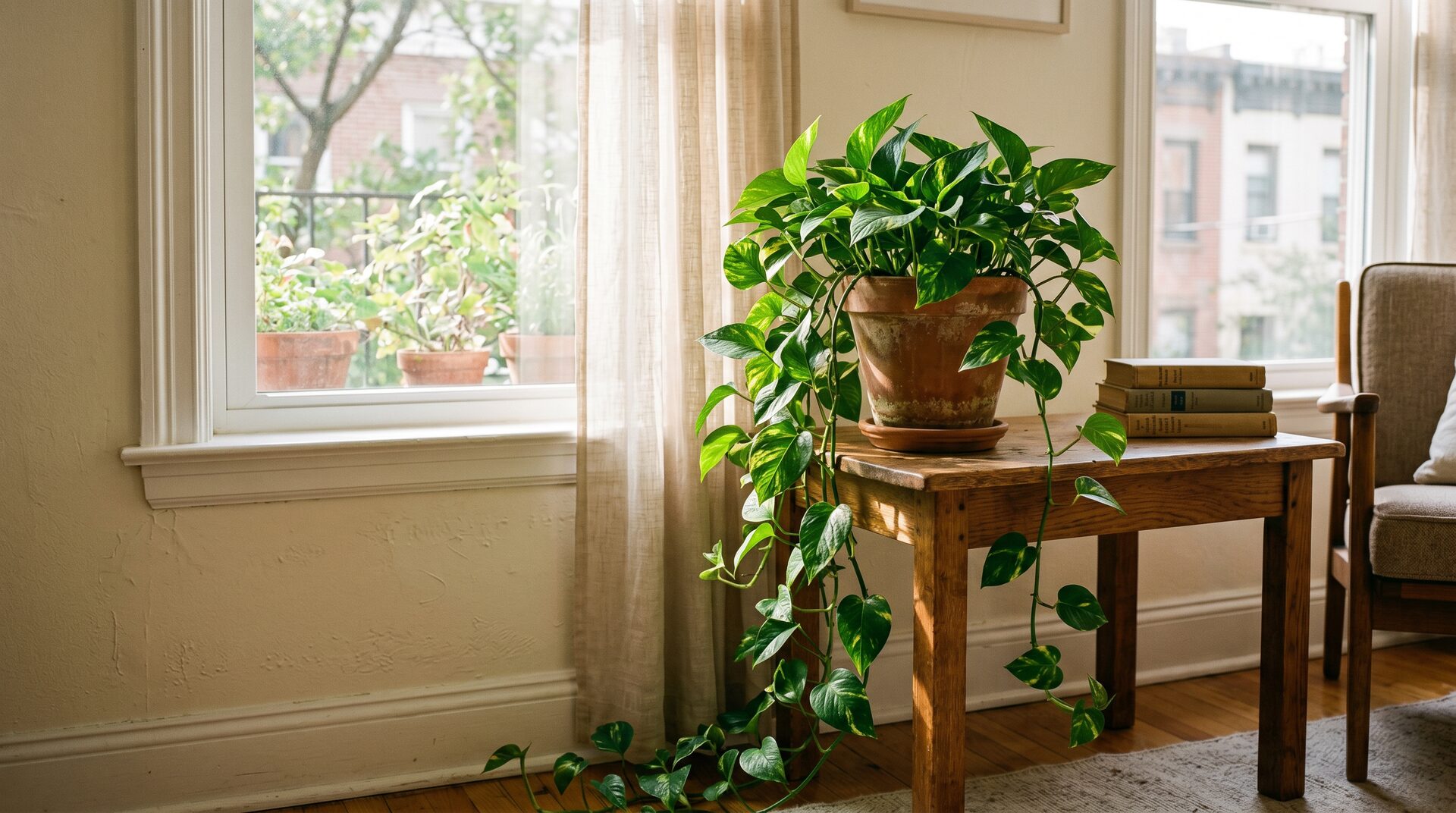
If you're new to houseplants and someone tells you to start with a pothos, they're not being lazy. They're being right. It's the Guild's pick for a first plant, and somehow it's also a plant I keep adding to my collection two years in. I've got five varieties now and I'm not sure where it ends.
Corrected September 2026: we've revised parts of this guide. See the correction note at the end.
Why Pothos Is a Good First Plant
Pothos (Epipremnum aureum) is a climbing vine in the arum family. Where it comes from depends on who you ask. Kew's Plants of the World Online puts its native range on Mo'orea in the Society Islands (POWO, n.d.), and NC State Extension agrees on the Society Islands (North Carolina Extension Gardener Plant Toolbox, n.d.). UF/IFAS points to the Solomon Islands instead (Henny et al., 2011), while Clemson Extension lists China, India and parts of Southeast Asia (Taylor & Tanner, 2026). We go with Kew, since it's the botanical authority, but the disagreement is real.
Clemson describes wild pothos as a vine of the forest understory, the shady layer below the tree canopy, that climbs trees to reach light, growing somewhere warm and humid under dappled sun (Taylor & Tanner, 2026). It climbs with brown aerial roots, roots that grow from the stem rather than in soil, and given something to climb and enough light, it starts producing large, mature leaves (North Carolina Extension Gardener Plant Toolbox, n.d.). Wild leaves can reach 3 feet (about 90 cm) long with holes along the middle; as a houseplant, the leaves typically stay a few inches long and whole (Taylor & Tanner, 2026).
Indoors, it's about as easy as houseplants get. NC State calls it very easy to grow, noting that it likes bright light that isn't direct sun and can get by in dim light for a long time (North Carolina Extension Gardener Plant Toolbox, n.d.). UF/IFAS notes that it's widely used in indoor plantings because it's easy to grow, hardy and good-looking (Norman & Ali, 2018). That's our reason for recommending it first. It forgives a lot while you learn what "enough light" and "enough water" look like in your home.
I've only been growing pothos for about two years, but I've picked up five varieties now: Golden, Neon, Snow Queen, Cebu Blue, and Manjula. The Golden on my bookshelf grows slowly but never complains. The Neon in the kitchen put out a four-foot vine in 18 months. The Manjula is the diva of the bunch and makes me earn every new leaf. Five plants, totally different behaviors depending on light and placement.
Pothos Varieties Worth Knowing
Clemson notes that pothos cultivars (named varieties selected and propagated by growers) differ a lot in leaf color and patterning, in how they grow, and in how much light they'll put up with (Taylor & Tanner, 2026). Satin pothos isn't a true pothos at all, and Cebu Blue belongs to a different species (Taylor & Tanner, 2026). Golden pothos itself used to be filed as a cultivar of Epipremnum pinnatum, under the name E. pinnatum 'Aureum'; botanists now treat it as its own species (North Carolina Extension Gardener Plant Toolbox, n.d.). You'll still see the old name on some lists.
| Variety | Look | Light needs | Notes |
|---|---|---|---|
| Golden | Green with yellow variegation | Bright indirect; tolerates lower light | Sold at most garden centers. |
| Neon | Bright lime-green, no variegation | Tolerates lower light | Slender leaves. Grows quickly. |
| Marble Queen | White or cream variegation | More than other varieties | Grows faster and carries more green than Snow Queen. |
| Snow Queen | Mostly white, speckled with green | Plenty of bright indirect | Needs good light to grow well. |
| Pearls and Jade | Small teardrop leaves, green speckles, large white spots | Lots of light to keep its color | Selected from Marble Queen at the University of Florida. |
| N'Joy | Compact, green and white | Not stated | A separate patented cultivar, found in a group of Marble Queen clones. |
| Manjula | Colored like Pearls and Jade; broad, upright, pointed leaves | Not stated | Slower growing than other cultivars. |
| Cebu Blue | Slender, pointed, silvery-blue leaves | Care similar to pothos | A different species, Epipremnum pinnatum, which may need a moss pole to develop leaves with holes. |
| Satin (Scindapsus pictus) | Silvery, shiny leaves | Bright indirect; no direct sun | Not a true pothos. Slower and harder to grow. |
The table draws on Clemson's cultivar list (Taylor & Tanner, 2026), UF/IFAS on Pearls and Jade (Henny et al., 2011), the N'Joy plant patent (Hansoti, 2009), and NC State on satin pothos (North Carolina Extension Gardener Plant Toolbox, n.d.). Satin pothos deserves a warning: Clemson says it grows much more slowly than pothos and is harder to keep, with more pest and disease trouble and less patience for overwatering (Taylor & Tanner, 2026). Don't buy it expecting pothos-level forgiveness.
Our advice is to start with a plain Golden or Neon rather than a white-heavy cultivar. Clemson notes that Neon tolerates lower light, while Marble Queen, Snow Queen and Pearls and Jade all need more of it (Taylor & Tanner, 2026), so the plainer plants give you more room for error while you figure out your light and your watering. Once you've kept it happy for a season and taken a few cuttings, then look at the fancier cultivars.
Light: How Little Is Too Little
"Tolerates low light" is true of pothos, but it's not the same as "does well in low light." Clemson says pothos likes bright, indirect light and puts up with less, but that dimmer light may cost variegated plants some of their color (Taylor & Tanner, 2026). UF/IFAS puts numbers on it, in foot-candles, a measure of how much light reaches a surface. Indoors, pothos tolerates light as low as 50 foot-candles (about 540 lux), but new leaves come in small and variegated cultivars lose color. At 150 foot-candles (about 1,600 lux) or more, it keeps its color and leaf size (McConnell et al., 2003). Light at any spot varies with the season, shading, curtains and even wall color, and inexpensive light meters are available if you want a number (Shaughnessy & Pertuit, 1999a).
- Too dark: small new leaves, fading variegation (McConnell et al., 2003), and long bare stretches of stem between leaves, the stretching botanists call etiolation (Moore & Bradley, 2022).
- About right: bright, indirect light (Taylor & Tanner, 2026).
- Too bright: too much direct light can bleach or scald a houseplant's leaves, often after it's moved outdoors into direct sun (Shaughnessy & Pertuit, 1999a). Clemson says scorched leaves and withered tips often come from light that's too strong or air that's too dry (Taylor & Tanner, 2026); more on that under Common Problems.
If your plant looks sparse and spindly, light is the first thing we'd check. Iowa State says the usual cause of spindly houseplant growth is low light, and the fix is a brighter spot or supplemental light (Steil, 2024).
Watering
Let the soil dry between waterings, then water thoroughly so the water reaches all the roots (Taylor & Tanner, 2026). UF/IFAS frames it as keeping the mix moist, but notes that in most indoor spots pothos does better grown "a little on the dry side" (McConnell et al., 2003). In practice that means not bone dry, and not wet all the time either.
When you do water, keep going until water drains from the holes in the bottom, then empty the saucer rather than leaving the pot standing in the runoff (Shaughnessy & Pertuit, 1999b). To decide when, check the mix with a finger about an inch (2.5 cm) below the surface rather than watering by the calendar (Pettinelli, 2013). We don't give a schedule here on purpose. How fast a pot dries depends on temperature, pot size and pot material, and houseplants dry out faster near heat sources, which is often the case in winter (Pettinelli, 2013).
Overwatering is the main cause of losing potted plants in general: roots surrounded by water can't take up oxygen and may rot (Shaughnessy & Pertuit, 1999b). If you're unsure whether to water, our advice is to check again tomorrow.
Don't treat a droopy pothos as an automatic signal to water. Wilting often means a plant needs water, but not always: root rot from too much water also causes wilting, and watering then may make it worse (Shaughnessy & Pertuit, 1999b). UF/IFAS's disease guide for growers adds that ethylene damage can make a pothos look wilted even when the soil is moist enough (Norman & Ali, 2018). Feel the soil before you reach for the watering can.
Humidity & Temperature
Pothos prefers 50 to 70% humidity but tolerates the 30 to 60% typical of homes, and a humidifier can add more (Taylor & Tanner, 2026). Pebble trays are a common tip, and NC State still suggests a tray of wet pebbles (North Carolina Extension Gardener Plant Toolbox, n.d.), but we'd skip them. Penn State Extension says they make almost no difference to a room's humidity, because the evaporated water spreads through the whole room (Miklas, 2024). It presents that as a summary of current thinking rather than a definitive study.
At night it prefers 60 to 70°F (16 to 21°C), and during the day 70 to 85°F (21 to 29°C); in summer, keep it out of the path of air-conditioning vents, and in winter, away from windowsills and heating vents (Taylor & Tanner, 2026). Several hours at 33 to 40°F (1 to 4°C), or an abrupt temperature change, can leave scattered brown patches in the centers of the leaves (McConnell et al., 2003).
Pot & Soil
Use a pot with drainage holes
A houseplant pot needs drainage holes so excess water can drain; waterlogged mix may lead to disease problems. Cachepots (decorative outer pots) usually have no drainage holes and generally aren't suitable for planting into directly, so slip the potted plant inside instead (Concklin & Marquesen, 2026).
Size up gradually
When repotting a houseplant, choose a pot only one to two inches (2.5 to 5 cm) wider than the current one (PlantTalk Colorado, n.d.). Minnesota Extension explains why: in an oversized pot, the extra soil can stay too wet, and that can lead to root problems (Trott, 2026). Repot pothos when roots show through the drainage holes or the plant is root-bound; most plants can be repotted every year or two (Taylor & Tanner, 2026).
Match the pot material to your habits
Unglazed clay pots dry out faster than plastic or glazed pots (Pettinelli, 2013). Houseplant growers who tend to overwater can use clay pots, though Nebraska Extension notes that won't fix incorrect watering on its own (Baxendale et al., 2013).
Use an airy, well-draining mix
Clemson asks for an airy mix that drains well (Taylor & Tanner, 2026). A good-quality soilless potting mix made for containers works; garden soil indoors could lead to disease and pest problems (Concklin & Marquesen, 2026). Potting mixes typically include perlite to improve drainage (PlantTalk Colorado, n.d.), and a bagged mix is where we'd start.
Feeding
NC State says to fertilize pothos every other month, except when it is dormant in winter (North Carolina Extension Gardener Plant Toolbox, n.d.). For houseplants coming into spring growth, Minnesota Extension suggests starting gently with a balanced houseplant fertilizer at half strength (Trott, 2026). Nebraska Extension adds two useful exceptions (Browning, 2021). A plant in a very bright south or west window, or under grow lights, may keep growing through winter and can be fed like any growing plant. And plants that are newly repotted, unrooted, dormant (resting) or wilted should not be fed (Browning, 2021). For plants moved into indoor settings, UF/IFAS advises holding off repotting or feeding for about four weeks (McConnell et al., 2003), and we'd give a new plant at home the same grace period.
Avoid overfeeding houseplants, especially in low light; burned leaf edges and wilting are often signs of too much fertilizer (Baxendale et al., 2013). Nebraska Extension recommends flushing out built-up fertilizer salts every 4 to 6 months by running water equal to twice the pot's volume through the pot (Browning, 2021).
Go deeper · The Substrate Library
Want the deep science?
The Guild's Substrate Library has a full Foundation series on potting mixes: pH, cation exchange, air-filled porosity, and how to design your own mix. This guide keeps things practical; that series gets into the science.
Start with The Root Zone for the friendly intro, or jump to How Substrate Actually Works for the physics.
Common Problems & Fixes
Yellow leaves
Some yellowing is normal. Over time pothos leaves yellow and drop, leaving most leaves at the ends of the stems; pruning stems back keeps the plant bushy (North Carolina Extension Gardener Plant Toolbox, n.d.). When it's more than that, check the soil. Older pothos leaves turn yellow when the mix is kept either too dry or too wet (McConnell et al., 2003), and Clemson says yellow leaves are often caused by overwatering or low fertility (Taylor & Tanner, 2026).
Brown, crispy leaf tips and edges
Iowa State lists several causes that apply to houseplants in general. Letting a houseplant dry out too long between waterings browns leaf edges and tips, and too much fertilizer lets salts build up in the mix, which can also brown leaf tips (Steil, 2026). In pothos specifically, Clemson points to dry air or too-strong light as common causes of scorched leaves and withered tips (Taylor & Tanner, 2026).
Long, sparse vines with small leaves
As we covered under Light, low light is the typical cause of spindly growth (Steil, 2024), and small new leaves are a low-light sign too (McConnell et al., 2003). Move it somewhere brighter or add a grow light. You can also cut the leggy vines back. In plants generally, the stem tip is the source of a hormone called auxin that holds back side buds; cut off the tip and those buds can grow (Moore & Bradley, 2022). Root the pieces you cut off and you get new plants too.
Losing variegation
As in the Light section, variegated cultivars lose color in low light, and 150 foot-candles (about 1,600 lux) or more keeps it (McConnell et al., 2003). Move the plant somewhere brighter.
Pests: spider mites and mealybugs
Indoors, pothos is generally pest-free, but it may get spider mites and mealybugs (Taylor & Tanner, 2026). If you find pests on a houseplant, isolate it from the others (Hahn & Weisenhorn, 2026). For indoor plants, Minnesota Extension lists products sold as insecticidal soap and warns against mixing your own, because homemade soap products can burn plants (Hahn & Weisenhorn, 2026). Colorado State agrees that homemade soap or detergent sprays are more likely to injure a plant. When in doubt, it suggests trying a soap spray on a small patch of leaves a day or two before treating the whole plant (Cranshaw, 2008). If you're considering neem, note that plant-based oils such as neem are less refined than petroleum oils and may burn plants more readily (Skelly, 2013).
Root rot
Root rot is a common houseplant problem caused by overwatering or poorly draining soil; a well-draining mix and proper watering help prevent it (Taylor & Tanner, 2026). UF/IFAS's disease guide for commercial growers says the most common pothos disease is Phytophthora root rot, which frequently arrives on imported propagation cuttings (Norman & Ali, 2018). When you repot a houseplant, check the roots: healthy ones are white and firm, and any black, mushy ones should come out and be thrown away (PlantTalk Colorado, n.d.). If the stems are still healthy, taking cuttings is a good backup.
Propagation: Your Plant Makes More Plants
This is the best part. Pothos stem cuttings root easily in soil or water, but need at least one node to root properly (Taylor & Tanner, 2026). A node is the point on the stem where a leaf is or was attached, and it holds a bud (Moore & Bradley, 2022).
Take a cutting with a node
Use a sharp, clean blade, which does less damage to the parent plant and is less likely to spread disease (Schalau, 2024). Growers typically use short cuttings with one node and one leaf (McConnell et al., 2003).
Put it in water
When rooting houseplant cuttings in water, make the cut just under a node and strip any leaf that would end up submerged; new roots grow from the nodes (Schalau, 2024). Pothos roots in water, and propagation usually works best in spring and early summer (Cabrera-Garcia, 2026).
Be patient
In commercial production, single-node pothos cuttings with one leaf break bud (start pushing new growth) in 2 to 3 weeks and root in 3 to 4 weeks (McConnell et al., 2003). A home cutting in a jar may be faster or slower; give it time before you decide it isn't working.
Move it to soil once roots appear
The general houseplant advice is to move a water-rooted cutting into mix as soon as some roots develop, so the roots don't rot (Strickland, 2024).
Pruning stems back keeps pothos bushy, and the cut vines root easily in water (North Carolina Extension Gardener Plant Toolbox, n.d.). So every cutting you take does two jobs: a new plant, and a fuller old one.
Keep It Potted
Outdoors in places like Florida and Hawaii, pothos can become a problem plant. UF/IFAS predicts pothos will be invasive in Florida and does not recommend planting it there (Norman & Ali, 2018), and the Florida Exotic Pest Plant Council lists pothos, under the name Epipremnum pinnatum 'Aureum', as a Category II invasive, a plant that has become more common in the wild but hasn't yet reshaped native plant communities the way the worst invaders have (Florida Exotic Pest Plant Council, 2019). Pothos is described as highly invasive in Hawaii and Sri Lanka (Moodley et al., 2017). Hawaii's weed-risk program says it's fine in a pot but quickly goes feral once its stems touch the ground, another plant or a structure (Plant Pono, n.d.). Keep it in a pot, and put spare cuttings in the trash or give them away rather than tossing them into the garden.
A Note on Tap Water
Tap water is the normal choice for houseplants, though chemicals in municipal water may cause injury (Pettinelli, 2013). UConn suggests filling the watering can and letting it sit for a day or so, which often lets harmful chemicals dissipate (Pettinelli, 2013). That won't help everywhere: more than one in five Americans drinks chloramine-treated water (U.S. Environmental Protection Agency, n.d.), and chloramine, unlike chlorine, does not dissipate quickly on standing or boiling (U.S. Environmental Protection Agency, Region 9, 2017). The good news: an Ask Extension expert says the low chloramine levels in drinking water are not toxic to plants (Ask Extension, 2018).
Pothos and Pets
Pothos is toxic to cats and dogs. ASPCA lists golden pothos as toxic to dogs and cats because of insoluble calcium oxalates; signs are intense burning and irritation of the mouth, tongue and lips, heavy drooling, vomiting and difficulty swallowing (ASPCA Animal Poison Control, n.d.). Severity labels vary. Clemson calls it mildly toxic and says to keep pothos out of reach of children and pets (Taylor & Tanner, 2026). NC State's plant database entry for pothos rates its poison severity as medium, lists cats and dogs among the animals it affects, and names mouth pain and swelling, drooling, vomiting and difficulty swallowing (North Carolina Extension Gardener Plant Toolbox, n.d.).
The Merck Veterinary Manual says chewing any part of the plant causes immediate, intense mouth pain that resolves slowly without treatment (Schmid, 2023). Pothos is one of what Merck calls insoluble-oxalate plants (Schmid, 2023). For most pets that chew these plants the outlook is good to excellent and "full recovery is expected," often without a trip to the vet (Schmid, 2023). The same manual does warn that throat swelling can cause breathing trouble and may need airway and oxygen support (Schmid, 2023). If your pet has chewed pothos and is having any trouble breathing, call your vet or an animal poison line.
If you have a chewer, hang the pothos well out of reach or pick a different trailing plant. ASPCA lists both Boston fern and spider plant as non-toxic to dogs and cats (ASPCA Animal Poison Control, n.d.), but the Merck Veterinary Manual reports that cats eating spider plant can vomit, drool, retch and briefly go off food within hours (Schmid, 2023). It's a gentler choice than pothos, but not one to let a cat graze on.
Whether you stop at one pothos or end up with five varieties in different rooms, it's a forgiving plant to learn on. Give it good light and let the soil dry a little between waterings. And keep it where the cat can't get it.
We review our guides against the research and extension guidance available at the time, and we correct them when a source doesn't say what we took it to say or when we can't find support for a point. In this review we corrected our pet-safety advice, including a plant we had called a cat-safe alternative, and our care advice, fixed points we had credited to sources that don't make them, and removed claims we couldn't source.
Go deeper in the free Apprenticeship: Module II, Reading Light →
Ask Extension. (2018, June 19). Chloramine in tap water and its effects on houseplants and gardens (#460986). Extension Foundation. https://ask.extension.org/kb/faq.php?id=460986
ASPCA Animal Poison Control. (n.d.). Toxic and non-toxic plant list [Database entries: Boston fern; Golden pothos; Spider plant]. American Society for the Prevention of Cruelty to Animals. https://www.aspca.org/pet-care/aspca-poison-control/toxic-and-non-toxic-plants
Baxendale, F. P., Wegulo, S. N., Lott, D. E., & Lindgren, D. T. (2013). Guide to growing houseplants (NebGuide G2205). University of Nebraska–Lincoln Extension. https://extensionpubs.unl.edu/publication/g2205/na/html/view
Browning, S. (2021, January 17). Success with houseplants: Fertilization. Nebraska Extension in Lancaster County. https://lancaster.unl.edu/success-houseplants-fertilization
Cabrera-Garcia, J. (Reviewer). (2026). Home propagation of houseplants (G6560). University of Missouri Extension. https://extension.missouri.edu/publications/g6560
Concklin, M., & Marquesen, S. (2026). Repotting houseplants. Penn State Extension. https://extension.psu.edu/repotting-houseplants
Cranshaw, W. S. (2008). Insect control: Soaps and detergents (Fact Sheet No. 5.547). Colorado State University Extension. https://www.extension.colostate.edu/docs/pubs/insect/05547.pdf
Florida Exotic Pest Plant Council. (2019). Florida Exotic Pest Plant Council's 2019 list of invasive plant species. https://bugwoodcloud.org/CDN/fleppc/plantlists/2019/2019_Plant_List_ABSOLUTE_FINAL.pdf
Hahn, J., & Weisenhorn, J. (2026). Managing insects on indoor plants. University of Minnesota Extension. https://extension.umn.edu/product-and-houseplant-pests/insects-indoor-plants
Hansoti, A. (2009). Epipremnum plant named ‘NJOY’ (U.S. Plant Patent No. PP19,965). U.S. Patent and Trademark Office. https://patents.google.com/patent/USPP19965
Henny, R. J., Chen, J., & Mellich, T. A. (2011). New Florida foliage plant cultivar: Pothos ‘Pearls and Jade’ (ENH1180/EP441). UF/IFAS Extension. https://edis.ifas.ufl.edu/publication/EP441
McConnell, D. B., Chen, J., Henny, R. J., & Everitt, K. C. (2003). Cultural guidelines for commercial production of interiorscape Epipremnum (ENH894/EP151). UF/IFAS Extension. https://edis.ifas.ufl.edu/publication/EP151
Miklas, L. (2024, December 13). Humidity and houseplants. Penn State Extension. https://extension.psu.edu/humidity-and-houseplants
Moodley, D., Procheş, Ş., & Wilson, J. R. U. (2017). Assessing and managing the threat posed by Epipremnum aureum in South Africa. South African Journal of Botany, 109, 178–188. https://doi.org/10.1016/j.sajb.2016.12.005
Moore, K. A., & Bradley, L. K. (Eds.). (2022). Botany. In North Carolina extension gardener handbook (2nd ed., AG-831, Chapter 3). NC State Extension. https://content.ces.ncsu.edu/extension-gardener-handbook/3-botany
Norman, D. J., & Ali, G. S. (2018). Pothos (Epipremnum aureum) diseases: Identification and control in commercial greenhouse production (PP340). UF/IFAS Extension. https://doi.org/10.32473/EDIS-pp340-2018
North Carolina Extension Gardener Plant Toolbox. (n.d.). [Database entries: Epipremnum aureum; Scindapsus pictus]. NC State Extension. https://plants.ces.ncsu.edu/
Pettinelli, D. (2013). Watering houseplants. UConn Extension. https://extension.uconn.edu/2013/12/24/watering-houseplants/
Plant Pono. (n.d.). Epipremnum aureum (pothos). Hawaii-Pacific Weed Risk Assessment. https://plantpono.org/high-risk-plants/epipremnum-aureum/
PlantTalk Colorado. (n.d.). Houseplants: Repotting (No. 1316). Colorado State University Extension. https://planttalk.colostate.edu/topics/houseplants/1316-houseplants-repotting/
POWO. (n.d.). Epipremnum aureum (Linden & André) G.S.Bunting. Plants of the World Online, Royal Botanic Gardens, Kew. https://powo.science.kew.org/taxon/urn:lsid:ipni.org:names:87014-1
Schalau, J. (2024, February 11). Propagating plants (Backyard Gardener #96). University of Arizona Cooperative Extension, Yavapai County. https://extension.arizona.edu/sites/extension.arizona.edu/files/attachment/PropagatingPlants.pdf
Schmid, R. D. (2023). Houseplants and ornamentals toxic to animals. In Merck veterinary manual. Merck & Co. https://www.merckvetmanual.com/toxicology/poisonous-plants/houseplants-and-ornamentals-toxic-to-animals
Shaughnessy, D., & Pertuit, A. (1999a). Indoor plants: Cleaning, fertilizing, containers & light requirements (HGIC 1450). Clemson Cooperative Extension. https://hgic.clemson.edu/factsheet/indoor-plants-cleaning-fertilizing-containers-light-requirements/
Shaughnessy, D., & Pertuit, A. (1999b). Indoor plants: Watering (HGIC 1459). Clemson Cooperative Extension. https://hgic.clemson.edu/factsheet/indoor-plants-watering/
Skelly, J. (2013). Horticultural oils: What a gardener needs to know (FS-13-20). University of Nevada, Reno Extension. https://extension.unr.edu/publication.aspx?PubID=3029
Steil, A. (2024). Diagnosing houseplant problems from improper environmental conditions. Iowa State University Extension and Outreach. https://yardandgarden.extension.iastate.edu/how-to/diagnosing-houseplant-problems-improper-environmental-conditions
Steil, A. (2026, February 3). Why does my houseplant have brown leaf tips and edges? Iowa State University Extension and Outreach. https://yardandgarden.extension.iastate.edu/faq/why-does-my-houseplant-have-brown-leaf-tips-and-edges
Strickland, J. (2024). Propagating houseplants. N.C. Cooperative Extension, Wayne County Center. https://wayne.ces.ncsu.edu/2019/08/propagating-houseplants/
Taylor, A., & Tanner, C. (2026). How to grow pothos indoors (Epipremnum spp.): Care, cultivars, and common problems (HGIC 1568). Clemson Cooperative Extension. https://hgic.clemson.edu/factsheet/how-to-grow-pothos-indoors-epipremnum-spp-care-cultivars-and-common-problems/
Trott, R. (2026). Spring houseplant care. University of Minnesota Extension. https://extension.umn.edu/garden-and-home/yard-and-garden/gardening-in-minnesota/houseplants/spring-houseplant-care
U.S. Environmental Protection Agency. (n.d.). Chloramines in drinking water. https://www.epa.gov/dwreginfo/chloramines-drinking-water
U.S. Environmental Protection Agency, Region 9. (2017). Chloramine [Archived web page]. https://19january2017snapshot.epa.gov/www3/region9/water/chloramine.html