A plantlet fresh out of the flask needs a few weeks of careful handling while it adjusts to open air, and we want a mix that stays airy and damp while it does. This is the mix we deflask into, half Fluval Stratum and half perlite, and the aftercare we follow. Most of our attention goes to the aftercare, though the research shows the mix matters too.
Corrected September 2026: we've revised parts of this guide. See the correction note at the end.
Tissue culture (TC) plants arrive as plantlets grown in a closed flask on a sugary gel (agar). Getting them out of that flask and into a pot is called deflasking, and the weeks that follow, while the plantlet adjusts to open air, are called acclimation. This guide covers the mix we deflask into and the aftercare we follow. The recipe and the care steps are our practice. Where research or extension guidance covers a step, we tell you what it found, including where it differs from what we do.
What a Plantlet Is Missing
Inside the flask the air is humid and moisture is plentiful. That shows in its leaves. A review of acclimatization describes little surface wax, abnormal stomata and a non-continuous cuticle as typical of herbaceous plants grown under abundant moisture, as they are in the flask (Hazarika, 2003). In many species the stomata and cuticle are slow to develop in vitro, so the leaves lose water quickly after transfer (Pospíšilová et al., 1999). In some species the cuticle is already close to normal, and the fast water loss comes only from stomata that fail to close (Pospíšilová et al., 1999). Roots and the connection between root and stem can also carry water poorly at first (Pospíšilová et al., 1999, citing work on grapevine).
So the first weeks are about water. Pospíšilová et al. (1999) write that plantlets "usually need some weeks of acclimatization with gradual lowering in air humidity," and conclude that many species need gradual changes after transfer to avoid drying out and light damage. The cuticle can take a while to catch up: in several species they review, water loss through stomata and cuticle matched that of seedlings only 8 to 12 weeks after transfer.
Where the Mix Fits
When a batch struggles, the order we check things in is humidity first, then light, then feeding, then the physical state of the mix, then the ingredients. That order is our own habit, not a ranking from research.
The mix still matters. In a bromeliad, Vriesea splendens, plantlets given the same care in one experiment survived at rates from 50% to 100% depending on the substrate (Eisa et al., 2025). In pothos (Epipremnum aureum), survival ran from 50% in soil alone to 75% in soil mixed with coconut fiber (Nguyen et al., 2025). In Syngonium podophyllum, every plantlet survived on all six mixes tested (each cocopeat or peat moss blended with perlite), but the substrate significantly changed root growth and leaf area (Paknia et al., 2026). In Alocasia longiloba, survival was 97% overall, and the substrate affected how tall the leaf stalks grew (Abdulhafiz et al., 2020). So a mix can change whether a plantlet makes it, and how well it grows once it does.
The Recipe
This is TC Acclimation Mix v1. All percentages are by volume.
| Ingredient | Percentage | Grade |
|---|---|---|
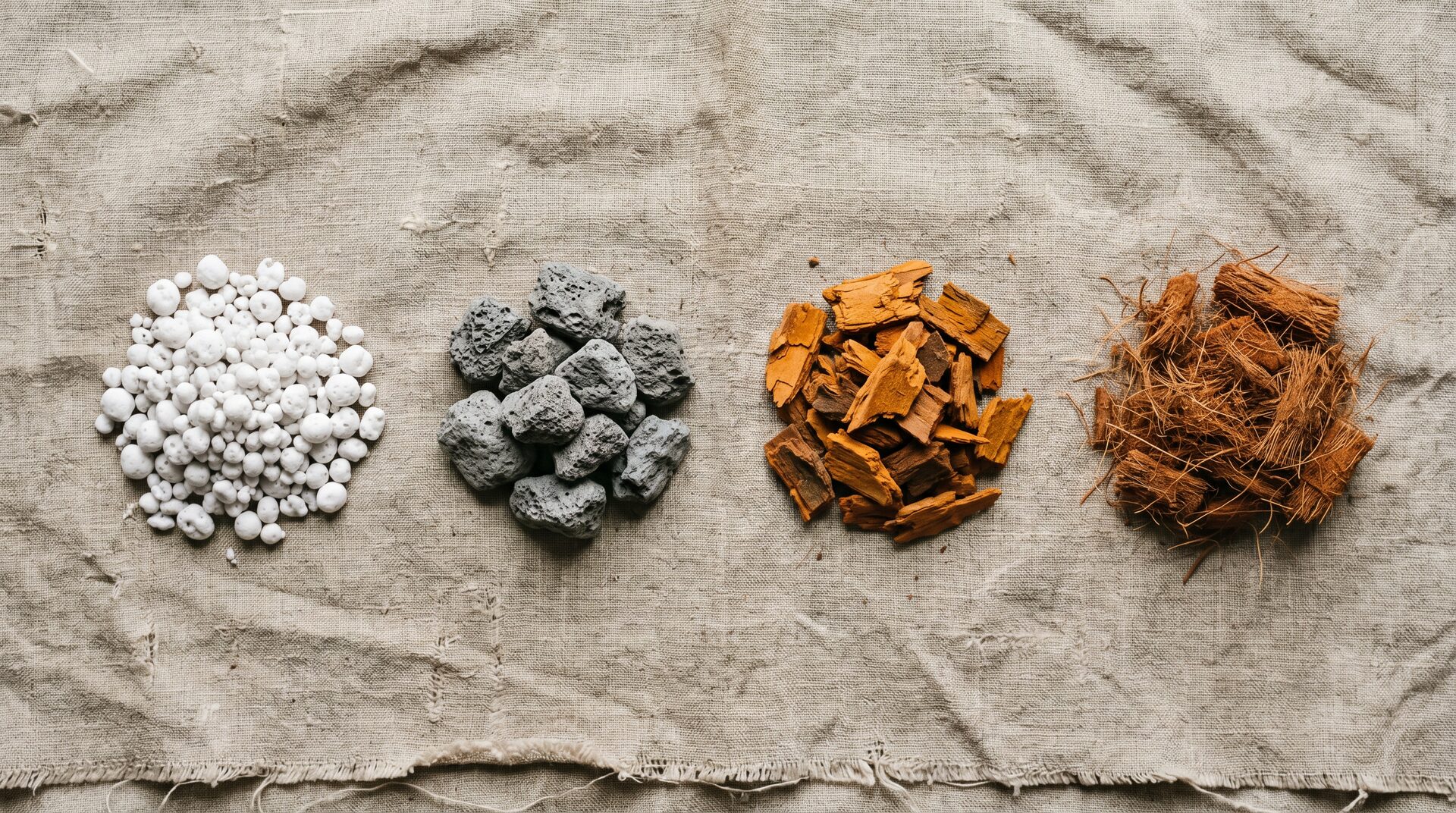
| Fluval Stratum, rinsed | 50% | As sold, about 3–5 mm granules |
| Perlite | 50% | Fine to medium |
We deflask every tissue-culture plantlet into this mix, whatever the genus, and move plants to a grow-out mix once they graduate (see below). That includes bananas (Musa), but we've put only one small batch through it and lost some of those plantlets, so we can't yet say how well it suits them. We're working on a separate deflask mix for the prayer-plant family (Marantaceae). It isn't finished, so we don't publish a recipe for it yet.
Perlite grades are sold by name, and some brands also use numbers. The Perlite Institute describes fine grades as usually smaller than 1 mm and coarse grades as usually larger (Perlite Institute, n.d.). In Hydrofarm’s GROW!T line, "#2" is sold as a super coarse grade, 1/16 to 5/8 inch (about 1.6 to 16 mm) (Hydrobuilder, n.d.), so go by the particle size, not the number.
Fluval Stratum and Perlite
Fluval Stratum is an aquarium substrate. Fluval says it's collected from the foothills of Mount Aso, a volcano in Japan, sold in 3 to 5 mm granules, and contains a proprietary mix of nutrients, minerals and trace elements (Fluval, n.d.-a; Fluval, n.d.-b). The maker calls it a natural soil product that, like other organic matter, can slightly raise ammonia in an aquarium (Fluval, n.d.-a). In aquarium water, it says, Stratum helps support a neutral to slightly acidic pH and lowers carbonate hardness, and it recommends a gentle rinse before use (Fluval, n.d.-a; Fluval, n.d.-b). Those are the maker's statements about aquarium use, not measurements in a pot, and we found no study that uses Stratum to acclimatize plantlets. Using it here is our choice.
Perlite holds very little in the way of nutrients, but it isn't empty. In one 24-day trial, pure perlite had a cation exchange capacity (CEC, a measure of how many positively charged nutrients a material can hold) of 12.7 cmolc/kg, against 103 for pure coir (Monsalve Camacho et al., 2026). How much water perlite holds depends on the grade. Fine grades hold about as much as peat moss, and coarse grades hold less and give more air (Perlite Institute, n.d.).
We don't count on either ingredient to store fertilizer for the plant. For soilless container mixes in general, the Southern Nursery Association says CEC plays a minimal role in nutrient uptake and leaching. It adds that nutrients from a single application of soluble granular fertilizer leach quickly from a container (Southern Nursery Association, 2013).
What We Look For in a Mix
We haven't measured the porosity of our own mix, so we don't give numbers for it. For nursery container substrates after watering and draining, the recommended ranges are 50 to 85% total porosity and 10 to 30% air space, by volume (Southern Nursery Association, 2013; Bilderback et al., 2005). Those figures come from nursery production, not plantlets, but they're the closest guide we found.
We also want a mix that holds its structure for the few weeks a plantlet spends in it. Mineral ingredients such as perlite and pumice don't decompose, or break down only slowly (Bilderback et al., 2005). Mixes made mostly of organic ingredients decompose during a crop cycle, and their balance of air and water shifts (Bilderback et al., 2005). Fluval Stratum is sold as a natural soil product, so we don't call this mix inert.
Aftercare
Humidity
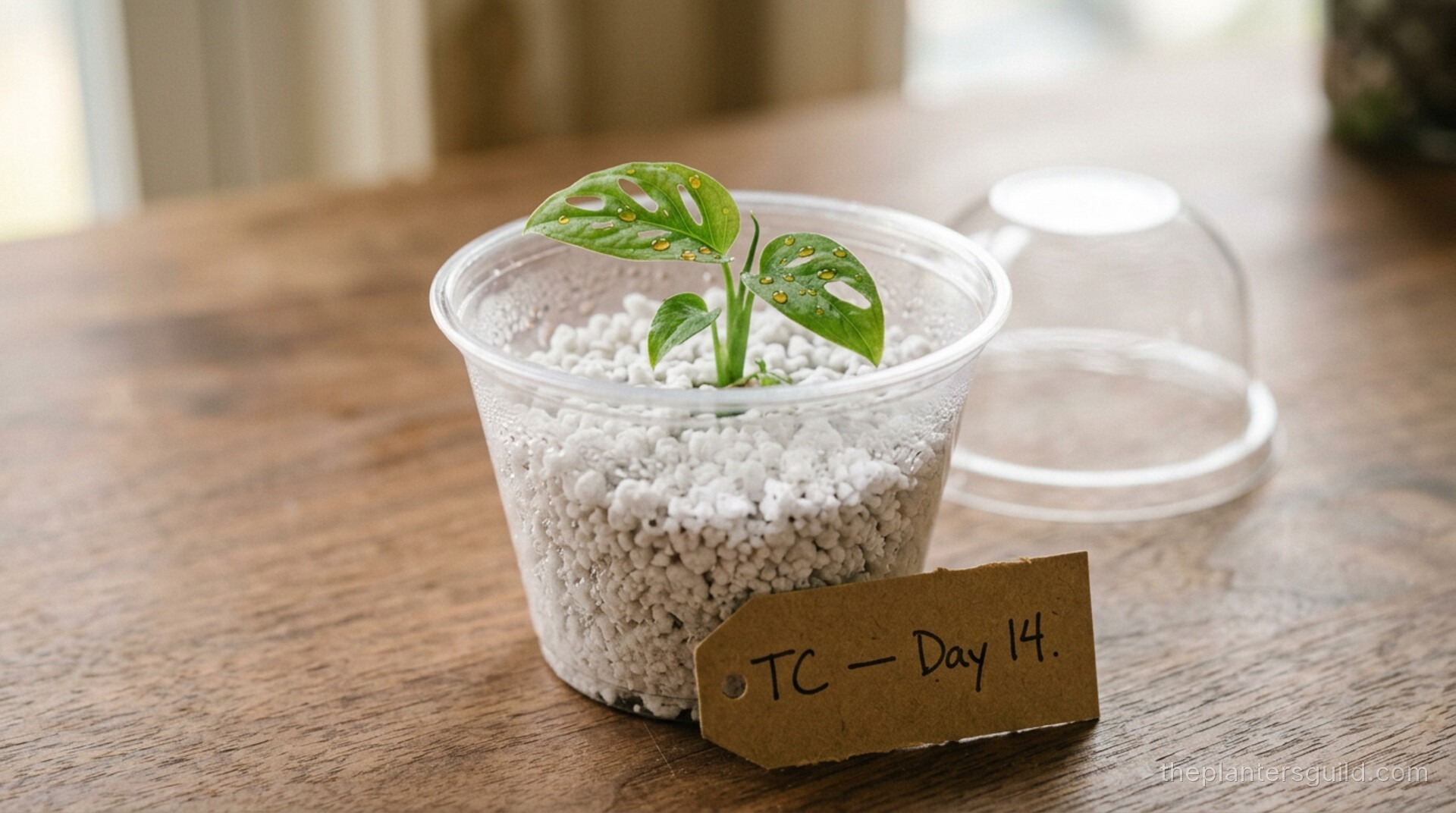
We start plantlets under a clear dome at high humidity and lower it in steps: first by venting the dome briefly, then for longer each day, then leaving it off during the day before removing it. We don't follow a fixed calendar: we move to the next step when the plantlets stay firm with the dome vented.
The published protocols we found take a few weeks for this. A Philodendron protocol held plantlets at 95 to 100% relative humidity for two weeks, then lowered it gradually to 60% (Kang & Sivanesan, 2025). A Rosa canina protocol lowered humidity from about 100% to 60% over 14 to 21 days (Casanovas et al., 2026). A Syngonium protocol kept plantlets covered for two weeks, then gradually added vent holes. In the third week the covers came off for several hours a day, and after four weeks the plants went to the greenhouse (Paknia et al., 2026).
A sealed dome is one way to do this. UF/IFAS suggests a mist or fog system for foliage microcuttings, with mist intervals lengthened gradually, and advises watching for fungal diseases and treating them immediately (Chen & Henny, 2015).
Light
We use bright, indirect light and no direct sun while the dome is on. High light immediately after transfer caused photoinhibition and even chlorophyll bleaching in Calathea louisae and Spathiphyllum plantlets (Pospíšilová et al., 1999). For comparison, a Caladium acclimatization protocol ran its growth chambers at a light intensity of 250 µmol m−2 s−1 (Dehestani-Ardakani et al., 2025). We raise the light as new leaves appear.
Watering
We pot into damp mix and water again when the surface starts to dry, so the mix stays damp but never soggy. High soluble salts can damage roots, and during propagation those salts can come from a rooting medium that goes dry, even briefly (Pacific Northwest Plant Disease Management Handbook, 2026). Pythium can get into roots damaged that way (Pacific Northwest Plant Disease Management Handbook, 2026). So we check the pots under the dome every day.
Feeding
We hold off fertilizer until new roots and new growth show, and not for at least two weeks. Nebraska Extension says newly repotted, unrooted and wilted plants shouldn't be fertilized (Browning, 2021). Virginia Cooperative Extension advises that a rooting medium for cuttings be low in fertilizer, because too much can damage or hold back new roots (Relf & Ball, 2025). When growth starts, we begin at a quarter of the label strength of a balanced fertilizer.
Other growers feed sooner. UF/IFAS allows dilute liquid feed at 100 to 150 ppm when microcuttings are first potted, with salts kept low (Chen & Henny, 2015). Weak Anthurium plantlets sprayed with a foliar fertilizer at transplanting and again two weeks later grew better than ones sprayed with water, at the best rates tested (Kumarasinghe et al., 2019). In a hydroponic setup, Caladium plantlets given nutrient solution grew better than on water alone (Zhang et al., 2019). We still hold off until new roots show.
Deflasking Day
This is how we do it.
- Prepare first. Mix made and dampened, pots filled, dome ready, tools within reach.
- Take plantlets out one at a time. We use long tweezers and work over a tray.
- Wash off the gel. Published protocols wash the agar off the roots, usually under running tap water (Paknia et al., 2026), because its sugars can feed fungi during acclimatization (Casanovas et al., 2026). We use room-temperature water and get off as much as we can without tearing roots.
- Pot with the crown at the surface. We set the plantlet so the point where stem meets roots sits level with the mix, not buried, and firm the mix gently around the roots. That's our practice.
- Dome on, into bright indirect light.
Reading the Plant
The calendar is a rough guide. We watch the plants.
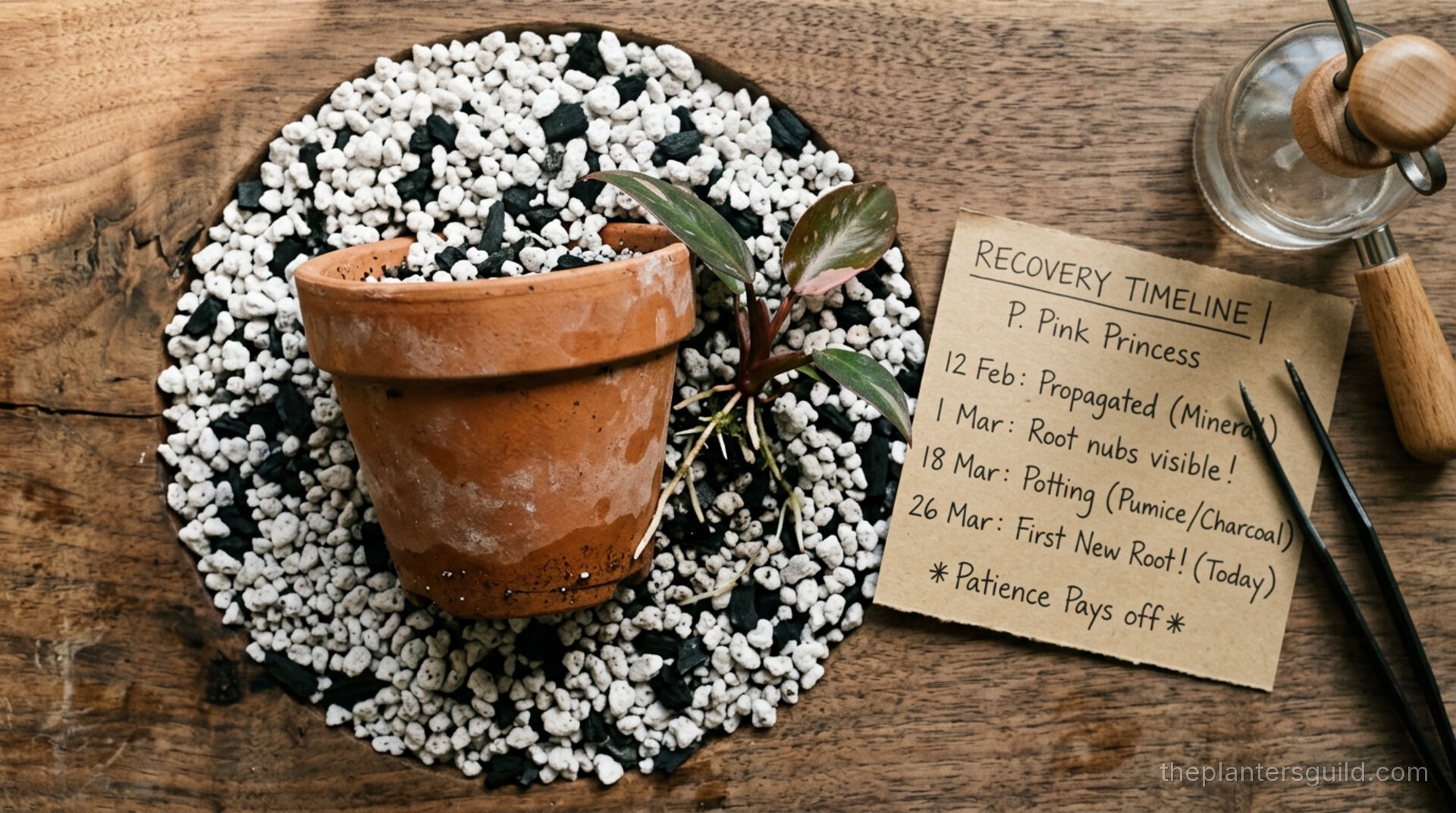
New roots. White or cream root tips showing through the side of a clear pot are the first sign we look for.
New leaves. In many species the leaves formed in the flask can't develop further outside it and are replaced by new ones (Pospíšilová et al., 1999). In Calathea louisae and Spathiphyllum, substantial photosynthesis was measured once new leaves were fully developed (Pospíšilová et al., 1999). A new leaf means progress, not readiness: in micropropagated bananas, the first leaves formed after transfer still lost more water than leaves formed later (Costa et al., 2009).
Tolerance of the vented dome. If plantlets droop every time the dome is opened, we stay at the current step longer.
Common Problems
Wilting soon after deflasking. In vitro leaves lose water fast (Pospíšilová et al., 1999). We take it as a sign the humidity dropped too soon, and close the dome back up.
New root tips turn brown and soft. We read that as the mix staying too wet, so we let the surface dry a little more before the next watering. Pythium is more likely when potting media stay too wet (Pacific Northwest Plant Disease Management Handbook, 2026).
Glassy, water-soaked leaves. Hyperhydricity, a glassy, translucent condition, is a disorder of tissue culture itself, linked to conditions in the flask such as high ammonium in the growing medium (Polivanova & Bedarev, 2022). In its guide to growing Syngonium, UF/IFAS also lists wet or water-soaked young leaves as a sign of water imbalance when the leaves are warm but the root medium is still cold. It advises keeping the root zone at 65 °F (18 °C) or higher (McConnell et al., 2014). So we first check whether the leaves came out of the flask that way.
No new growth after several weeks. We check the light first, then whether the mix is damp, soggy or dry.
When to Graduate
These are the signs we look for before moving a plant on. They're our practice, not published criteria:
- Several new leaves, larger than the ones that came out of the flask
- A new leaf has fully opened and firmed up, no longer soft to the touch
- Roots visible at the edges of the pot
- The plant holds up with the dome off, with two weeks of steady growth and no leaf loss
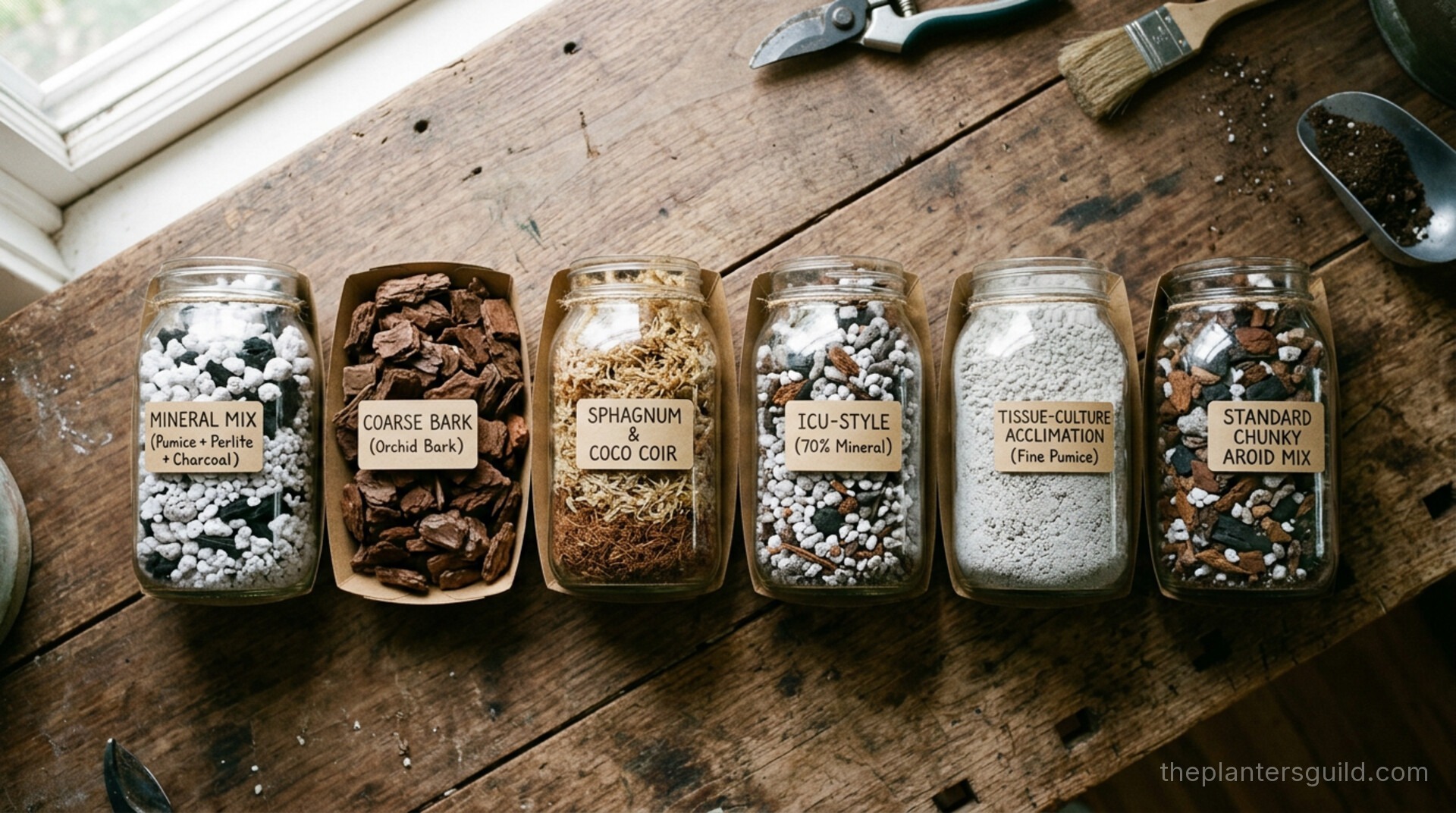
At that point we repot into Standard Mineral Mix for most tropicals, or Aroid Mineral Mix for climbing aroids, going up one pot size.
The Short Version
We deflask everything into 50% rinsed Fluval Stratum and 50% fine to medium perlite. Research shows the mix can change survival and growth, but most of our attention goes to the weeks after potting: humidity lowered gradually under a dome, bright indirect light, mix kept damp but not wet, and no fertilizer until new roots and growth show.
When the plant shows the graduation signs above, it moves on to one of our everyday mixes.
We review our guides against the research and extension guidance available at the time, and we correct them when a source doesn't say what we took it to say or when we can't find support for a point. We dropped the peroxide dip, 72-hour dry spell, temperature and heat-mat advice, weekly humidity schedule and graduation timeline, and corrected our light, watering, feeding and glassy-growth advice and claims about Fluval Stratum, perlite, air space and how much the mix matters. We also fixed points credited to sources that don't make them, cut unsupported figures and unrecorded field results, and withdrew our genus-specific recipes and notes.
Go deeper in the free Apprenticeship: Module IV, What Substrate Is →
Abdulhafiz, F., Mohammed, A., Kayat, F., Zakaria, S., Hamzah, Z., Reddy Pamuru, R., Gundala, P. B., & Reduan, M. F. H. (2020). Micropropagation of Alocasia longiloba Miq and comparative antioxidant properties of ethanolic extracts of the field-grown plant, in vitro propagated and in vitro-derived callus. Plants, 9(7), 816. https://doi.org/10.3390/plants9070816
Bilderback, T. E., Warren, S. L., Owen, J. S., Jr., & Albano, J. P. (2005). Healthy substrates need physicals too! HortTechnology, 15(4), 747–751. https://doi.org/10.21273/HORTTECH.15.4.0747
Browning, S. (2021, January 17). Success with houseplants: Fertilization. Nebraska Extension in Lancaster County. https://lancaster.unl.edu/success-houseplants-fertilization/
Casanovas, M., Roca, E., & Dolcet-Sanjuan, R. (2026). In vitro micropropagation of Rosa canina L.: From establishment to plant acclimatization. Plants, 15(9), 1285. https://doi.org/10.3390/plants15091285
Chen, J., & Henny, R. J. (2015). Commercial production of ornamental tropical foliage plants: Micropropagation (ENH1259). University of Florida IFAS Extension. https://edis.ifas.ufl.edu/publication/EP520
Costa, F. H. S., Scherwinski-Pereira, J. E., Pasqual, M., Castro, E. M., & Santos, A. M. (2009). Perda de água e modificações anatômicas em folhas de plantas de bananeiras micropropagadas durante a aclimatização [Water loss and anatomical changes in leaves of micropropagated banana plants during acclimatization]. Ciência Rural, 39(3), 742–748. https://www.redalyc.org/pdf/331/33113640017.pdf
Dehestani-Ardakani, M., Meftahizadeh, H., Karimi, M., & Gholamnezhad, J. (2025). Establishment of a refined somatic embryogenesis protocol and light-spectrum-based acclimatization in Caladium bicolor ‘White’. BMC Plant Biology, 25, 1564. https://doi.org/10.1186/s12870-025-07551-1
Eisa, E. A., Pasquel Davila, D. S., & Ördögh, M. (2025). Enhancing acclimatization conditions for Vriesea splendens ‘Fire’: A comparative analysis of substrate effects on growth and survival. Plants, 14(2), 172. https://doi.org/10.3390/plants14020172
Fluval. (n.d.-a). Stratum [Product page]. Rolf C. Hagen Inc. Retrieved September 29, 2026, from https://fluvalaquatics.com/us/shop/product/stratum
Fluval. (n.d.-b). Stratum aquarium substrates [Product series page]. Rolf C. Hagen Inc. Retrieved September 29, 2026, from https://fluvalaquatics.com/us/shop/product/stratum-series-page
Hazarika, B. N. (2003). Acclimatization of tissue-cultured plants. Current Science, 85(12), 1704–1712.
Hydrobuilder. (n.d.). GROW!T #2 perlite, 4 cubic feet [Retailer product page]. Retrieved September 29, 2026, from https://hydrobuilder.com/products/grow-t-2-perlite-super-coarse-4-cubic-feet-pallet-of-30-bags
Kang, I., & Sivanesan, I. (2025). Micropropagation of Philodendron ‘White Knight’ via shoot regeneration from petiole explants. Plants, 14(11), 1714. https://doi.org/10.3390/plants14111714
Kumarasinghe, P. G. S. A., Srikrishnah, S., Anjali, Y. M. U., & Sutharsan, S. (2019). Effect of different concentrations of selected liquid fertilizers on acclimatization of weakly grown in vitro plantlets of Anthurium andraeanum L. var. ‘Lalani’. AGRIEAST, 13(1), 19–31. https://doi.org/10.4038/agrieast.v13i1.61
McConnell, D. B., Chen, J., & Everitt, K. C. (2014). Cultural guidelines for commercial production of interiorscape Syngonium (ENH993/EP244). University of Florida IFAS Extension. https://edis.ifas.ufl.edu/publication/EP244 (Original work published 2004)
Monsalve Camacho, O. I., Luque Sanabria, N. Y., & Sánchez Rodríguez, L. Á. (2026). Nutrient chemistry in coconut-mineral mixed substrates for soilless culture. Advances in Horticultural Science, 40(2), 165–180. https://doi.org/10.36253/ahsc-18670
Nguyen, H. T., Khuat, Q. V., Ninh, T. T., Dang, A. T. P., Nguyen, L. T., Kalasnikova, E. A., Batukaev, A. A., & Kirakosyan, R. N. (2025). Direct organogenesis of Epipremnum aureum G.S. Bunting for mass propagation. Plants, 14(21), 3299. https://doi.org/10.3390/plants14213299
Pacific Northwest Plant Disease Management Handbook. (2026). Greenhouse plants, ornamental: Pythium seed rot, damping-off, and root rot. Oregon State University, Washington State University and University of Idaho. https://pnwhandbooks.org/plantdisease/host-disease/greenhouse-plants-ornamental-pythium-seed-rot-damping-root-rot
Paknia, M., Dehestani-Ardakani, M., & Meftahizade, H. (2026). Integrated in vitro regeneration and ex vitro establishment of Syngonium podophyllum ‘Pink Allusion’: Optimization of growth regulators and acclimatization substrates. BMC Plant Biology, 26, 1520. https://doi.org/10.1186/s12870-026-09563-x
Perlite Institute. (n.d.). Finer perlite grades: Perlite gradation and peat/perlite mixtures [Technical data sheet]. https://www.perlite.org/wp-content/uploads/2018/03/perlite-gradation-peat-perlite-mixtures.pdf
Polivanova, O. B., & Bedarev, V. A. (2022). Hyperhydricity in plant tissue culture. Plants, 11(23), 3313. https://doi.org/10.3390/plants11233313
Pospíšilová, J., Tichá, I., Kadleček, P., Haisel, D., & Plzáková, Š. (1999). Acclimatization of micropropagated plants to ex vitro conditions. Biologia Plantarum, 42(4), 481–497. https://doi.org/10.1023/A:1002688208758
Relf, D., & Ball, E. (2025). Propagation by cuttings, layering and division (SPES-683P). Virginia Cooperative Extension. https://www.pubs.ext.vt.edu/content/dam/pubs_ext_vt_edu/426/426-002/SPES-683.pdf
Southern Nursery Association. (2013). Best management practices: Guide for producing nursery crops (3rd ed.). Southern Nursery Association.
Zhang, Y.-S., Gu, S.-J., Chen, J.-J., & Cai, X.-D. (2019). Effects of different nutrient solutions on the acclimatisation of in vitro Caladium plantlets using a simplified hydroponic system. Sains Malaysiana, 48(8), 1627–1633. https://doi.org/10.17576/jsm-2019-4808-08