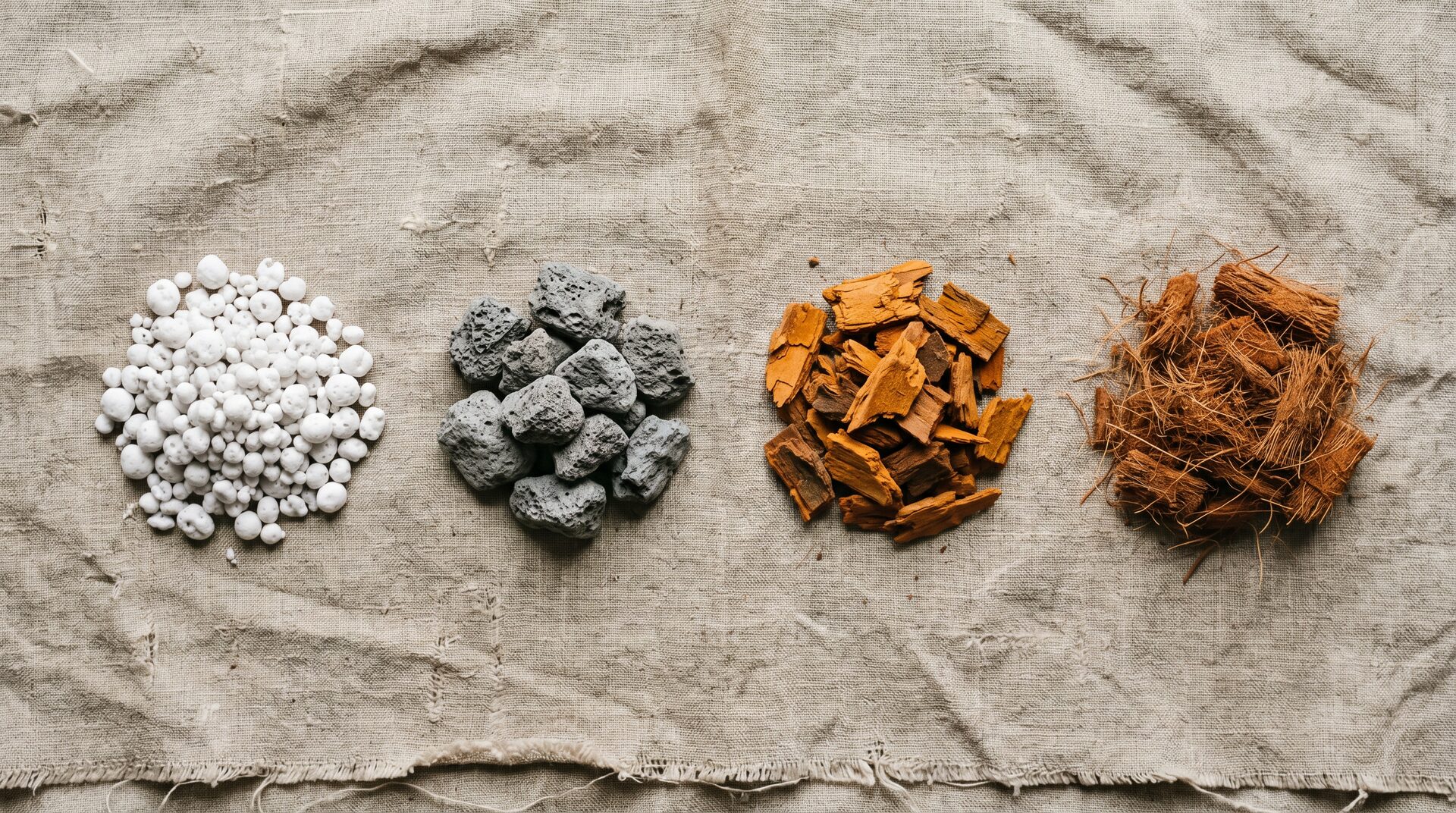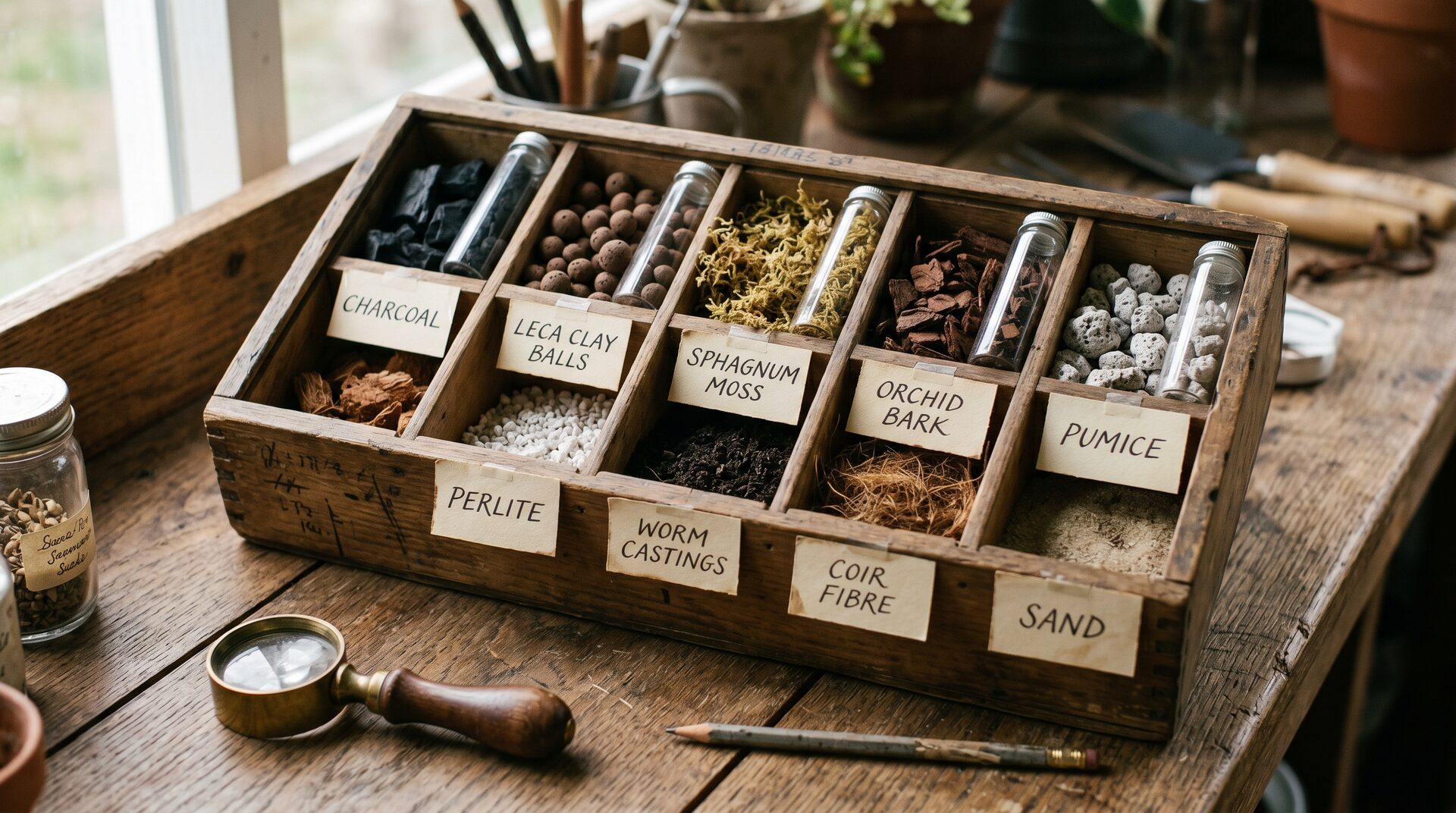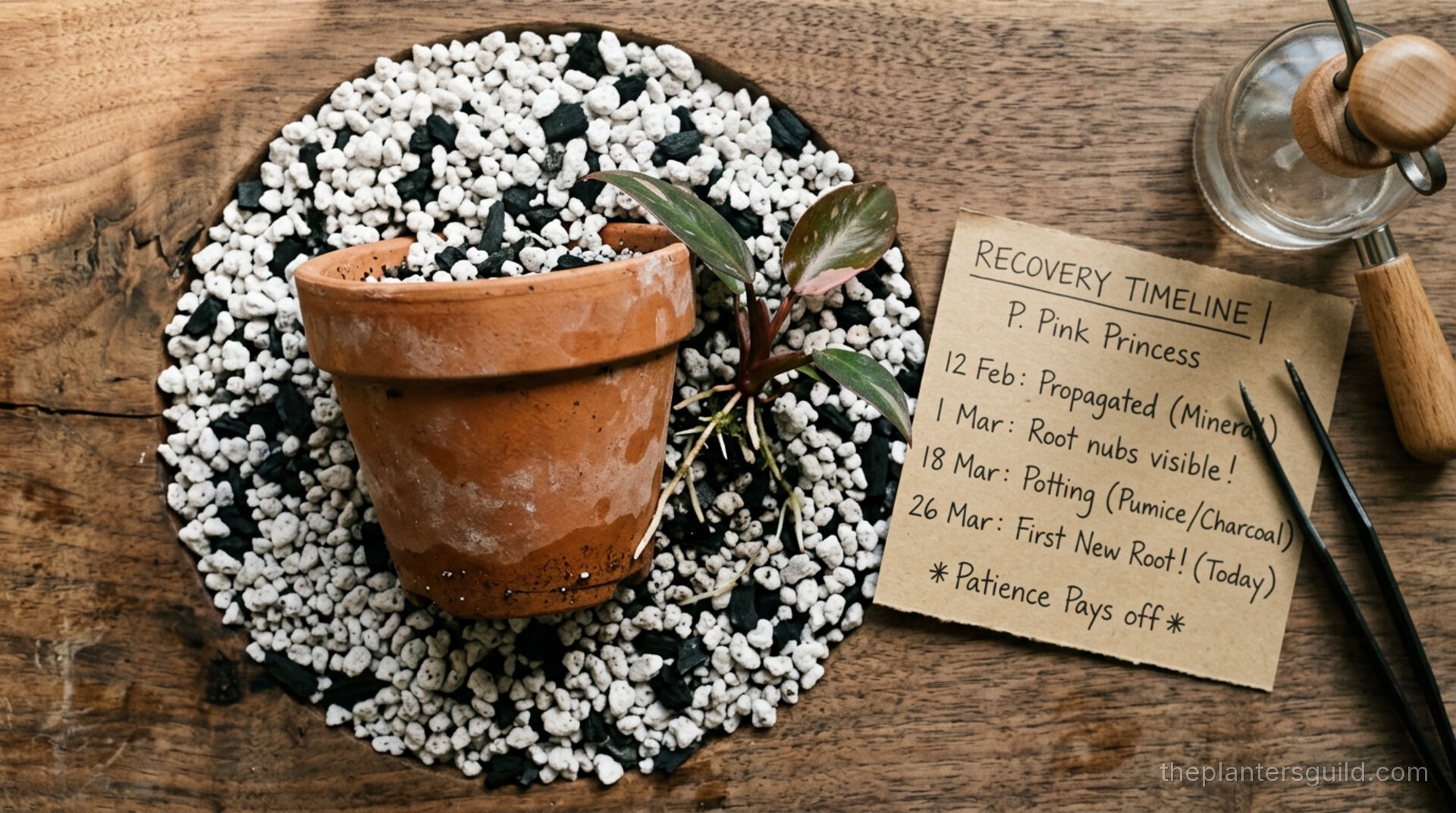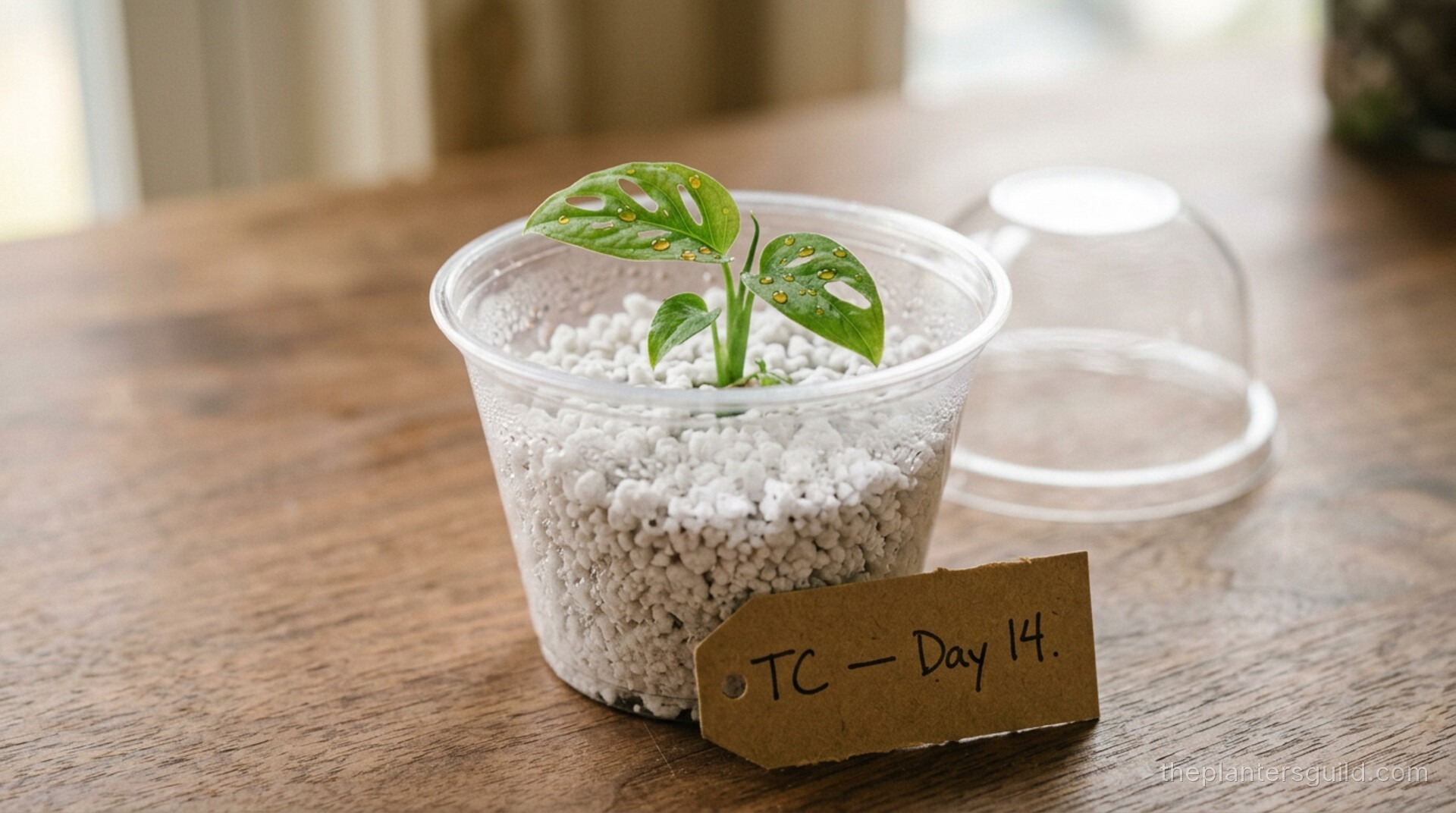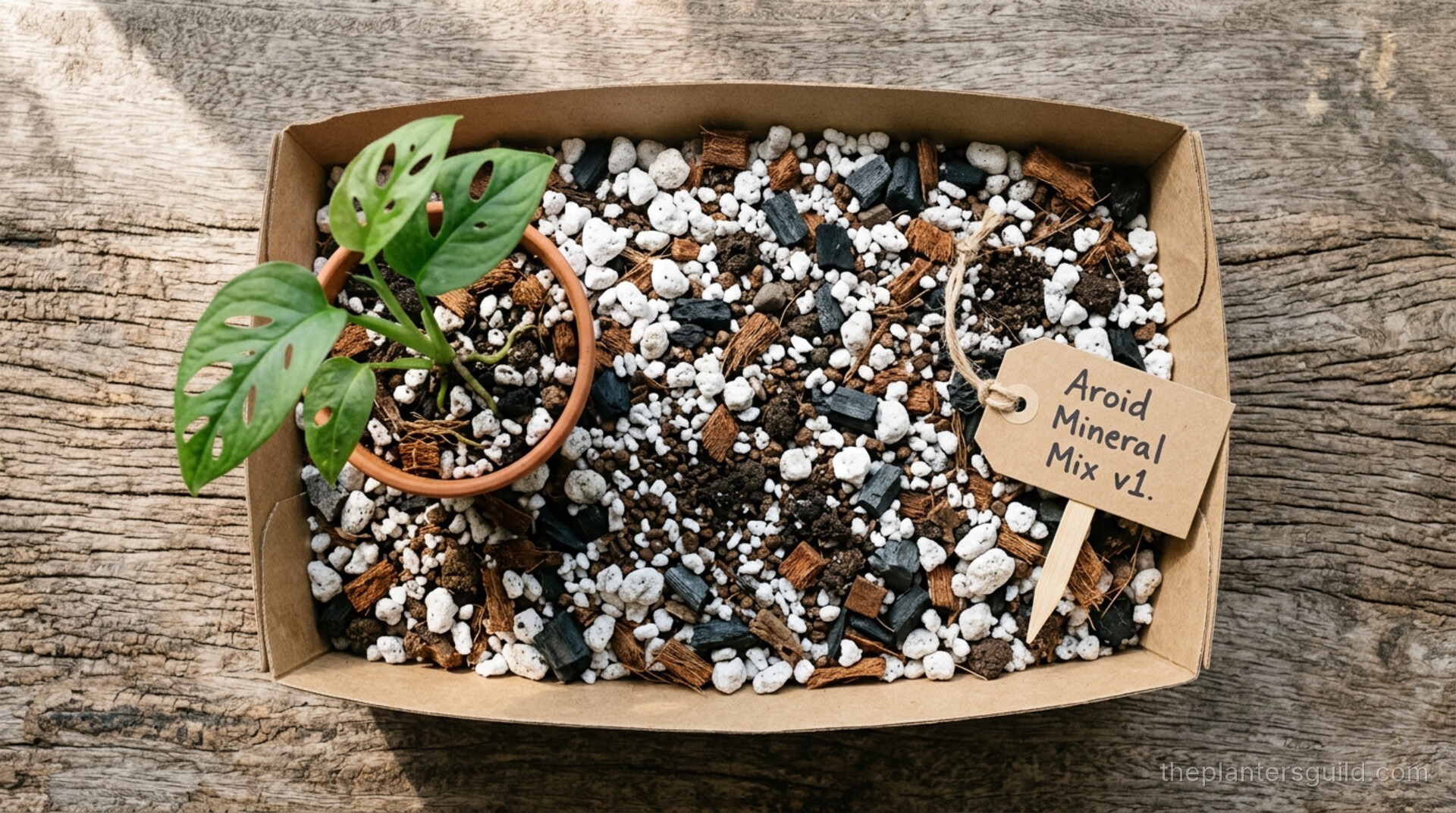
This is the mix we pot our climbing Philodendron, Monstera and Anthurium into: mostly mineral, with charcoal in place of bark.
Corrected September 2026: we've revised parts of this guide. See the correction note at the end.
Standard Mineral Mix is the Guild's everyday substrate. Aroid Mineral Mix is the one we use for the aroids we grow up a moss pole or a plank: climbing Philodendron, Monstera, many Anthurium and their relatives. It carries less organic matter than Standard Mineral Mix and, like it, no bark.
This is the Guild's own recipe, and there are other ways to do the job. UF/IFAS's production guide for Philodendron builds media from peat, pine bark, vermiculite or perlite (McConnell et al., n.d.). Anthura, a Dutch Anthurium company, says Anthurium substrates are now often "a high proportion of peat products supplemented, for example, by coir or perlite" (Anthura, n.d.). What the research does support is that roots in a pot need air as well as water (Bilderback et al., 2005), and a mostly mineral mix is one way to keep that air in.
The Recipe
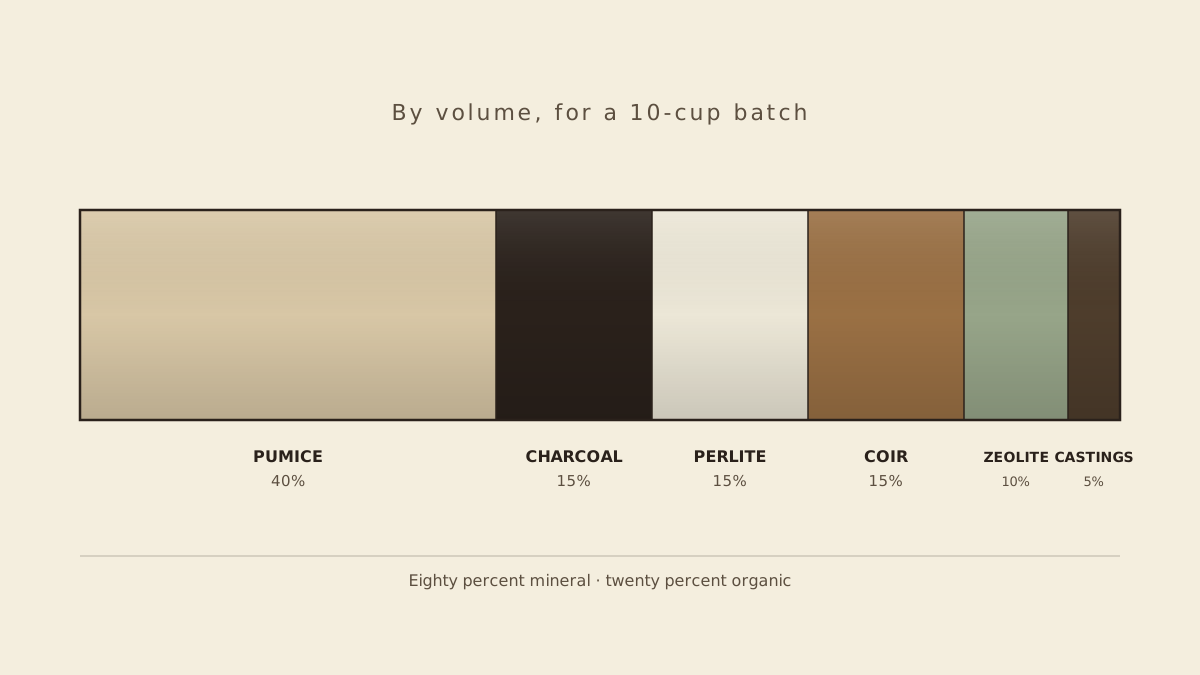
All percentages by volume. For a 10-cup batch:
| Ingredient | Percentage | Cups | Grade / Particle Size |
|---|---|---|---|
| Pumice (coarse) | 40% | 4.0 | 1/2 inch |
| Horticultural charcoal | 15% | 1.5 | 1/4 to 1/2 inch |
| Perlite (coarse) | 15% | 1.5 | #3 grade |
| Buffered coir | 15% | 1.5 | Medium pith |
| Zeolite (clinoptilolite) | 10% | 1.0 | 3 to 5 mm |
| Earthworm castings | 5% | 0.5 | Sifted |
Target pH: 6.0 to 6.5, the range UF/IFAS gives for Philodendron production (McConnell et al., n.d.).
Runoff EC target: 0.8 to 1.2 mS/cm by the pour-through method, which tests the salts in the water that drains out of the pot, the reading UF/IFAS calls appropriate for Anthurium indoors (Chen et al., n.d.).
Watering: when the top inch of mix is dry. Our rough starting point in a 4-inch terracotta pot is every 7 to 10 days, longer in plastic, and it moves with light, pot size, season and plant.
Refresh: about every 24 months, our practice.
Sourcing note: the exact pumice, horticultural charcoal, and worm castings I buy for this mix are on the Guild's recommendations page. Those are affiliate links.
Why Mostly Mineral
Air space is the reason. Shorter pots drain less after watering, so more of the mix's pores stay full of water and less air is left for roots (Virginia Cooperative Extension, n.d.). Organic components also break down over time into finer particles that hold more water and less air, while mineral aggregates such as pumice and perlite hold their size much longer (Bilderback et al., 2005). That's the reasoning behind a mostly mineral mix.
A mostly mineral mix doesn't keep all of its air space, though. In a study of fir bark amended with pumice, air space still fell over a year, with or without pumice, and roots growing into the pores made the drop larger (Altland et al., 2011). That's part of why we refresh the mix instead of treating it as permanent.
The trade-off is water and nutrients. A mostly mineral mix drains fast and holds few nutrients of its own, so the Guild's version adds coir for water, zeolite and castings for nutrients, and relies on steady feeding. We set the proportions at 80/20 as our own formulation; it isn't a figure we took from a study.
Why Each Ingredient Is There
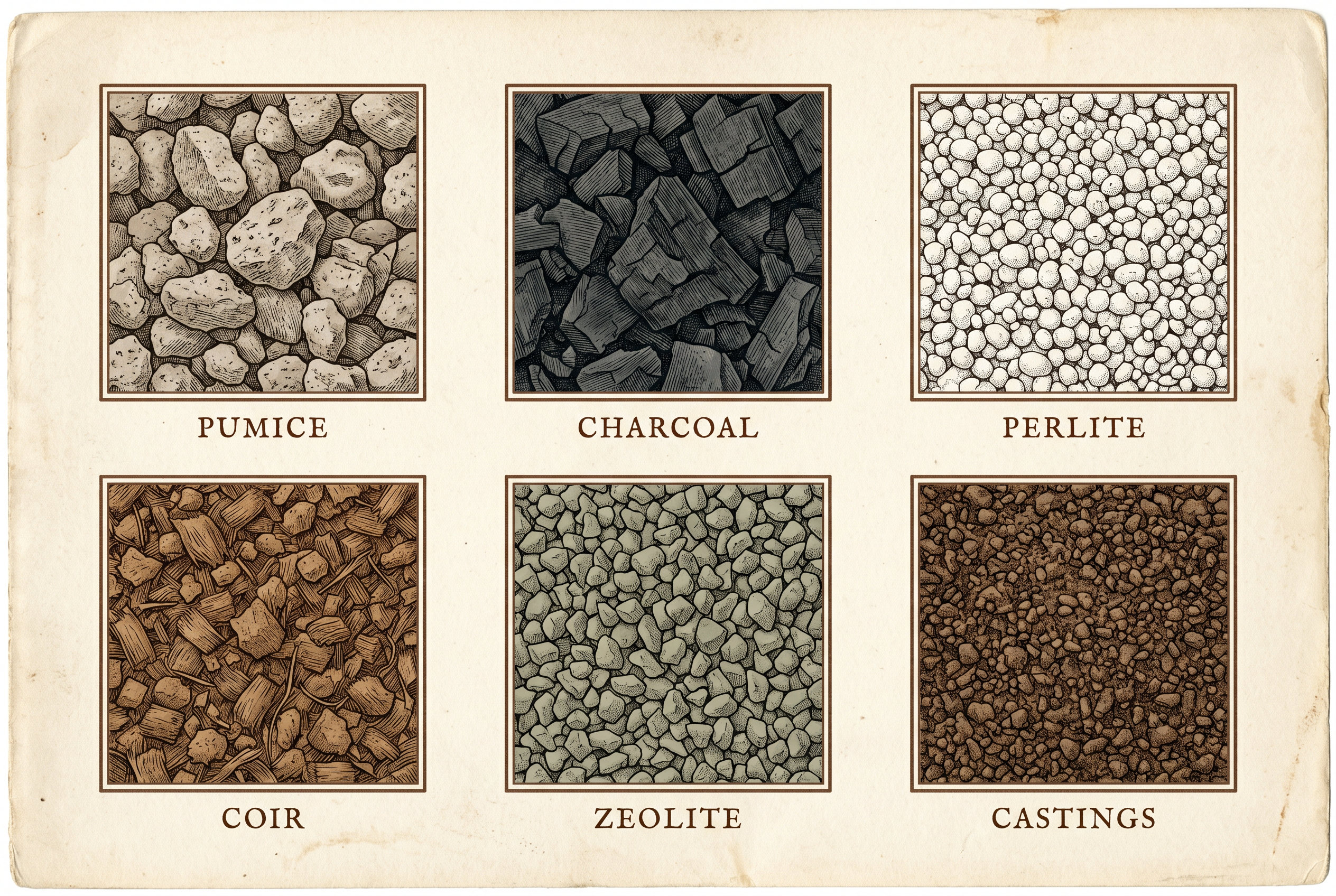
Coarse pumice (40%): the structure
Pumice holds a little water inside its pores, but it's the size of the pieces that gives a mix drainage and air space (Evans, n.d.). Grade matters in both directions. In a glasshouse trial on straight pumice, the finer grades had relatively low air-filled porosity (13.5% to 14.3%), which the authors call a disadvantage for plants grown in bags. The coarsest grade tested (4 to 8 mm) held very little easily available water, and coarse pumice held back gypsophila and cucumber yields in pots (Gizas & Savvas, 2007). Those were greenhouse crops in pure pumice, not aroids in a blended mix, but they show why we don't run the mix on pumice alone.
We use half-inch pumice in 4-inch pots and larger, and grade down to 1/4 inch in 3-inch and smaller pots. We haven't tested that cutoff; it's simply how we do it.
Horticultural charcoal (15%): our stand-in for bark
UF/IFAS lists pine bark among the ingredients for commercial Philodendron media (McConnell et al., n.d.). The Guild's substrate system leaves bark out, and one of our reasons is dust and spores for people who are sensitive to them. Mulching and composting can expose people to Aspergillus spores. That isn't a concern for most healthy people, but people who are asthmatic or have weakened immunity may be at risk from high spore levels (Minnesota Pollution Control Agency, 2005). Bark has real strengths too. Composted bark media can suppress some root diseases, though how well depends on the kind of bark and how the medium is made, and composted pine bark didn't suppress every disease tested (Hoitink, 1980).
So we chose charcoal for the chunky role instead. It isn't inert. Most biochars (the research term for charcoal made from plant material) raise the pH of container substrates, some raise salt levels, and results depend on what the charcoal was made from and how (Huang & Gu, 2019). In one study, biochar added a substantial amount of potassium to a soilless substrate (Altland & Locke, 2012). Treat it as an ingredient with its own chemistry, and check your runoff pH and EC after a new batch. For grades and specs, the Aroid Ingredient Glossary has the full breakdown.
Coarse perlite (15%): extra air between the chunks
Perlite doesn't break down in a mix, though it can crumble into smaller pieces when handled (Pinkerton et al., n.d.). We use #3 (coarse) grade to fill the gaps between the larger chunks. Don't breathe in perlite dust; put on a dust mask or dampen the perlite before you handle it (NC State Extension, n.d.-a).
Buffered coir (15%): the water buffer
Coir takes up water readily and doesn't need a wetting agent the way dry peat does (Evans, n.d.). It's the part of this mix that holds water between waterings.
Buy it buffered. Raw coir can carry potassium, sodium and chloride that raise its salt level, by how much depending on the source (Evans, n.d.). Before it's used, it should be washed with fresh water or with a calcium nitrate solution to leach those salts (Premier Tech Horticulture, n.d.). Our own habit is to check a new bag before using it: we look for a reading under 0.5 mS/cm in a 1:1.5 coir-to-water extract. We use medium pith rather than fine.
Zeolite, clinoptilolite (10%): the nutrient holder
Exchange capacity is a material's ability to hold nutrient ions such as potassium, calcium and ammonium so they don't wash straight out. Perlite has almost none (Evans, n.d.). Clinoptilolite zeolite runs about 2.25 meq/g (milliequivalents per gram, a measure of how many nutrient ions it can hold), or roughly 225 meq/100 g, and it prefers larger ions such as potassium and ammonium over sodium, calcium and magnesium (Mumpton, 1999). Coir runs 39 to 60 meq/100 g (Evans, n.d.), so by weight clinoptilolite holds roughly four to six times as much.
More isn't better. In a trial with beech seedlings in a peat substrate, seedlings grew best at 5% zeolite, and higher doses held back root growth, most clearly at 20% (Kučera et al., 2025). We use 10% of a much coarser grade, 3 to 5 mm, in a very different mix. That's our choice, and the trial doesn't tell us how our mix would compare.
Earthworm castings (5%): a small organic share
We keep castings the smallest part of the mix by choice, alongside the coir. Composts and vermicomposts can suppress some plant diseases, but the suppression is inconsistent (Jack & Nelson, 2010), so we don't count on it.
About the Roots
Climbing aroids aren't plants that live without soil. Croat describes most species in Philodendron section Philodendron, one of the genus's subgroups, as starting out on the ground or low on a tree trunk, then climbing, sometimes losing their connection with the ground as adults (Croat, 1997). Reviewing a study of a community of climbing aroids in Panama, Zotz and colleagues report that they "invariably maintained connections to the soil via adventitious roots," meaning roots that grow from the stem. The same review notes that some Anthurium and Philodendron start life on trees and later root into the soil (Zotz et al., 2021). In Epipremnum aureum, young plants creep along the ground on soil roots, and feeder roots from climbing stems grow down through the air until they reach the soil (Mantovani & Groba, 2026).
Their aerial roots vary. Philodendron that climb pressed against their support generally produce the most roots (Croat, 1997). Many Anthurium roots carry a velamen, a spongy covering of non-living cells like the one on orchid roots. A survey found one in almost 90% of the species studied, in epiphytic (tree-dwelling) and ground-dwelling species alike (Werner et al., 2024). How aroid roots respond to the surface they climb is still thinly studied (Yu et al., 2025). None of this says these plants need a mineral mix; as noted above, commercial growers use peat and bark mixes.
What We Use It For
These are the plants we suggest Aroid Mineral Mix for. It's our list, not a botanical grouping.
- Climbing Philodendron: P. melanochrysum, P. gigas, P. verrucosum, P. squamiferum, and others you're training up a pole or plank. P. gloriosum and P. pastazanum creep along the ground instead of climbing (CATE Araceae, n.d.), so we leave them off this list.
- Monstera: M. deliciosa, M. adansonii, M. dubia, M. obliqua, M. standleyana, especially once they're climbing.
- Anthurium: A. warocqueanum, A. veitchii, A. magnificum, A. forgetii. A. clarinervium grows among rocks in the wild (CATE Araceae, n.d.); if it stays too wet in a more organic mix, this one is worth a try. We keep most other Anthurium on Standard Mineral Mix.
- Rhaphidophora: R. tetrasperma, R. decursiva, R. cryptantha, R. korthalsii.
- Epipremnum: the E. aureum cultivars, once you give them something to climb.
- Scindapsus, climbing Syngonium and Cissus discolor.
If a plant is pushing aerial roots out the side of its pot looking for something to climb, give it a pole or plank. Whether it goes into this mix or Standard Mineral Mix is a judgment call, and ours usually turns on how hard it's climbing.
What We Don't Use It For
- A plant in active recovery. We use ICU Mix until the plant is pushing new growth and its new roots are established.
- A fresh-from-agar tissue culture plantlet. Those start on the Tissue Culture Acclimation mix.
- 'Birkin', 'White Knight' and most 'Pink Princess' hybrids. We keep these on Standard Mineral Mix by preference.
- Marantaceae. Goeppertia, Stromanthe and Ctenanthe want soil kept moist (NC State Extension, n.d.-b), and this mix dries fast.
- Hoya as a group. The genus runs to about 350 to 450 species (Rodda & Rahayu, 2022), too many for one blanket recommendation.
- A grower who doesn't feed. This mix holds few nutrients of its own, so it needs a regular feeding program (see below).
How to Use It
Mix it damp
Wear a dust mask and gloves when you mix. Perlite dust is the main concern (see above), and NSW Health advises a mask and gloves when handling potting mix and compost (NSW Health, 2022). Add water until the mix is evenly damp but not wet: it should hold its shape loosely when squeezed and break apart when tapped. Damp mixing keeps the dust down and wets the coir before it goes in the pot.
Pot size and material
Step up one pot size at a time, about 1 to 2 inches wider than the current pot for pots 8 inches or smaller (Colorado State University Extension, n.d.; NC State Extension, n.d.-a). A pot that's much too big leaves the roots sitting in mix that stays too wet (Virginia Cooperative Extension, n.d.). Terracotta is our default for this mix. Porous clay pots lose water through their walls and dry faster than plastic or glazed pots (Virginia Cooperative Extension, n.d.). Plastic and glazed ceramic work too; expect them to stay wet longer.
For a plant going onto a slab or into a hanging basket, use the mix as the rooting base and pack it lightly.
Watering
Water when the top inch of the mix feels dry; for small pots, the top half inch (University of Arizona Cooperative Extension, n.d.). Our rough starting point is every 7 to 10 days in a 4-inch terracotta pot, longer in plastic, and it will shift with light, pot size, season and plant. Use it as a place to begin checking, not a schedule.
When you water, water through. We pour until water has run from the drainage holes for about 10 seconds. Potting mixes that dry out can turn hydrophobic, meaning they shed water instead of soaking it up, and peat- and bark-based mixes are the most prone to it (Virginia Cooperative Extension, n.d.). Coir, the main organic ingredient here, absorbs water readily, unlike dry peat (Evans, n.d.). If the middle of the pot still stays dry, two or three slow waterings will help rewet it (Virginia Cooperative Extension, n.d.).
Feeding
A mix this mineral needs an ongoing feeding program. Pumice may carry some potassium and sodium but generally only trace amounts of other nutrients, and perlite has almost no exchange capacity (Evans, n.d.). Even the fertilizer charge in a bagged potting mix usually lasts only a couple of weeks (NC State Extension, n.d.-a).
Our practice is a balanced liquid feed at one-third to half label strength every other watering in the growing months, and every third watering as growth slows. Check the runoff with the pour-through method: 0.8 to 1.2 mS/cm is the range UF/IFAS gives for Anthurium indoors (Chen et al., n.d.). UF/IFAS writes these readings in dS/m, which gives the same number as mS/cm. For Philodendron indoors, UF/IFAS says to hold off on feeding once the salt reading reaches 2.0 dS/m or higher, and that watering through with plain water may help when they're above 3.0 (McConnell et al., n.d.).
Refresh
We refresh the mix about every 24 months. Air space in a pot falls as the organic part breaks down and as roots fill the pores (Bilderback et al., 2005; Altland et al., 2011). When we refresh, we wash and reuse the pumice and zeolite, and replace the charcoal, coir and castings.
Common Problems
Drying out faster than you can keep up with. Small pots and coarse mixes dry faster (Virginia Cooperative Extension, n.d.). If the roots have filled the pot, step up one size.
Mix staying wet for two weeks or more. Look at the pot size and the light first; a pot that's too big keeps the mix wet longer (see Pot size above).
Aerial roots not taking to the pole. Our practice is to keep a moss pole damp, wetting it whenever we water the pot.
Moving Plants On or Off This Mix
We move plants onto Aroid Mineral Mix:
- From Standard Mineral Mix, when they start climbing hard and putting out aerial roots.
- From ICU Mix, once recovery is complete and the plant is pushing new growth.
- From Tissue Culture Acclimation, once the plantlet is established and is a climbing aroid.
And off it:
- To Standard Mineral Mix, if a plant stops climbing.
- To ICU Mix, if it's in distress and needs recovery.
- Most often, into a larger pot of the same mix.
The Short Version
Four parts mineral (charcoal included) to one part organic, and no bark. It's the Guild's mix for the aroids we grow up a pole, one way among several to keep air in the pot. Pumice and perlite for structure, charcoal in place of bark (check your pH and runoff, since charcoal isn't inert), buffered coir for water, zeolite and castings for a little nutrient holding. Water when the top inch is dry, feed through the growing season, check the runoff, and refresh about every two years.
We review our guides against the research and extension guidance available at the time, and we correct them when a source doesn't say what we took it to say or when we can't find support for a point. In this review we corrected how we described the recipe's proportions (the recipe is unchanged), dropped our claim that these aroids evolved on bark, and corrected our care, safety, ingredient and plant-list details. We also fixed points we'd credited to sources that don't make them and removed claims we couldn't source, including observations we have no record of.
Go deeper in the free Apprenticeship: Module IV, What Substrate Is →
Altland, J. E., Owen, J. S., Jr., & Gabriel, M. Z. (2011). Influence of pumice and plant roots on substrate physical properties over time. HortTechnology, 21(5), 554–557. https://doi.org/10.21273/HORTTECH.21.5.554
Altland, J. E., & Locke, J. C. (2012). Biochar affects macronutrient leaching from a soilless substrate. HortScience, 47(8), 1136–1140. https://doi.org/10.21273/HORTSCI.47.8.1136
Anthura. (n.d.). Substrate Anthurium pot plants. https://anthura.nl/en/crop-optimization/anthurium-pot-advice/substrate-anthurium-pot-plants/
Bilderback, T. E., Warren, S. L., Owen, J. S., Jr., & Albano, J. P. (2005). Healthy substrates need physicals too! HortTechnology, 15(4), 747–751. https://doi.org/10.21273/HORTTECH.15.4.0747
CATE Araceae. (n.d.). Species descriptions of Philodendron gloriosum, P. pastazanum, P. melanochrysum, P. squamiferum, Monstera adansonii, M. dubia, M. obliqua, Anthurium clarinervium, Rhaphidophora tetrasperma, R. decursiva, R. cryptantha, R. korthalsii, and the genera Scindapsus and Syngonium. Via the GBIF species API. https://api.gbif.org/v1/species/2870786/descriptions
Chen, J., McConnell, D. B., Henny, R. J., & Everitt, K. C. (n.d.). Cultural guidelines for commercial production of interiorscape Anthurium (ENH956). UF/IFAS Extension. https://edis.ifas.ufl.edu/publication/EP159
Colorado State University Extension. (n.d.). 1316: Houseplants: Repotting. PlantTalk Colorado. https://planttalk.colostate.edu/topics/houseplants/1316-houseplants-repotting/
Croat, T. B. (1997). A revision of Philodendron subgenus Philodendron (Araceae) for Mexico and Central America. Annals of the Missouri Botanical Garden, 84(3), 311–704. https://www.missouribotanicalgarden.org/Portals/0/staff/PDFs/croat/Croat1997-RevisionOfPhilodendronMexicoAndCentral%20America.pdf
Evans, M. R. (n.d.). Unit 7: Substrates. Greenhouse Management Online, University of Arkansas. https://greenhouse.hosted.uark.edu/Unit07/Printer_Friendly.html
Gizas, G., & Savvas, D. (2007). Particle size and hydraulic properties of pumice affect growth and yield of greenhouse crops in soilless culture. HortScience, 42(5), 1274–1280. https://doi.org/10.21273/HORTSCI.42.5.1274
Hoitink, H. A. J. (1980). Composted bark, a lightweight growth medium with fungicidal properties. Plant Disease, 64(2), 142–147. https://scholar.lib.vt.edu/ejournals/JARS/v36n2/v36n2-hoitink.htm
Huang, L., & Gu, M. (2019). Effects of biochar on container substrate properties and growth of plants: A review. Horticulturae, 5(1), 14. https://doi.org/10.3390/horticulturae5010014
Jack, A. L. H., & Nelson, E. B. (2010). Suppression of Pythium damping off with compost and vermicompost [Final report]. Organic Farming Research Foundation; Cornell University. https://cwmi.css.cornell.edu/organicfarmingfinalreport.pdf
Kučera, A., Volánek, J., Tomášková, G., et al. (2025). Substrate enrichment with clinoptilolite: Limits and possibilities for container-grown seedling propagation. Journal of Soil Science and Plant Nutrition. https://doi.org/10.1007/s42729-025-02794-1
Mantovani, A., & Groba, Y. C. (2026). Sclerified cork outperforms the exodermis: Root water permeability decreases in the soil-to-canopy transition of the aroid vine Epipremnum aureum. Physiologia Plantarum, 178(2), e70779.
McConnell, D. B., Chen, J., Henny, R. J., & Everitt, K. C. (n.d.). Cultural guidelines for commercial production of interiorscape Philodendron (ENH893). UF/IFAS Extension. https://edis.ifas.ufl.edu/publication/EP150
Minnesota Pollution Control Agency. (2005). Aspergillus fungus spores from yard waste compost facilities (w-sw1-01). https://www.pca.state.mn.us/sites/default/files/w-sw1-01.pdf
Mumpton, F. A. (1999). La roca magica: Uses of natural zeolites in agriculture and industry. Proceedings of the National Academy of Sciences, 96(7), 3463–3470. https://doi.org/10.1073/pnas.96.7.3463
NC State Extension. (n.d.-a). Extension Gardener Handbook, chapter 18: Plants grown in containers. https://content.ces.ncsu.edu/extension-gardener-handbook/18-plants-grown-in-containers
NC State Extension. (n.d.-b). Extension Gardener Plant Toolbox: Goeppertia makoyana, Stromanthe sanguinea, Ctenanthe oppenheimiana, Philodendron erubescens. https://plants.ces.ncsu.edu/plants/philodendron-erubescens/
NSW Health. (2022, November 26). Stay safe from Legionnaires’ disease when gardening [Media release]. https://www.health.nsw.gov.au/news/Pages/20221126_00.aspx
Pinkerton, M. G., Whitman, B., Eason, H., & Gomez, C. (n.d.). Common media used in hydroponics (ENH1359). UF/IFAS Extension. https://edis.ifas.ufl.edu/publication/EP623
Premier Tech Horticulture. (n.d.). Coir: A component of growing media. PT Growers and Consumers. https://www.pthorticulture.com/en-us/training-center/coir-a-component-of-growing-media
Rodda, M., & Rahayu, S. (2022). Nine new species and one new subspecies of Hoya (Apocynaceae: Asclepiadoideae) from Borneo. Gardens’ Bulletin Singapore, 74(1), 101–129. https://doi.org/10.26492/gbs74(1).2022-08
University of Arizona Cooperative Extension. (n.d.). Interior plant selection and care. https://extension.arizona.edu/publication/interior-plant-selection-and-care
Virginia Cooperative Extension. (n.d.). Properly watering container houseplants (SPES-804). https://www.pubs.ext.vt.edu/SPES/spes-804.html
Werner, J. C., Albach, D. C., Can, L., & Zotz, G. (2024). The velamen radicum is common in the genus Anthurium, both in the epiphytic and terrestrial species. Diversity, 16(1), 18. https://doi.org/10.3390/d16010018
Yu, P., Weng, S., Zhang, B., Huang, Y., & Xu, F. (2025). Diverse climbing strategies in aroid vines: Functional adaptations and environmental drivers. Frontiers in Plant Science, 16, 1692444. https://doi.org/10.3389/fpls.2025.1692444
Zotz, G., Almeda, F., Arias, S., Hammel, B., & Pansarin, E. (2021). Do secondary hemiepiphytes exist? Journal of Tropical Ecology, 37, 286–290.