A recipe gets you part of the way there. The thinking behind it is what lets you adapt it. Here's how the Guild designs a substrate (the potting mix itself), working backward from what the roots need to a ratio that delivers it, so you can adjust a published mix for your own room.
Corrected September 2026: we've revised parts of this guide. See the correction note at the end.
A published recipe is tuned for somebody's conditions. Mix our Standard Mineral Mix exactly as written and it will behave one way in a humid greenhouse and another in a dry apartment, because humidity changes how fast potting mix dries out (Criscione & Holliday-Goulart, n.d.). The recipe isn't wrong in either place, but it wasn't built for both.
So this entry is a way of thinking about mixes rather than another recipe. How Substrate Actually Works covers the physics and The Aroid Ingredient Glossary covers the materials. This is where we put them together.
Start with the Target, Not the Ingredients
It's tempting to start with a bag of pumice and a bag of coir and stir until the mix looks right. The trouble is that even two batches of the same recipe can behave differently, because the particle sizes and moisture of the components vary (Bilderback et al., 2005). So we start with what the substrate has to do, and write that down first. We work from four properties.
Air-filled porosity (air space)
Air-filled porosity, often shortened to just air space, is the share of the pot that holds air once a thoroughly watered pot has finished draining. Purdue Extension calls air space an important property for root aeration and growth (Nemali, 2018).
For container substrates in general, nursery best-management guidance suggests about 10 to 30% air space by volume (Bilderback et al., 2005, summarizing the Southern Nursery Association's guide). That's a general range from commercial nursery production, not a target for any particular houseplant, and the authors note that no universally accepted standard exists. So we use plant type to tell us which way to lean, not to set a number. Epiphytic and climbing aroids, such as climbing Philodendron and epiphytic Anthurium, get our airiest mixes, general aroids sit in the middle, and moisture-loving Marantaceae (the family that includes Calathea) get the most water-holding material.
Container capacity (water held)
Container capacity is the water a mix holds in its small pores against gravity once the excess has drained (Nemali, 2018). The same nursery guidance puts it at about 45 to 65% by volume for container substrates generally, and you can estimate it by weighing a pot after it drains and again once the mix is completely dry (Bilderback et al., 2005).
Cation exchange capacity (CEC)
Cation exchange capacity is a mix's ability to hold positively charged nutrients on charged sites on its particles, called exchange sites, such as potassium, calcium, magnesium and ammonium, and release them to roots. It doesn't hold negatively charged nutrients such as nitrate, phosphate and sulfate (Pennisi & Thomas, 2023).
The sources don't agree on how much CEC matters in a soilless mix. Purdue Extension says low-CEC substrates need more frequent fertilizing and recommends a CEC of at least 6 to 15 milliequivalents per 100 cubic centimeters (Owen & Lopez, 2015). William Argo, summarizing research on peat, coir and bark substrates, says their CEC has little effect on supplying nutrients (Argo, 2004). We plan around feeding first. Coir and most composted organic matter bring meaningful CEC while perlite brings little (Owen & Lopez, 2015). Zeolite adds exchange capacity (Alotaibi, 2025), which is why two of our mixes, the ICU Mix and the Aroid Mineral Mix, carry 10% zeolite.
pH
pH controls which nutrients roots can take up (Pennisi & Thomas, 2023). University of Florida production guides give a pH of 6.0 to 6.5 for Anthurium and Philodendron (Chen et al., 2003; McConnell et al., 2003). For Calathea, the guide gives about 6.0 and lists low pH as a likely cause of browning at the leaf edges and tips (Chen & McConnell, 2006).
Ingredients set the starting point. Peat moss is very acidic (Pennisi & Thomas, 2023), and coir generally runs higher than peat (Owen & Lopez, 2015). Pumice is chemically inert at about pH 7.0 to 7.4 (Owen & Lopez, 2015). Biochar can be strongly alkaline or mildly acidic depending on what it's made from (Yu et al., 2023). Castings vary as well: one vermicompost (worm castings) used in container research tested at pH 4.8 (Yu et al., 2023), while manure-based castings used on their own gave readings of about pH 7.1 to 8.0 in the water draining from the pots in a poinsettia trial (Matta et al., 2008).
Over time, though, feeding and water matter more than the starting ingredients. Argo puts the long-run drift in pH mainly on the balance between ammonium in the fertilizer and the alkalinity of the irrigation water (Argo, 2003). The University of Georgia lists water alkalinity, the substrate, the fertilizer and the crop itself among the factors that set it (Pennisi & Thomas, 2023). So check pH now and then rather than trusting the recipe to hold it.
The Three-Layer Model in Practice
The Guild thinks about a mix in three layers, meaning three groups of ingredients blended together, not bands stacked in the pot. It's our model, not the only way to build a substrate. Purdue Extension notes that a well-prepared mix may contain only one to three components, and its examples include 100% pine bark (Owen & Lopez, 2015).
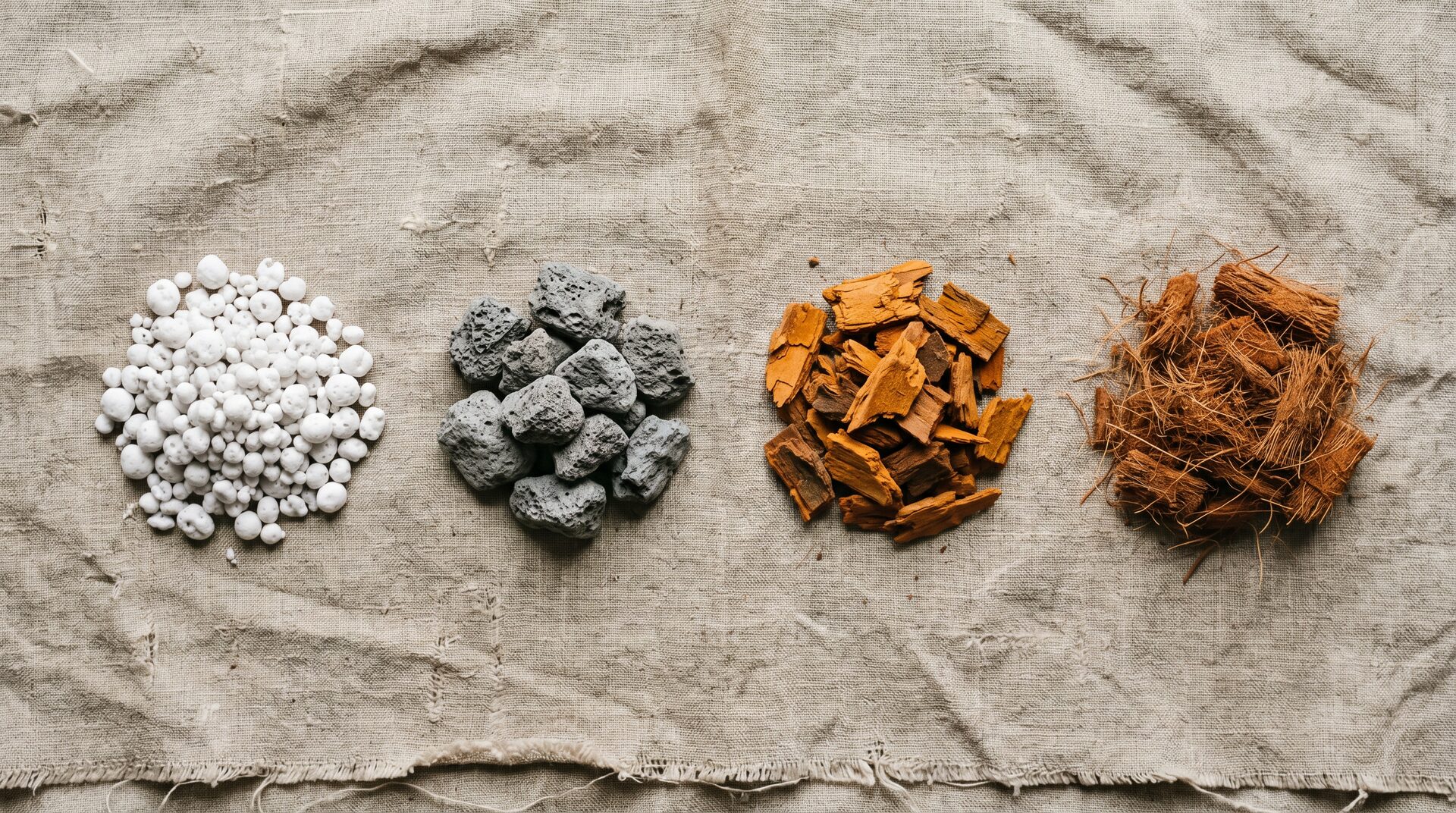
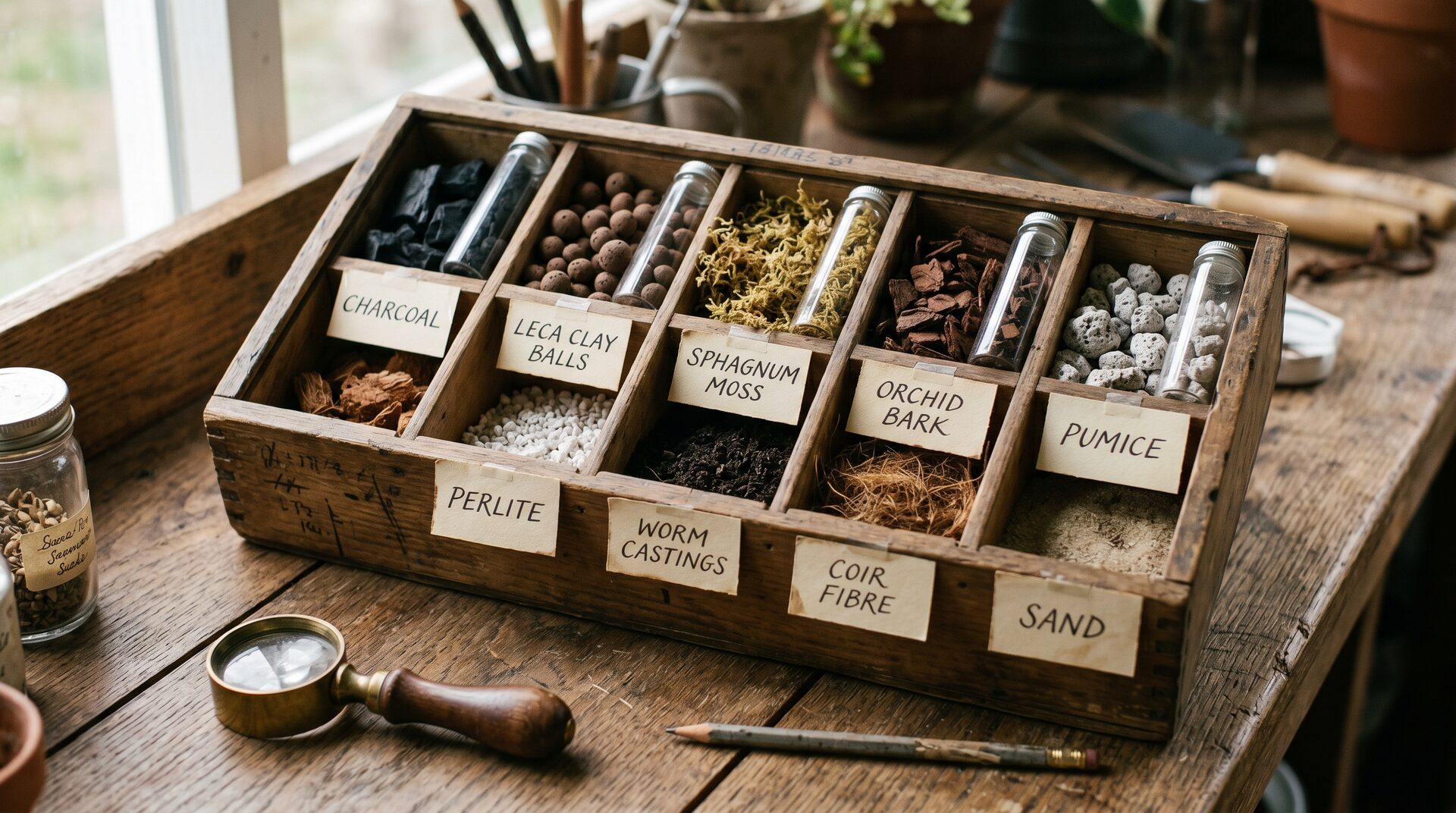
Structural minerals. Pumice, perlite, zeolite and horticultural charcoal, making up most of every mix below. Mineral aggregates don't decompose, or break down only slowly, and blending them with organics can reduce how much a mix's air and water properties change over time (Bilderback et al., 2005).
Water-holding organics. Buffered coir, and long-fiber sphagnum in some mixes. Coir holds water well and spreads it along its fibers to the roots (Owen & Lopez, 2015).
Biological inputs. Earthworm castings, 5 to 15% in our mixes. Vermicompost releases nitrogen, potassium, calcium, magnesium and phosphorus slowly, promotes beneficial microbes, and contains humic acids (Pathma & Sakthivel, 2012).
As a shortcut, the minerals mostly handle air, the organics handle water, and the castings handle nutrients, with help from zeolite in the mineral layer.
Adding mineral doesn't automatically add air, though. In one nursery study, mixing pumice into Douglas fir bark lowered air space when the pots were first filled, although the pumice mixes kept more of their air space over time as plants grew (Altland et al., 2011). The same components at the same ratio can also give different air and water figures when their particle sizes differ (Bilderback et al., 2005).
The Ratio Worksheet: How We Design a Mix
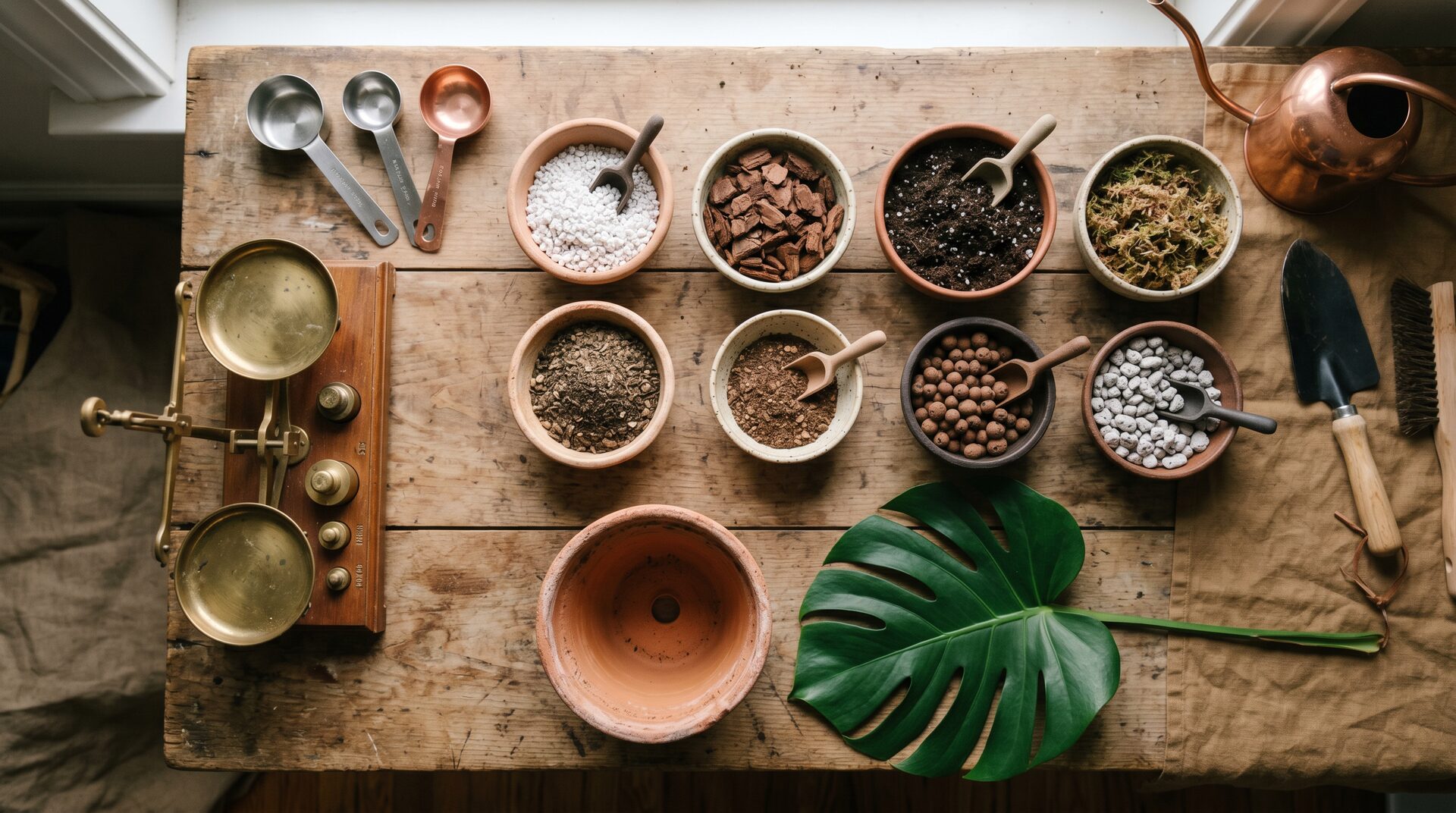
Here's how we build a mix, or adapt one of ours for different conditions.
Step 1
What are you growing, and what does it want?
A Monstera deliciosa and a Goeppertia orbifolia (sold as Calathea orbifolia) are not the same root-zone problem. Note the plant's native habitat, its growth habit (epiphyte, growing on other plants; hemiepiphyte, spending part of its life on them; or terrestrial, rooted in the ground) and what you've seen of its moisture tolerance. Then decide where it sits between our airiest and most water-holding mixes, as described above.
Step 2
Set the mineral-to-organic balance
This is the biggest single decision in how we design a mix. Counting castings with the organics and charcoal with the minerals, our starting ratios are:
- 80% mineral, 20% organic: epiphytic aroids and very wet rooms (our Aroid Mineral Mix)
- 70% mineral, 30% organic: plants in recovery (our ICU Mix)
- 65% mineral, 35% organic: general aroids and tropical collections in average indoor conditions (our Standard Mineral Mix)
- 55% mineral, 45% organic: moisture-loving Marantaceae
Commercial greenhouse mixes are typically peat-based. North Carolina State reported that most greenhouse mixes contained 30 to 60% peat moss, or peat plus composted pine bark, with vermiculite and perlite making up much of the rest (Fonteno et al., 1995). University of Florida production guides grow Anthurium in blends such as equal parts Canadian peat, perlite and bark (Chen et al., 2003). The Guild prefers a mineral-heavy mix, but it isn't a requirement.
When we're unsure, we lean mineral. It's easier to water a fast-drying pot more often than to dry out one that stays wet.
Step 3
Split up the minerals
Distribute the mineral share across structural ingredients. Our three published mixes show the range:
- Standard Mineral Mix: 35% pumice, 25% perlite, 5% charcoal, no zeolite
- ICU Mix: 35% pumice, 25% perlite, 10% zeolite
- Aroid Mineral Mix: 40% pumice, 15% charcoal, 15% perlite, 10% zeolite
Pumice is our default backbone. Purdue Extension describes pumice as lightweight, porous and chemically inert, perlite as a lightweight aggregate added for air space, and charcoal as an amendment in orchid bark mixes (Owen & Lopez, 2015). We use charcoal for structure in the Aroid Mineral Mix.
Step 4
Split up the organics
Buffered coir (sold pre-rinsed and calcium-treated) is the only water-holding organic in most of our mixes. For Marantaceae and other moisture-lovers, we split the coir-and-sphagnum part of the mix 70% buffered coir and 30% long-fiber sphagnum. For tissue-culture plantlets, follow the stages in our Tissue Culture Acclimation protocol rather than this worksheet.
Sphagnum is often called antimicrobial, but the effect found so far is narrow. In lab tests, sphagnan, a compound extracted from the moss, held back some bacteria only in its acid form and did nothing at neutral pH (Stalheim et al., 2009). Sphagnum moss can also carry the fungus behind sporotrichosis, a skin infection. Moss used to pack tree seedlings was linked to the largest outbreak of the infection documented in the United States at the time (Coles et al., 1992), and New York's health department advises avoiding skin contact with it (New York State Department of Health, n.d.). Wear gloves when you handle it.
Step 5
A little life
The Aroid Mineral Mix sits at 5% castings because it's built to be fed through the water, the ICU Mix uses 10%, and the Standard Mineral Mix uses 15%.
Step 6
Now adjust for where you grow
The ratios above assume average indoor conditions: roughly 50 to 65% relative humidity, daytime temperatures of 68 to 75°F (20 to 24°C) and a moderate watering schedule. If your conditions differ, adjust before you mix.
Adjusting for Your Actual Conditions
Here's how we think through the major adjustments to a published recipe.
Humidity
Below about 45% relative humidity (RH), we shift 5 to 10% of the mix from minerals to organics and add sphagnum. Indoors, low humidity increases transpiration (the water plants lose through their leaves), and most houseplants need watering more often (Criscione & Holliday-Goulart, n.d.).
Above about 75% RH, we shift 5 to 10% from organics to minerals, adding pumice or other minerals and cutting coir. In high humidity, potting mix doesn't dry out as quickly (Criscione & Holliday-Goulart, n.d.).
Temperature
In a room that's consistently above about 80°F (27°C), we treat the space like a dry one. Warm rooms can dry potting mix faster and raise how much water plants use (Criscione & Holliday-Goulart, n.d.). In a room that runs below about 65°F (18°C) in winter, we treat it like a humid one and lean mineral.
A wet root zone is a risk in warm and cool rooms alike. Pythium root rot is favored by high moisture (Wick & Madeiras, 2019), and Purdue Extension notes that one common Pythium species infects more often above 77°F (25°C) while another is most serious below 68°F (20°C) (Beckerman, n.d.).
Pot material
Unglazed terracotta lets water evaporate through its walls, so it tends to dry the mix faster than plastic, which loses water only from the drainage holes and the surface (Criscione & Holliday-Goulart, n.d.). Our recipes assume terracotta. Glazed ceramic doesn't lose water through its walls either, so in glazed and plastic pots the mix stays wet longer (Criscione & Holliday-Goulart, n.d.), and we go about 5% more mineral.
Glass and self-watering pots are a different system, and our recipes don't translate directly. Consider a semi-hydroponic setup instead, where the plant grows in an inert medium such as clay pebbles over a water reservoir.
Pot size and shape
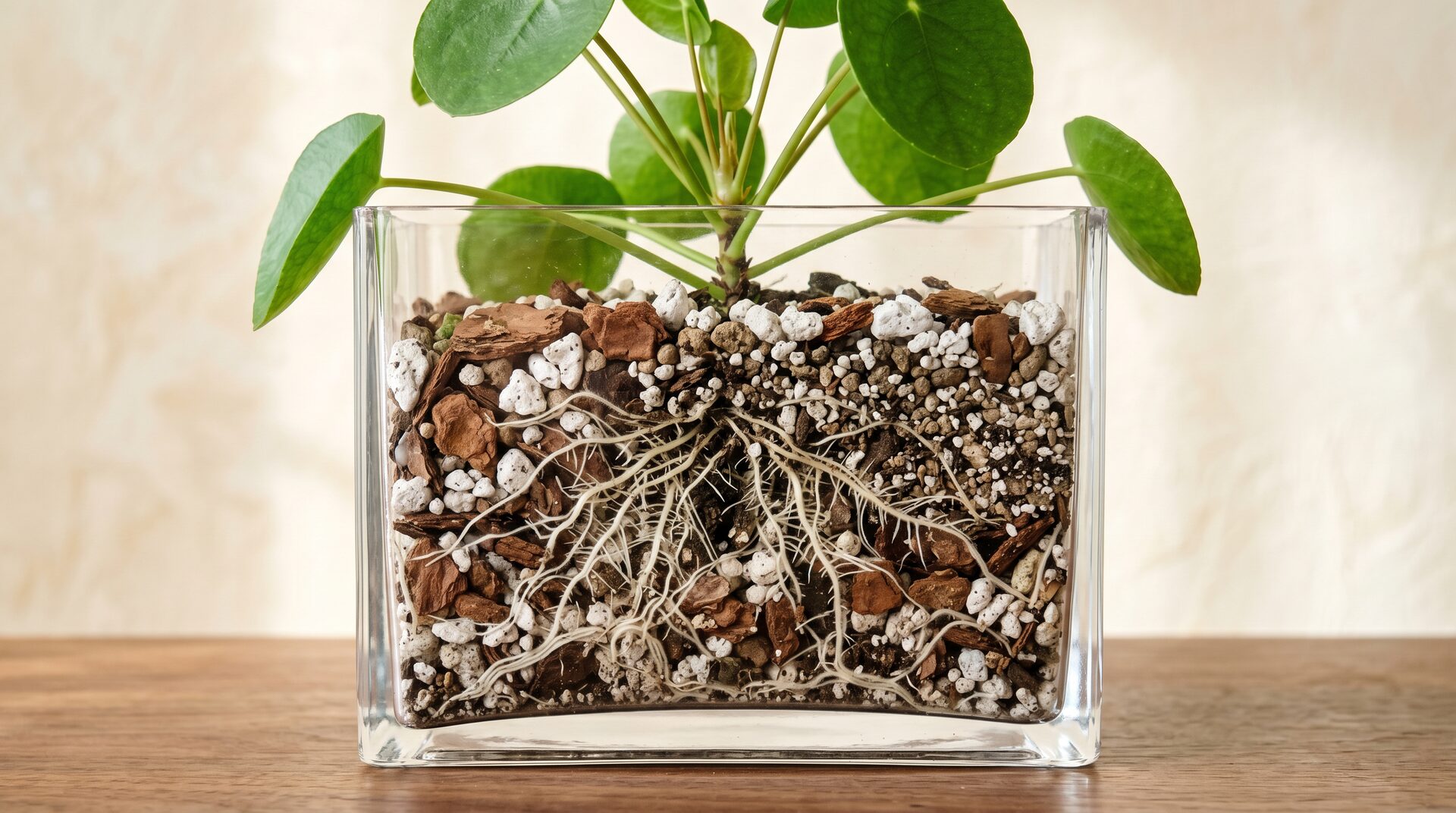
After watering, a saturated zone sits at the bottom of a pot. For a given mix, its depth stays about the same whatever the container's size or shape (Rowe, 2025, summarizing earlier studies), so in a short pot it takes up a bigger share of the volume. Put the other way round, taller containers of the same mix hold more air and less water overall (Owen & Altland, 2008). Virginia Cooperative Extension notes that height, not width, is what changes drainage (Criscione & Holliday-Goulart, n.d.).
Particle size shifts the picture too. Finer particles widen the difference between a wet bottom and a drier top, and coarser particles narrow it (Owen & Altland, 2008).
So small, short pots are where an airier mix helps most. We get that by leaning mineral-heavy in pots under about 4 inches (10 cm) tall, not by going to a coarser grade. There's a catch with small pots, though: a small pot holds so little mix that it tends to dry out faster and may need watering more often (Criscione & Holliday-Goulart, n.d.). A tall pot drains better on its own, so don't reach for a chunkier mix just because a pot is tall.
Fertilization style
Orchid growers use the saying "weakly, weekly", and an article in the American Orchid Society's Orchids magazine treats feeding a dilute solution at every watering, known as continuous liquid feed, as a different practice from feeding once a week (Bottom, 2023).
Zeolite adds exchange sites (Alotaibi, 2025), and exchange sites don't hold nitrate (Pennisi & Thomas, 2023), so zeolite doesn't replace feeding. How much we add depends on how much organic material a mix already has to hold nutrients, and on the plant: the ICU Mix carries 10% because a recovering plant isn't taking up nutrients reliably. The Standard Mineral Mix leaves it out because its coir and castings already do that job, while the lower-organic Aroid Mineral Mix carries 10%. If you feed heavily, the Standard Mineral Mix page suggests swapping 5% of the perlite for zeolite.
If you don't fertilize at all, our mineral-heavy mixes aren't a good fit. Either move toward a more organic mix or start feeding.
A Worked Example: One Recipe, Two Rooms
Here's the Standard Mineral Mix adapted for two example rooms.
Baseline · Standard Mineral Mix v5
Published baseline
- Pumice: 35%
- Perlite: 25%
- Buffered coir: 20%
- Earthworm castings: 15%
- Horticultural charcoal: 5%
For this example, the baseline room is about 60% RH and 70°F (21°C), with a terracotta pot and a quarter- to half-strength feed every other watering, the Standard Mineral Mix default.
Room A: a dry apartment
35% RH, 75°F (24°C), a plastic nursery pot, feeding once a month.
- Dry room → shift 5 to 10% from minerals to organics
- Plastic pot → shift about 5% back toward minerals
- Monthly feeding → no zeolite; the extra coir holds some nutrients, but feed more often if you can
Net change: minerals drop from 65% to 60% and organics rise from 35% to 40%.
Adapted · dry apartment
Standard Mineral Mix · dry-room variant
- Pumice: 35%
- Perlite: 20%
- Buffered coir: 23%
- Long-fiber sphagnum: 5%
- Earthworm castings: 12%
- Horticultural charcoal: 5%
Room B: a humid greenhouse
80% RH, 78°F (26°C), a glazed ceramic pot, a dilute feed at every watering.
- Humid room → shift 5 to 10% from organics to minerals
- Glazed pot → shift about 5% more toward minerals
- Dilute feed at every watering → no zeolite, as in the Standard Mineral Mix
Net change: minerals rise from 65% to 75%, organics drop from 35% to 25%, and there's no zeolite.
Adapted · humid greenhouse
Standard Mineral Mix · humid-room variant
- Pumice: 40%
- Perlite: 25%
- Horticultural charcoal: 10%
- Buffered coir: 15%
- Earthworm castings: 10%
When to Break from the Starting Recipe
A well-designed mix shouldn't need constant intervention. But sometimes the pot tells you clearly that the recipe needs adjusting.
- The mix stays wet noticeably longer than your other pots: first rule out a plant that isn't actively growing, a pot that's too big, or a mix that has compacted. If none of those fits, the mix may be too organic for your conditions. Shift toward minerals, or toward coarser grades.
- It dries out in under 48 hours in average conditions: first check whether the pot is very small. If it isn't, the mix may be too mineral or too coarse. Add organic material or use finer grades.
- Yellowing between the veins of older leaves: that pattern is called interveinal chlorosis. Where a deficiency shows first helps narrow it down. Magnesium deficiency appears first on older growth, and calcium deficiency on new growth (Shober & Denny, 2025). Coir is low in available calcium and magnesium (Abad et al., 2002), and coir-based mixes need more calcium than peat-based ones (Owen & Lopez, 2015). Check that your coir is sold as buffered and that your fertilizer supplies both nutrients.
- Older leaves turning pale and yellow: that suggests nitrogen deficiency (Shober & Denny, 2025). The fix is feeding, not a higher-CEC mix, because exchange sites hold ammonium but not nitrate, which leaches out easily (Pennisi & Thomas, 2023). Greenhouse guidance for underfed crops is to raise the fertilizer rate for a few feedings, then go back to the usual rate (Whipker et al., 2018).
- A white crust on the surface: usually a buildup of soluble salts (PlantTalk Colorado, n.d.), though hard water can leave mineral deposits too (University of Maryland Extension, n.d.). Flush the mix from the top with several potfuls of plain water (University of Maryland Extension, n.d.), and if the crust is fertilizer salt, feed less by cutting either the amount or how often you fertilize (Chen & McConnell, 2006).
- The mix smells sour: in mulch piles, sour and rotten-egg smells come from pockets with no air (UMass Extension, 2016), and our read is that a sour pot has the same problem. Go more mineral, or chunkier.
- Roots circle the pot wall and the center stays bare: that doesn't mean the wall is supplying air. Older container studies found that roots follow the wall because they can't grow through it (Davidson, 1961). Earlier work cited by Altland and colleagues also linked roots crowding the wall and the surface to low air space in the middle of the pot, caused by the wet zone at the bottom (Altland et al., 2011). Repot into a more mineral mix.
Common Design Mistakes
Over-designing. Ten ingredients at 3 to 10% each. It usually comes from wanting to include everything. It isn't wrong, but it isn't any better. At those low percentages you can't tell what any single ingredient is doing, and the mix is hard to reproduce. Five to seven ingredients is usually enough.
Not adjusting for pot height. Using the same mix in a 2-inch (5 cm) starter pot and an 8-inch (20 cm) pot. The short pot stays proportionally wetter, so lean airier in small, short pots.
Chasing perfection over consistency. Tweaking ratios based on one or two plants. Give a new formula at least two months and several plants before deciding.
Blaming the mix first. A struggling plant isn't always a substrate problem. Substrate is one variable; rule out pests, light and fertilizer first.
Not writing recipes down. If you're iterating, record exactly what you mixed each time, or you can't learn from the results. A small notebook or a spreadsheet column will change how fast you improve.
The Short Version
Design starts with what the roots need (air, water, nutrient holding and pH), not with a pile of ingredients. Our three-layer model is one way to answer those needs. Set the mineral-to-organic balance, fill each layer, then adjust for your room before you mix.
Humidity, temperature and pot material shift the balance between minerals and organics. The mix sets how deep the wet zone at the bottom of a pot is, and pot height decides how much of the pot it fills.
Start from a published recipe and tune it for your plants and your growing space.
With this framework, every recipe in the rest of the Substrate Library, such as the ICU Mix and the Aroid Mineral Mix, becomes a starting point you can reason about, not a formula to copy.
We review our guides against the research and extension guidance available at the time, and we correct them when a source doesn't say what we took it to say or when we can't find support for a point. In this review we corrected the guide's method for setting a mix's proportions, its pot size and shape, pH, nutrient and feeding advice, and air and water targets we had credited to sources that don't give them. We also removed claims we couldn't source, including Guild trials we have no record of.
End of the foundation reading
You've finished the Substrate Library's foundation reading.
The Root Zone (Foundation), How Substrate Actually Works (Going Deeper), The Aroid Ingredient Glossary (Reference), and now Designing a Mix (Practice). With the physics, the ingredients and the design framework in hand, the Guild's working recipes should make more sense.
Go deeper in the free Apprenticeship: Module IV, What Substrate Is →
Abad, M., Noguera, P., Puchades, R., Maquieira, A., & Noguera, V. (2002). Physico-chemical and chemical properties of some coconut coir dusts for use as a peat substitute for containerised ornamental plants. Bioresource Technology, 82(3), 241–245. https://pubmed.ncbi.nlm.nih.gov/11991072/
Alotaibi, A. M. (2025). An overview of zeolites: From historical background to diverse applications. Molecules, 30(20), 4036. https://doi.org/10.3390/molecules30204036
Altland, J. E., Owen, J. S., Jr., & Gabriel, M. Z. (2011). Influence of pumice and plant roots on substrate physical properties over time. HortTechnology, 21(5), 554–557. https://doi.org/10.21273/HORTTECH.21.5.554
Argo, B. (2003). Understanding pH management and plant nutrition. Part 3: Fertilizers. Journal of the International Phalaenopsis Alliance, 13(2). https://staugorchidsociety.org/PDF/IPAFertilizers.pdf
Argo, B. (2004). Understanding pH management and plant nutrition. Part 4: Substrates. Journal of the International Phalaenopsis Alliance, 13(3). https://staugorchidsociety.org/PDF/IPASubstrates.pdf
Beckerman, J. (n.d.). Pythium root rot of herbaceous plants (BP-181-W). Purdue Extension. https://www.extension.purdue.edu/extmedia/bp/bp-181-w.pdf
Bilderback, T. E., Warren, S. L., Owen, J. S., Jr., & Albano, J. P. (2005). Healthy substrates need physicals too! HortTechnology, 15(4), 747–751. https://doi.org/10.21273/HORTTECH.15.4.0747
Bottom, S. (2023, July). Fertilize weakly weekly. Orchids. American Orchid Society. https://www.aos.org/orchids/articles/fertilize-weakly-weekly
Chen, J., & McConnell, D. B. (2006). Cultural guidelines for commercial production of interiorscape Calathea (ENH1030). University of Florida, IFAS Extension. https://journals.flvc.org/edis/article/view/116741
Chen, J., McConnell, D. B., Henny, R. J., & Everitt, K. C. (2003). Cultural guidelines for commercial production of interiorscape Anthurium (ENH956). University of Florida, IFAS Extension. https://journals.flvc.org/edis/article/view/109136
Coles, F. B., Schuchat, A., Hibbs, J. R., Kondracki, S. F., Salkin, I. F., Dixon, D. M., Chang, H. G., Duncan, R. A., Hurd, N. J., & Morse, D. L. (1992). A multistate outbreak of sporotrichosis associated with sphagnum moss. American Journal of Epidemiology, 136(4), 475–487. https://pubmed.ncbi.nlm.nih.gov/1415167/
Criscione, K. S., & Holliday-Goulart, A. (n.d.). Properly watering container houseplants (SPES-804P). Virginia Cooperative Extension. https://www.pubs.ext.vt.edu/content/dam/pubs_ext_vt_edu/spes/spes-804/SPES-804.pdf
Davidson, O. W. (1961, April 1). Clay, plastic and other containers for plant culture. Minnesota State Florists’ Bulletin. University of Minnesota Agricultural Extension Service. https://hortscans.ces.ncsu.edu/uploads/c/l/clay_pla_543418275d72f.pdf
Fonteno, W. C., Bailey, D. A., & Nelson, P. V. (1995, August). Properties of greenhouse substrates. N.C. Flower Growers’ Bulletin, 40(4). North Carolina State University. https://hortscans.ces.ncsu.edu/uploads/p/r/properti_53ed0ad57a574.pdf
Matta, F. B., Hidalgo, P. R., Harkess, R. L., & Montgomery, E. J. (2008). Studies on earthworm castings as substrate for flowering pot plant production (Bulletin 1169). Mississippi Agricultural and Forestry Experiment Station, Mississippi State University. https://www.mafes.msstate.edu/publications/bulletins/b1169.pdf
McConnell, D. B., Chen, J., Henny, R. J., & Everitt, K. C. (2003). Cultural guidelines for commercial production of interiorscape Philodendron (ENH893). University of Florida, IFAS Extension. https://edis.ifas.ufl.edu/publication/EP150
Nemali, K. (2018). Understanding the pores of a soilless substrate (HO-287-W). Purdue Extension. https://www.extension.purdue.edu/extmedia/HO/HO-287-W.pdf
New York State Department of Health. (n.d.). Sporotrichosis [Fact sheet]. https://www.health.ny.gov/diseases/communicable/sporotrichosis/fact_sheet.htm
Owen, J. S., Jr., & Altland, J. E. (2008). Container height and Douglas fir bark texture affect substrate physical properties. HortScience, 43(2), 505–508. https://doi.org/10.21273/HORTSCI.43.2.505
Owen, W. G., & Lopez, R. G. (2015). Evaluating container substrates and their components (HO-255-W). Purdue Extension. https://www.extension.purdue.edu/extmedia/HO/HO-255-W.pdf
Pathma, J., & Sakthivel, N. (2012). Microbial diversity of vermicompost bacteria that exhibit useful agricultural traits and waste management potential. SpringerPlus, 1, 26. https://doi.org/10.1186/2193-1801-1-26
Pennisi, B. V., & Thomas, P. A. (2023). Essential pH management in greenhouse crops: pH and plant nutrition (Bulletin 1256). University of Georgia Cooperative Extension. https://fieldreport.caes.uga.edu/publications/B1256/
PlantTalk Colorado. (n.d.). Whitish crust on potting mixes (No. 1338). Colorado State University Extension. https://planttalk.colostate.edu/topics/houseplants/1338-whitish-crust-potting-mixes/
Rowe, A. (2025). Effect of drainage layers on water retention of potting media in containers. PLOS ONE, 20(2), e0318716. https://doi.org/10.1371/journal.pone.0318716
Shober, A. L., & Denny, G. C. (2025). Identifying nutrient deficiencies in ornamental plants. University of Delaware Cooperative Extension. https://www.udel.edu/academics/colleges/canr/cooperative-extension/fact-sheets/identifying-nutrient-deficiencies-in-ornamental-plants/
Stalheim, T., Ballance, S., Christensen, B. E., & Granum, P. E. (2009). Sphagnan: A pectin-like polymer isolated from Sphagnum moss can inhibit the growth of some typical food spoilage and food poisoning bacteria by lowering the pH. Journal of Applied Microbiology, 106(3), 967–976. https://doi.org/10.1111/j.1365-2672.2008.04057.x
UMass Extension. (2016, June 30). Hort notes: Beware of sour mulch. UMass Extension Landscape, Nursery & Urban Forestry Program. https://ag.umass.edu/landscape/news/hort-notes-beware-of-sour-mulch
University of Maryland Extension. (n.d.). Mineral and fertilizer salt deposits on indoor plants. Home and Garden Information Center. https://extension.umd.edu/resource/mineral-and-fertilizer-salt-deposits-indoor-plants
Whipker, B. E., Henry, J., & Owen, W. G. (2018). Corrective procedures for modifying substrate pH and electrical conductivity (EC). e-GRO Alert, 7(2). https://www.e-gro.org/pdf/2018_702.pdf
Wick, R. L., & Madeiras, A. (2019). Root diseases of greenhouse crops. UMass Extension Greenhouse Crops & Floriculture Program. https://ag.umass.edu/greenhouse-floriculture/fact-sheets/root-diseases-of-greenhouse-crops
Yu, P., Qin, K., Niu, G., & Gu, M. (2023). Alleviate environmental concerns with biochar as a container substrate: A review. Frontiers in Plant Science, 14, 1176646. https://doi.org/10.3389/fpls.2023.1176646