Walk into any garden center and the potting soil aisle is a wall of bags making the same promises. Fertile forest floor. Rich organic blend. Now with mycorrhizae. New and Improved! Turn the bags over, though, and most of them are built from the same few parts. You can't shop your way out of the confusion, but you can learn to read the label. The Guild uses two FoxFarm mixes, Happy Frog and Coco Loco, so this isn't a neutral lab report.
The Guild uses Happy Frog for ornamental flowers and Coco Loco for cucumbers, zucchini and herbs in containers. Its houseplants grow in the Guild's own mineral-forward mixes, not in bagged mix. So read this as a grower's working notes. We're not going to crown a single best bag. Instead, here are four questions you can ask of any bag on any shelf, before you've spent any money.
— Christopher · Founder, The Planters' Guild§ 01The four decisions in every bag
Every bag of potting mix is four decisions layered on top of each other. Once you can see them, the marketing copy matters a lot less.
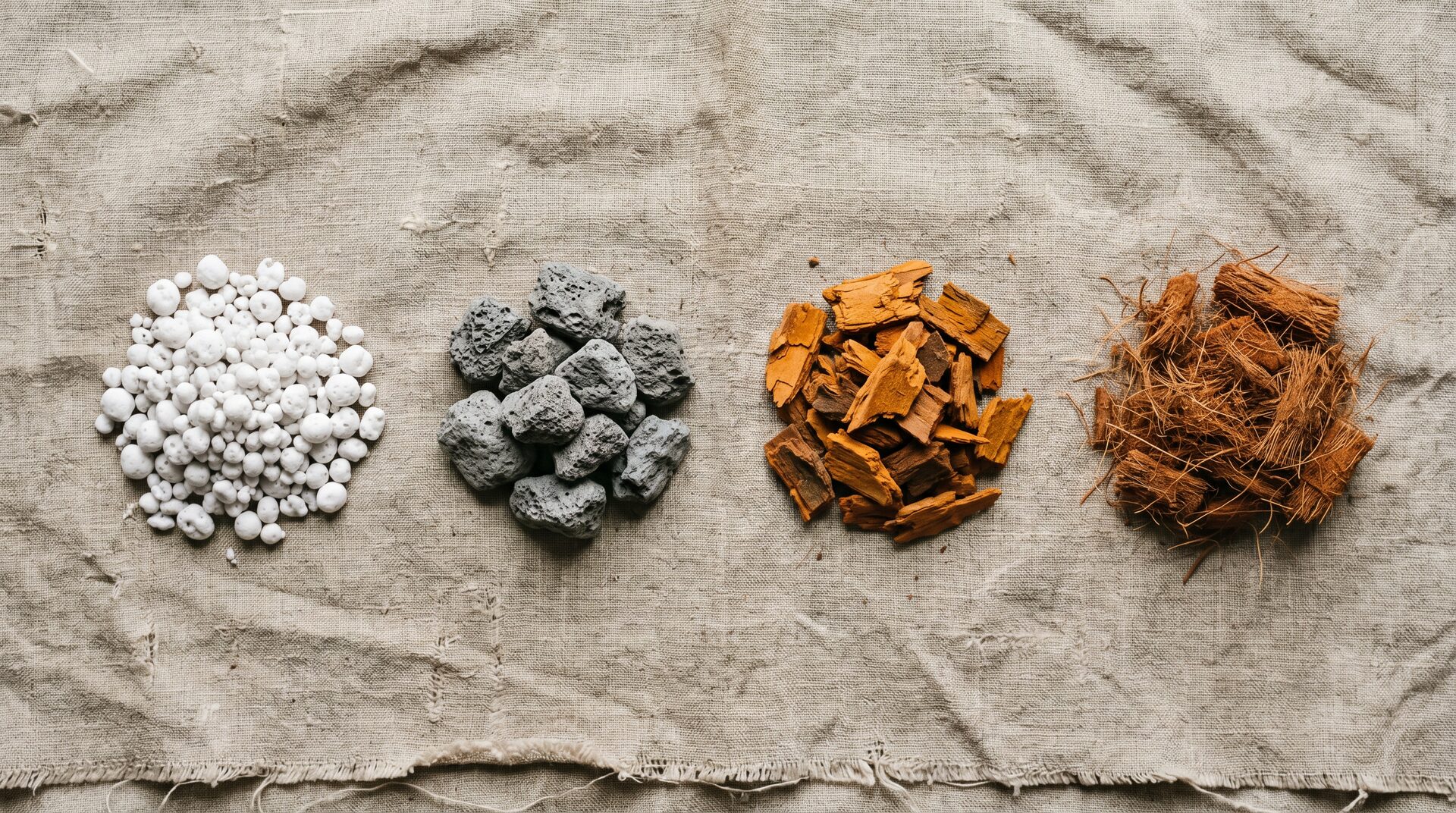
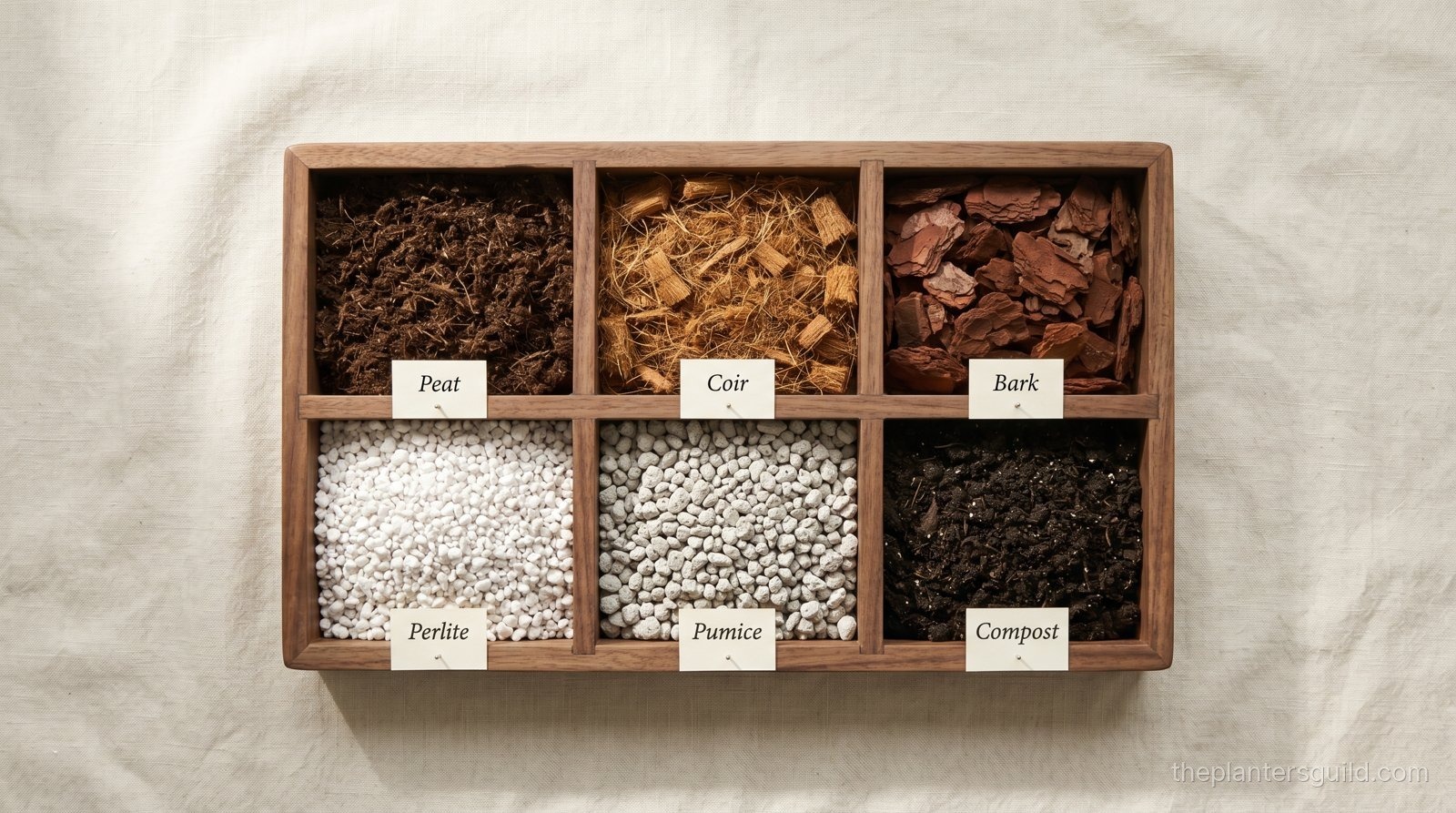
The base. This is the foundation of the mix, and it provides most of its water-holding capacity (Evans, n.d.-b). In soilless mixes it's usually sphagnum peat, sometimes coir (Grubinger, n.d.), and many bags add aged bark or other forest products. It's often the largest share of the bag: Pro-Mix BX, for example, lists sphagnum peat at 75 to 85 percent by volume (Premier Tech, 2024). Everything else adjusts from this one big choice.
The aeration. Perlite and pumice are added mainly for drainage and air. Perlite increases the share of large pores, which lowers water holding and raises air space (Evans, n.d.-a). Pumice holds a little water, but its larger particles mostly provide drainage and air (Evans, n.d.-a). Vermiculite is the odd one out: it holds a lot of water and adds nutrient-holding capacity (Evans, n.d.-a; UConn Home and Garden Education Center, 2016). So a bag that leans on perlite or pumice is built to drain, and one that leans on vermiculite is built to hold.
The charge. How much fertilizer is already mixed in. Some bags carry only a starter charge, and extension guidance is plain that those nutrients are soon used up, after which the plant needs regular feeding (UConn Home and Garden Education Center, 2016). Others carry fertilizer their makers say lasts longer: Miracle-Gro says its potting mix feeds for up to six months (ScottsMiracle-Gro, n.d.-a). For comparison, the controlled-release fertilizers used in container growing are rated to last from a few months to more than a year, and they release faster when it's warm (Pasian, 2013). Where the maker prints a guaranteed analysis (the three numbers, such as 0.30-0.30-0.05, in the table below), it tells you how much nitrogen, phosphate and potash the maker promises, so you can compare one bag's charge with another's.
The biology and pH. Mycorrhizae, beneficial bacteria, kelp, humic acid, plus lime. Unamended sphagnum peat runs at pH 3.0 to 4.5, so for most crops peat-based mixes are amended with ground limestone before plants go in (Evans, n.d.-a). The biology is the corner of the bag with the most marketing and the least disclosure, and it's where the next two sections spend most of their time.
That's the whole framework: base, aeration, charge, biology. Two terms are worth knowing, since the primer uses them. EC (electrical conductivity) measures the dissolved salts in a mix, which reflects either the fertilizer available or salts that have built up (Camberato et al., n.d.). Air-filled porosity is the share of the pot that's air after the mix drains, which is what roots breathe. If you want the physics under all of this, the root-zone primer goes deeper.
§ 02The clearest lesson on the shelf: peat versus coir
FoxFarm makes a handy comparison. Happy Frog is built on aged forest products and sphagnum peat (FoxFarm Soil & Fertilizer Company, n.d.-a). Coco Loco is built on coconut coir with aged forest products (FoxFarm Soil & Fertilizer Company, n.d.-b). Same company, same pitch, two different bases, sitting side by side on the shelf.
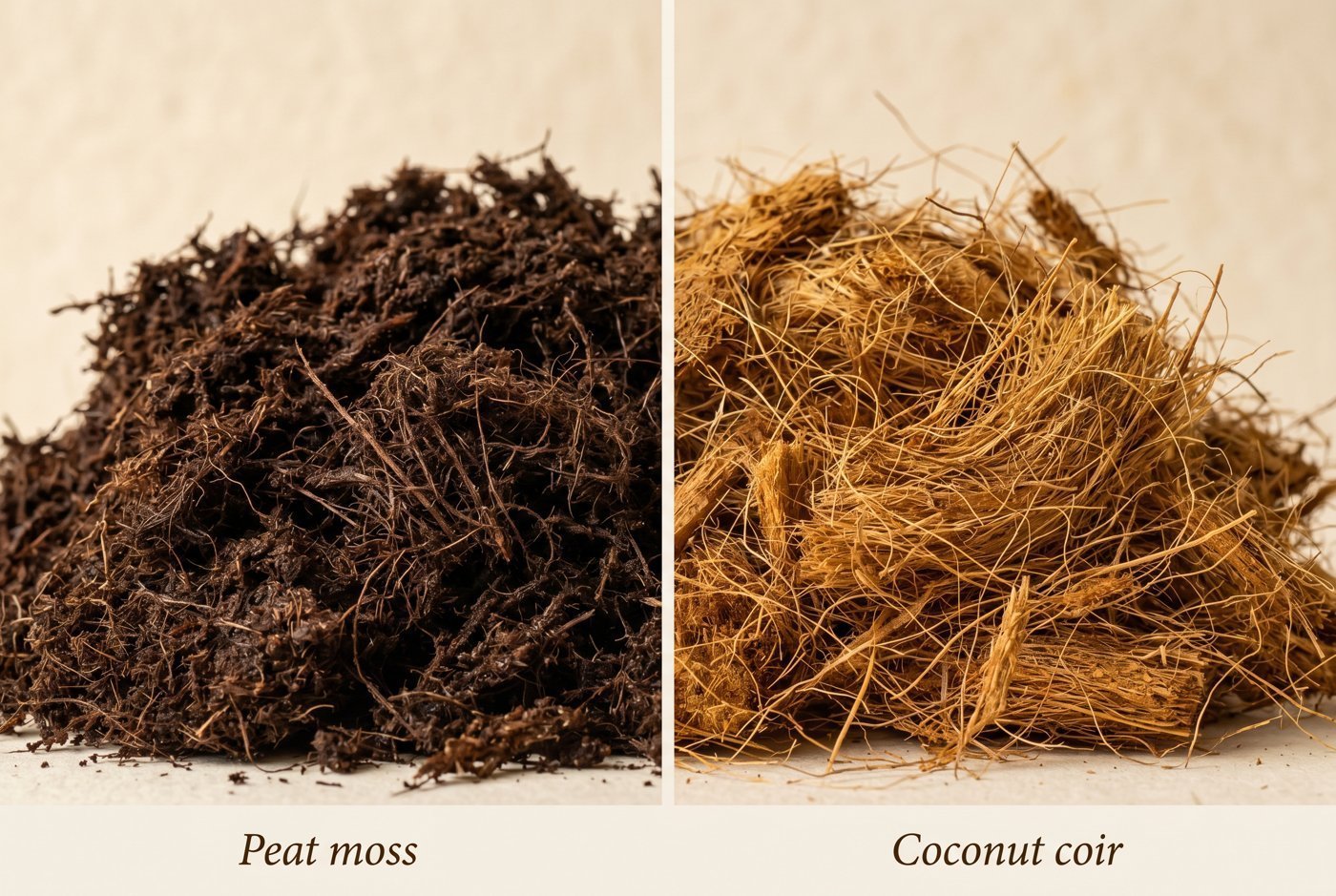
Start with the water. Sphagnum peat holds 60 to 68 percent of its volume as water (Evans, n.d.-a). Its well-known weakness is that it naturally repels water, and that shows most once it dries out. That makes rewetting a real problem, which is why some suppliers add a wetting agent (Robbins, 2018). You've seen this if you've ever watered a bone-dry pot and watched the water run straight out the bottom. In a lab rewetting test, dry peat with no wetting agent stayed far short of its capacity, though the authors note their peat sample may have been more water-repellent than usual (Fonteno et al., 2013).
Figures for coir vary between sources. Evans (n.d.-a) puts typical coir at 73 to 80 percent water by volume, slightly more than peat, while one lab comparison measured 42.5 percent for the coir it tested against 62.8 percent for its peat (Woznicki et al., 2023). Coir is easier to rewet after drying than peat (Robbins, 2018), but not immune: coir dried hard and given no wetting agent took up little water in lab tests (Fonteno et al., 2013; Fields et al., 2014). Robbins (2018) says coir's higher lignin content (lignin is the tough, woody part of plant fiber) makes it more resistant to microbial breakdown, so it may shrink less. That said, coir and peat were both fairly stable over three strawberry crops in the Woznicki et al. (2023) trial. Raw coir also carries potassium, sodium and chloride, which leach out easily (Evans, n.d.-a), and it's commonly washed, often with calcium nitrate, before use (Altland & Bugbee, 2026). FoxFarm says Coco Loco is triple-washed to reduce salt content (FoxFarm Soil & Fertilizer Company, n.d.-c).
Then there's where the base comes from. Northern sphagnum peatlands build up only about 1/85 to 1/36 inch (0.3 to 0.7 mm) of peat a year, so a layer about 3 feet (1 m) deep taken from one bog would take 1,400 to 3,300 years to replace at that spot (Altland & Bugbee, 2026, citing Vitt). Peat soils hold up to 44 percent of all soil carbon (International Union for Conservation of Nature [IUCN], 2021). The picture isn't one-sided, though. The same review calculates that Canada's peatlands as a whole grow peat far faster than horticulture harvests it, and concludes North American horticultural peat use is sustainable at current rates (Altland & Bugbee, 2026). Coir comes with its own costs: its processing uses a lot of water that's discharged to waste, and in the three life-cycle studies (which tally a product's environmental footprint from production to use) that measured broad environmental impact, coir pith came out with a higher impact than peat (Altland & Bugbee, 2026).
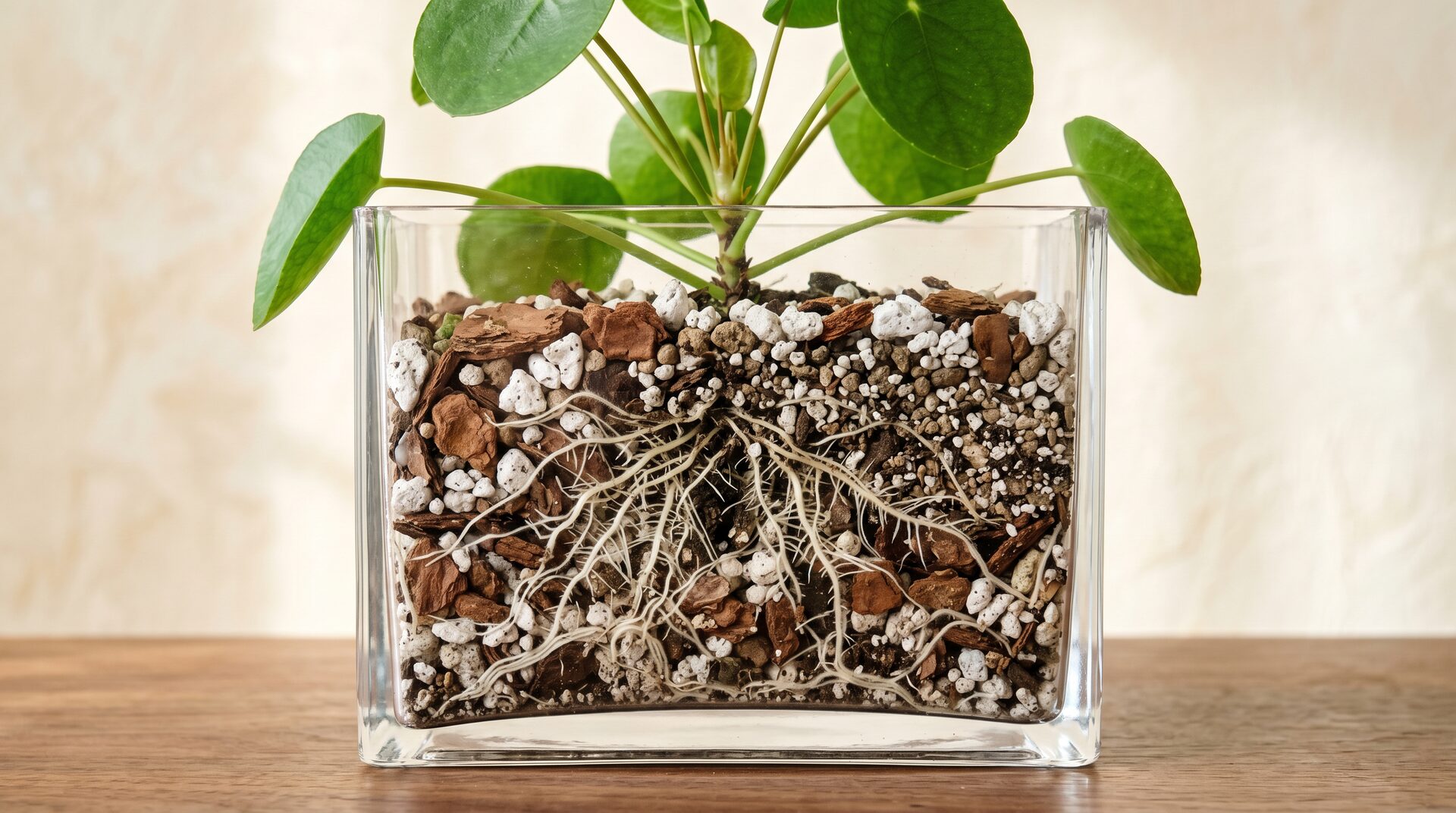
If you take a bagged mix indoors, expect fungus gnats to be a concern with any moist, organic mix, whatever its base (see § 05). Our suggestion is to open it up with coarse material such as pumice or perlite, or chunky bark or coco chips, before potting a houseplant.
§ 03The badge that doesn't earn its hype
Many premium bags now list added mycorrhizae. These are fungi that form partnerships with roots and help them take up water and nutrients. One common group, called arbuscular mycorrhizae, is especially good at taking up phosphorus (Epiphan, n.d.). Happy Frog's label lists 15 mycorrhizal species (FoxFarm Soil & Fertilizer Company, n.d.-a). Espoma adds its own blend, sold as Myco-tone (Espoma Company, n.d.). E.B. Stone's Recipe 420, Pro-Mix BX AGTIV REACH (the mycorrhizal version of BX) and Coast of Maine's Stonington Blend all list mycorrhizae too (E.B. Stone & Son, 2024; Premier Tech, n.d.; Coast of Maine Organic Products, n.d.-b). The underlying biology is real.
The problem is what's in the bag. A 2025 meta-analysis in New Phytologist pooled 302 inoculant trials and found that only 12 percent of the trials of commercial products both increased crop growth and showed good root colonization; most commercial inoculants gave minimal or no colonization (Koziol et al., 2025). A separate test of 23 inoculants (commercial products alongside lab-grown fungi and field soil) found that eight of the commercial products produced no colonization in any pot. For all but one product, the spore count ran 71 to 100 percent below the propagule count (the maker's tally of fungal units) on the product listing (Koziol et al., 2024). The same test found that inoculant products carrying more fertilizer of their own produced less colonization (Koziol et al., 2024). In an older study of bedding plants grown in peat-based media, inoculation did colonize the roots but didn't increase growth or phosphorus uptake (Koide & Besmer, 2000).
None of this is a mark against the mixes that carry mycorrhizae. It means "now with mycorrhizae" belongs near the bottom of your buying checklist, not the top.
§ 04What's in the premium bags
Strip away the label copy and the premium bags look a lot alike. Here's the lineup, taken from each maker's current label, product page or safety data sheet, and for Black Gold its organic listing certificate. We've left prices out on purpose, since cost per cubic foot swings by retailer, region and bag size, so check it at the shelf.
| Mix | Base | Aeration | Feed (per the label) | Also on the label |
|---|---|---|---|---|
| FoxFarm Happy Frog | Aged forest products + sphagnum peat | Perlite | 0.30-0.30-0.05 | Earthworm castings, bat guano; 15 mycorrhizal species |
| FoxFarm Coco Loco | Coconut coir + aged forest products | Perlite | 0.50-0.15-0.20 | Coir triple-washed; castings, bat guano; mycorrhizae |
| FoxFarm Ocean Forest | Aged forest products + sphagnum peat + sandy loam | Perlite | 0.30-0.45-0.05; maker says it feeds for about 3–4 weeks | Fish emulsion, crab meal, shrimp meal, castings, bat guano |
| Espoma Organic | Processed forest products + sphagnum peat + humus | Perlite | No analysis published; maker says feed at least monthly from two weeks after planting | Castings, alfalfa, kelp and feather meal; Myco-tone |
| Pro-Mix BX | Sphagnum peat (75–85%) | Perlite | Starter fertilizer; maker says begin feeding within 7–10 days | Limestone, wetting agent; mycorrhizae in the AGTIV REACH version (formerly BX Mycorrhizae) |
| E.B. Stone Recipe 420 | Aged forest products + coir + sphagnum peat | Pumice | No analysis on the web label; maker says to fertilize through the season | Castings, seabird and bat guano, crab meal, kelp; 3 mycorrhizal species |
| Coast of Maine Bar Harbor | Sphagnum peat + composted manure + aged bark | Perlite | 0.4-0.11-0.07 | Lobster and crab shell meal, kelp meal |
| Black Gold Natural & Organic | Bark + sphagnum peat + compost | Perlite + pumice or cinders | 0.09-0.03-0.03 | Castings; OMRI Listed |
| Miracle-Gro Potting Mix | Sphagnum peat + composted bark + coir (Canadian page; the US page lists none) | Perlite (Canadian page) | Maker says it feeds for up to 6 months | 0.21-0.11-0.16 on the Canadian page |
Label sources: (FoxFarm Soil & Fertilizer Company, n.d.-a; FoxFarm Soil & Fertilizer Company, n.d.-b; FoxFarm Soil & Fertilizer Company, n.d.-c; FoxFarm Soil & Fertilizer Company, n.d.-d; FoxFarm Soil & Fertilizer Company, n.d.-e; Espoma Company, n.d.; Premier Tech, 2024; Premier Tech, n.d.; E.B. Stone & Son, 2024; Coast of Maine Organic Products, n.d.-a; Sun Gro Horticulture, n.d.-a; Organic Materials Review Institute, 2021; ScottsMiracle-Gro, n.d.-a; ScottsMiracle-Gro, n.d.-d).
OMRI is the Organic Materials Review Institute, a nonprofit that reviews products meant for use in certified organic production (Organic Materials Review Institute, n.d.-a). An OMRI Listed seal means the product was reviewed and allowed for organic use; it isn't an organic certification of the product itself, which needs a separate certificate (Organic Materials Review Institute, n.d.-b). Black Gold's Natural & Organic mix in the table is one that carries the seal (Sun Gro Horticulture, n.d.-a; Organic Materials Review Institute, 2021).
The pattern jumps out once it's in a row. Almost all of them are a base, plus an aerator, plus a charge of meals and castings, often with a biology garnish. They differ at the edges: which base, how much feed, which meals. Two break the mold. Pro-Mix BX is a general-purpose peat mix with only a starter charge, and its maker says to begin feeding within 7 to 10 days after planting (Premier Tech, n.d.). Miracle-Gro is the other extreme, a mix its maker says feeds for up to six months (ScottsMiracle-Gro, n.d.-a).
Where the makers are
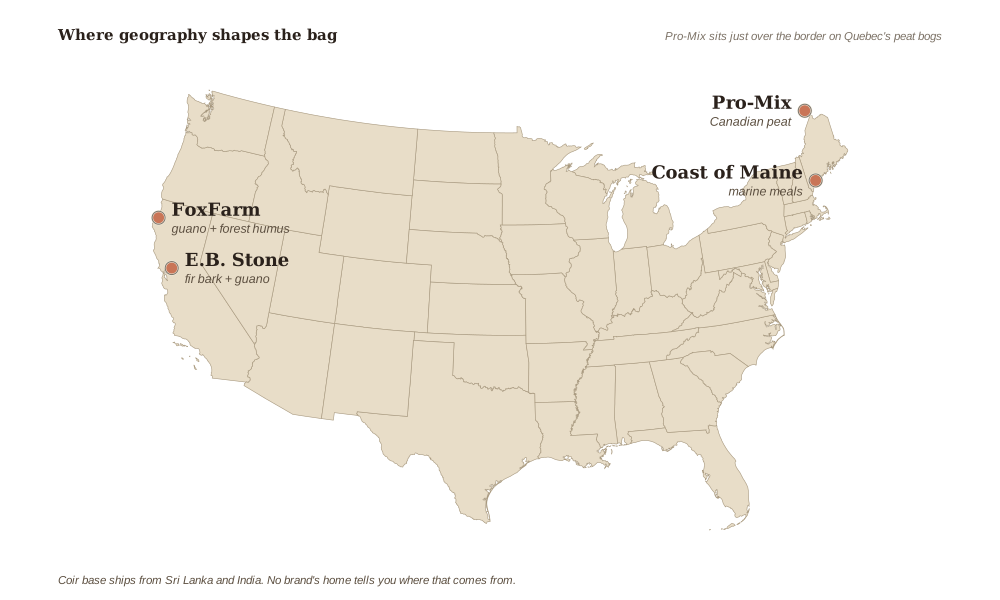
A few of these companies lean on ingredients that fit where they're based. Coast of Maine, headquartered in Portland, Maine, puts lobster and crab shell meal and kelp meal in its Bar Harbor Blend (Coast of Maine Organic Products, n.d.-a; Coast of Maine Organic Products, n.d.-c). Premier Tech, which makes Pro-Mix, is headquartered in Rivière-du-Loup, Quebec, and harvests peat in several Canadian provinces (Innovation, Science and Economic Development Canada, n.d.). FoxFarm (Arcata, California) and E.B. Stone (Suisun, California) both build on forest products and guano (FoxFarm Soil & Fertilizer Company, n.d.-d; E.B. Stone & Son, 2024; E.B. Stone & Son, n.d.-b). A company's address isn't where every ingredient comes from, though. India and Sri Lanka are the main coir exporters, whoever's name is on the bag (Austin et al., 2026).
§ 05The gnat question
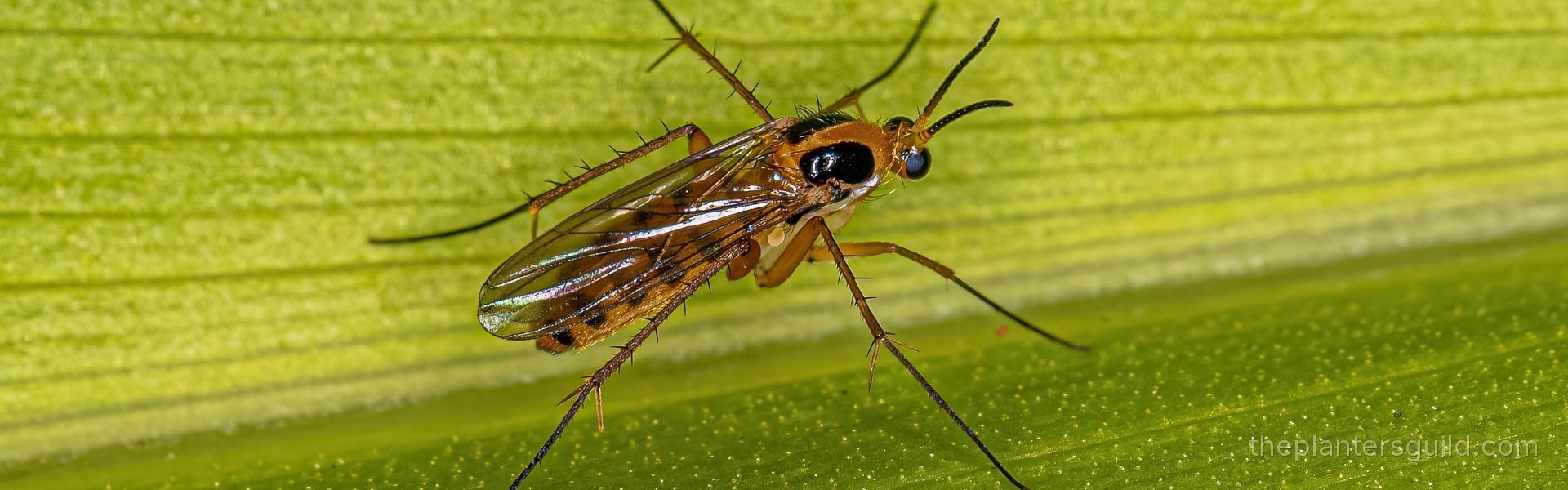
If you've used a living organic mix, you've probably met fungus gnats. Their larvae usually stay within the upper 2 to 3 inches of the mix, depending on how moist it is, and feed mainly on fungi, algae and decaying plant matter. The adults are strongly drawn to moist growing media (Cranshaw & Cloyd, 2003). That makes any moist, organic mix a candidate, whatever the brand. Switching bases doesn't solve it: fungus gnats live and breed as well in a coir-based mix as in a peat-based one (Cloyd, 2010), and in lab choice tests the number of eggs females laid in a coir mix didn't differ significantly from two other commercial mixes (Meers & Cloyd, 2006).
Some makers sell around the problem. Miracle-Gro says its Indoor Potting Mix is "designed to be less prone to gnats (contains no compost or bark, which are known to shelter fungus gnats)" (ScottsMiracle-Gro, n.d.-b). The most important thing you can do with any mix is let the top 1 to 2 inches dry between waterings (Cranshaw & Cloyd, 2003). Top dressings, a layer spread over the surface of the mix, are less certain than they sound: a layer of sand didn't stop adults emerging or females laying eggs (Cloyd, 2010), though a layer of recycled-glass aggregate reduced adult emergence over time (Cloyd, 2015). If they've already moved in, our fungus-gnats field guide has the full protocol.
§ 06Match the bag to the job
This is where it pays off. Four common jobs, and the bag we'd reach for.
Houseplants and aroids. The Guild's own houseplants grow in its mineral-forward mixes (that's the whole Substrate Library), not in bagged mix. If you want to stay with a bag, our suggestion is to start from Coco Loco or Happy Frog and mix in coarse material, such as orchid bark or chunky coco chips plus perlite or pumice, until it makes up at least half the mix, then let the top of the pot dry between waterings.
Container vegetables. Container vegetables need steady feeding once any starter charge is used up (UConn Home and Garden Education Center, 2016). For established transplants we'd reach for Ocean Forest. FoxFarm says it feeds for about three to four weeks (FoxFarm Soil & Fertilizer Company, n.d.-e), so plan to start feeding after that. For younger plants, our suggestion is Happy Frog, with feeding stepped up as they grow.
Raised beds. Extension advice is mixed. Minnesota Extension says potting soil isn't a good fit for raised beds because it dries out too fast, and suggests filling them with roughly half to two-thirds topsoil and the rest plant-based compost (Hoidal et al., n.d.). Maryland Extension, for a bed built on a hard surface, suggests compost and a soilless growing mix in equal parts (University of Maryland Extension, 2024). Cost is the other catch: buying enough prepared mix for a raised bed can be cost-prohibitive (Durham et al., 2018). Several makers sell blends labeled for raised beds, including E.B. Stone, Black Gold, Coast of Maine and Miracle-Gro (E.B. Stone & Son, n.d.-a; Sun Gro Horticulture, n.d.-b; Coast of Maine Organic Products, n.d.-d; ScottsMiracle-Gro, n.d.-c).
Seed starting and propagation. Here the rules change. Extension guidance is to germinate seeds in a sterile, fine-textured soilless mix (Peronto et al., 2021). Watch the salts: mixes made with compost can be high enough in salts to hold back germination (DuPont, 2025), and injury from too much fertilizer or high soluble salts can be mistaken for damping-off (Meadows, 2017). Damping-off itself is caused by several fungi and water molds, among them Pythium, Phytophthora and Rhizoctonia. It can attack a seedling before it comes up, or rot the stem where it meets the soil, or just under it, after it does (Mazzone, 2026). A bag labeled for seed starting is built for this job.
§ 07The bottom line
Brand matters less than you'd think. What you're buying is a base and a charge for a specific job. Once you can read those off the back of the bag, the aisle gets a lot simpler, and you stop paying extra for stickers. Read the bag, match the job, and watch how the plant responds.
Go deeper in the free Apprenticeship: Module IV, What Substrate Is →
Altland, J., & Bugbee, B. (2026). The limits of sustainability of peat as a soilless media for agriculture. Frontiers in Plant Science, 17, 1856037. https://doi.org/10.3389/fpls.2026.1856037
Austin, C. C., Parrish, S. B., Clark, D. G., & Wilkie, A. C. (2026). Kenaf core as an alternative soilless growing medium: A review. Plants, 15(4), 666. https://doi.org/10.3390/plants15040666
Camberato, D. M., Lopez, R. G., & Mickelbart, M. V. (n.d.). pH and electrical conductivity measurements in soilless substrates (HO-237-W). Purdue Extension. https://www.extension.purdue.edu/extmedia/ho/ho-237-w.pdf
Cloyd, R. A. (2010). Fungus gnat management in greenhouses and nurseries (MF2937). Kansas State University Agricultural Experiment Station and Cooperative Extension Service. https://bookstore.ksre.ksu.edu/pubs/fungus-gnat-management-in-greenhouses-and-nurseries_MF2937.pdf
Cloyd, R. A. (2015). Ecology of fungus gnats (Bradysia spp.) in greenhouse production systems associated with disease-interactions and alternative management strategies. Insects, 6(2), 325–332. https://doi.org/10.3390/insects6020325
Coast of Maine Organic Products. (n.d.-a). Bar Harbor Blend potting soil. https://coastofmaine.com/products/bar-harbor-premium-potting-soil
Coast of Maine Organic Products. (n.d.-b). Stonington Blend grower’s mix. https://coastofmaine.com/products/stonington-blend-super-soil
Coast of Maine Organic Products. (n.d.-c). Contact us. https://coastofmaine.com/pages/contact-us
Coast of Maine Organic Products. (n.d.-d). Castine Blend raised bed mix. https://coastofmaine.com/products/castine-blend-organic-raised-bed-mix
Cranshaw, W., & Cloyd, R. A. (2003). Fungus gnats as houseplant and indoor pests (Fact Sheet 5.584). Colorado State University Extension. https://extension.colostate.edu/resource/fungus-gnats-as-houseplant-and-indoor-pests
DuPont, T. (2025). Potting media and plant propagation. Penn State Extension. https://extension.psu.edu/potting-media-and-plant-propagation
Durham, R., Lee, B., & Osborne, A. (2018). Gardening in small spaces (ID-248). University of Kentucky Cooperative Extension Service. https://daviess.ca.uky.edu/sites/daviess.ca.uky.edu/files/ID248%20Gardening%20in%20small%20spaces.pdf
E.B. Stone & Son. (2024). Recipe 420 potting soil [Product label]. https://www.ebstone.org/wp-content/uploads/2024/06/70880-R1-EBS-420-Web-New-Trans-Potting-Soil-English.pdf
E.B. Stone & Son. (n.d.-a). Raised bed. https://www.ebstone.org/product/raised-bed-bag-1-5-cu-ft/
E.B. Stone & Son. (n.d.-b). About EB Stone. https://www.ebstone.org/about/
Epiphan, J. (n.d.). Mycorrhizal fungi, their benefits to plant health, and roles in resiliency (FS1384). Rutgers New Jersey Agricultural Experiment Station. https://njaes.rutgers.edu/FS1384/
Espoma Company. (n.d.). Potting mix. https://www.espoma.com/product/espoma-organic-potting-soil-mix/
Evans, M. R. (n.d.-a). Substrates, section 5: Common substrate components. University of Arkansas. https://greenhouse.hosted.uark.edu/Unit07/Section05.html
Evans, M. R. (n.d.-b). Substrates, section 6. University of Arkansas. https://greenhouse.hosted.uark.edu/Unit07/Section06.html
Fields, J. S., Fonteno, W. C., & Jackson, B. E. (2014). Hydration efficiency of traditional and alternative greenhouse substrate components. HortScience, 49(3), 336–342. https://doi.org/10.21273/HORTSCI.49.3.336
Fonteno, W. C., Fields, J. S., & Jackson, B. E. (2013). A pragmatic approach to wettability and hydration of horticultural substrates. Acta Horticulturae, 1013, 139–146. https://doi.org/10.17660/ActaHortic.2013.1013.15
FoxFarm Soil & Fertilizer Company. (n.d.-a). Happy Frog® potting soil [Label text]. https://foxfarm.com/translations_happyfrogpottingsoil/
FoxFarm Soil & Fertilizer Company. (n.d.-b). Coco Loco® potting mix [Label text]. https://foxfarm.com/translations_cocoloco/
FoxFarm Soil & Fertilizer Company. (n.d.-c). Bush Doctor® Coco Loco® potting mix. https://foxfarm.com/product/bush-doctor-coco-loco-potting-mix/
FoxFarm Soil & Fertilizer Company. (n.d.-d). Ocean Forest® potting soil [Label text]. https://foxfarm.com/translations_oceanforest/
FoxFarm Soil & Fertilizer Company. (n.d.-e). FAQ. https://foxfarm.com/faq/
Grubinger, V. (n.d.). Potting mixes for organic growers. University of Vermont Extension. https://www.uvm.edu/vtvegandberry/factsheets/pottingmix.html
Hoidal, N., Rosen, C., Salzer, T., & Thurmer, F. (n.d.). Raised bed gardens. University of Minnesota Extension. https://extension.umn.edu/planting-and-growing-guides/raised-bed-gardens
Innovation, Science and Economic Development Canada. (n.d.). Project highlights: Premier Tech, Canadian sphagnum peat moss innovators. https://ised-isde.canada.ca/site/industrial-technologies-office/en/technology-partnerships-canada-tpc/project-highlights/project-highlights-premier-tech-canadian-sphagnum-peat-moss-innovators
International Union for Conservation of Nature. (2021). Peatlands and climate change [Issues brief]. https://iucn.org/sites/default/files/2022-04/iucn_issues_brief_peatlands_and_climate_change_final_nov21.pdf
Koide, R. T., & Besmer, Y. L. (2000). Use of mycorrhizal fungi in horticultural production (Special Research Report No. 501). American Floral Endowment. https://hortscans.ces.ncsu.edu/uploads/u/s/use_of_m_52027aac93750.pdf
Koziol, L., Lubin, T., & Bever, J. D. (2024). An assessment of twenty-three mycorrhizal inoculants reveals limited viability of AM fungi, pathogen contamination, and negative microbial effect on crop growth for commercial products. Applied Soil Ecology, 202, 105559. https://doi.org/10.1016/j.apsoil.2024.105559
Koziol, L., McKenna, T. P., & Bever, J. D. (2025). Meta-analysis reveals globally sourced commercial mycorrhizal inoculants fall short. New Phytologist, 246(3), 821–827. https://doi.org/10.1111/nph.20278
Mazzone, J. D. (2026). Safeguard your seedlings from damping-off. Penn State Extension. https://extension.psu.edu/safeguard-your-seedlings-from-damping-off
Meadows, I. (2017). Damping-off in flower and vegetable seedlings. NC State Extension. https://content.ces.ncsu.edu/damping-off-in-flower-and-vegetable-seedlings
Meers, T. L., & Cloyd, R. A. (2006). Female fungus gnats’ favorite places. Greenhouse Product News. https://gpnmag.com/article/female-fungus-gnats-favorite-places/
Organic Materials Review Institute. (2021). OMRI Listed certificate: Sun Gro Black Gold Natural & Organic Potting Mix Plus Fertilizer. https://www.sungro.com/wp-content/uploads/2026/08/sgh-14583_Sun-Gro-Black-Gold-Natural-Organic-Potting-Mix-Plus-Fertilizer-Resilience-Silicon-Enriched-0.09-0.03-0.03.pdf
Organic Materials Review Institute. (n.d.-a). OMRI. https://www.omri.org/
Organic Materials Review Institute. (n.d.-b). Frequently asked questions. https://www.omri.org/faq
Pasian, C. (2013). Controlled-release fertilizers in the production of container-grown floriculture crops (HYG-1260). The Ohio State University. https://ohioline.osu.edu/factsheet/HYG-1260
Peronto, M., Wertheim, F., & Fournier, E. (2021). Starting seeds at home (Bulletin #2751). University of Maine Cooperative Extension. https://extension.umaine.edu/publications/2751e/
Premier Tech. (2024). Safety data sheet: PRO-MIX BX family. https://www.pthorticulture.com/sites/ptgc_pro/files/2024-07/sds-pro-mix-bx-family_3.pdf
Premier Tech. (n.d.). PRO-MIX® BX AGTIV REACH®. https://www.pthorticulture.com/en-us/products/pro-mix-bx-mycorrhizae
Robbins, J. A. (2018). Growing media for container production in a greenhouse or nursery, part I: Components and mixes (FSA6097). University of Arkansas System Division of Agriculture. https://www.uaex.uada.edu/publications/pdf/fsa-6097.pdf
ScottsMiracle-Gro. (n.d.-a). Miracle-Gro® potting mix. https://scottsmiraclegro.com/en-us/brands/miracle-gro/products/potting-mix/miracle-gro-potting-mix/75678301.html
ScottsMiracle-Gro. (n.d.-b). Miracle-Gro® indoor potting mix. https://scottsmiraclegro.com/en-us/brands/miracle-gro/products/potting-mix/miracle-gro-indoor-potting-mix.html
ScottsMiracle-Gro. (n.d.-c). Miracle-Gro® raised bed soil. https://scottsmiraclegro.com/en-us/brands/miracle-gro/products/raised-bed-in-ground-soils/73959430.html
ScottsMiracle-Gro. (n.d.-d). Miracle-Gro® potting mix [Canada]. https://scottsmiraclegro.com/en-ca/brands/miracle-gro/products/potting-mix/miraclegro-potting-mix.html
Sun Gro Horticulture. (n.d.-a). Black Gold® Natural & Organic Potting Mix. https://www.sungro.com/retail-product/black-gold-natural-organic-potting-mix/
Sun Gro Horticulture. (n.d.-b). Black Gold® Natural & Organic Raised Bed & Potting Mix. https://www.sungro.com/retail-product/black-gold-natural-organic-raised-bed-potting-mix/
UConn Home and Garden Education Center. (2016). Potting media. University of Connecticut. https://homegarden.cahnr.uconn.edu/factsheets/potting-media/
University of Maryland Extension. (2024). Soil to fill raised beds. https://extension.umd.edu/resource/soil-fill-raised-beds
Woznicki, T., Kusnierek, K., Vandecasteele, B., & Sønsteby, A. (2023). Reuse of coir, peat, and wood fiber in strawberry production. Frontiers in Plant Science, 14, 1307240. https://doi.org/10.3389/fpls.2023.1307240