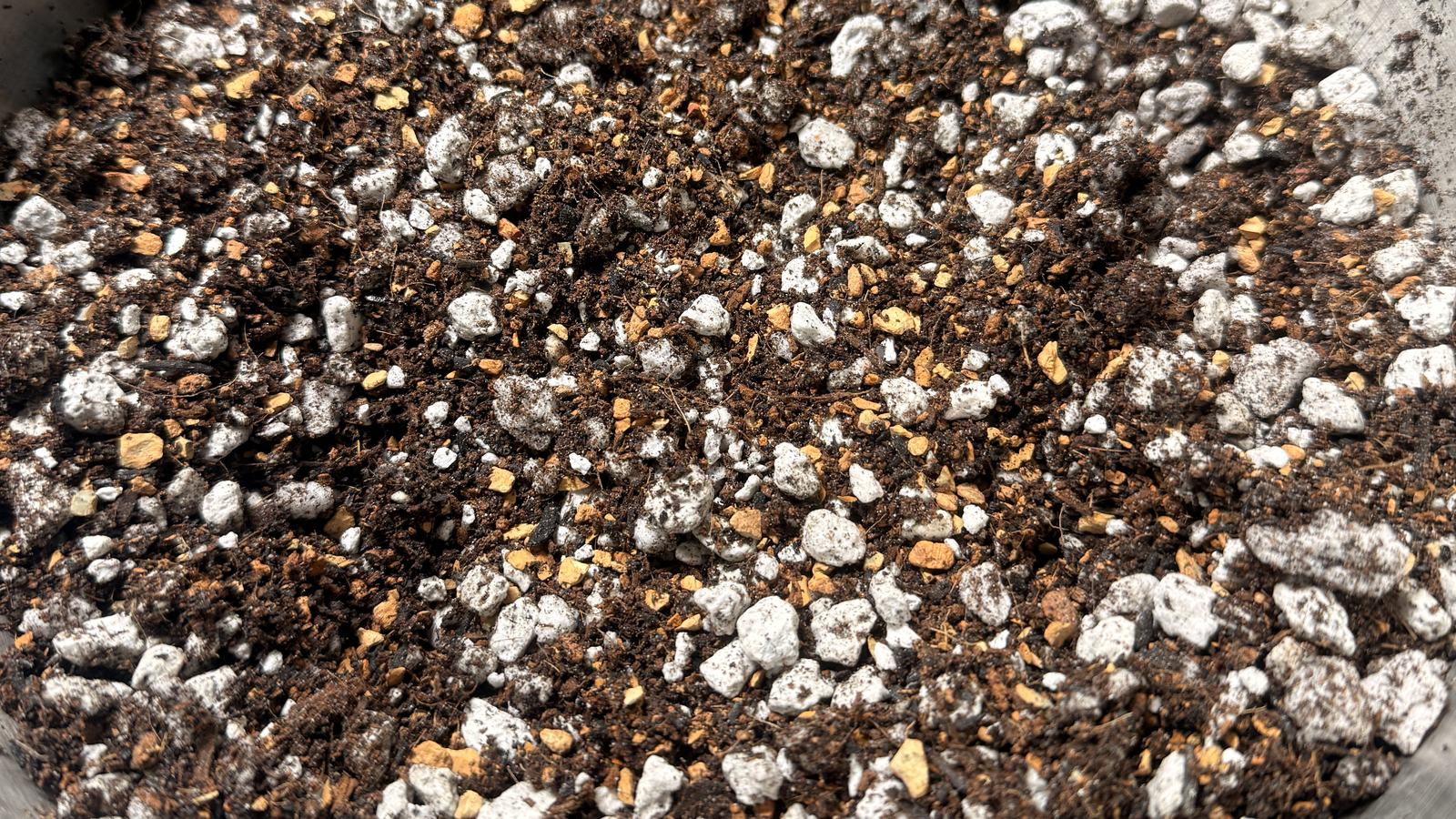
Open a bag of chunky substrate and you're holding the output of several industries. The pumice was dug from an open pit in the western US or shipped from Greece. The coir was processed from coconut husks in India or Sri Lanka. The bark came off logs at a sawmill. The zeolite came out of a mine. The charcoal was made by heating coconut shell or hardwood with little oxygen. Each one has a supply chain, a cost the price tag doesn't show and a reason to be in the bag. This article isn't an argument against any ingredient. It's a map.
Corrected September 2026: we've revised parts of this guide. See the correction note at the end.
Every ingredient in a bag of substrate has an origin, a cost the price tag doesn't show, and a reason it's still on the shelf. We don't moralize about any of them. We name what's there so you can decide on real information.
— Christopher · Founder, The Planters' Guild§ 01Substrate is an industry
A chunky indoor mix draws on several industries at once: peat harvesting, coconut processing, sawmills, volcanic mining, perlite expansion, charcoal making and worm composting.
For perlite and zeolite, most of the market lies elsewhere. In 2025, horticulture took about 15% of the expanded perlite sold in the US, and that share includes commercial growers; building products took 45% (U.S. Geological Survey [USGS], 2026b). Of US natural zeolite sales, 42% went to animal feed and 15% to odor control (USGS, 2026d). Peat is the exception: in the UK, the retail sector that sells to gardeners accounts for about 70% of the peat sold (Department for Environment, Food & Rural Affairs, 2023). Pine bark supply follows the lumber and bioenergy markets (Barrett et al., 2016), and the demand for growing media as a whole is being driven by high-input commercial agriculture (Altland & Bugbee, 2026).
That doesn't make buyers powerless. The Royal Horticultural Society (RHS) asks gardeners to request peat-free plants from retailers, on the reasoning that visible demand encourages growers to produce them (Royal Horticultural Society [RHS], n.d.-b). One grower switching ingredients won't move an industry, but a lot of buyers asking for the same thing can.
This piece walks ingredient by ingredient through the bags on the shelf. Each section covers where the material comes from, what it costs beyond the price, and what the tradeoffs are for a grower. It doesn't tell you what to use; that's your call.
§ 02Peat moss: the ingredient our houseplant mixes leave out
- What it is
- Partly decayed plant material, often but not only sphagnum moss, that builds up in waterlogged, usually acidic peatlands (IUCN UK Peatland Programme, 2026). Northern peatlands add only about 0.01 to 0.03 inch (0.3 to 0.7 mm) of peat a year, so 3.3 feet (1 m) removed from one spot would take 1,400 to 3,300 years to replace (Altland & Bugbee, 2026, citing Vitt).
- Where it's from
- USGS names Finland, Canada, Latvia, Belarus, Russia and Sweden as the leading peat producers in 2025. Nearly all the peat the US imports comes from Canada: 95% in 2021 to 2024 (USGS, 2026a).
- Carbon
- Peatlands cover at least 3% of the world's land but hold more than 600 billion metric tons of carbon. That's as much as 44% of the world's soil carbon, and more than all other vegetation, forests included. Drained peatlands release an estimated 1.9 billion metric tons of CO₂-equivalent (all greenhouse gases counted as the amount of CO₂ with the same warming effect) a year (International Union for Conservation of Nature [IUCN], 2021).
- Regrowth
- USGS calls peat a renewable resource, still building up on 60% of the world's peatlands, while total peatland volume shrinks about 0.05% a year from harvesting and land development (USGS, 2026a). Altland and Bugbee (2026) argue that Canada's bogs as a whole grow faster than they're harvested. They also argue that with active restoration, such as the moss layer transfer technique, sphagnum cover on temperate peatlands approaches its undisturbed level within 30 to 35 years.
The policy picture is less settled than it looks. In August 2022 the UK government announced that peat sales to amateur gardeners in England would end by 2024 (Department for Environment, Food & Rural Affairs, 2022). In March 2023 the same department, Defra, said the ban for professional growers would come in stages, with some uses exempt from 2026 and a full ban in 2030 (Department for Environment, Food & Rural Affairs, 2023). None of it has become law: Defra's July 2026 progress report still lists the ban as something it will legislate for "when parliamentary time allows" (Department for Environment, Food & Rural Affairs, 2026). The RHS ended its sales of peat-based compost in 2019 and has been "no new peat" across most of its operations since January 2026, with a limited allowance for "peat starter plants" at its shows (RHS, n.d.-a).
Why our houseplant mixes leave it out. Our mineral houseplant mixes are built around pumice, perlite and coir, and we'd rather not draw on a material that takes thousands of years to form. That's our preference, not a scientific verdict. Peat does useful work: it holds a lot of water, has a high air capacity and is naturally acidic, with a pH of about 3.0 to 4.0 (Owen & Lopez, 2015). USGS says its water-holding and other properties limit substitutes in most uses (USGS, 2026a). And the footprint question is contested: reviewing seven life-cycle studies, Altland and Bugbee (2026) found the environmental impact of the alternatives similar to peat's or greater. The one Guild recipe that does use peat is our carnivorous-plant mix.
§ 03Live sphagnum is not peat
The Guild uses live long-fiber sphagnum on moss poles and in our Nepenthes and jewel orchid mixes. Live moss and peat come from different supply chains.
Live sphagnum is the growing moss, harvested and dried. New Zealand's West Coast exports it, mainly Sphagnum cristatum (Lambie & Soliman, 2019). Chile exports far more: an average of 2,675 metric tons a year over the nine years to 2012, mostly S. magellanicum (Díaz & Silva, 2012; Lambie & Soliman, 2019). Compared with Chile, New Zealand's share of the world market is smaller and shrinking (Lambie & Soliman, 2019).
Peat is the partly decayed material that builds up over thousands of years (see § 02). The industry, the carbon question and the timescale are different.
How fast harvested moss comes back depends on the site and on how it was picked. New Zealand's Department of Conservation set eight-year harvest cycles in 1991. Researchers working for it later found two- to three-year cycles possible at some lowland sites, and five-year cycles that appear achievable in most places if certain steps are followed, including leaving moss to reseed and choosing a site where the water table doesn't swing too widely. At one site, the same study estimated that if moss kept growing at the measured rate, its biomass could fully recover in about 11 years in reseeded plots and 32 years in plots that weren't. The authors treat that straight-line projection as a worst case (Buxton et al., 1996).
Practice matters as much as place. In Chile, harvesting done as "mining" can leave ground with little or no regenerative capacity (Díaz & Silva, 2012). A recent study of harvesters there found some working outside the national rules even as they described their practice as sustainable (Leiva-Pinto et al., 2026). A "sustainably harvested" label is a claim worth asking about, not a guarantee.
One handling note: the fungus behind sporotrichosis, a skin infection, is found in moss, hay, soil and decaying plant matter. After an outbreak traced to sphagnum moss, the CDC advised gloves and long sleeves when handling it (Centers for Disease Control [CDC], 1988).
§ 04Coir: the byproduct that grew into its own industry
What it is. Horticultural coir is the pithy tissue and short fibers from the husk of the coconut (Abad et al., 2002).
Where it comes from. India and Sri Lanka lead: in 1996 they made 70% and 27% of the world's brown coir fiber (van Dam, 2002). India's coir industry grew up in Kerala and has since spread to other states (Press Information Bureau, 2021). In Sri Lanka, more than 85% of coir now comes from mills in the North-Western and Western provinces (Ministry of Industries, Sri Lanka, 2023).
Industry origin. Coir has long been a low-value by-product. In most producing countries coir was discarded as waste and only sometimes burned as fuel, and traditional extraction left large dumps of pith (van Dam, 2002). In the 2010s, one of Europe's main responses to cutting peat was a sharp rise in coir imports (Aurdal, 2025).
The salt problem. Coir can carry a lot of salt. Many coconuts grow on coasts or saline soils (Gbollie et al., 2021), and husks were traditionally retted (soaked until the fiber separates) for months in brackish ponds or salt backwaters (van Dam, 2002). Buffering soaks coir in a calcium solution so calcium takes over its exchange sites (the charged spots that hold positively charged nutrients) and sodium and potassium are released (Gbollie et al., 2021). Unbuffered coir starts with those sites loaded with potassium and sodium, which can hold back calcium (Gbollie et al., 2021). Feeding too much potassium can also crowd out calcium and magnesium (HortGrow Solutions, an industry source, n.d.). Not every bag is buffered: one UK coir compost maker told the RHS that most coir is washed in plain water and that calcium-buffered coir is a small minority (RHS, 2026). Our published mixes call for buffered coir.
The shipping question. Shipping by sea is far lower in carbon per ton moved than flying. UK government factors put an average container ship at about 16 grams of CO₂-equivalent per metric ton per kilometer (Department for Energy Security and Net Zero [DESNZ], 2026). The same factors put international air freight at about 530 grams, or about 900 grams counting the extra warming from emissions at altitude (DESNZ, 2026). Distance still counts. In an industry-commissioned European life-cycle study, transport made up more than half of coir pith's own climate impact, although pure white peat (the lightly decomposed upper layer of a bog) still scored higher than pure coir (Quantis, 2012). Across seven life-cycle studies, Altland and Bugbee (2026) found the results split: one put coir pith well below peat, another above it, and the three that measured broader impacts rated coir higher.
Labor and water. India's coir industry supports more than 700,000 workers, about 80% of them women (Press Information Bureau, 2021), and Sri Lanka's adds about 10,000 direct and 20,000 indirect jobs (Ministry of Industries, Sri Lanka, 2023). The UN Food and Agriculture Organization (FAO) describes traditional retting as highly polluting of surface waters; mechanical processing can start after about five days of soaking in tanks instead of months (van Dam, 2002). Buffering has its own cost: the calcium nitrate wash takes a lot of water, which is discharged as waste (Altland & Bugbee, 2026). The UK's Responsible Sourcing Scheme, an industry-led program, rates growing-media materials (Responsible Sourcing Scheme, n.d.), and its chair told the RHS that the scheme was looking at getting an auditor to check social compliance at coir factories (RHS, 2026).
§ 05Fir and pine bark: a sawmill by-product with other buyers
What it is and where it comes from. In the eastern US, nurseries use loblolly or longleaf pine bark as the main organic part of their mixes (Altland et al., 2018). In Oregon and other regions with a large Douglas-fir timber industry, Douglas-fir bark, a forest-industry by-product, is widely used in container nurseries (Buamscha & Altland, 2008).
Where the bark goes. Bark comes off logs at the mill, but it doesn't sit idle. Nearly all US mill residues, bark among them, already go into other products or energy (White, 2010), and pine bark also sells for fuel, fiber, charcoal and landscape mulch (Altland & Krause, 2012). A review describes pine bark shifting from a cheap by-product to an increasingly valuable one as the North American lumber industry shrank and bioenergy demand competed for the supply (Barrett et al., 2016).
What it means for growers. Bark changes as it ages. In a U.S. Department of Agriculture (USDA) study, aging pine bark from a month to six months before potting made it finer and cut its air space by about 17 percentage points (Altland et al., 2018). In Douglas-fir bark packed in test cores and kept in a nursery, air space fell over about a year (Altland et al., 2011). Aged Douglas-fir bark also tended to be more acidic (Buamscha & Altland, 2008). Growing-media makers usually process pine bark further, often by aging or composting it; aging helps drive off terpenes, volatile compounds that can harm plants (Barrett et al., 2016).
Composted bark can suppress several root-rot fungi (Hoitink, 1982). Moldy bark is a different matter: one reported case of Aspergillus pneumonia followed spreading bags of moldy bark mulch (Butler et al., 2013). Heavy exposure to wood dust at work can irritate the eyes, nose and throat (Occupational Safety and Health Administration [OSHA], n.d.).
Why our bark-free mixes leave it out. Standard Mineral Mix, Aroid Mineral Mix and ICU Mix are bark-free by choice. One reason is dust and mold spores, for growers sensitive to them; another is that its structure shifts as it breaks down. In Standard Mineral Mix and Aroid Mineral Mix, horticultural charcoal and coarse pumice take its place; ICU Mix uses pumice and zeolite instead. Several of our other recipes use bark, and their allergen-safe versions swap it out.
§ 06Pumice and perlite: the volcanic minerals
Pumice. A light, porous volcanic rock (Crangle, 2019). US pumice comes from open-pit mines in Oregon, California, Idaho, New Mexico and Kansas, and imports, net of exports, came to about 10% of US use in 2025. Most imported pumice comes from Greece, with smaller amounts from Iceland; Turkey is the world's largest producer (USGS, 2026c).
The pumice mining footprint. Pumice is usually dug with rippers, bulldozers or front-end loaders, and processing usually stops at drying, crushing and screening (Crangle, 2019). USGS notes that the fine waste from mining and milling may cause local dust problems at some US pumice operations, effects it considers limited to fairly small areas (USGS, 2024).
Perlite, a mineral that gets cooked. Perlite is a volcanic glass that can swell to as much as 20 times its original volume when heated fast. China, Turkey and Greece mine the most, New Mexico leads US production, and Greece supplied 94% of US imports in 2021 to 2024. In 2025, 53 plants in 29 states expanded the crude ore (USGS, 2026b). The expansion furnaces run at about 1,600 to 1,800 °F (870 to 980 °C) and typically burn natural gas (U.S. Environmental Protection Agency, 1995).
The perlite-expansion energy cost. In an industry-funded life-cycle study, the energy used for expansion made up about 70% of perlite's climate impact (Quantis, 2012).
In the pot. Both are mineral aggregates that don't decompose and break down only slowly in potting mixes (Bilderback et al., 2005). Purdue Extension describes pumice as chemically inert, with a pH between 7.0 and 7.4 (Owen & Lopez, 2015). Pumice may still contain some potassium and sodium, though, and perlite may contain fluoride. Growers of some fluoride-sensitive crops have often been advised to use little or no perlite, though researchers note that fluoride injury is unlikely unless the mix's pH runs low (Evans, 2014).
§ 07Zeolite: the mined ion exchanger
What it is. The zeolite in our mixes is clinoptilolite, a natural mineral with a crystal cage structure that holds positively charged ions. Its cation exchange capacity (CEC, a measure of how many of those nutrient ions it can hold) is about 2.2 milliequivalents per gram in theory (Grifasi et al., 2024). Mumpton (1999) calls clinoptilolite's CEC relatively small, but notes that it holds potassium and ammonium in preference to sodium, calcium and magnesium.
Natural vs synthetic. Industrial catalysis mostly uses synthetic zeolites, which are more uniform (Grifasi et al., 2024), and nearly all US zeolite imports and exports are thought to be synthetic (USGS, 2026d).
Where it comes from. In the US, chabazite, another natural zeolite, is mined in Arizona, and clinoptilolite in Oregon, California, Idaho, New Mexico and Texas. Other producers include Slovakia, Georgia, China, Russia, Turkey and Cuba. US sales of natural zeolite were an estimated 77,000 metric tons in 2025 (USGS, 2026d).
Mining. The western US deposits are generally flat-lying beds that are easy to mine from the surface (Mumpton, 1999). The same US production goes into animal feed, odor control, soil amendment, pet litter, water treatment and absorbents (USGS, 2026d). Our mixes use 1–3 mm and 3–5 mm grades.
In the pot. Zeolite doesn't rot, but it isn't inert. It keeps trading ions: clinoptilolite added to a chrysanthemum potting mix behaved like a slow-release potassium fertilizer (Mumpton, 1999). Clinoptilolite is among the zeolites that commonly form alongside erionite, a zeolite whose fibers, when inhaled, have been linked to lung cancers such as mesothelioma (Patel et al., 2022). USGS notes that US zeolite mining likely produced small amounts of erionite too (USGS, 2026d). That's one more reason to buy from a supplier that names the mineral.
§ 08Charcoal and biochar: the carbon math
What it is. Charcoal is biomass heated with little oxygen (pyrolysis), leaving a porous carbon solid. Biochar is essentially the same material, made for soil or growing-media use (Altland & Locke, 2012); the International Biochar Initiative (IBI) defines it as a solid obtained from biomass heated in an oxygen-limited environment (IBI, 2015). Activating it with steam or CO₂ raises its surface area (Ajien et al., 2023).
Where it comes from. Coconut shell is one feedstock (Ajien et al., 2023), and hardwoods are among the feedstocks the IBI lists (IBI, 2015). The largest coconut producers are Indonesia, the Philippines and India, with Sri Lanka fourth (Ajien et al., 2023, citing 2019 FAO figures).
The biochar carbon argument. Turning biomass into biochar keeps about half of its carbon, against 3% after burning and less than 10 to 20% after five to ten years of decomposition (Lehmann et al., 2006). Once in soil, biochar is estimated to persist for decades to thousands of years, with the range set by the feedstock and how it was made (Nabuurs et al., 2022). A recent policy commentary, as reported by Norway's bioeconomy research institute, advises treating it as lasting hundreds of years rather than thousands (Gulden, 2025). Lehmann and colleagues conservatively estimated that charring farm, forest and urban wastes could store about 0.16 billion metric tons of carbon a year (Lehmann et al., 2006). The Intergovernmental Panel on Climate Change (IPCC) puts biochar's technical mitigation potential, the most it could deliver with available technology, at about 2.6 billion metric tons of CO₂-equivalent a year (range 0.2 to 6.6). About 1.1 billion of that is available at up to US$100 per metric ton of CO₂-equivalent. It also notes that the estimates rest on pilot-scale plants and that the biggest uncertainty is how much biomass can be supplied sustainably (Nabuurs et al., 2022).
In the pot. Horticultural charcoal isn't inert. Its pH and nutrients vary with what it was made from and how. In one study, biochars from two feedstocks made at about 570 and 1,110 °F (300 and 600 °C) ranged from pH 4.69 to 11.9 (Murtaza et al., 2024). In another, one biochar tested in a peat and perlite mix added a substantial amount of potassium (Altland & Locke, 2012). In Standard Mineral Mix and Aroid Mineral Mix, charcoal is there for structure, in place of bark, so check your pH and runoff when you use it. At the scale of one pot, the carbon argument adds up to very little.
What to avoid. Barbecue briquettes aren't horticultural charcoal. One major brand's safety data sheets list limestone, borax and wood dust alongside the charcoal (The Clorox Company, 2016), and its quick-light version adds petroleum distillates (The Clorox Company, 2026). The IBI publishes standards for what counts as biochar (IBI, 2015).
§ 09Vermicompost: the waste-stream ingredient
What it is. Vermicompost, often called worm castings, is compost made by putting earthworms to work on organic matter (Raza et al., 2021; Sitton, 2010). Eisenia fetida is the most commonly used species (Sherman, n.d.).
Where it comes from. Large operations profiled in the trade press fed their worms cow manure, fresh or precomposted, or treated biosolids, which is processed sewage sludge (Sitton, 2010). What goes in shapes what comes out: in one tropical study, the type of manure was the main factor setting the nutrient content of composts and vermicomposts (Faverial et al., 2016).
Not sterile, not emission-free. Castings carry living microbes. Under the produce-safety rule the US Food and Drug Administration proposed in 2013, worm composts would have needed proof that human pathogens die off, as Rutgers Cooperative Extension explained it (Kline & Melendez, 2013). Composts and vermicomposts can suppress some plant diseases, but inconsistently (Jack & Nelson, 2010), so we don't count on it. And worm composting still gives off greenhouse gases: in one field study, a pig-manure vermicompost gave off more nitrous oxide than a conventional cow-manure compost, while cow-manure and biochar vermicomposts gave off less (Raza et al., 2021).
How we use it. Our published mixes use 5 to 15% castings. The Aroid Ingredient Glossary covers what castings do in a mix.
§ 10The takeaway: what to do with this information
A grower building a mix makes several ingredient choices, and each one has an origin, an environmental cost and a tradeoff. None of them are free of cost, and none of them are off limits.
The rule of thumb we use: substitute an ingredient when something else does its job and its cost is real; keep it when it does work nothing else in the mix does. In our mixes, pumice gives structure and drainage, coir holds water, zeolite holds potassium and ammonium, and in Standard Mineral Mix and Aroid Mineral Mix, charcoal gives structure where bark would otherwise go. Zeolite isn't the only mineral that holds nutrients: extension guidance lists clay and vermiculite among the high-CEC components (Owen & Lopez, 2015).
Peat stays out of our houseplant mixes because we build them mineral-forward and would rather not draw on it; the evidence hasn't settled the question.
We're not telling you to buy peat-free. Know what's in the bag, where it came from and what it costs beyond the price, then decide.
We review our guides against the research and extension guidance available at the time, and we correct them when a source doesn't say what we took it to say or when we can't find support for a point. In this review we corrected how fast peat forms, peatlands' share of soil carbon, how bogs and sphagnum recover, where the UK's peat phase-out stands and how peat compares with its alternatives. We also corrected where ingredients come from, what else uses them, how they behave, our shipping and carbon figures and how our own mixes use them, fixed citations and removed claims we couldn't source.
Go deeper in the free Apprenticeship: Module IV, What Substrate Is →
Abad, M., Noguera, P., Puchades, R., Maquieira, A., & Noguera, V. (2002). Physico-chemical and chemical properties of some coconut coir dusts for use as a peat substitute for containerised ornamental plants. Bioresource Technology, 82(3), 241–245. https://doi.org/10.1016/S0960-8524(01)00189-4
Ajien, A., Idris, J., Md Sofwan, N., Husen, R., & Seli, H. (2023). Coconut shell and husk biochar: A review of production and activation technology, economic, financial aspect and application. Waste Management & Research, 41(1), 37–51. https://doi.org/10.1177/0734242X221127167
Altland, J., & Bugbee, B. (2026). The limits of sustainability of peat as a soilless media for agriculture. Frontiers in Plant Science, 17, Article 1856037. https://doi.org/10.3389/fpls.2026.1856037
Altland, J. E., & Krause, C. (2012). Substituting pine wood for pine bark affects physical properties of nursery substrates. HortScience, 47(10), 1499–1503. https://doi.org/10.21273/HORTSCI.47.10.1499
Altland, J. E., & Locke, J. C. (2012). Biochar affects macronutrient leaching from a soilless substrate. HortScience, 47(8), 1136–1140. https://www.ars.usda.gov/ARSUserFiles/50820500/GPRG/2012PublicationsandSummaries/2012_Biochar%20affect%20micronutrient.pdf
Altland, J. E., Owen, J. S., Jr., & Gabriel, M. Z. (2011). Influence of pumice and plant roots on substrate physical properties over time. HortTechnology, 21(5), 554–557. https://doi.org/10.21273/HORTTECH.21.5.554
Altland, J. E., Owen, J. S., Jr., Jackson, B. E., & Fields, J. S. (2018). Physical and hydraulic properties of commercial pine-bark substrate products used in production of containerized crops. HortScience, 53(12), 1883–1890. https://doi.org/10.21273/HORTSCI13497-18
Aurdal, S. M. (2025). The persistent challenge of alternatives to peat in container-based horticulture: A historical review of the field of growing media. Frontiers in Horticulture, 4, Article 1657037. https://doi.org/10.3389/fhort.2025.1657037
Barrett, G. E., Alexander, P. D., Robinson, J. S., & Bragg, N. C. (2016). Achieving environmentally sustainable growing media for soilless plant cultivation systems: A review. Scientia Horticulturae, 212, 220–234. https://doi.org/10.1016/j.scienta.2016.09.030
Bilderback, T. E., Warren, S. L., Owen, J. S., Jr., & Albano, J. P. (2005). Healthy substrates need physicals too! HortTechnology, 15(4), 747–751. https://doi.org/10.21273/HORTTECH.15.4.0747
Buamscha, M. G., & Altland, J. E. (2008). What's in your Douglas-fir bark? In R. K. Dumroese & L. E. Riley (Tech. Coords.), National proceedings: Forest and Conservation Nursery Associations, 2007 (Proceedings RMRS-P-57, pp. 96–103). USDA Forest Service, Rocky Mountain Research Station. https://rngr.net/publications/fnn/2009-winter/new-nursery-literature/what-s-in-your-douglas-fir-bark/at_download/file
Butler, L., Brockley, T., Denning, D., Richardson, M., Chisholm, R., Sinha, S., & O'Driscoll, R. (2013). Acute Aspergillus pneumonia associated with mouldy tree bark-chippings, complicated by anti-glomerular basement membrane disease causing permanent renal failure. Medical Mycology Case Reports, 2, 140–142. https://doi.org/10.1016/j.mmcr.2013.06.001
Buxton, R. P., Johnson, P. N., & Espie, P. R. (1996). Sphagnum research programme: The ecological effects of commercial harvesting (Science for Conservation 25). Department of Conservation, New Zealand. https://www.doc.govt.nz/globalassets/documents/science-and-technical/sfc025.pdf
Centers for Disease Control. (1988). Multistate outbreak of sporotrichosis in seedling handlers, 1988. Morbidity and Mortality Weekly Report, 37(42), 652–653. https://www.cdc.gov/mmwr/preview/mmwrhtml/00001295.htm
Crangle, R. D., Jr. (2019). Pumice and pumicite [Advance release]. In 2019 minerals yearbook. U.S. Geological Survey. https://pubs.usgs.gov/myb/vol1/2019/myb1-2019-pumice.pdf
Department for Energy Security and Net Zero. (2026). Greenhouse gas reporting: Conversion factors 2026 [Data set]. GOV.UK. https://www.gov.uk/government/publications/greenhouse-gas-reporting-conversion-factors-2026
Department for Environment, Food & Rural Affairs. (2022, August 27). Sale of horticultural peat to be banned in move to protect England's precious peatlands [Press release]. GOV.UK. https://www.gov.uk/government/news/sale-of-horticultural-peat-to-be-banned-in-move-to-protect-englands-precious-peatlands
Department for Environment, Food & Rural Affairs. (2023, March 24). Media reporting on peat-ban for the professional horticulture sector. Defra in the media. https://deframedia.blog.gov.uk/2023/03/24/media-reporting-on-peat-ban-for-the-professional-horticulture-sector/
Department for Environment, Food & Rural Affairs. (2026, July 16). Environmental Improvement Plan: Annual progress report, April 2025 to March 2026. GOV.UK. https://assets.publishing.service.gov.uk/media/6a588b0031fb6daf314137a3/Environmental_Improvement_Plan_Annual_Progress_Report.pdf
Díaz, M. F., & Silva, W. (2012). Improving harvesting techniques to ensure Sphagnum regeneration in Chilean peatlands. Chilean Journal of Agricultural Research, 72(2), 296–300. https://www.scielo.cl/pdf/chiljar/v72n2/at21.pdf
Evans, M. R. (2014). Unit 07: Substrates [Greenhouse management course material]. University of Arkansas. https://greenhouse.hosted.uark.edu/Unit07/Printer_Friendly.html
Faverial, J., Cornet, D., Paul, J., & Sierra, J. (2016). Multivariate analysis of the determinants of the end-product quality of manure-based composts and vermicomposts using Bayesian network modelling. PLoS ONE, 11(6), Article e0157884. https://doi.org/10.1371/journal.pone.0157884
Gbollie, S. N., Mwonga, S. M., & Kibe, A. M. (2021). Effects of calcium nitrate levels and soaking durations on cocopeat nutrient content. Journal of Agricultural Chemistry and Environment, 10, 372–388. https://doi.org/10.4236/jacen.2021.103024
Grifasi, N., Ziantoni, B., Fino, D., & Piumetti, M. (2024). Fundamental properties and sustainable applications of the natural zeolite clinoptilolite. Environmental Science and Pollution Research, 32, 27805–27840. https://doi.org/10.1007/s11356-024-33656-5
Gulden, K. T. (2025, December 8). Biochar: Stable for centuries, but not forever. Norwegian Institute of Bioeconomy Research (NIBIO). https://www.nibio.no/en/news/biochar-stable-for-centuries-but-not-forever
Hoitink, H. A. J. (1982). Composted bark, a light weight growth medium with fungicidal properties. Journal American Rhododendron Society, 36(2). https://scholar.lib.vt.edu/ejournals/JARS/v36n2/v36n2-hoitink.htm
HortGrow Solutions. (n.d.). Coco coir as a medium-CEC substrate: Balancing precision and buffering [Industry source]. Retrieved September 28, 2026, from https://hortgrow.com/blogs/blog/coco-coir-as-a-medium-cec-substrate-balancing-precision-and-buffering
International Biochar Initiative. (2015). Standardized product definition and product testing guidelines for biochar that is used in soil (IBI Biochar Standards, Version 2.1). https://biochar-international.org/wp-content/uploads/2020/06/IBI_Biochar_Standards_V2.1_Final2.pdf
International Union for Conservation of Nature. (2021, November). Peatlands and climate change [Issues brief]. https://iucn.org/sites/default/files/2022-04/iucn_issues_brief_peatlands_and_climate_change_final_nov21.pdf
IUCN UK Peatland Programme. (2026, April 1). Celebrating Peat Free April: Your questions answered. https://www.iucn-uk-peatlandprogramme.org/blog/iucn-uk-peatland-programme/celebrating-peat-free-april-your-questions-answered
Jack, A. L. H., & Nelson, E. B. (2010). Suppression of Pythium damping off with compost and vermicompost: Final report to the Organic Farming Research Foundation. Cornell University. https://cwmi.css.cornell.edu/organicfarmingfinalreport.pdf
Kline, W., & Melendez, M. (2013, April 24). FDA food safety Q&A: Biological soil amendments. Plant & Pest Advisory. Rutgers Cooperative Extension. https://plant-pest-advisory.rutgers.edu/fda-food-safety-qa-biological-soil-amendments/
Lambie, S. M., & Soliman, T. A. (2019). The potential use of sphagnum moss to improve river health and as an economically and ecologically sustainable crop (Contract Report LC3451). Manaaki Whenua – Landcare Research, prepared for West Coast Regional Council. http://www.envirolink.govt.nz/assets/Envirolink/Reports/1929-WCRC176-The-potential-use-of-sphagnum-moss-to-improve-river-health-and-as-an-economically-and-ecologically-sustainable-crop.pdf
Lehmann, J., Gaunt, J., & Rondon, M. (2006). Bio-char sequestration in terrestrial ecosystems: A review. Mitigation and Adaptation Strategies for Global Change, 11, 403–427. https://doi.org/10.1007/s11027-005-9006-5
Leiva-Pinto, E., Alarcón, C., Tartakowsky, V., Zúñiga, M., Benítez-Mora, A., Herrera, J., & León, C. A. (2026). Barriers and facilitators of behavior change for the sustainable harvesting of Sphagnum magellanicum moss in southern Chile. Frontiers in Conservation Science, 6, Article 1634211. https://doi.org/10.3389/fcosc.2025.1634211
Ministry of Industries, Sri Lanka. (2023). Sector overview: Coir and coir based product sector. https://www.industry.gov.lk/web/wp-content/uploads/2023/03/Sector-overview-coir-and-coir-based-products-sector.pdf
Mumpton, F. A. (1999). La roca magica: Uses of natural zeolites in agriculture and industry. Proceedings of the National Academy of Sciences, 96(7), 3463–3470. https://doi.org/10.1073/pnas.96.7.3463
Murtaza, G., Usman, M., Iqbal, J., Hyder, S., Solangi, F., Iqbal, R., Okla, M. K., Al-Ghamdi, A. A., Elsalahy, H. H., Tariq, W., & Al-Elwany, O. A. A. I. (2024). Liming potential and characteristics of biochar produced from woody and non-woody biomass at different pyrolysis temperatures. Scientific Reports, 14, Article 11469. https://doi.org/10.1038/s41598-024-61974-8
Nabuurs, G.-J., Mrabet, R., Abu Hatab, A., Bustamante, M., Clark, H., Havlík, P., House, J., Mbow, C., Ninan, K. N., Popp, A., Roe, S., Sohngen, B., & Towprayoon, S. (2022). Agriculture, forestry and other land uses (AFOLU). In P. R. Shukla et al. (Eds.), Climate change 2022: Mitigation of climate change. Contribution of Working Group III to the Sixth Assessment Report of the Intergovernmental Panel on Climate Change (Chapter 7). Cambridge University Press. https://doi.org/10.1017/9781009157926.009
Occupational Safety and Health Administration. (n.d.). Wood dust: Hazard recognition. Retrieved September 28, 2026, from https://www.osha.gov/wood-dust/hazards
Owen, W. G., & Lopez, R. G. (2015). Evaluating container substrates and their components (HO-255-W). Purdue University Extension. https://www.extension.purdue.edu/extmedia/HO/HO-255-W.pdf
Patel, J. P., Brook, M. S., Kah, M., & Hamilton, A. (2022). Global geological occurrence and character of the carcinogenic zeolite mineral, erionite: A review. Frontiers in Chemistry, 10, Article 1066565. https://doi.org/10.3389/fchem.2022.1066565
Press Information Bureau, Ministry of Micro, Small & Medium Enterprises. (2021, September 25). Coir industry proliferates and flourishes in non-conventional regions. https://www.pib.gov.in/PressReleaseIframePage.aspx?PRID=1757976
Quantis. (2012). Comparative life cycle assessment of horticultural growing media based on peat and other growing media constituents: Final report [Industry-commissioned report prepared for EPAGMA]. https://erden-substrate.info/wp-content/uploads/2023/02/comparative-life-cycle-assessment-of-horticultural-growing-media-based-on-peat-and-other-growing-media-constituents-1.pdf
Raza, S. T., Tang, J. L., Ali, Z., Yao, Z., Bah, H., Iqbal, H., & Ren, X. (2021). Ammonia volatilization and greenhouse gases emissions during vermicomposting with animal manures and biochar to enhance sustainability. International Journal of Environmental Research and Public Health, 18(1), Article 178. https://doi.org/10.3390/ijerph18010178
Responsible Sourcing Scheme. (n.d.). Welcome to the Responsible Sourcing Scheme. Retrieved September 28, 2026, from https://responsiblesourcing.org.uk/
Royal Horticultural Society. (n.d.-a). Peat-free gardening. Retrieved September 28, 2026, from https://www.rhs.org.uk/advice/peat
Royal Horticultural Society. (n.d.-b). Peat-free information for gardeners. Retrieved September 28, 2026, from https://www.rhs.org.uk/advice/peat/for-gardeners
Royal Horticultural Society. (2026, June 5). How sustainable is coir for gardening https://www.rhs.org.uk/advice/peat/coir-questions-answered
Sherman, R. (n.d.). Vermicomposting for households. NC State Extension. Retrieved September 28, 2026, from https://composting.ces.ncsu.edu/vermicomposting-2/vermicomposting-for-households/
Sitton, J. (2010, September 21). Vermiculture gains momentum. BioCycle. https://www.biocycle.net/vermiculture-gains-momentum/
The Clorox Company. (2016). Kingsford Original Charcoal Briquets: Safety data sheet. https://digitalcontent.target.com/vault/1770336000/CLOUD_a3db5e9a-7b4f-480a-9e67-67f4e0990c9f.pdf
The Clorox Company. (2026). Kingsford Match Light Instant Charcoal Briquets: Safety data sheet. https://www.thecloroxcompany.com/wp-content/uploads/2026/04/Kingsford%E2%84%A2-Match-Light%E2%84%A2-Instant-Charcoal-Briquets-Bilingual-1.pdf
U.S. Environmental Protection Agency. (1995). AP-42, Compilation of air pollutant emission factors, Section 11.30: Perlite processing. https://www.epa.gov/sites/default/files/2020-10/documents/c11s30.pdf
U.S. Geological Survey. (2024). Pumice and pumicite. In Mineral commodity summaries 2024. https://pubs.usgs.gov/periodicals/mcs2024/mcs2024-pumice.pdf
U.S. Geological Survey. (2026a). Peat. In Mineral commodity summaries 2026. https://pubs.usgs.gov/periodicals/mcs2026/mcs2026-peat.pdf
U.S. Geological Survey. (2026b). Perlite. In Mineral commodity summaries 2026. https://pubs.usgs.gov/periodicals/mcs2026/mcs2026-perlite.pdf
U.S. Geological Survey. (2026c). Pumice and pumicite. In Mineral commodity summaries 2026. https://pubs.usgs.gov/periodicals/mcs2026/mcs2026-pumice.pdf
U.S. Geological Survey. (2026d). Zeolites (natural). In Mineral commodity summaries 2026. https://pubs.usgs.gov/periodicals/mcs2026/mcs2026-zeolites.pdf
van Dam, J. E. G. (2002). Coir processing technologies: Improvement of drying, softening, bleaching and dyeing coir fibre/yarn and printing coir floor coverings (Technical Paper No. 6). Food and Agriculture Organization of the United Nations. https://www.fao.org/4/y3612e/y3612e00.htm
White, E. M. (2010). Woody biomass for bioenergy and biofuels in the United States: A briefing paper (General Technical Report PNW-GTR-825). USDA Forest Service, Pacific Northwest Research Station. https://www.fs.usda.gov/pnw/pubs/pnw_gtr825.pdf


