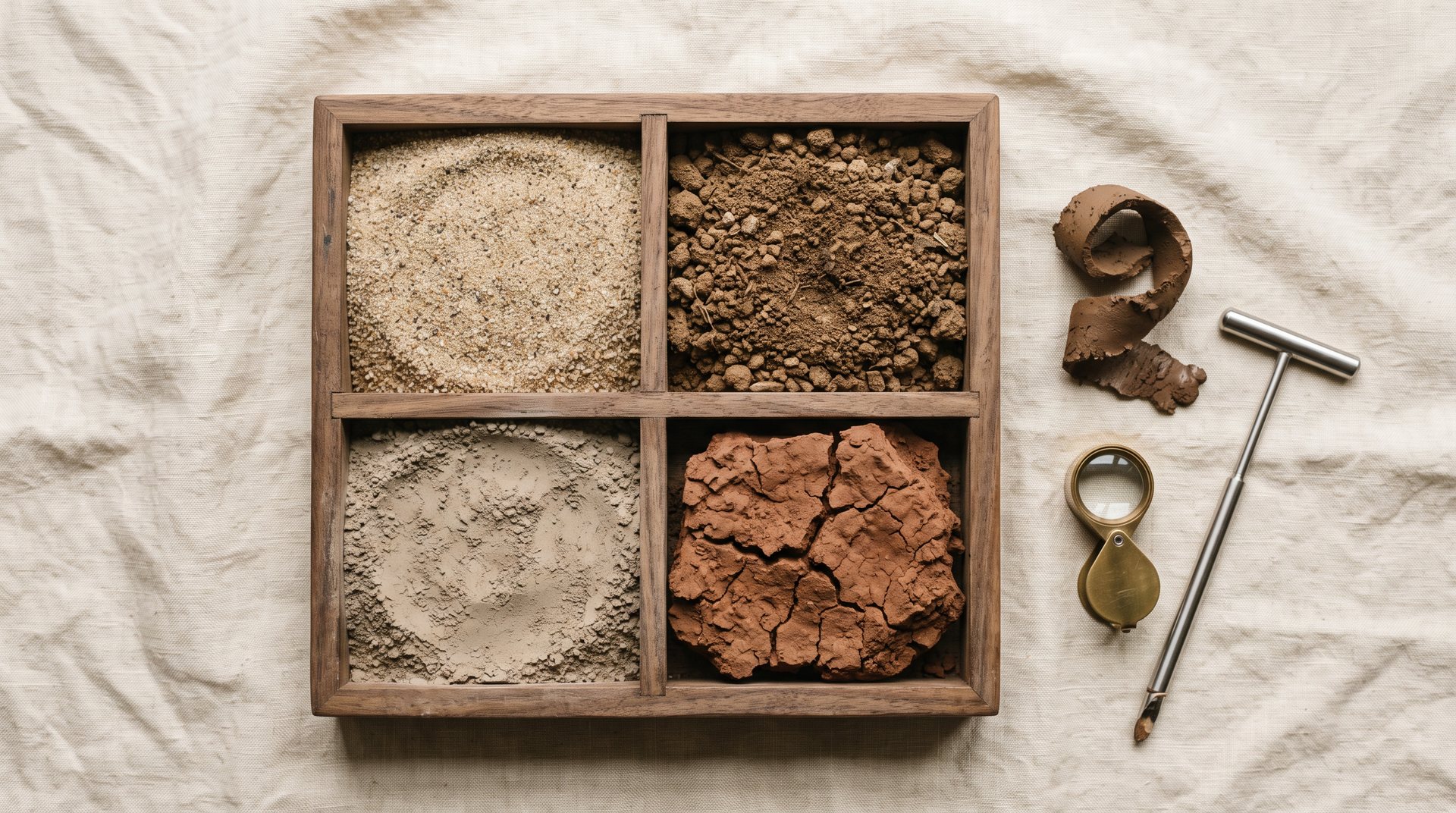
Most of the Substrate Library is about potting mixes, the ones you build and the ones you buy by the bag. The ground in your yard is different. You inherited it, and you can't dump it out and start over in April. So before you spend a weekend and a pile of money amending it, it's worth an afternoon finding out what you're working with. Three tests do most of that job, and two of them are free.
Corrected September 2026: we've revised parts of this guide. See the correction note at the end.
This is where the Substrate Library steps out of the pot and into the yard. Your ground came with the house. You don't get to pick the base, the aeration, or the charge the way you do in a pot. The good news is that it's readable, and two of the three tests cost nothing but a little time. Read it before you buy, and the amendments you choose are aimed at a problem you've confirmed.
— Christopher · Founder, The Planters' Guild§ 01The ground doesn't play by the pot's rules
A pot is a closed system you get to design. Water goes in the top and drains out the holes in the bottom, but a layer of mix at the base never fully drains. That saturated layer is called the perched water zone, and it has almost no air space (Nemali, 2018). The narrow pores in a mix hold water against gravity by capillary force, while water in the large pores drains out (Nemali, 2018). When the mix stops working, you tip the plant out and start over. That's the whole premise of building a substrate.
Open ground is different. Water can keep moving down through the soil profile, and there's no dumping the yard out in spring to try a better recipe. Ground can still hold a wet layer, though. Hardpans, which are dense, compacted layers, and other impermeable layers can stop water (Steil, 2024). And where a finer-textured layer sits over a coarser one, water often won't move down into the coarse layer until the finer layer above it is saturated (Fidel, 2025). You garden with what you have, and that's why ground rewards measuring before you touch it. In a pot, a bad guess costs you a repot. In a bed it costs you a season, plus a truckload of the wrong amendment.
So the smartest first move in any new bed is reading what's already under your feet. Buying compost comes after that. Three tests cover it: the first reads how the soil is built, the second how it drains, and the third gets at what's actually in it.
§ 02The ribbon test: reading texture with your hands
Start with texture, because it shapes a lot of what follows. Soils with a lot of sand have more pore space and drain sharply, while soils high in clay have much less pore space and hold water longer (Steil, 2024). Soils with more clay generally hold more nutrients, too (Traunfeld, 2026), and clay soils can be very hard for gardeners to dig and work (Wagner et al., 2015).
Texture is the mix of three particle sizes. Each size has its own feel: sand, the biggest, is gritty; silt is finer and smooth, almost floury; and clay, the finest, is sticky (Card et al., 2022). The mix of the three gives a soil its personality, and you can read it with your hands.
Take a small lump of soil in your palm and add water a little at a time, kneading until it's smooth and holds together like moist putty. Then press it out between your thumb and the side of your index finger into a flat ribbon, and let the ribbon run out over your finger until it breaks under its own weight. Colorado State's key sorts soils by how far the ribbon gets before it breaks. If the soil won't hold together in a ball at all, it's a sand, and if it balls up but won't form a ribbon, it's a loamy sand. A ribbon that breaks before an inch (2.5 cm) puts the soil in the loam group. A ribbon of one to two inches (2.5 to 5 cm) is the clay loam group, and two inches or more is the clay group (Card et al., 2022).

The feel narrows it down. Rub a pinch of the moist soil between your thumb and forefinger. Within each group, very gritty means sand leads, so you have a sandy loam, sandy clay loam, or sandy clay. Very smooth means silt leads: a silt loam, silty clay loam, or silty clay. Equally gritty and smooth puts you in the middle, a loam, clay loam, or clay (Card et al., 2022). Even 20% clay is enough to make a soil act clayey (Card et al., 2022).
Hand texturing takes practice. In one field comparison, professional soil scientists matched the lab-measured texture class for 66% of samples (Salley et al., 2018). The group is what decides your next move, though, and a sandy bed and a clay bed fail in opposite ways. Knowing which one you've got is worth more than any bag of anything.
§ 03The perc test: measuring drainage
Texture hints at how a soil will drain. A perc test, short for percolation, measures it, and Iowa State calls it the best way to find out how well drained a soil is (Steil, 2024). Roots need air as well as water. Excess water in the soil pushes out oxygen, and low oxygen harms the health of roots (Steil, 2024).
You need a shovel, a ruler, water, and a timer. Dig a hole at least 12 inches (30 cm) deep and 4 to 12 inches (10 to 30 cm) wide, and as deep as 18 inches (45 cm) if the rootballs you're planting are taller than 12 inches. Don't dig when the soil is overly wet, which can glaze the sides of the hole and throw off the result. Fill the hole and let the water drain away, which can take anywhere from a short while to a whole day. That first fill saturates the soil. As soon as it has drained, refill the hole, use a ruler to note how deep the water is, wait 15 minutes, and measure how far it dropped. Multiply that by four for inches per hour (Steil, 2024).
Iowa State rates 1 to 3 inches (2.5 to 7.5 cm) an hour as desirable for most plants. Under an inch an hour is poor drainage: either improve it or choose plants that tolerate wet conditions. Over 4 inches an hour is very well drained, and you can amend that soil or choose plants suited to drier conditions (Steil, 2024).
When you test matters, too. Nebraska Extension's rain garden guide says to run its drainage test in spring or in the usual rainy season. Not in the middle of summer or fall, when the soil is dry and cracked, because dry soil can give a misleading result (Franti & Rodie, 2007).
§ 04The lab test: the chemistry you can't feel
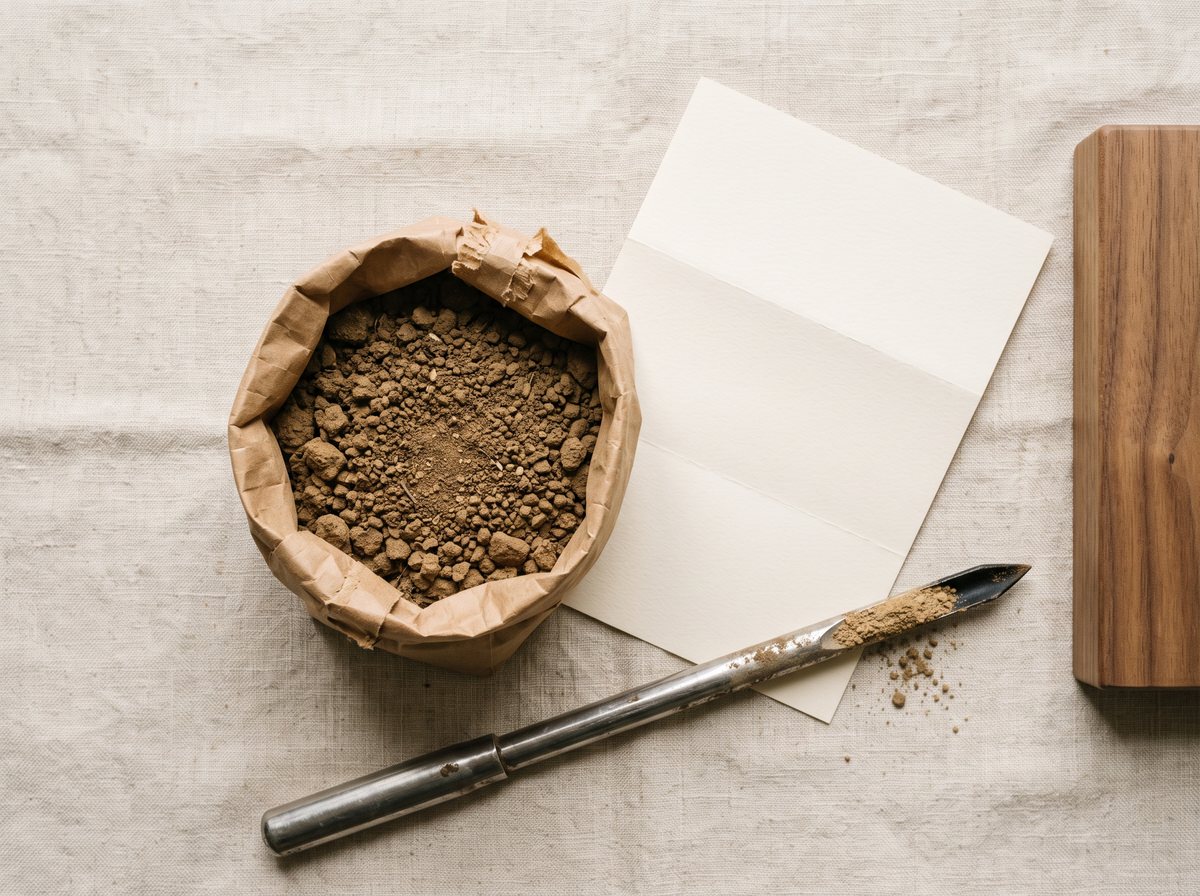
Your hands can read how a soil is built, and a shovel tells you how it drains. Neither can tell you what's chemically in it, and that's where a lab test earns its fee. You send a sample to a soil-testing lab and get back a report. A UMass Amherst fact sheet, for example, says to spread about a cup of soil on clean paper to air-dry (Spargo, 2012). Maryland Extension singles out pH, phosphorus (P), potassium (K), magnesium, calcium, organic matter, and the lab's fertilizer and lime recommendations as especially important lines on a report. Its guide to reading one also covers cation exchange capacity (Traunfeld, 2026). Of those, pH, organic matter, and CEC are the three we'd read first.
A home kit can give you a rough pH. In a South Dakota State comparison, home kits generally estimated soil pH within one unit of the lab's result but were inconsistent on nutrients, especially phosphorus and potassium (Klopp, 2025). Test kits generally measure nitrogen, phosphorus, potassium, and pH, and for pH, a soil pH meter is more reliable than color test strips (Montana State University Extension Soil Fertility, 2025). Organic matter and CEC usually mean a lab test.
pH measures how acidic or alkaline the soil is, and it directly affects which nutrients are available (Traunfeld, 2026). Maryland Extension says pH 5.5 to 7.0 suits vegetables, grasses, and most ornamental and native plants, while conifers and acid-loving plants such as azaleas, rhododendrons, and blueberries prefer 4.5 to 5.5 (Traunfeld, 2026). Some extension services set narrower targets for vegetable beds. Mississippi State, for one, puts the ideal for vegetable garden soils at 6.0 to 6.5 (Mississippi State University Extension Service, n.d.), so go by the recommendation on your own lab report. Phosphorus shows why pH matters. Below about pH 6.0 it combines with iron and aluminum, above about 7.3 it combines with calcium, and either way less of it is available for plants to take up (Traunfeld, 2026).
Organic matter (OM) is made up of the plants, small animals, and microorganisms in the soil, whether living or decomposing (Traunfeld, 2026). Maryland Extension puts healthy soils at 2% organic matter or more (Traunfeld, 2026), and Penn State treats 2 to 5% as a good target for its clay-rich Pennsylvania field soils (Sánchez & Ford, 2025). Baselines vary a lot by region: Utah State says that state's soils typically run 0.25 to 1% (Heaton & Koenig, 2010). The figure is a percentage by weight, which is why a heavily amended bed can still test under 5% (Traunfeld, 2026). Soils high in organic matter hold more moisture, stay crumbly and resist compaction, and keep a reservoir of nutrients that are released slowly (Traunfeld, 2026), including some nitrogen as the organic matter decomposes (Sánchez & Ford, 2025).
CEC, cation exchange capacity, measures how much of the positively charged nutrients, such as calcium, magnesium, and potassium, a soil can hold. It's reported in milliequivalents per 100 grams of soil (meq/100 g), and a higher number means the soil can hold more (Sánchez & Ford, 2025). Penn State's table, adapted from another source, gives typical values at pH 7.0 running from 1 to 5 for sand up to more than 30 for clay, with fine sandy loam at 5 to 10, loam at 5 to 15, and clay loam at 15 to 30 (Sánchez & Ford, 2025). Penn State also notes that CEC depends on other factors, including soil type, so treat those as rough ranges (Sánchez & Ford, 2025). More clay or more organic matter generally means a higher CEC (Traunfeld, 2026). Low-CEC soils lose potassium, magnesium, and other cations (positively charged nutrients) more easily to leaching, where water carries them down past the roots. That's why a large one-time dose of potassium on a sandy soil can wash through (Ketterings et al., 2007). Maryland Extension's rule of thumb: if CEC comes back under 10, add organic matter (Traunfeld, 2026).
§ 05Reading the three together
Any one test is a clue. Together they tell you what to do. Once you have all three, you're aiming the amendment at a named problem instead of guessing.
A sandy bed that percs fast and reads low on CEC and organic matter is losing water and nutrients. Iowa State's answer is organic matter, such as compost, which improves how well a sharply drained soil holds water, air, and nutrients (Steil, 2024). A heavy clay bed that percs under an inch an hour is the opposite problem, too much holding and not enough air. It also wants organic matter, but for a different reason: in a poorly drained soil, compost improves the structure by grouping soil particles into small clumps called aggregates, and the spaces between those clumps hold and exchange air and water (Steil, 2024).
Skip the old fix of adding sand to clay. Iowa State says to add organic matter, not sand (Steil, 2024), and Utah State warns that getting the sand-to-clay proportions wrong can leave a material "similar to low-grade concrete" (Wagner et al., 2015).
For the amount, Iowa State's method is to spread compost 2 to 4 inches (5 to 10 cm) thick over the surface. Then mix it through the top 6 to 12 inches (15 to 30 cm) of soil with a spade, fork, or tiller, without over-tilling (Steil, 2024). Compost made from manure or biosolids can be high in salts, and Colorado State says application rates for it need to be reduced substantially unless a lab test of the compost shows it's low in salt (Card et al., 2015).
Work amendments through the whole bed, not just the planting holes. Georgia Extension warns that organic matter in a planting hole "can act like a sponge," keeping roots too wet, and that when you're planting just one plant, the soil you dug out is the best backfill (Wade & Dorn, 2024). A group of plants grows more uniformly in a well-prepared bed than in individual holes (Wade & Dorn, 2024). Amend the bed, not the hole.
§ 06The bottom line
Amending soil is the satisfying part of gardening, the weekend where you haul compost and picture the harvest. It's also where money and effort quietly disappear when they're aimed at a problem you don't actually have. An afternoon with a ribbon, a hole, and a mailing envelope tells you which problem is yours. Read the soil first, then amend it on purpose.
We review our guides against the research and extension guidance available at the time, and we correct them when a source doesn't say what we took it to say or when we can't find support for a point. In this review we corrected our advice on home pH testing, pH ranges, water-holding soil layers, when to run the perc test, and whether sand and clay need opposite fixes. We also relabeled ribbon-test groups, filled in missing jar and perc test steps, fixed points we'd credited to sources that don't make them and removed claims we couldn't source.
Go deeper in the free Apprenticeship: Module IV, What Substrate Is →
Card, A., Whiting, D., Wilson, C., & Reeder, J. (2022). Estimating soil texture: Sandy, loamy, or clayey (GardenNotes No. 214). Colorado State University Extension. https://extension.colostate.edu/resource/estimating-soil-texture-sandy-loamy-or-clayey/
Card, A., Whiting, D., Wilson, C., Reeder, J., & Goldhamer, D. (2015). Using compost in Colorado gardens. Colorado State University Extension. https://extension.colostate.edu/resource/using-compost-in-colorado-gardens/
Fidel, R. (2025). Water flow in soil. In Introduction to soil science (2nd ed.). Iowa State University Digital Press. https://iastate.pressbooks.pub/isudp-2025-201/chapter/water-flow-in-soil/
Franti, T. G., & Rodie, S. N. (2007). Stormwater management: Rain garden design for homeowners (NebGuide G1758). University of Nebraska–Lincoln Extension. https://extensionpubs.unl.edu/publication/g1758/na/html/view
Heaton, K., & Koenig, R. (2010). Solutions to soil problems V. Low organic matter. Utah State University Extension. https://extension.usu.edu/yardandgarden/research/solutions-to-soil-problems-v-low-organic-matter
Ketterings, Q., Reid, S., & Rao, R. (2007). Cation exchange capacity (CEC) (Agronomy Fact Sheet 22). Cornell University Cooperative Extension. http://nmsp.cals.cornell.edu/publications/factsheets/factsheet22.pdf
Klopp, H. (2025). Are cheap home garden soil test kits accurate? South Dakota State University Extension. https://extension.sdstate.edu/are-cheap-home-garden-soil-test-kits-accurate
Mississippi State University Extension Service. (n.d.). Test soil to find its pH value. https://extension.msstate.edu/lawn-and-garden/vegetable-gardens/test-soil-find-its-ph-value
Montana State University Extension Soil Fertility. (2025). Soil testing: Test kits vs. laboratory analysis. Montana State University. https://landresources.montana.edu/soilfertility/soilscoop/ss_soiltestkits.html
Nemali, K. (2018). Understanding the pores of a soilless substrate (HO-287-W). Purdue University Extension. https://www.extension.purdue.edu/extmedia/HO/HO-287-W.pdf
Salley, S. W., Herrick, J. E., Holmes, C. V., Karl, J. W., Levi, M. R., McCord, S. E., van der Waal, C., & Van Zee, J. W. (2018). A comparison of soil texture-by-feel estimates: Implications for the citizen soil scientist. Soil Science Society of America Journal, 82(6), 1526–1537. https://doi.org/10.2136/sssaj2018.04.0137
Sánchez, E., & Ford, T. (2025). High tunnel soil test report: Organic matter and cation exchange capacity. Penn State Extension. https://extension.psu.edu/high-tunnel-soil-test-report-organic-matter-and-cation-exchange-capacity
Spargo, J. (2012). Soil sampling for meaningful results. University of Massachusetts Amherst Center for Agriculture, Food, and the Environment. https://www.umass.edu/agriculture-food-environment/turf/fact-sheets/soil-sampling-for-meaningful-results
Steil, A. (2024). Testing and improving soil drainage. Iowa State University Extension and Outreach. https://yardandgarden.extension.iastate.edu/how-to/testing-and-improving-soil-drainage
Traunfeld, J. (2026, April 15). Understanding your soil test report. University of Maryland Extension. https://extension.umd.edu/resource/understanding-your-soil-test-report
Wade, G., & Dorn, S. (2024). Soil preparation and planting procedures for ornamental plants in the landscape (Bulletin 932). University of Georgia Cooperative Extension. https://fieldreport.caes.uga.edu/publications/B932/soil-preparation-and-planting-procedures-for-ornamental-plants-in-the-landscape
Wagner, K., Kuhns, M., & Cardon, G. (2015). Gardening in clay soils. Utah State University Extension. https://extension.usu.edu/yardandgarden/research/gardening-in-clay-soils.pdf


