A working grower's guide to identifying Bradysia, understanding why the larvae live in the upper inches of a wet, organic-rich mix, and breaking the cycle with watering, sanitation and the right biological controls. The flies are the part you see. The larvae in the pot are the part that matters.
Corrected October 2026: we've revised parts of this guide. See the correction note at the end.
The flies are the symptom.
Those small, dark, delicate flies hanging around a houseplant are the adults, and they do little direct harm to plants. The larvae in the growing medium are the stage that feeds on roots (Cloyd, 2010).
So the useful question is what the larvae are living on in the pot, and how to take that away while you deal with the ones already there.
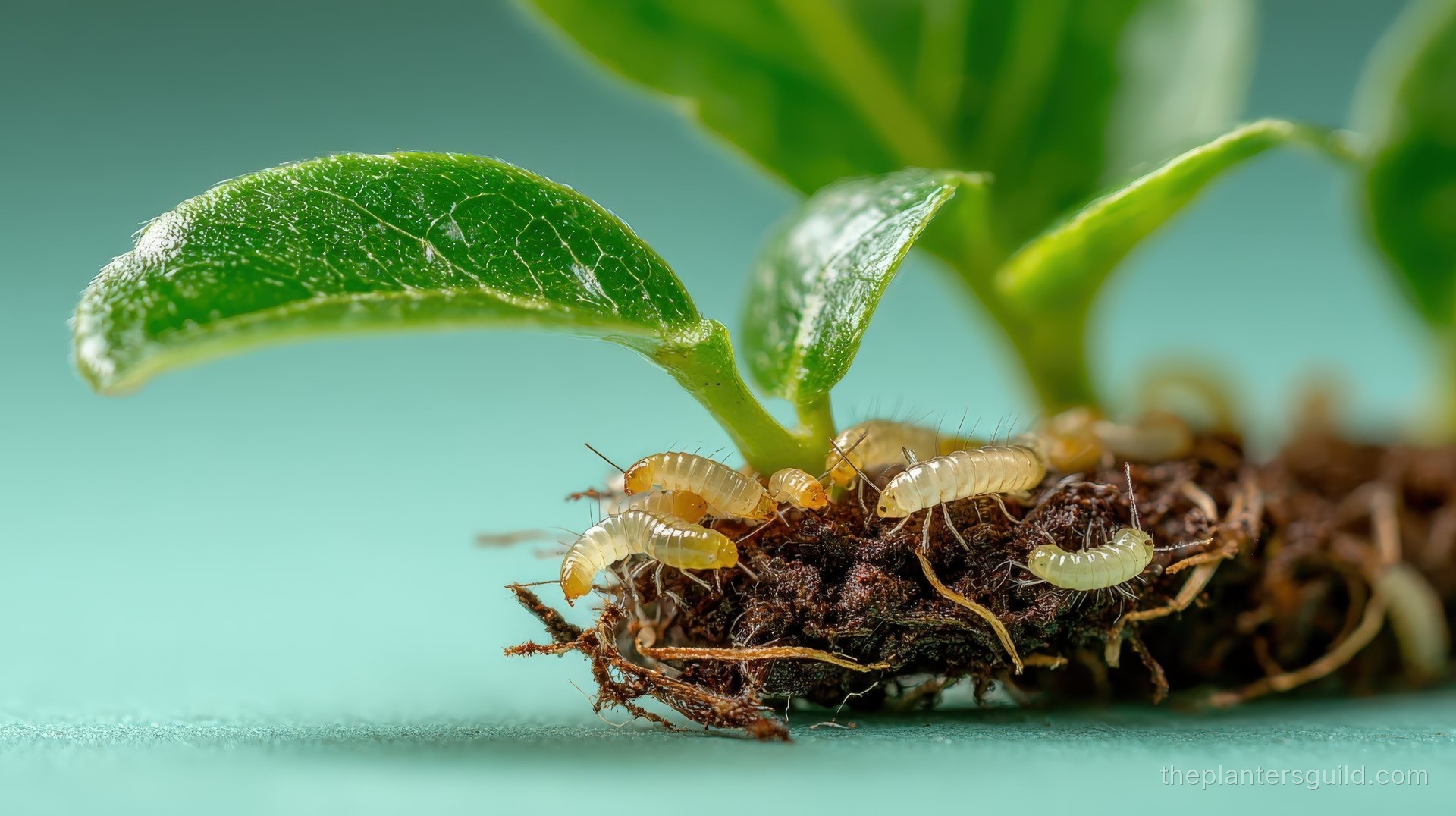
Two conditions do most of the work. Larvae prefer a moist medium, and they need fungi as a supplemental food to finish developing (Cloyd, 2010). They also feed on algae and decaying plant matter (Cranshaw & Cloyd, 2003), so a mix that stays wet and holds decaying matter suits them. That's why this dossier starts with watering and sanitation and adds treatments alongside them.
Indoor Pests · Family Sciaridae
Fungus Gnats
Bradysia coprophila · Bradysia impatiens · Bradysia spp.
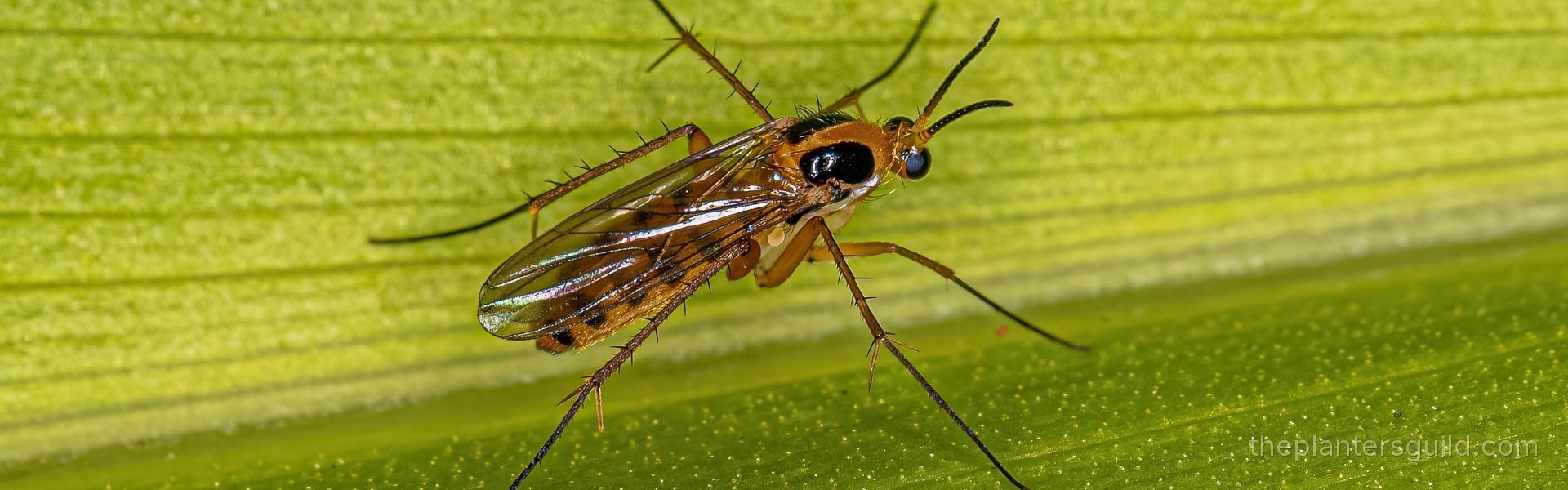
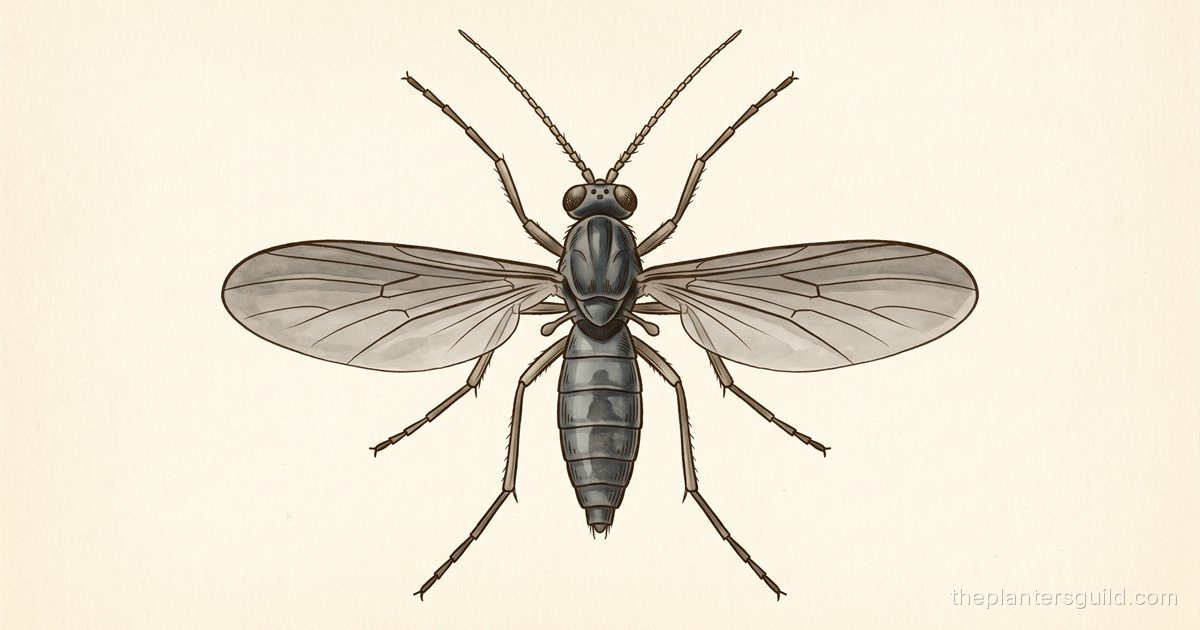 Mug Shot Illustration · adult about 1/8 in
Vital Statistics
- Family
- Sciaridae
- Adult size
- about 1/8 in (3 to 4 mm)
- Larva size
- about 1/4 in (6 mm)
- Egg to adult
- 3 to 4 weeks
- Larval instars
- 4
- Damaging stage
- larva
Modus Operandi
Larvae feed mainly on fungi, algae and decaying plant matter in the growing medium, and also on roots, root hairs and leaves lying on the surface. Root feeding stunts growth, and young plants and seedlings are especially susceptible. Larvae and adults have both been reported to carry plant pathogens between plants (Cloyd, 2010).
Last Seen
The upper 1 to 3 inches of a moist growing medium, though larvae can turn up anywhere in the pot, down to the drainage holes. Adults are weak fliers, usually seen near the infested plant.
Apprehension Protocol
The Mug Shot
Fungus gnats belong to the family Sciaridae, the dark-winged fungus gnats, in the order Diptera (true flies). The species commonly found in greenhouses are Bradysia coprophila and Bradysia impatiens (Cloyd, 2015).
Adults are about 1/8 inch (3 to 4 mm) long: slender black flies, delicate-looking, with long legs and antennae. Look at the forewings for a distinct Y-shaped pattern (Cranshaw & Cloyd, 2003). They're weak fliers that tend to stay close to the growing medium (Cloyd, 2015). They fly in short, erratic patterns, though they can disperse short distances (Cranshaw & Cloyd, 2003).
The larvae are white, translucent and legless, about 1/4 inch (6 mm) long, with a distinct black head capsule (Cloyd, 2010). That black head against a pale body is the thing to look for.
Where to find them
Larvae live in the growing medium. They're found in the upper 1 to 2 inches, though they can be spread through the whole pot, even near the drainage holes at the bottom (Cloyd, 2010). In houseplants they usually stay within 2 to 3 inches of the surface, depending on how moist the mix is (Cranshaw & Cloyd, 2003).
To check for larvae, press 1/4-inch slices of raw potato into the surface of the mix. Within a few days, larvae gather on the potato to feed. Turn the slices over and look at the underside (Cranshaw & Cloyd, 2003).
For adults, use yellow sticky cards. In greenhouse monitoring, cards laid flat just above the soil surface catch fungus gnats better than cards standing upright above the plants (Pundt, 2019).
Treat the cards as a way to see whether numbers are rising or falling. A K-State bulletin for greenhouse growers reports that there are no thresholds for deciding when gnat numbers call for action. It adds that no relationship has been established between adult counts on sticky cards and the larvae found under potato slices (Cloyd, 2010).
The lifecycle you have to break
The protocol follows from this cycle.
Three things follow from it.
First, it's quick. At typical room temperatures of 65 to 75 °F (18 to 24 °C), one generation can run egg to adult in three to four weeks, with breeding going on year-round on indoor plants. A female may lay up to 200 eggs into cracks and crevices in the mix during her 7- to 10-day life (Cranshaw & Cloyd, 2003).
Second, the larva is the stage that eats. Adults don't feed on plants, though they may drink water from leaves or the surface of the mix, while larvae feed mostly on fungi, algae and decaying plant matter, along with roots and leaves resting on the surface (Cranshaw & Cloyd, 2003). The kind of food they get affects how many adults come out and how many eggs those females lay (Cloyd, 2010).
Third, moisture sets the pace. Larvae prefer a wet medium, and gnats are especially a problem in the excessively moist conditions of propagation, while cuttings and plugs (young plants grown in small cells) are making roots (Cloyd, 2010).
How they damage plants
The larva does two kinds of harm.
The first is root feeding. Larvae eat root hairs and roots, which interferes with how well a plant takes up water and nutrients and leads to stunted growth. Young plants and seedlings are more susceptible than mature plants, unless the larval population is very large (Cloyd, 2010). In houseplants, fungus gnats are considered a nuisance when they're present in noticeable numbers, and the larvae are considered minor pests (Cranshaw & Cloyd, 2003).
The second is disease. Larval feeding can open wounds that let soilborne pathogens in, both larvae and adults have been reported to carry fungal diseases, including Pythium, Fusarium, Verticillium and Thielaviopsis basicola, from infected to healthy plants, and adults can carry spores of some pathogens on their bodies (Cloyd, 2010). How much this matters in practice is less settled. In one set of experiments, transmission of one Pythium strain by larvae reached 65% in petri dishes but was under 6% in plug cells of potting mix, and the authors concluded that fungus gnats aren't important vectors of Pythium (Braun et al., 2012). Larval transmission of Pythium seen in the lab may be less of a factor in a greenhouse, and it may vary with the Pythium species (Cloyd, 2015).
We'd still take gnats seriously around seedlings and cuttings, for the root feeding alone.
The Apprehension Protocol
Four tiers, as in the other dossiers. This is how the Guild approaches fungus gnats: Tier 1 is always on, and the others go alongside it rather than after it. A K-State bulletin and a review by the same entomologist, both written for greenhouse growers, take the same line, pairing water management and sanitation with insecticides or biological controls rather than relying on any one measure alone (Cloyd, 2010; Cloyd, 2015).
Tier 1: Fix the conditions
Start with water. For houseplants, Colorado State's fact sheet puts drying first: let the mix dry out between waterings, above all in the top 1 to 2 inches. A dry surface means fewer eggs and young larvae survive, and it's less attractive to egg-laying females (Cranshaw & Cloyd, 2003). Eggs laid in a dry surface fail to hatch for lack of moisture, the K-State bulletin adds (Cloyd, 2010).
Don't expect clean results right away. In one greenhouse study, different moisture levels within the same mix made no significant difference to gnat numbers, though the driest and wettest media tended to have fewer (Olson et al., 2002). Adults can also emerge in a burst when a pot that was allowed to dry is watered again (Smith, 2012). Keep at it; drying the surface is still the core of the extension advice.
Then clean up. Get rid of pots holding a lot of decaying plant matter, such as rotted bulbs and roots, which feeds the larvae (Cranshaw & Cloyd, 2003). Repot every so often, especially when the mix has broken down and holds too much water (Cranshaw & Cloyd, 2003). UConn's greenhouse guidance is to store bagged mix dry, in bags without tears or openings that let gnats in (Pundt, 2024).
What about top-dressing? A layer of sand on the surface has been proposed as a way to make the mix unattractive to egg-laying females (Cloyd, 2010), but the evidence we found doesn't support it. Layers of sand or diatomaceous earth on the surface didn't stop adults emerging or females laying eggs, because the layers have openings where larvae can pupate (turn into the resting stage before adulthood) and females can lay (Cloyd, 2015). In laboratory tests, dry layers of diatomaceous earth soaked up moisture from the mix and expanded, opening fissures where larvae could pupate and females could lay eggs (Cloyd et al., 2007). The one barrier we found that worked was a fine recycled-glass aggregate tested in laboratory cups. Layers 3/4 inch (1.90 cm) and 1 1/4 inches (3.18 cm) deep reduced adult emergence, while in one experiment 1/4-inch and 1/2-inch layers didn't differ from bare mix. Larvae were seen moving through the layers (Raudenbush et al., 2014). We found no studies of perlite, pumice or gravel top-dressings.
Tier 2: Bti drench
Bacillus thuringiensis subsp. israelensis, or Bti, is a bacterial larvicide that you drench into the growing medium. The EPA label says it controls larvae, not adults, so it has to go on when larvae are present, and that larvae generally respond within 24 hours of treatment (U.S. Environmental Protection Agency, 2026).
It tends to do better against the youngest larvae, the first and second instars (the growth stages between molts), than against older ones (Cloyd, 2010). UConn Extension notes it's toxic to larvae for only about two days and that repeat applications may be needed (Pundt, 2024).
So follow the timing on the label. The residential section of the current EPA label says to apply enough mixture to wet the soil surface and to "repeat once a week for at least three weeks." For commercial and plantscape (interior landscaping) use, it calls for three weekly applications where all life stages are present (U.S. Environmental Protection Agency, 2026). Use the rate on your product's label.
The label lists it for organic gardening and carries a CAUTION statement: it's harmful if inhaled and causes moderate eye irritation, so avoid breathing the dust or spray and keep it out of your eyes. The same EPA registration is sold under several names, Gnatrol among them, including home-and-garden versions (U.S. Environmental Protection Agency, 2026).
Tier 3: Beneficial nematodes
Steinernema feltiae is a beneficial nematode, about 1/64 inch (0.5 mm) long, that hunts fungus gnat larvae in the growing medium. The infective juveniles (the young stage that seeks out hosts) enter a larva through its mouth, anus or breathing pores and release a bacterium that can finish it off within 24 to 48 hours (Cloyd, 2023a).
Getting them to work comes down to a few things, all from the same K-State bulletin (Cloyd, 2023a).
Temperature: the growing medium should be between 46 and 86 °F (8 and 30 °C) for them to infect and reproduce. They're most effective between 59 and 79 °F (15 and 26 °C).
Moisture: they need a moist medium to move and survive, but too much water harms them. Water before you apply them and again right after, use a well-drained mix, and don't water heavily afterward, which can wash them out of the pot.
Handling: release them as soon as they arrive. If you have to store them, keep them in the refrigerator at 38 to 42 °F (3 to 6 °C) for no more than a week, and check the expiration date on the package.
Timing: they're effective when applied before larvae have become established in the medium. They should give control for up to four weeks. If no larvae are left, their numbers fall off and you may need to release them again later.
Tier 4: Predatory soil mites
Stratiolaelaps scimitus, a predatory mite once known as Hypoaspis miles, lives in the top inch of the growing medium. Nymphs (young mites) and adults feed on fungus gnat larvae and on the pupae of western flower thrips (Cloyd, 2023b). It doesn't attack gnat eggs or pupae (Cloyd, 2010). It's a generalist that also eats springtails, nematodes and other small soil organisms (Koppert, n.d.).
What sets it apart is staying power. Without prey it feeds on algae and plant debris in the medium, adults can go three to four weeks without eating, and one application can establish a population for a whole growing season (Cloyd, 2023b). Release it early, while fungus gnat numbers are low. It develops and reproduces best between 59 and 86 °F (15 and 30 °C), and it slows down below 57 °F (14 °C) (Cloyd, 2023b).
Don't count on it alone. The K-State bulletin says that in most cases the mite on its own won't manage fungus gnats, and it should go alongside sanitation, proper watering and other controls (Cloyd, 2023b). That's why it sits on top of Tier 1, not instead of it.
The substrate connection
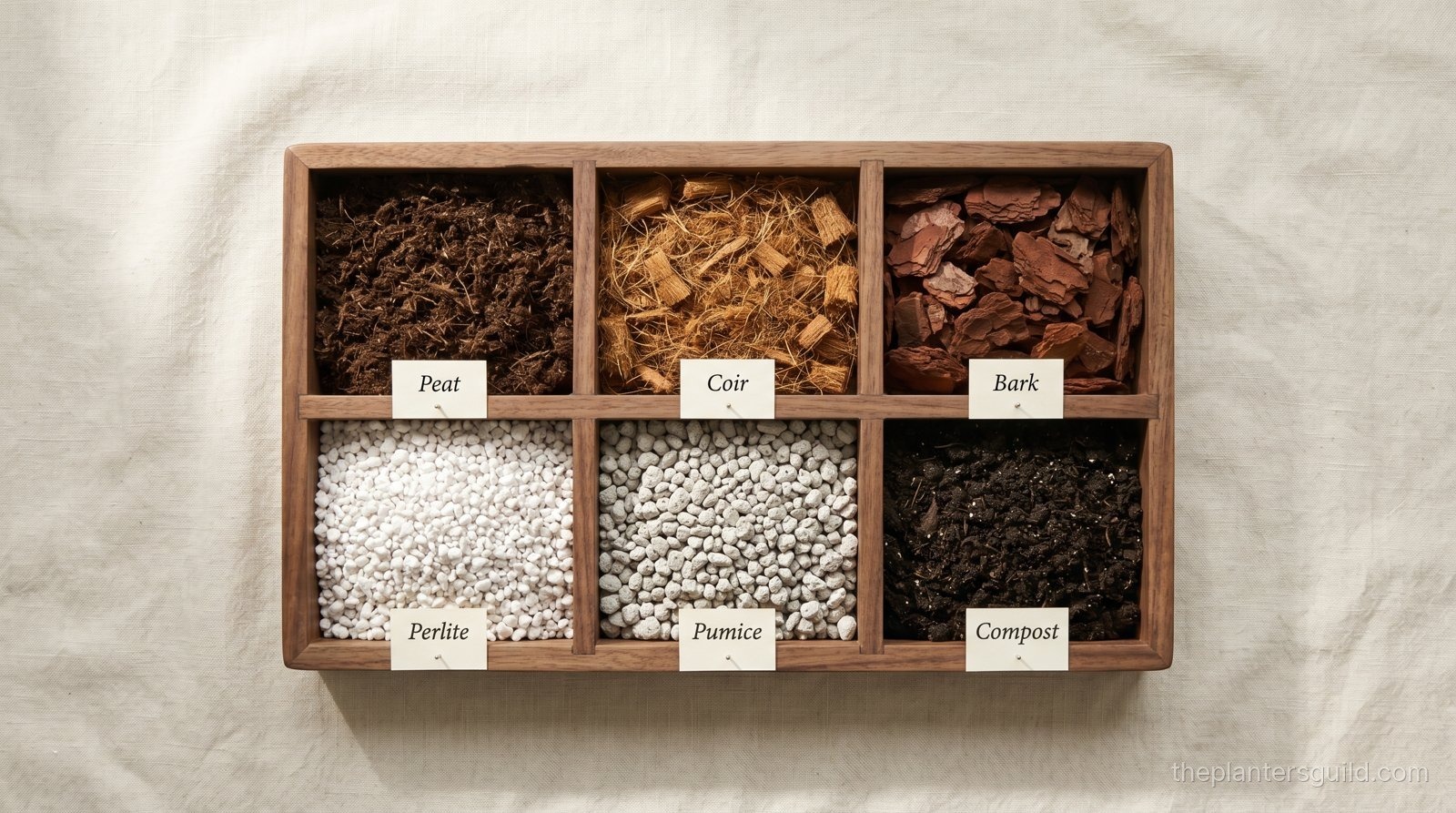
The mix matters, though it's less simple than peat against everything else.
What the larvae need is food. In a laboratory test, 20 fungus gnat eggs placed in peat moss or coconut coir, either pure or sterilized, produced fewer than one adult on average. Adding a gram of yeast as a food source raised that to between 11.5 and 13 adults, in either medium (Olson et al., 2002). Gnats develop and reproduce best in a mix with lots of microbial activity, and organic-rich mixes tend to have bigger pores that give females places to lay eggs (Cloyd, 2010). UMass Extension, citing work by Dick Lindquist of Ohio State, notes that fungus gnat problems are worst in mixes amended with immature compost (Smith, 2012).
Swapping peat for coir isn't a fix. A K-State bulletin says fungus gnats survive and reproduce as well in a coir-based mix as in a peat-based one (Cloyd, 2010). In the 2002 greenhouse study, more adults came from the peat-based mixes than from the coir-based ones, and the results depended on the mix's texture, but the authors still concluded that coir doesn't necessarily inhibit fungus gnats (Olson et al., 2002). Given a choice of three commercial soilless mixes, females laid about the same number of eggs in each (Meers & Cloyd, 2005). As UConn puts it, no potting mix is immune (Pundt, 2024).
And when a mix is less attractive to gnats, larvae may feed on plant roots instead of on fungi in the medium, which can mean more plant injury (Cloyd, 2010).
Bagged mix can also bring gnats in. Fungus gnats emerged from samples of bagged soilless media stored in a greenhouse and from bags delivered to greenhouses by wholesale distributors (Cloyd & Zaborski, 2004). We didn't find a study of retail bags sold to home growers, but keeping bags closed and dry costs nothing (Pundt, 2024).
The Guild grows its houseplants in mineral-forward mixes and lets the top of the pot dry between waterings. That's our practice rather than a tested result. We didn't find a study of fungus gnats in pumice- or lava-based mixes, so we can't tell you a mineral mix will keep them away.
If you've never thought about substrate at this level, our Substrate Primer is the place to start.
Predictable mistakes
Spraying the adults and stopping there. Colorado State's fact sheet notes that insecticides aimed at adults don't directly affect the larvae in the growing medium, that short-lived contact sprays such as pyrethrins, soaps, oils and neem don't give lasting control of adults and need repeat applications every couple of days, and that sticky cards may help by trapping egg-laying females (Cranshaw & Cloyd, 2003). We found no study showing that trapping on its own brings numbers down. Put your effort into Tier 1 and the larvae.
Drenching with Bti once. It's toxic to larvae for only about two days, and repeat applications may be needed (Pundt, 2024). The label calls for weekly applications over at least three weeks (U.S. Environmental Protection Agency, 2026).
Reaching for a spinosad spray. Neither the commercial spinosad label nor the home-garden spinosad labels we checked list fungus gnats, and we found no study of spinosad against fungus gnat larvae. If a product's label doesn't list fungus gnats, it isn't the tool for them.
Treating harder without changing the watering. A pot that stays wet, with decaying matter in it, keeps feeding the next generation. Change the conditions in Tier 1 alongside whatever else you use.
Saving biological controls for a full outbreak. Both K-State bulletins say to put them on early: nematodes before larvae become established, mites while gnat numbers are low (Cloyd, 2023a; Cloyd, 2023b).
The takeaway
Fungus gnats thrive where the growing medium stays moist and gives the larvae fungi and decaying matter to eat. The larvae do the root damage, young plants and seedlings are especially susceptible, and both larvae and adults can carry plant pathogens.
Start with the conditions: let the top 1 to 2 inches dry between waterings, clear out decaying matter, repot out of broken-down mix, and keep bags of mix closed and dry. Add Bti when larvae are active, following the label's weekly schedule, and use nematodes or predatory mites as preventive layers if your collection keeps having trouble.
When gnats show up, look at what's going on in the top of that pot before you think about spraying.
We review our guides against the research and extension guidance available at the time, and we correct them when a source doesn't say what we took it to say or when we can't find support for a point. In this review we corrected the guide's pest-control and safety advice, including its top-dressing step, its account of fungus gnat biology, monitoring, the mix and plant disease, and images that didn't show fungus gnats accurately. We also fixed points we'd credited to sources that don't make them, including damage thresholds, and removed claims we couldn't source.
Braun, S. E., Sanderson, J. P., & Wraight, S. P. (2012). Larval Bradysia impatiens (Diptera: Sciaridae) potential for vectoring Pythium root rot pathogens. Phytopathology, 102(3), 283–289. [link]
Cloyd, R. A. (2010). Fungus gnat management in greenhouses and nurseries (MF2937). Kansas State University Agricultural Experiment Station and Cooperative Extension Service. [link]
Cloyd, R. A. (2015). Ecology of fungus gnats (Bradysia spp.) in greenhouse production systems associated with disease-interactions and alternative management strategies. Insects, 6(2), 325–332. [link]
Cloyd, R. A. (2023a). Steinernema feltiae: Biological control agent of fungus gnat larvae (MF3649). Kansas State University Agricultural Experiment Station and Cooperative Extension Service. [link]
Cloyd, R. A. (2023b). Stratiolaelaps scimitus: Biological control agent of fungus gnats and the western flower thrips (MF3632). Kansas State University Agricultural Experiment Station and Cooperative Extension Service. [link]
Cloyd, R. A., Dickinson, A., & Kemp, K. E. (2007). Effect of diatomaceous earth and Trichoderma harzianum T-22 (Rifai strain KRL-AG2) on the fungus gnat Bradysia sp. nr. coprophila (Diptera: Sciaridae). Journal of Economic Entomology, 100(4), 1353–1359. [link]
Cloyd, R. A., & Zaborski, E. R. (2004). Fungus gnats, Bradysia spp. (Diptera: Sciaridae), and other arthropods in commercial bagged soilless growing media and rooted plant plugs. Journal of Economic Entomology, 97(2), 503–510. [link]
Cranshaw, W., & Cloyd, R. A. (2003). Fungus gnats as houseplant and indoor pests (Fact Sheet 5.584). Colorado State University Extension. [link]
Koppert. (n.d.). Stratiolaelaps scimitus (Hypoaspis miles) predatory mite. [link]
Meers, T. L., & Cloyd, R. A. (2005). Egg-laying preference of female fungus gnat Bradysia sp. nr. coprophila (Diptera: Sciaridae) on three different soilless substrates. Journal of Economic Entomology, 98(6), 1937–1942. [link]
Olson, D. L., Oetting, R. D., & van Iersel, M. W. (2002). Effect of soilless potting media and water management on development of fungus gnats (Diptera: Sciaridae) and plant growth. HortScience, 37(6), 919–923. [link]
Pundt, L. (2019). Using sticky cards to monitor for greenhouse insects. UConn Extension Integrated Pest Management Program. [link]
Pundt, L. (2024). Managing fungus gnats and shore flies in commercial greenhouse vegetable transplant production (EXT060). UConn Extension. [link]
Raudenbush, A. L., Cloyd, R. A., & Echegaray, E. R. (2014). Effect of a physical barrier on adult emergence and egg survival associated with the fungus gnat, Bradysia sp. nr. coprophila (Diptera: Sciaridae), under laboratory conditions. HortScience, 49(7), 905–910. [link]
Smith, T. (2012). Fungus gnats and shore flies. UMass Extension Greenhouse Crops and Floriculture Program. [link]
Image (hero): Schulz, K. (2016, May 28). Dark fungus gnat ovipositing [Photograph]. Wikimedia Commons. Cropped from the original. Licensed under CC BY 2.0. [link]
Image (larvae): Löhr, K. (2022, December 26). Sciaridae larvae in a potted plant, Düsseldorf, Germany [Photograph]. iNaturalist observation 148258615. Cropped from the original. Licensed under CC BY. [link]
U.S. Environmental Protection Agency. (2026). VectoBac WDG biological larvicide water dispersible granule (EPA Reg. No. 73049-56) [Pesticide label]. [link]