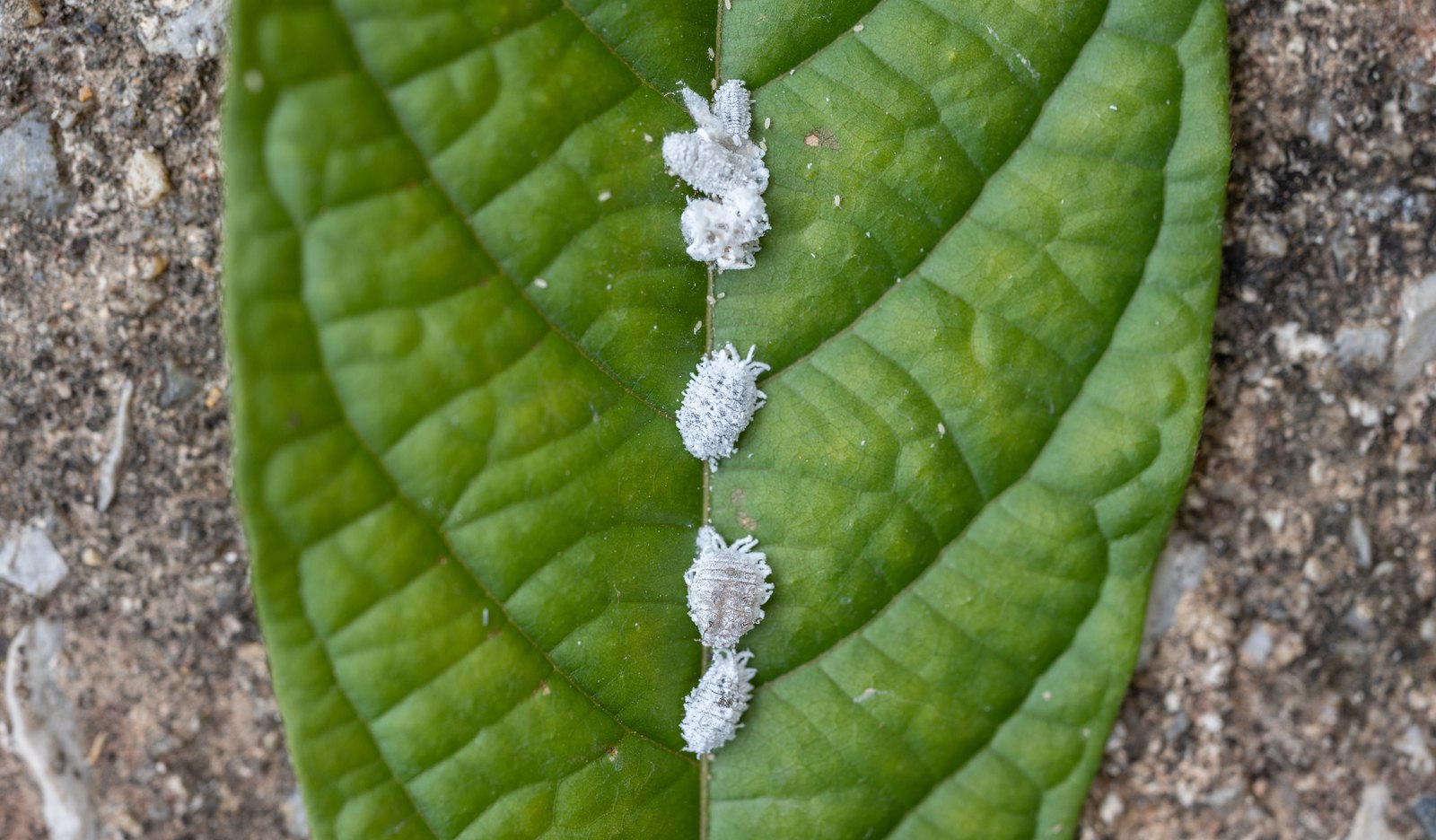
Much of what makes mealybugs hard to control comes from a coat of wax on the older nymphs and adults, and from where they settle. Understand the wax and the hiding places, and the protocol makes sense, including the part where you check the roots.
Corrected October 2026: we've revised parts of this guide. See the correction note at the end.
Cotton in the crotch of a leaf
The first sign is often the wax: a bit of white, cottony material, perhaps in a joint where stems branch (Washington State University, n.d.).
Light infestations are easy to miss because mealybugs tend to wedge themselves into crevices on the plant (Baker, 2013a). A Kansas State bulletin describes them as nearly invisible early on, until the population suddenly becomes noticeable (Cloyd, 2011). Honeydew, a shiny, sticky substance, may collect on the leaves below (Washington State University, n.d.).
In a greenhouse, citrus mealybug can reproduce year-round, which keeps populations going continuously (Gill et al., 2012), and UF/IFAS notes that plants kept in homes or greenhouses seem especially at risk because temperature and humidity there stay fairly stable (Gillett-Kaufman & Byron, 2016).
Among the reasons they're hard to control are the wax on the older insects, overlapping generations and the places they settle (Cloyd, 2011).
Indoor & Container Pests · Order Hemiptera
Mealybugs
Planococcus citri · Pseudococcus longispinus · Rhizoecus spp.
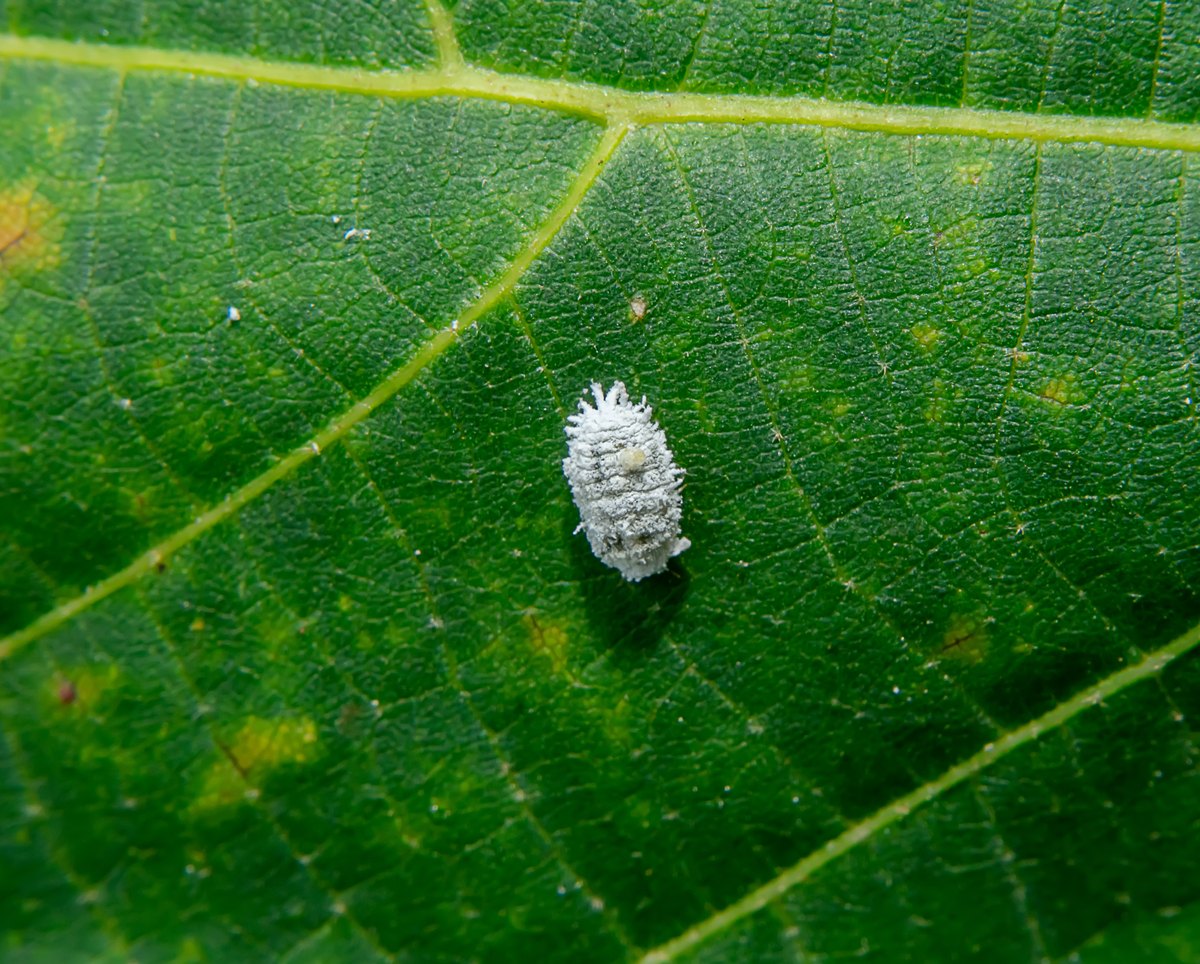 Mug Shot Photograph · species not identified
Vital Statistics
- Order
- Hemiptera
- Family
- Pseudococcidae (citrus, longtailed); EFSA places the root mealybug Ripersiella hibisci in Rhizoecidae
- Adult female size
- about 1/8 in (3 mm), citrus and longtailed; 1/16 to about 1/8 in, root
- Color
- white wax over the body
- Nymph to adult (citrus)
- 6 to 10 weeks
- Eggs per female (citrus)
- 300 to 600
- Female lifespan (citrus)
- up to 29 days
Modus Operandi
Feeds on plant sap with piercing-sucking mouthparts and excretes the surplus as honeydew, on which black sooty mold grows. Feeding can stunt growth and yellow or distort leaves. Older nymphs and adults carry a waxy coat that protects them from many insecticides; newly hatched crawlers don't have it yet.
Last Seen
Leaf undersides, the junctions of leaf stalks and stems, near the base of the plant, inside the pot rim and in the drainage hole. Root mealybugs live on the roots and in the growing medium.
Apprehension Protocol
The Mug Shot: three animals, one name
Several kinds of mealybug turn up in greenhouses and on houseplants. Kansas State names citrus mealybug and longtailed mealybug as the main species in greenhouses and interiorscapes, with root mealybugs a concern of their own because they're so hard to find and manage (Cloyd, 2011). Telling the three apart matters, because longtailed changes which predator is worth buying and root mealybugs change where you look.
Citrus mealybug (Planococcus citri, pronounced plan-oh-KOK-us SIT-ry). Adult females are about 0.12 in (3 mm) long, wingless, white to light brown, coated in white wax with a faint gray stripe down the back, short wax filaments around the edge of the oval body and a slightly longer pair at the rear (Gill et al., 2012). Adult males are winged, about 0.18 in (4.5 mm) long, can't feed, and live one to two days (Gill et al., 2012). NC State records citrus mealybug on plants from at least 27 families (Baker, 2013a).
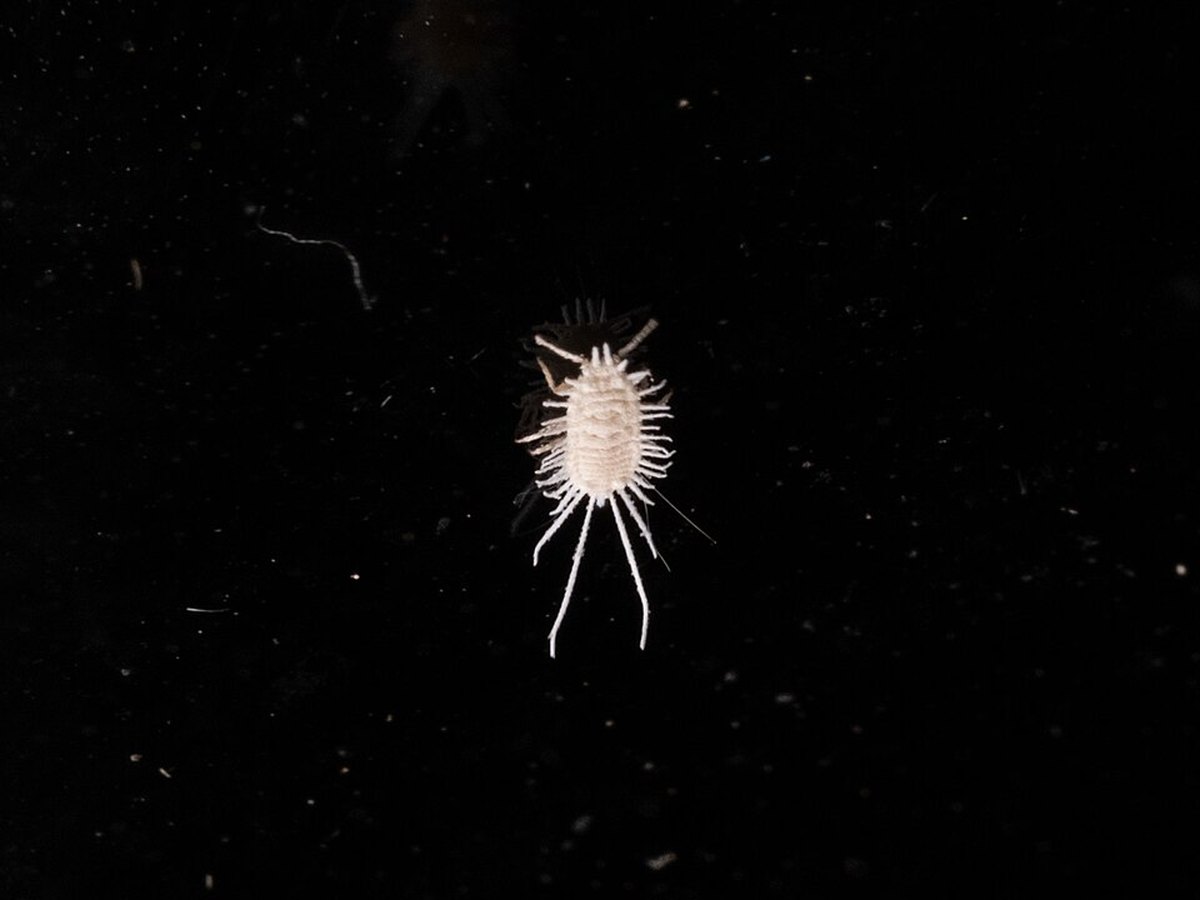
Longtailed mealybug (Pseudococcus longispinus, soo-doh-KOK-us lon-jih-SPY-nus). Adult females are about 1/8 in (3 mm) long and white (University of Massachusetts Amherst, 2024). On mature specimens, the tail filaments match or exceed the body's length, unless they've broken off (Baker, 2013b), and they break off easily (University of Massachusetts Amherst, 2024), so a short-tailed specimen doesn't rule the species out. Its host range includes avocado, citrus, grapes, pear, persimmon and pineapple, along with cycads and orchids (Gillett-Kaufman & Byron, 2016).
Root mealybugs (Rhizoecus spp., ry-zo-EE-kus). Adult females measure 1/16 to about 1/8 inch, a little flattened and rounded at both ends, with a bluish-white body under a shallow, fluffy white bloom. They almost or completely lack eyes, and their antennae are short. NC State compares them to large white springtails that move much more slowly (Baker, 2018). One root mealybug, long listed as Rhizoecus hibisci, has been placed in Ripersiella since a 1976 taxonomic revision, and EFSA uses Ripersiella hibisci as its current valid name (EFSA Panel on Plant Health, 2020), so you'll see both names.
What gets confused with mealybugs. Whiteflies, soft scales, woolly aphids and cottony cushion scale also make wax and honeydew (Rezazadeh, 2023). Mealybugs are soft-bodied, segmented and oval, and a fringe of wax filaments may be present around the edge of the body (University of Massachusetts Amherst, n.d.).
Why the spray beads off
The wax covers the older nymphs and the adults, not every stage. First-instar nymphs, called crawlers (Gill et al., 2012), don't yet have the waxy outer layer that shields older nymphs and adults, which is why UF/IFAS advises aiming chemical control at the crawler stage (Gillett-Kaufman & Byron, 2016). UMass Extension says the same about crawlers, and puts the difficulty of managing mealybugs with pesticides down to their waxy coating (University of Massachusetts Amherst, n.d.). Kansas State goes further: very few, if any, insecticides get through the waxy covering, though insecticides containing ethyl alcohol, such as some oil-based products, may let the material penetrate it (Cloyd, 2011).
One lab study suggests what the wax is doing. Working on cotton mealybug (Phenacoccus solenopsis, fen-uh-KOK-us so-len-OP-sis), the researchers found that hydrocarbons made up 59 to 68 percent of the wax's chemical profile across four lab methods (Tong et al., 2022). When they suppressed a gene involved in making it, the insects secreted less wax, and 48 hours after a deltamethrin spray, survival had decreased by 16.56 percent in the insects injected to suppress the gene and by 22.22 percent in those fed on genetically modified tobacco, as the paper reports it (Tong et al., 2022). Suppressing the gene lowered survival even without the insecticide, so the result isn't only about the coat. Read it as evidence that the wax helps protect the insect, from a species that isn't the usual houseplant pest, not as a measure of how much a spray will do on your plant.
That leaves three ways to work against a waxed population:
- Take them off. When only a few plants are infested, a swab dipped in rubbing alcohol removes mealybugs, and a wash in mild soapy water removes the wax they leave behind (Baker, 2013a). Where it's feasible, a forceful water spray applied regularly dislodges all life stages (Cloyd, 2011).
- Catch the crawlers. Repeat contact sprays at intervals so each new wave of crawlers is hit before it builds its wax.
- Go around the wax. A systemic insecticide moves throughout the plant's parts (Cloyd, 2011), rather than having to land on the insect. It has real limits.
Where to look
If you treat only the colony you can see, you can miss the ones sheltering elsewhere. UMass lists the usual places (University of Massachusetts Amherst, n.d.):
- Leaf undersides.
- The junctions of leaf stalks and stems.
- Near the base of the plant.
- Inside the pot rim and in the drainage holes.
Young mealybugs tend to move to new growth to feed, so check the shoot tips too (University of Massachusetts Amherst, n.d.).
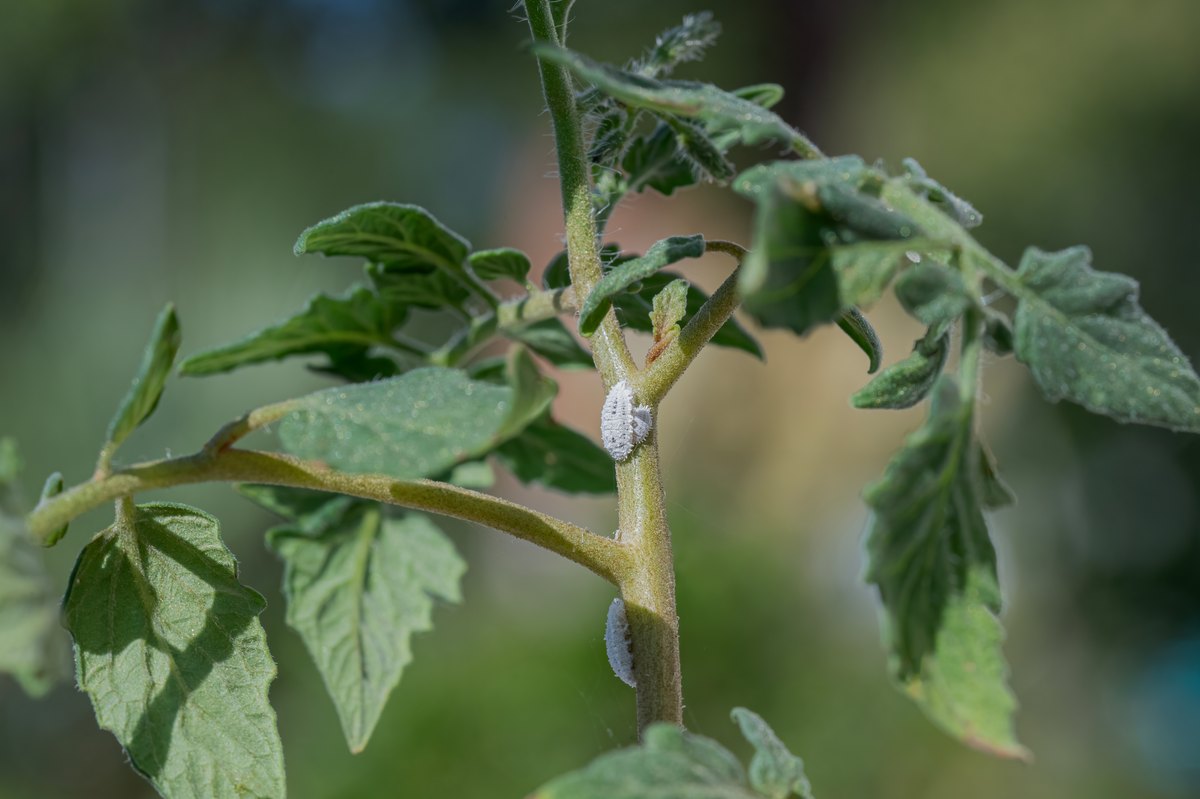
Follow the honeydew. Mealybugs excrete honeydew, a sweet, sticky liquid (Baker, 2013a), and black sooty mold grows on it. UMass notes that sooty mold cuts the plant's ability to photosynthesize and spoils its looks (University of Massachusetts Amherst, n.d.). Honeydew may collect on lower leaves or on surfaces below an infested plant (Washington State University, n.d.), so a sticky leaf or a black film is a reason to look at the stems above it. Ants on the plant are another sign (University of Massachusetts Amherst, n.d.).
Quarantine new plants. In greenhouses, mealybugs usually arrive on infested plants (University of Massachusetts Amherst, n.d.). Washington State University advises keeping a plant that's moving indoors isolated from the rest of the collection for about a month, inspecting it regularly, and quarantining newly bought plants as well (Washington State University, n.d.). A shelf quarantine is unlikely to show you root mealybugs, though: they're not easily detected unless the plant is out of its pot (Hara et al., 2001). University of Hawaiʻi Extension recommends inspecting the roots of newly bought plants by taking them out of the pot (University of Hawaiʻi Cooperative Extension Service, 2001).
Egg sacs and overlapping generations
A single treatment rarely finishes the job, and the egg sac is a big part of the reason.
A citrus mealybug female lays 300 to 600 eggs, packed into a dense, fluffy egg sac, or ovisac (Baker, 2013a). The sac shields the eggs: pesticides don't readily get into it, so eggs inside go on to hatch after you spray. That's why NC State says infested plants "probably should be treated at weekly intervals at least twice and probably three times," giving the eggs time to hatch and the young to leave the egg sacs (Baker, 2013a). Kansas State adds that most insecticides do nothing to eggs, except possibly petroleum-based or neem oils, so at least two to three weekly applications are usually needed (Cloyd, 2011).
Citrus mealybug nymphs take six to ten weeks to reach maturity. Females go through four instars, the stages between molts; males go through three plus a pre-pupal stage (Gill et al., 2012). In a greenhouse, reproduction can run year-round (Gill et al., 2012), and Kansas State notes frequent overlapping generations, with eggs, crawlers and adults all present at once (Cloyd, 2011).
Longtailed mealybug works differently. There's no visible egg stage: the nymphs hatch as the eggs are laid (Gillett-Kaufman & Byron, 2016). Some sources describe this as live birth instead (Cloyd, 2011; University of Massachusetts Amherst, n.d.). Either way, there's no cottony egg mass to find (Shelton, n.d.). For longtailed, NC State advises re-treating two or more times at weekly intervals unless you're using a systemic, to catch mealybugs earlier treatments missed (Baker, 2013b).
The Apprehension Protocol
Five tiers, in the order the Guild works through them. The order is our practice. The steps within each tier come from the sources cited.
Tier 1: Isolate and search the refuges
Move the infested plant away from the others before you do anything else. UMass calls early detection and isolating infested plants important to preventing outbreaks (University of Massachusetts Amherst, n.d.).
Then check the plants nearby, and the pots as well as the plants. Mealybugs keep their legs throughout their lives, so they can move from plant to plant (University of Massachusetts Amherst, n.d.), and young ones can be blown by wind (Gill et al., 2012).
Tier 2: Take them off by hand
For a light infestation, a cotton swab dipped in rubbing alcohol. NC State gives the swab for a few infested plants (Baker, 2013a). Washington State University notes that excessive alcohol may harm some plants, and suggests testing it on a single leaf and waiting a few days to check for damage (Washington State University, n.d.). On concentration, a UF/IFAS county agent gives a 70 percent or weaker solution of isopropyl alcohol and water for removing mealybugs from indoor plants with serious infestations, and says to test plants for damage first and reduce the concentration (Rezazadeh, 2023). We use 70 percent or less, after a patch test.
Dab the swab onto every colony you found in Tier 1. Then wash the plant with mild soapy water, about 2 percent soap rather than detergent, to remove the wax the mealybugs leave behind (Baker, 2013a). In citrus groves, UF/IFAS rates high-pressure water sprays as moderately effective (Gill et al., 2012), and a strong stream of water is worth using on foliage sturdy enough to take it.
Keep watching the plant closely for a few weeks and remove new mealybugs as they appear (Baker, 2013a). Pinch or prune off leaves and shoots that are heavily infested (Washington State University, n.d.).
Tier 3: Insecticidal soap or horticultural oil, weekly, three rounds
Contact sprays such as insecticidal soap and horticultural oil work on young nymphs, and because eggs keep hatching, repeat applications are needed. UMass calls thorough coverage of every part of the plant essential (University of Massachusetts Amherst, n.d.).
Wet every infested surface: leaf undersides, the stem junctions, the shoot tips, the base of the plant.
Plan on three weekly rounds. That follows NC State's "probably three times" (Baker, 2013a), and it's as far as the indoor directions on the insecticidal soap label we checked go: spray weekly, at 7 to 10 day intervals, no more than three times as needed (Woodstream Corporation, 2011). Follow your product's label on rate, interval and how many applications in a row it allows.
The same soap label says not to use it on new transplants, freshly rooted cuttings or drought-stressed plants, to avoid spraying when the temperature is over 90°F, and to test it first on palms, succulents, dracaena, dieffenbachia, delicate ferns and ornamental ivies (Woodstream Corporation, 2011). UMass adds that a spreader-sticker may improve coverage but may also raise the risk of damage to the plant (University of Massachusetts Amherst, n.d.).
Tier 4: Root mealybugs and colonies a spray can't reach
Two options.
A labeled systemic. NC State recommends imidacloprid or another systemic insecticide for root mealybugs, labeled for residential use (Baker, 2018). Use only a product whose label covers indoor houseplants and lists mealybugs. The plant-spike label we checked, for example, lists mealybugs and excludes edible plants, herbs, fruits and vegetables (U.S. Environmental Protection Agency, 2012). Read the section on systemics below before you reach for one.
Discard and clean. UMass advises that greenhouses with root mealybugs discard infested plants and debris, and disinfest containers before reusing them (University of Massachusetts Amherst, n.d.). For a houseplant, that means binning the plant and its mix and scrubbing the pot before it goes back into use.
Tier 5: Retire the reservoir
A heavily infested plant that keeps seeding the shelf around it may be better off gone. UMass says it may be best to discard plants when only a few are heavily infested, to limit spread (University of Massachusetts Amherst, n.d.), and UConn says the same (Pundt, 2019).
It isn't a nice call to make, and we've put it off ourselves longer than we should have.
The ones under the soil
Root mealybugs are often overlooked because they're tiny and live on roots (Baker, 2018).
Their damage isn't specific. The most common symptoms are slow growth and lack of vigor, and unless an infestation is unusually heavy, it isn't evident until the pot comes off and the root ball is examined. Slow-growing and root-bound plants are more susceptible, as are plants stressed by their environment or nutrition (Hara et al., 2001).
A plant that's growing slowly is worth a root check. University of Hawaiʻi Extension recommends inspecting the roots of slow-growing plants by removing the pot (University of Hawaiʻi Cooperative Extension Service, 2001). Slide it out and look.
With the root mealybug Ripersiella hibisci, what you're likely to see first is wax. EFSA notes that the creamy-white wax adult females leave on the soil, around the roots or on the inside wall of the container is often the first sign of an infestation, and that close inspection may show white adults and nymphs on the outside of the root ball, next to the pot wall (EFSA Panel on Plant Health, 2020). In a Hawaiʻi trial, root mealybugs occurred throughout the root mass but were concentrated in the gap between root mass and pot (Hu et al., 1996). Their powdery wax can also give the soil a bluish tint (Baker, 2018).
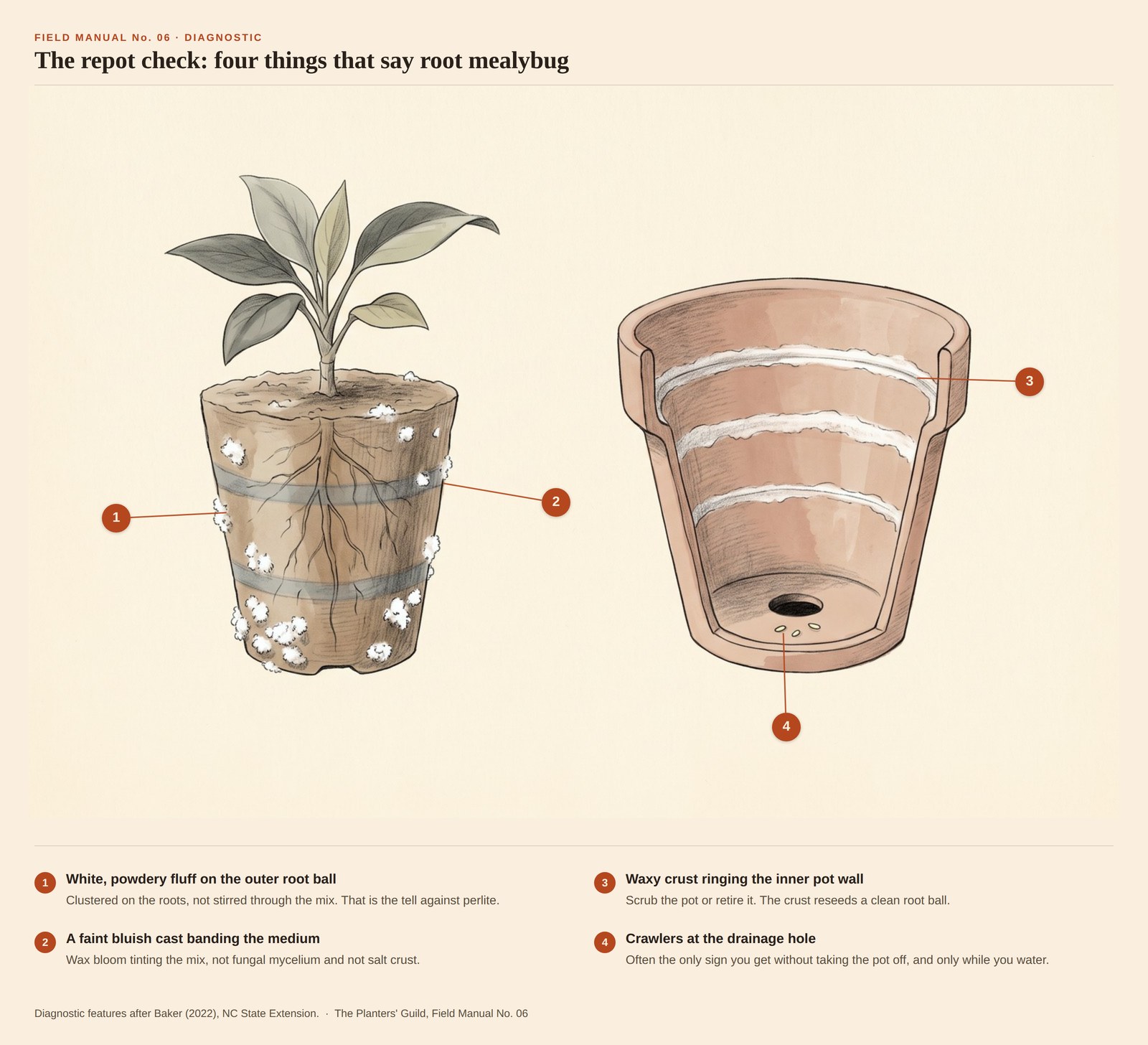
The other way to find them is at the drainage hole. When potted plants are watered, root mealybugs sometimes crawl out through the drainage holes and move onto nearby plants (Baker, 2018), so pale specks on a saucer after watering are worth a close look, along with the plants next to it.
For treatment, the options are the ones in Tier 4: a systemic labeled for this use, or discarding the plant and cleaning the pot. Researchers in Hawaiʻi have also tested hot water on the roots of potted palms (Hu et al., 1996; Hara et al., 2001). The trial was small, and University of Hawaiʻi Extension notes that more work is needed on how well different plants tolerate heat (University of Hawaiʻi Cooperative Extension Service, 2001), so we don't give a home method.
Treat every repot as an inspection. You already have the root ball out of the pot, so give it a careful look in good light before it goes back in.
The ant problem
Ants protect mealybugs from their natural enemies (Cloyd, 2011) in order to feed on their honeydew (Pundt, 2019). They can also carry crawlers from plant to plant (Cloyd, 2011).
One study measured part of this. In a caged trial with cotton mealybug (Phenacoccus solenopsis), the ghost ant (Tapinoma melanocephalum, tap-ih-NO-muh mel-an-oh-SEF-uh-lum) and the parasitoid wasp Aenasius bambawalei, parasitism was 34.5 percent on plants with ants and 47.7 percent on plants without them. When the wasp was excluded, ants made no difference to mealybug survival (Feng et al., 2015).
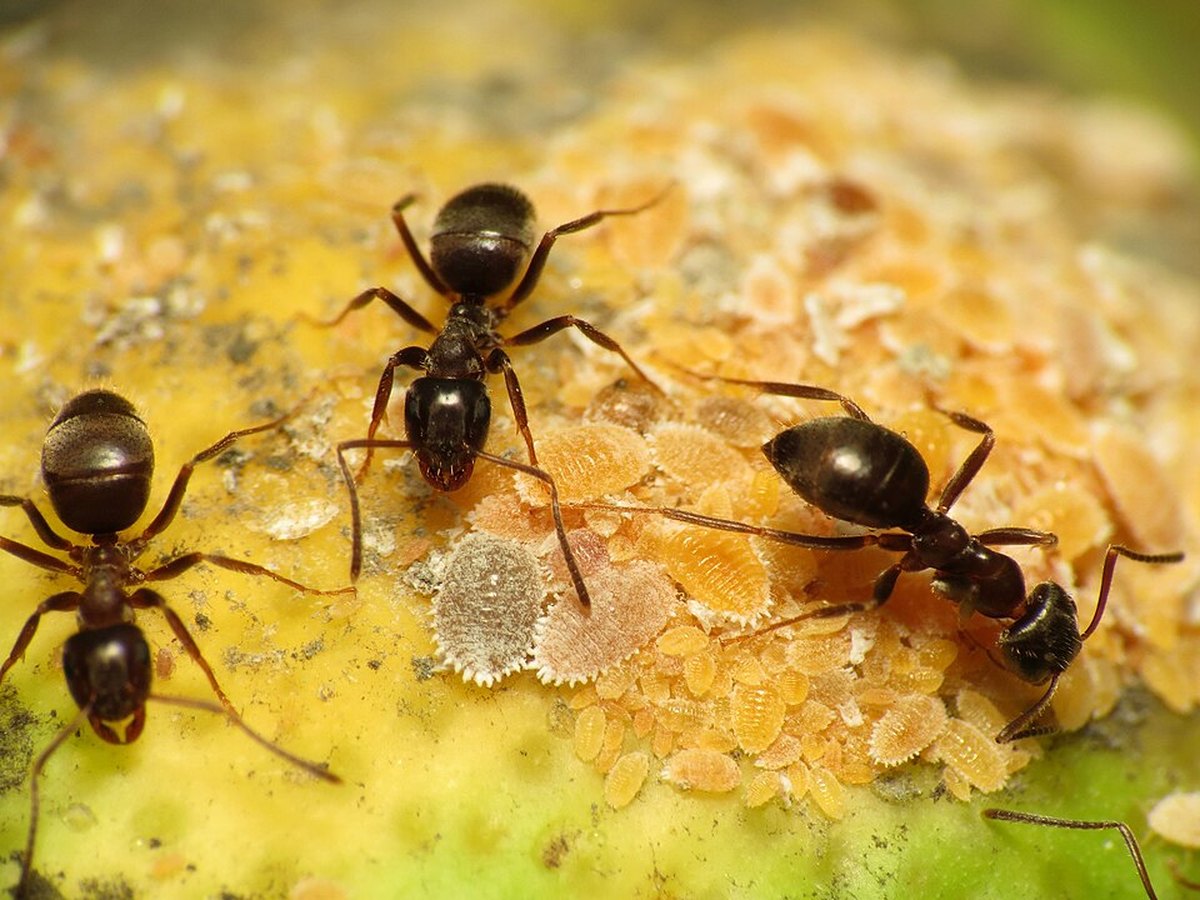
Deal with the ants before you release predators or parasitoids (Pundt, 2019). In California citrus, UF/IFAS notes that banding trees or baiting for ants is recommended where Argentine ants interfere with natural enemies (Gill et al., 2012).
Buying the right predator
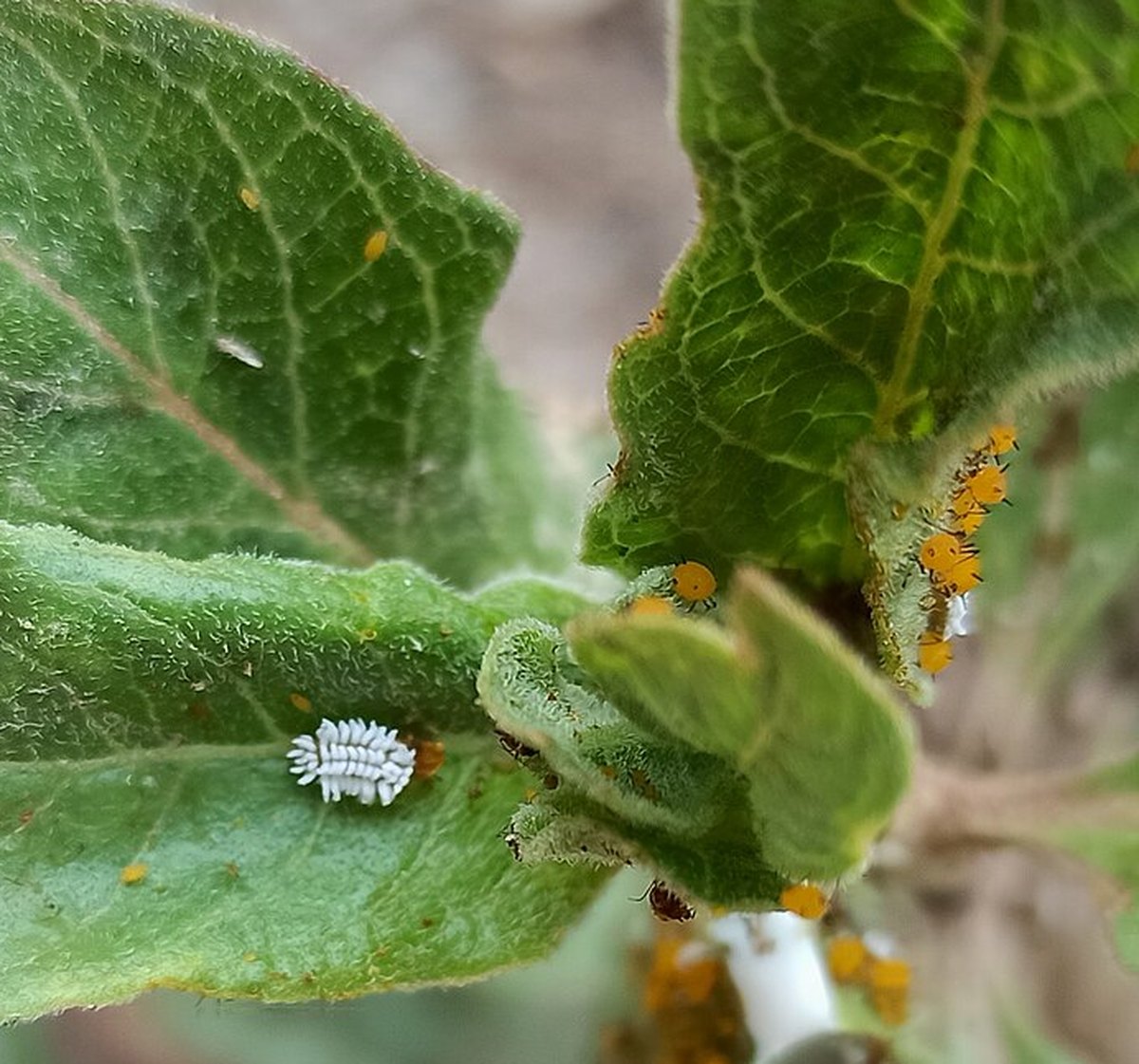
Cryptolaemus montrouzieri (krip-toh-LEE-mus mon-troo-zee-AIR-ee), the mealybug destroyer, is a small lady beetle. Its larvae carry woolly wax appendages that make them look like mealybugs (Shelton, n.d.). Adults and larvae both feed on mealybugs, and a single larva may eat up to 250 small ones (Shelton, n.d.).
Two things decide whether it's worth buying.
It needs cottony egg masses to breed. Females lay their eggs among a mealybug's cottony egg sac, and longtailed mealybugs don't make one (Shelton, n.d.). UConn says the beetle reproduces only on mealybugs that produce egg masses, so it isn't effective against longtailed mealybug (Pundt, 2019). Cornell still calls it an important predator of citrus and longtailed mealybugs in greenhouses and interior plantscapes (Shelton, n.d.), so it will eat longtailed mealybugs. It just won't build a population on them.
Conditions matter. UConn gives an optimum of 72 to 77°F (22 to 25°C) at 70 to 80 percent relative humidity. The beetles are most active on sunny days, less active during short winter days, and most effective when mealybug numbers are high (Pundt, 2019). When mealybugs are scarce, they fly off in search of other prey such as aphids and soft scales, though they reproduce far better on mealybugs (Shelton, n.d.). In complex interior plantings with several infestations and other prey, they can persist (Shelton, n.d.).
In our reading, that makes Cryptolaemus a better fit for a greenhouse or warm conservatory with a heavy citrus mealybug infestation, once the ants are under control, than for a few houseplants on a windowsill.
Parasitoid wasps. Identify the mealybug to species before releasing any natural enemy (University of Massachusetts Amherst, n.d.). UMass says Leptomastix dactylopii (lep-toh-MAS-tix dak-tih-LOH-pee-eye) attacks only citrus mealybug, is very effective on long-term crops, and isn't useful against longtailed mealybug (University of Massachusetts Amherst, n.d.). A UF/IFAS profile lists it as a parasitoid of more than 20 mealybug species, longtailed among them (Al-Shami & Qureshi, n.d.), so the sources don't agree on its range. Anagyrus pseudococci (an-uh-JY-rus soo-doh-KOK-sy) is sold as a parasitoid of citrus mealybug, with an optimum temperature of 76°F and a minimum of 51°F, and UConn says it's effective only against citrus mealybug (Pundt, 2019), though it has been recorded on longtailed mealybug (Chormanski & Cave, n.d.). Parasitoids recorded on longtailed mealybug include Anarhopus sydneyensis (an-uh-ROH-pus sid-nee-EN-sis) and Pseudaphycus angelicus (soo-DAF-ih-kus an-JEL-ih-kus) (Gillett-Kaufman & Byron, 2016), but Kansas State notes that none is sold commercially for it (Cloyd, 2011).
About systemics
The Field Manual's standing position, set out in Dossier No. 01 on thrips, is that systemic neonicotinoids are almost always the wrong tool indoors. Mealybugs, especially root mealybugs, are the case where a systemic is worth knowing about, so here are the limits.
How it gets there. After root uptake, imidacloprid moves up through the plant in the xylem, the water-conducting tissue (Sur & Stork, 2003).
It may be less dependable on mealybugs. Kansas State notes that systemics, depending on the type, may work less well on mealybugs than on aphids or whiteflies, possibly because mealybugs don't take in a lethal dose (Cloyd, 2011). UMass says systemics must be applied preventively, while the plant is actively growing, and that because they don't affect eggs, another application may be needed after three to four weeks (University of Massachusetts Amherst, n.d.).
Only a label that covers your use. Use a product labeled for indoor houseplants that lists mealybugs, and follow it. Never use one on anything you intend to eat, including herbs; the spike label we checked excludes edible plants, herbs, fruits and vegetables (U.S. Environmental Protection Agency, 2012).
Never on a plant that will flower where bees forage. UMass advises making insecticide applications after bloom to protect pollinators (University of Massachusetts Amherst, 2024).
Try the physical route first. Swabbing, washing and repeat sprays come before a systemic, and for root mealybugs, so does the option of discarding the plant.
There's one more reason to catch mealybugs early, outdoors in particular. Some mealybugs, longtailed mealybug among them, transmit grapevine leafroll-associated virus 3. In a lab study, single young nymphs (first to second instar) of Planococcus ficus and Pseudococcus longispinus, after feeding on infected vines, transmitted the virus to 70 percent of the grapevine plants they were placed on, for each species (Douglas & Krüger, 2008).
Predictable mistakes
Treating once and calling it. Egg sacs shield eggs, and generations overlap. Plan on three weekly rounds, within the label.
Spraying only what's visible. Mealybugs shelter on leaf undersides, in stem junctions, near the base of the plant and inside the pot rim.
Expecting a spray to get through the wax. Older mealybugs are protected. Take them off by hand, time sprays for the crawlers, and repeat.
Ignoring the ants. Ants protect mealybugs from their natural enemies. Deal with them before you release any.
Skipping quarantine. In greenhouses, mealybugs usually arrive on infested plants. Isolate new plants, and look at their roots.
Missing root mealybugs. A plant that's growing slowly is worth taking out of its pot.
Buying Cryptolaemus for longtailed mealybug. It can't breed without cottony egg masses, so it won't build a population on longtailed.
Keeping a reservoir plant on the shelf. Discarding a few heavily infested plants helps limit the spread to the rest.
The takeaway
Mealybugs are stubborn more than complicated. Much of what makes them hard comes down to the wax on the older insects, overlapping generations, and where they choose to sit.
Take them off where you can reach them, wash off the wax, and time repeat sprays so each wave of crawlers gets hit before it builds its coat. Plan on three weekly rounds, within the label. Handle the ants before you buy a predator, and match the predator to the species you actually have.
And check the roots. If a plant has stalled, take the pot off and look.
We review our guides against the research and extension guidance available at the time, and we correct them when a source doesn't say what we took it to say or when we can't find support for a point. In this review we corrected the guide's pest-control and safety advice, including alcohol strength, the spray schedule and label limits, how systemic insecticides work and which ones to use, and a hot-water root treatment, along with its account of mealybug biology, their natural enemies and the image labels. We also fixed points we'd credited to sources that don't make them and removed claims we couldn't source, including figures from studies we couldn't read in full.
Baker, J. R. (2013a; rev. 2023). Citrus mealybug. NC State Extension Publications. [link]
Baker, J. R. (2013b; rev. 2022). Longtailed mealybug. NC State Extension Publications. [link]
Baker, J. R. (2018; rev. 2022). Root mealybugs. NC State Extension Publications. [link]
Cloyd, R. A. (2011). Mealybug management in greenhouses and interiorscapes (MF3001). Kansas State University Agricultural Experiment Station and Cooperative Extension Service. [link]
Douglas, N., & Krüger, K. (2008). Transmission efficiency of Grapevine leafroll-associated virus 3 (GLRaV-3) by the mealybugs Planococcus ficus and Pseudococcus longispinus (Hemiptera: Pseudococcidae). European Journal of Plant Pathology, 122(2), 207–212. [link]
EFSA Panel on Plant Health. (2020). Pest categorisation of Ripersiella hibisci. EFSA Journal, 18(6), e06178. [link]
Feng, D.-D., Michaud, J. P., Li, P., Zhou, Z.-S., & Xu, Z.-F. (2015). The native ant, Tapinoma melanocephalum, improves the survival of an invasive mealybug, Phenacoccus solenopsis, by defending it from parasitoids. Scientific Reports, 5, 15691. [link]
Gill, H. K., Goyal, G., & Gillett-Kaufman, J. L. (2012; rev. 2019). Citrus mealybug, Planococcus citri (Risso) (Insecta: Hemiptera: Pseudococcidae) (EENY-537/IN947). UF/IFAS Extension. [link]
Gillett-Kaufman, J. L., & Byron, M. A. (2016). Longtailed mealybug, Pseudococcus longispinus (Targioni Tozzetti) (Insecta: Hemiptera: Pseudococcidae) (EENY-666/IN1149). UF/IFAS Extension. [link]
Golsteyn, L., Mertens, H., Audenaert, J., Verhoeven, R., Gobin, B., & De Clercq, P. (2021). Intraguild interactions between the mealybug predators Cryptolaemus montrouzieri and Chrysoperla carnea. Insects, 12(7), 655. [link]
Hara, A. H., Niino-DuPonte, R. Y., & Jacobsen, C. M. (2001). Root mealybugs of quarantine significance in Hawaii (Insect Pests IP-6). College of Tropical Agriculture and Human Resources, University of Hawaiʻi at Mānoa. [link]
Hu, B. K. S., Hara, A. H., & Hata, T. Y. (1996). Hot water as a potential treatment against root mealybugs, Hawaii, 1995. Arthropod Management Tests, 21(1), 382–383. [link]
Pundt, L. (2019). Biological control of mealybugs. UConn Extension Integrated Pest Management Program. [link]
Rezazadeh, A. (2023). Mealybug on tomato and its management. UF/IFAS Extension St. Lucie County. [link]
Shelton, A. M. (Ed.). (n.d.). Cryptolaemus montrouzieri. In Biological control: A guide to natural enemies in North America. Cornell University. Retrieved October 7, 2026. [link]
Sur, R., & Stork, A. (2003). Uptake, translocation and metabolism of imidacloprid in plants. Bulletin of Insectology, 56(1), 35–40. [link]
Tong, H., Wang, Y., Wang, S., Omar, M. A. A., Li, Z., Li, Z., Ding, S., Ao, Y., Wang, Y., Li, F., & Jiang, M. (2022). Fatty acyl-CoA reductase influences wax biosynthesis in the cotton mealybug, Phenacoccus solenopsis Tinsley. Communications Biology, 5, 1108. [link]
Al-Shami, S., & Qureshi, J. A. (n.d.). Leptomastix dactylopii Howard (Hymenoptera: Encyrtidae): Parasitoid of mealybugs (EENY-807/IN1420). UF/IFAS Extension. [link]
Chormanski, T., & Cave, R. D. (n.d.). Anagyrus pseudococci Girault (Insecta: Hymenoptera: Encyrtidae) (EENY-619/IN1081). UF/IFAS Extension. [link]
University of Hawaiʻi Cooperative Extension Service. (2001). Mealybugs and slugs on potted-foliage plants (Horticulture Digest 106). [link]
University of Massachusetts Amherst. (n.d.). Mealybugs in greenhouses [Fact sheet]. UMass Extension Greenhouse Crops and Floriculture Program. [link]
University of Massachusetts Amherst. (2024). Pseudococcus longispinus [Professional insect & mite guide]. UMass Extension Landscape, Nursery and Urban Forestry Program. [link]
U.S. Environmental Protection Agency. (2012). 2-in-1 insect control plus fertilizer plant spikes (EPA Reg. No. 432-1399) [Pesticide label]. [link]
Washington State University. (n.d.). Mealybugs [PestSense fact sheet]. WSU Pesticide Resources and Education Program. [link]
Woodstream Corporation. (2011). Insect killing soap concentrate II (EPA Reg. No. 42697-60) [Pesticide label]. [link]
Image (longtailed mealybug): Abair, A. (n.d.). Pseudococcus longispinus [Photograph]. Wikimedia Commons. Licensed under CC BY 4.0. [link]
Image (ants): Schulz, K. (2014). Black garden ant tending citrus mealybug [Photograph]. The photographer's description names the mealybugs as possibly Planococcus citri, photographed on a lemon tree at Els Poblets in Alicante, Spain. Wikimedia Commons. Licensed under CC BY 2.0. [link]
Image (mealybug destroyer larva): Fonseca Mata, J. C. (n.d.). Cryptolaemus montrouzieri (Coccinellidae) larva [Photograph]. Wikimedia Commons. Cropped from the original. Licensed under CC BY-SA 4.0. [link]


