Two garden insects go by the name “harlequin,” and they call for opposite responses. One is a lady beetle that eats aphids outdoors and crowds into houses in fall. The other is a stink bug that feeds on cabbage-family crops. Here’s how to tell which one you’re looking at, and what to do about each.
Corrected October 2026: we've revised parts of this guide. See the correction note at the end.
Two bugs, one name.
A beetle taps at the inside of a window in fall, and somebody swats it as an invader. Across town, a glossy black-and-orange bug sits on a kale leaf, and somebody leaves it alone because it looks like a ladybug. Both mistakes come from the same nickname: “harlequin” gets attached to two insects that share bright colors and not much else.
One is the harlequin ladybird, Harmonia axyridis, also called the multicolored Asian lady beetle (Roy et al., 2016). It's a true lady beetle, native to Asia, and its larvae and adults eat aphids, insect eggs and other soft-bodied prey (Skvarla, 2026). It was released in North America many times from 1916 on, including in California, as biological control (using a natural enemy to manage a pest), but the first established population wasn't documented until 1988 (Koch, 2003). One analysis argued that the beetles established in eastern North America most likely arrived by accident through seaports (Day et al., 1994), and a later global review calls the question unsettled (Roy et al., 2016). The other is the harlequin bug, Murgantia histrionica, a member of the stink bug family, Pentatomidae (Knox, 2025). It feeds on more than 50 kinds of plants, with mustard, turnip and other cabbage-family crops high on its list (Wallingford et al., 2011).
The Guild's call: the beetle is a garden ally that turns into a household nuisance in fall, and the bug is a garden pest.
The case files.
Pick the tab for the insect you're looking at.
Garden Ally, Fall Indoor Nuisance · Family Coccinellidae
Asian Lady Beetle
Harmonia axyridis · the “harlequin ladybird”
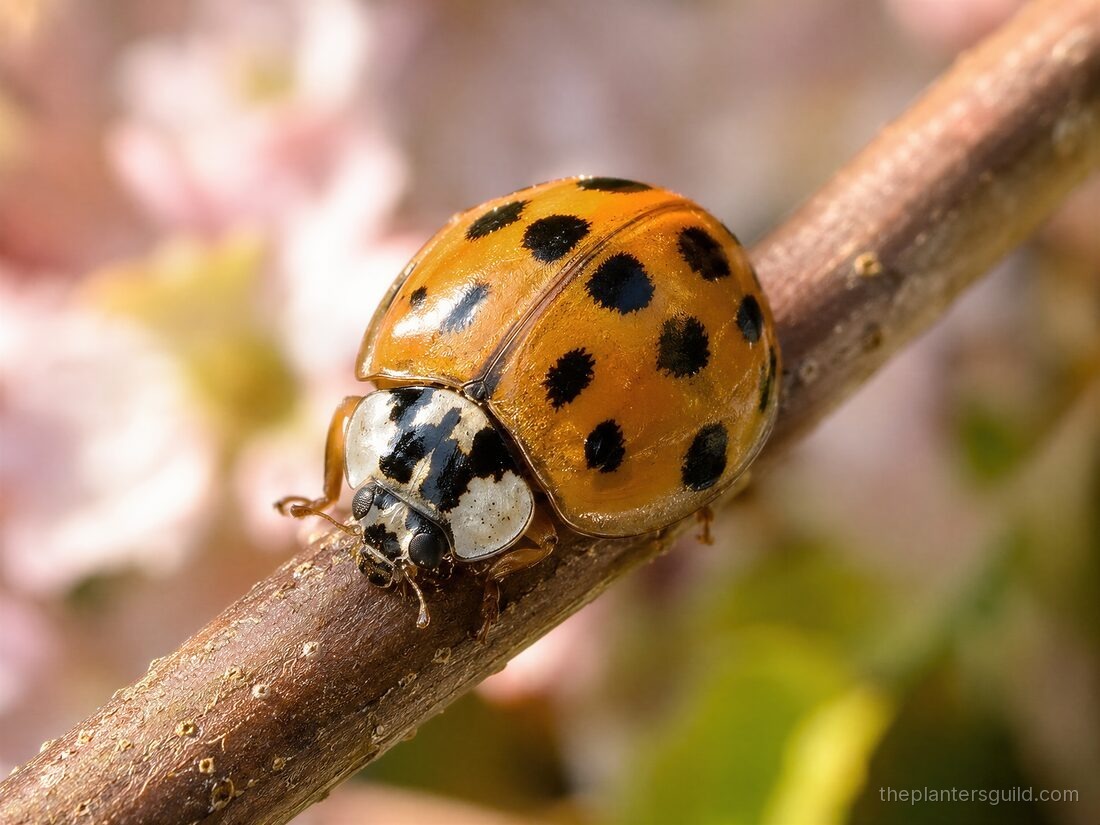 Mug Shot adult, about 3/16–5/16 in (4.9–8.2 mm)
Vital Statistics
- Family
- Coccinellidae
- Adult size
- about 1/4 in
- Body
- round, domed
- Spots
- 0 to 19
- Diet
- aphids, other soft-bodied prey
- Nuisance
- adults indoors in fall; ripening fruit
The Tell
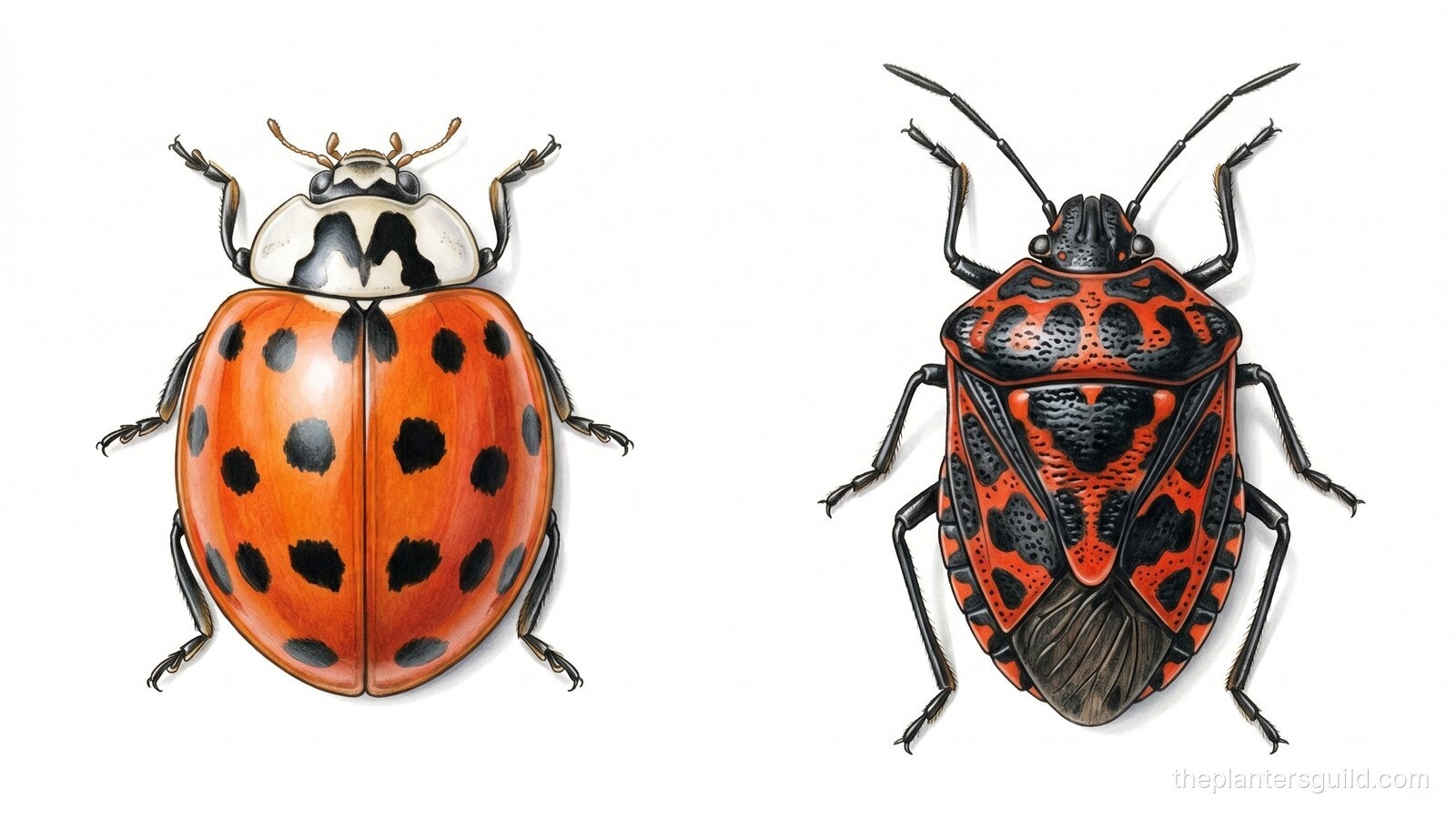
Most have a dark “M” or “W” on the whitish plate behind the head. The mark varies, from four spots to a solid black patch, so read it with the round, domed shape.
Verdict
Friend outdoors, nuisance indoors. Outdoors, leave it to hunt. Seal gaps in late spring or summer, before the fall flights. Indoors, vacuum them up instead of crushing them; the fluid they release can stain.
Also Look For
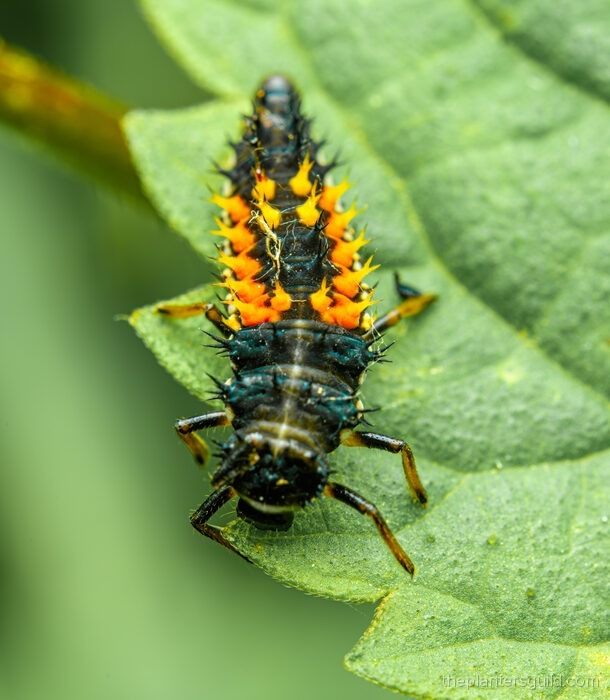
The dark, spiny “alligator” larva with orange markings. A larva eats roughly 90 to 370 aphids before it pupates, depending on the aphid species. Leave it be.
Garden Pest · Family Pentatomidae
Harlequin Bug
Murgantia histrionica · a stink bug
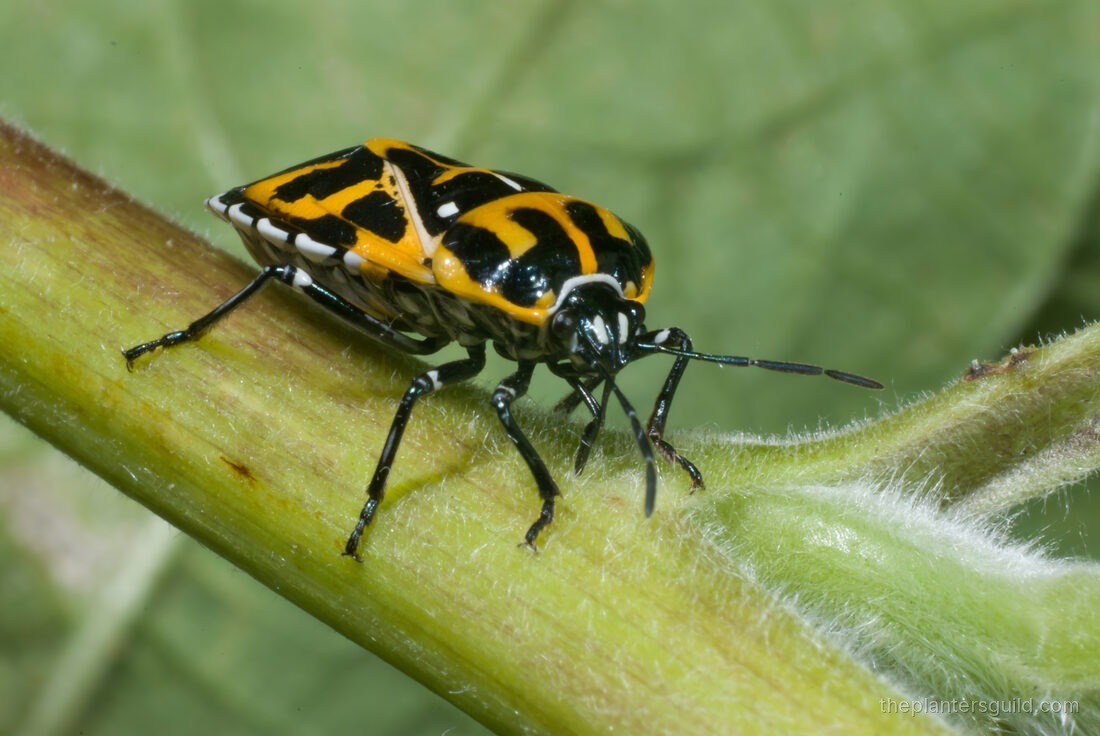 Mug Shot adult, 1/4–3/8 in (about 6–10 mm)
Vital Statistics
- Family
- Pentatomidae
- Adult size
- 1/4–3/8 in
- Body
- flat shield
- Markings
- red, orange or yellow on black
- Mouth
- needle-like, sucks plant juices
- Damaging stage
- adults & nymphs
The Tell
A flat, shield-shaped stink bug, black with red, orange or yellow markings, feeding on cabbage-family plants. Other stink bugs share the shield shape, so the pattern and the host plant together make the call.
Verdict
Pest. Hand-pick adults and nymphs into a container of soapy water, wearing gloves, and destroy the egg clusters. Clear crop debris at season’s end and keep wild mustards down.
Also Look For
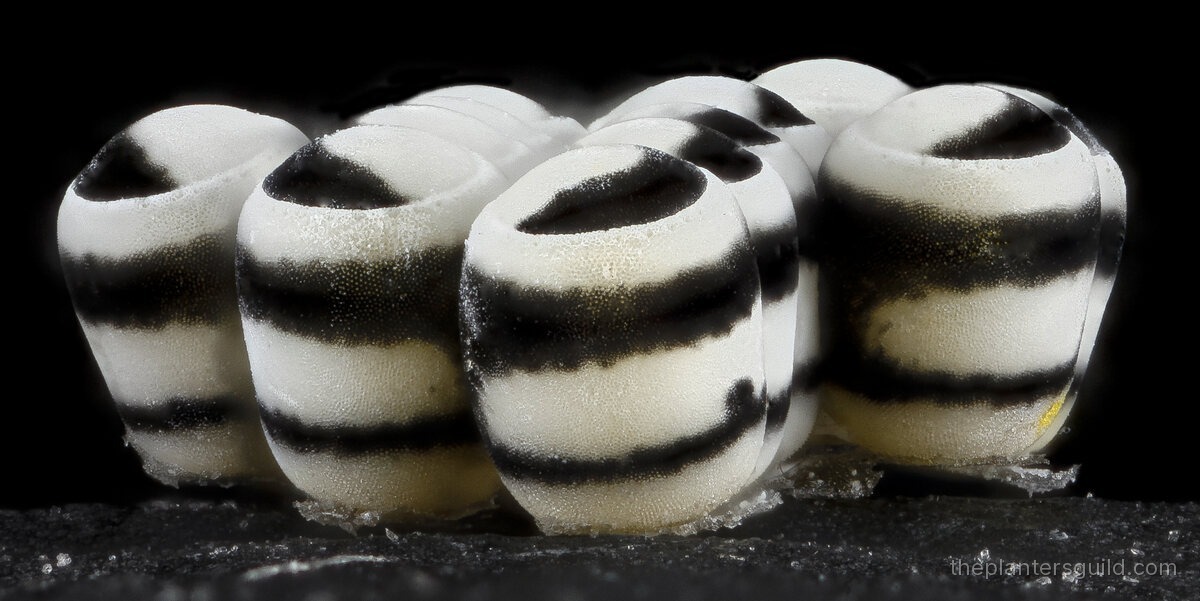
Barrel-shaped eggs, pale with two black bands, standing in double rows of about a dozen under a leaf. In spring, the adults are out and feeding for about two weeks before the first eggs appear.
How to tell them apart
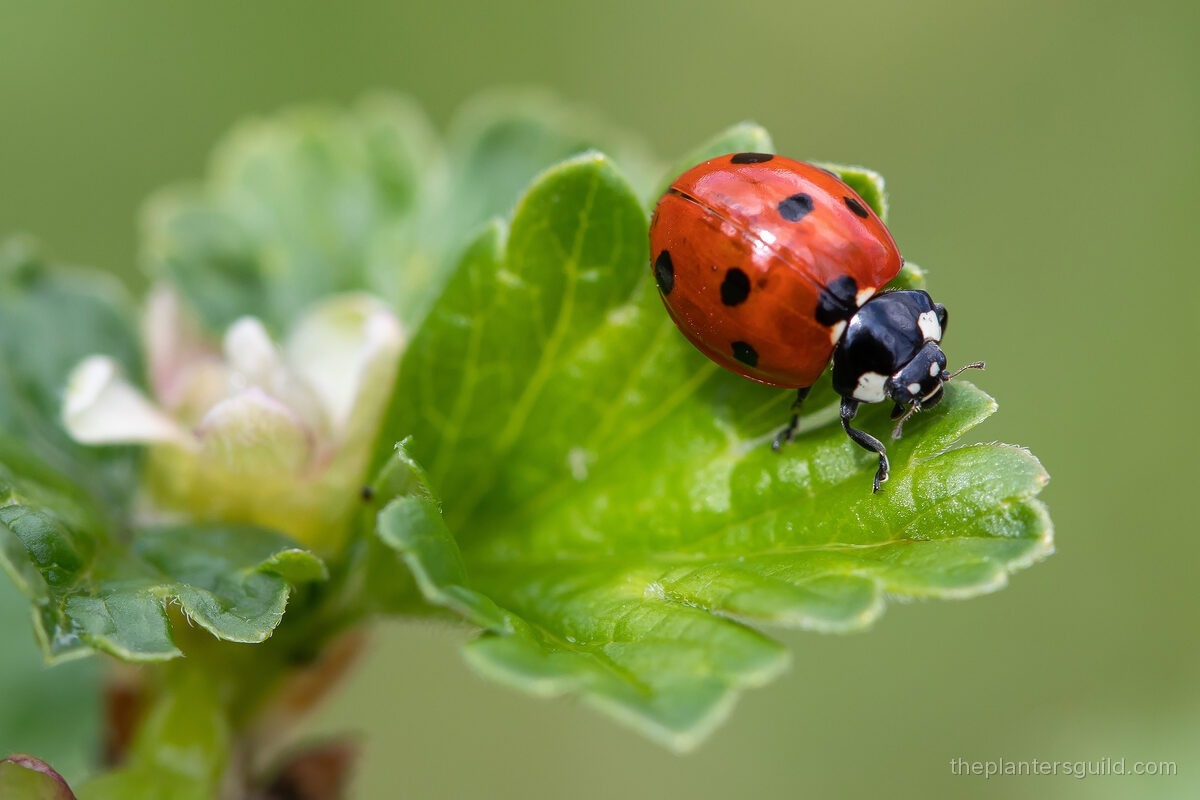
Start with the shape. The Asian lady beetle is round and domed, about 1/4 inch long (Malinoski, 2023). Koch (2003), citing an earlier monograph, gives a length of about 3/16 to 5/16 inch (4.9 to 8.2 mm). In his review the wing covers run from yellow-orange to red with anywhere from zero to 19 black spots; some beetles are instead black with red spots, a form he reports as rare in North America. Spot count doesn't settle much: Kentucky's extension entomologists note that many-spotted beetles tend to be female and few-spotted ones male (Potter et al., 2026).
Then look behind the head. Most of these beetles have a small dark mark shaped like an “M” or a “W” on the whitish plate there (Potter et al., 2026). The mark isn't fixed. Koch (2003), citing the first U.S. description, lists four black spots, two curved lines, an M-shaped mark or a solid black trapezoid, and Penn State Extension notes that the W can fill in to a solid black patch on dark beetles (Skvarla, 2026). That white plate with its dark mark sets this species apart from many other lady beetles, though not every one (Skvarla, 2026), so we read it together with the size and the domed shape.
The harlequin bug looks nothing like a lady beetle up close. It's flat and shield-shaped, 1/4 to 3/8 inch long, and black with red, orange or yellow markings (Baker, 2020). At rest, its overlapping front wings make an “X” across the back (Knox, 2025). Other stink bugs share the shield shape (Cloyd, 2014), and some of them are predators. Koch (2003) reports that one predatory stink bug, Podisus maculiventris, gets the better of the Asian lady beetle when the two prey on each other. So we take the bright pattern and the cabbage-family host together before calling it a harlequin bug.
Watch how it feeds. Adults and nymphs (the young, wingless stage) push needle-like mouthparts into stalks, leaves and veins and draw out the plant juices, which leaves irregular cloudy spots around each puncture (Baker, 2020). On leafy crops such as collards and kale the feeding shows as white blotches (Wallingford et al., 2011).
The young of both insects matter as much as the adults. The lady beetle larva is dark and spiny with orange markings, “alligator-shaped” like most lady beetle larvae (Malinoski, 2023). The harlequin bug's eggs are barrel-shaped, pale with two black bands and a black circle or crescent on top, laid in double-row clusters of about 10 to 13 on mustard-family plants (Baker, 2020). Adults that spent the winter in plant debris come out early in spring, and about two weeks later females start laying eggs on the undersides of leaves (Baker, 2020). The adults feed first, on wild mustard and other cabbage-family weeds (Chittenden, 1908), so feeding damage often shows up before the eggs do.
The myths, busted
“That orange thing isn't even a real ladybug.” It is. The Asian lady beetle belongs to the lady beetle family, Coccinellidae, and it's an aphid predator (Koch, 2003).
“So it's harmless.” Not quite. In fall the adults gather on buildings and move inside to spend the winter (Koch, 2003). Disturbed beetles release a strong-smelling yellowish fluid from their leg joints that can stain light-colored surfaces, and some can bite hard enough to break the skin, though the discomfort is minor and brief (Hahn, 2026). Roy et al. (2016) note that the species doesn't bite more readily than other lady beetles; bites get reported more because so many come indoors. Some people develop allergic reactions to the beetles, including eye and nasal symptoms, asthma, hives and swelling (Goetz, 2008; Koch, 2003). Adults also feed on some ripening fruit, grapes among them, though only as a minor pest (Malinoski, 2023).
“It pushes out native lady beetles.” The evidence is mixed. Declines of some native lady beetles in North America have been linked to its spread (Harmon et al., 2007; Roy et al., 2016), and a long-term Michigan study found significant declines in some native species, with some natives shifting habitat in years when the Asian lady beetle was abundant (Bahlai et al., 2015). A study of Missouri lady beetle records reaching back more than a century found gradual change in the native community, with no abrupt shift when exotic (non-native) species arrived (Diepenbrock et al., 2016).
“That spiky alligator is a pest.” That's the lady beetle larva. Koch (2003), summarizing a Japanese study, reports that one larva eats roughly 90 to 370 aphids over its development, depending on the aphid species. It also eats other aphid-eating insects, other lady beetles among them (Koch, 2003). The Guild leaves it alone in the garden.
“It's bright and orange, so it's a friend.” That's the costly one. Brassicas are the harlequin bug's favorite hosts, wild mustards included, and heavy infestations spread to squash, corn, beans, asparagus, okra and tomato (Baker, 2020). Under heavy feeding, plants can wilt (Wallingford et al., 2011), and young plants are the most at risk; older plants are usually stunted (Baker, 2020).
What to actually do
Asian lady beetle, outdoors. Leave it to hunt aphids.
Asian lady beetle, indoors. The time to keep them out is late spring or summer, before the adults fly to buildings in search of winter shelter (Potter et al., 2026). They can squeeze through gaps as narrow as 1/8 inch, so seal cracks around doors, windows and fascia boards (Hahn, 2026). Once they're inside, vacuum them up; a knee-high nylon stocking held in the vacuum hose with a rubber band catches them before they reach the bag (Hahn, 2026). Empty the catch well away from the house, or they'll come back (Washington State University Extension, n.d.). Don't swat or crush them, because the fluid they release can stain fabrics and walls (Malinoski, 2023). Insecticide foggers and sprays aren't recommended indoors; they tend to be ineffective and can leave residues on walls and counters (Potter et al., 2026). If anyone in the house develops eye, nose or breathing symptoms during an infestation, the Guild suggests mentioning the beetles to a doctor.
Harlequin bug. Check the undersides of brassica (cabbage-family) leaves. Pick the adults and nymphs off into a container of soapy water, and wear gloves, since they give off a foul odor when handled (Cloyd, 2014). Search out and crush the egg clusters as well (University of Maryland Extension, 2025). Hand-picking helps most where the bugs are still few (Knox, 2025). The adults spend the winter in plant debris (Baker, 2020), so clean up the garden at season's end and remove all crop debris (University of Maryland Extension, 2025). In early spring the adults can feed on wild mustards, and controlling those weeds can keep populations from building up by midsummer (Pierce, 2018).
Instead of clearing every host plant, some growers plant a trap crop, such as kale in fall or mustard or radish in spring, to draw the bugs off the main crop (Pierce, 2018). It only works if you remove the bugs from it diligently and often; otherwise a trap crop can raise their numbers (Pierce, 2018; Wallingford et al., 2011). In a two-year field trial on broccoli, mesh exclusion netting gave the best protection, while the essential-oil and bokashi (fermented compost) products tested didn't control the bugs (Clark et al., 2024).
Quick reference
- Round, domed, usually an “M” or “W” behind the head means Asian lady beetle. Friend outside. Seal it out before fall and vacuum it up indoors.
- Dark, spiny “alligator” with orange markings means lady beetle larva. Friend. Leave it be.
- Flat black shield with red, orange or yellow markings, on a cabbage-family plant, means harlequin bug. Pest. Hand-pick it into soapy water.
- Pale barrels with two black bands, in double rows under a leaf, means harlequin bug eggs. Pest. Crush or remove them.
We review our guides against the research and extension guidance available at the time, and we correct them when a source doesn't say what we took it to say or when we can't find support for a point. In this review we corrected how the guide identifies both insects, including the lady beetle's head mark, size and spots and the harlequin bug's colors, host plants and egg timing, and how it describes the lady beetle's arrival in North America, its effect on native lady beetles, the aphids its larvae eat and the damage adults can do to ripening fruit. We also added the indoor safety and allergy guidance the guide lacked, fixed points we'd credited to sources that don't make them and removed claims we couldn't source.
Angalet, G. W., Tropp, J. M., & Eggert, A. N. (1979). Coccinella septempunctata in the United States: Recolonizations and notes on its ecology. Environmental Entomology, 8(5), 896–901. [link]
Aristizábal, L. F., & Arthurs, S. P. (n.d.). Convergent lady beetle, Hippodamia convergens Guérin-Méneville (EENY592). University of Florida IFAS Extension. [link]
Bahlai, C. A., Colunga-Garcia, M., Gage, S. H., & Landis, D. A. (2015). The role of exotic ladybeetles in the decline of native ladybeetle populations: Evidence from long-term monitoring. Biological Invasions, 17, 1005–1024. [link]
Baker, J. (2020, reviewed 2025). Harlequin bug. NC State Extension. [link]
Chittenden, F. H. (1908). The harlequin cabbage bug (Murgantia histrionica Hahn.) (Circular No. 103). U.S. Department of Agriculture, Bureau of Entomology. [link]
Clark, S., Bessin, R., Gonthier, D., & Larson, J. (2024). Evaluation of ten alternative treatments for the management of harlequin bug (Murgantia histrionica) on Brassica crops. Plants, 13(12), 1618. [link]
Cloyd, R. A. (2014). Harlequin bug (MF3135). Kansas State University Agricultural Experiment Station and Cooperative Extension Service. [link]
Cranshaw, W. S. (2001, reviewed 2025). Lady beetles (Fact sheet 5.594). Colorado State University Extension. [link]
Day, W. H., Prokrym, D. R., Ellis, D. R., & Chianese, R. J. (1994). The known distribution of the predator Propylea quatuordecimpunctata (Coleoptera: Coccinellidae) in the United States, and thoughts on the origin of this species and five other exotic lady beetles in eastern North America. Entomological News, 105(4), 244–256. [link]
Diepenbrock, L. M., Fothergill, K., Tindall, K. V., Losey, J. E., Smyth, R. R., & Finke, D. L. (2016). The influence of exotic lady beetle (Coleoptera: Coccinellidae) establishment on the species composition of the native lady beetle community in Missouri. Environmental Entomology, 45(4), 855–864. [link]
Goetz, D. W. (2008). Harmonia axyridis ladybug invasion and allergy. Allergy and Asthma Proceedings, 29(2), 123–129. [link]
Hahn, J. (2026). Multicolored Asian lady beetles. University of Minnesota Extension. [link]
Harmon, J. P., Stephens, E., & Losey, J. (2007). The decline of native coccinellids (Coleoptera: Coccinellidae) in the United States and Canada. Journal of Insect Conservation, 11(1), 85–94. [link]
Knox, M. A. (2025). Harlequin bug, Murgantia histrionica (Hahn) (Insecta: Hemiptera: Pentatomidae) (EENY-025). University of Florida IFAS Extension. [link]
Koch, R. L. (2003). The multicolored Asian lady beetle, Harmonia axyridis: A review of its biology, uses in biological control, and non-target impacts. Journal of Insect Science, 3, 32. [link]
Malinoski, M. K. (2023). Multicolored Asian lady beetle. University of Maryland Extension. [link]
Pierce, J. B. (2018). Harlequin bug (Guide H-259). New Mexico State University Cooperative Extension Service. [link]
Potter, M. F., Bessin, R., & Townsend, L. (2026). Asian lady beetle infestation of structures (ENTFACT-416). University of Kentucky Entomology. [link]
Roy, H. E., Brown, P. M. J., Adriaens, T., Berkvens, N., Borges, I., Clusella-Trullas, S., … Zhao, Z. (2016). The harlequin ladybird, Harmonia axyridis: Global perspectives on invasion history and ecology. Biological Invasions, 18(4), 997–1044. [link]
Skvarla, M. J. (2026). Multicolored Asian lady beetle. Penn State Extension. [link]
University of Maryland Extension. (2025). Harlequin bug on vegetables. [link]
Wallingford, A. K., Kuhar, T. P., Schultz, P. B., & Freeman, J. H. (2011). Harlequin bug biology and pest management in brassicaceous crops. Journal of Integrated Pest Management, 2(1), H1–H4. [link]
Washington State University Extension. (n.d.). Common insects and mites: Asian lady beetle. HortSense. [link]