A grower's guide to spotting thrips on indoor plants, working out which kind you have, and treating them with products labeled for where your plants are growing.
Corrected October 2026: we've revised parts of this guide. See the correction note at the end.
Look for the damage.
Thrips are about 1/16 inch (1 to 2 mm) long, shaped like a grain of rice, and usually yellow, brownish or black depending on the species. Adults have wings, but they aren't easily visible without magnification (Talabac, 2025).
So look at the plant as well as for the insects. Thrips puncture plant cells and feed on the contents, and the emptied cells show up as pale flecks. When the flecks run together, they read as pale or silvery streaks. Look for small, dark, tar-like spots of frass (their droppings) stuck to the plant near the damage. Young leaves that are fed on while they're still expanding can stay stunted, crinkled or curled (Talabac, 2025).
That damage isn't unique to thrips. Spider mites cause similar stippling (fine, pale speckling), indoors and out (Talabac, 2025). Confirm what you're dealing with under a magnifier before you treat anything.
Indoor Pests · Order Thysanoptera
Thrips
Frankliniella occidentalis · Echinothrips americanus · Thrips tabaci
 Mug Shot Onion thrips (left), western flower thrips (right)
Vital Statistics
- Order
- Thysanoptera
- Adult size
- about 1/16 in (1 to 2 mm)
- Color
- yellow, brownish or black, by species
- Egg to adult
- 2 weeks warm to about a month cool
- Eggs per female
- a couple dozen to a couple hundred
- Pupates
- in the mix or on the leaves, by species
Modus Operandi
Thrips puncture plant cells and feed on what leaks out. The emptied cells show as pale flecks that run together into silvery streaks, with small dark specks of frass nearby. Young leaves fed on while they're still expanding can stay stunted, crinkled or curled.
Last Seen
New leaves, leaf edges and the main vein, flower buds and open blooms, and the joints where leaf stalks meet the stem. Western flower thrips usually pupate in the mix; Echinothrips stays on the leaves.
Apprehension Protocol
The Mug Shot
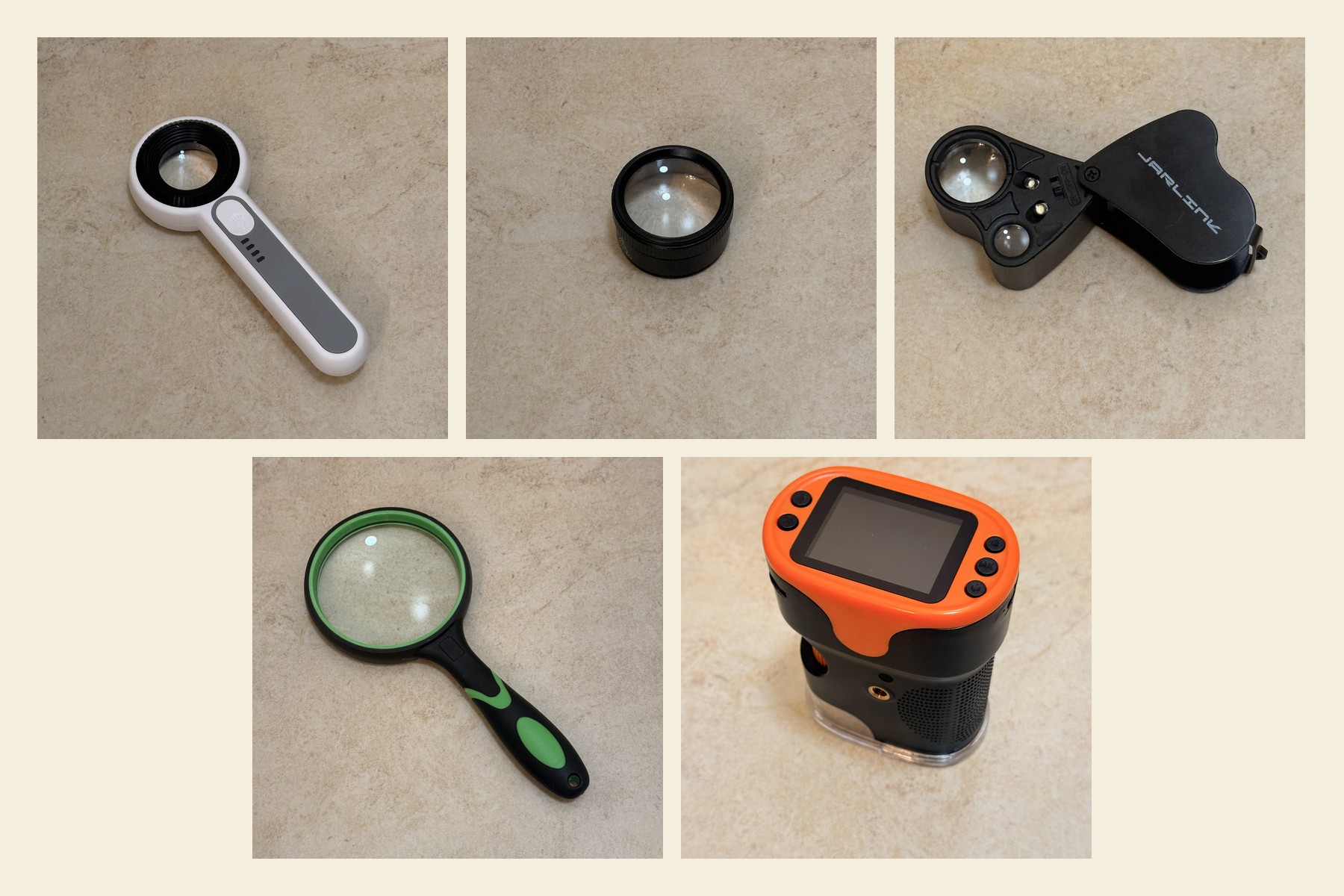
Juveniles, called larvae or nymphs, look like small wingless adults and are often near-white or yellow. Adults have narrow, fringed wings, held flat over the back at rest, and their color runs from yellow through brown to glossy black, by species (Talabac, 2025). We use a 30× or 60× hand lens to see the fringe; our Workshop review covers which ones.
One identification shortcut doesn't hold: the idea that real thrips wings have no visible veins. Western flower thrips and Echinothrips both belong to the order Thysanoptera, family Thripidae (Cluever et al., 2015; Krischik, 2021). In Thripidae, the forewings have two longitudinal veins joined by a cross vein near the base, and wing veins aren't visible in the family Phlaeothripidae (Mound et al., n.d.). So don't rule thrips out because you can see veins.
Which thrips do you have?
Start here, because the species decides whether the potting mix is part of the problem.
Western flower thrips (Frankliniella occidentalis) is, in K-State's words, "one of the most destructive insect pests of greenhouse-grown crops" (Cloyd, 2010). It's under 2 mm (about 1/12 inch) long (Cluever et al., 2015). Its second-stage larvae usually move down to the base of the plant and into the growing medium to pupate, although some pupate on the plant, in leaf debris or in open flowers (Cloyd, 2010).
Echinothrips americanus is the one to watch on tropical foliage. It prefers greenhouse crops in the aroid family (Araceae) and the impatiens family (Balsaminaceae) (Panthi et al., 2019). UConn describes the adults as dark brown to black, and reports that it has spread through greenhouse ornamentals on tropical foliage plants (Pundt, 2024). Unlike western flower thrips, all of its life stages, egg to adult, are found on the leaves (Pundt, 2024). Its prepupae and pupae (the two resting stages before adulthood) sit on the leaf and move only when disturbed (Krischik, 2021).
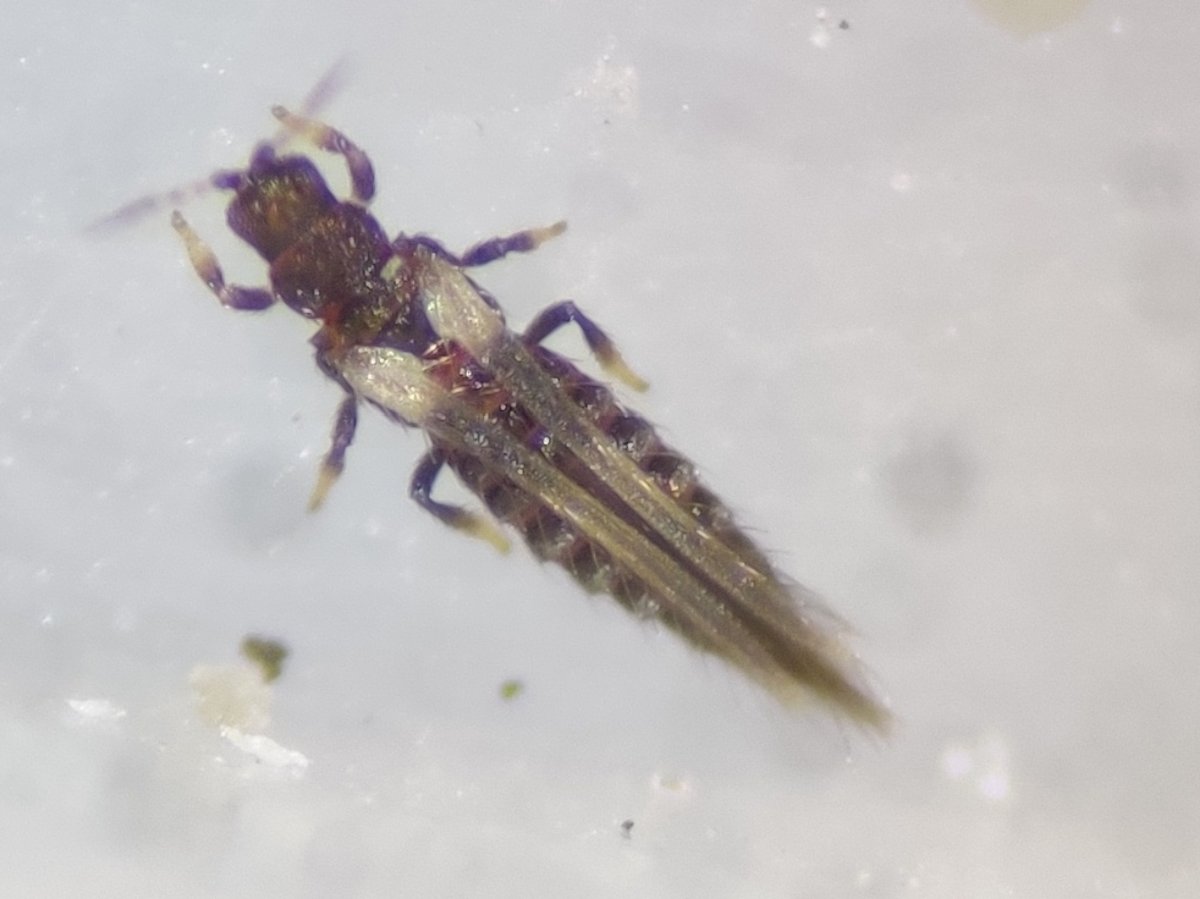
Banded greenhouse thrips (Hercinothrips femoralis) is another one to know. NC State's host list includes philodendron, pothos, syngonium, ficus, hoya and peperomia (Baker, 2018).
The mug shot pairs a western flower thrips with an onion thrips (Thrips tabaci).
UMD's list of indoor plants thrips commonly attack runs from African violets and their relatives, Tradescantia and aroids such as Anthurium, Philodendron and Alocasia, to Ficus, poinsettia, Peperomia, orchids, palms, herbs and miniature roses (Talabac, 2025).
You don't need a species name to act. What you need to know is whether the immatures and pupae are on the leaves or disappearing into the mix. If you're finding pale pupae on the leaves alongside dark adults, assume a leaf-dweller like Echinothrips.
Where to look
UMD names young leaves, leaf margins and the area along the main vein as common feeding sites. Thrips also get into flower buds and tuck into crevices, such as where leaf stalks join the stem. Species that eat pollen or nectar can gather in blooms (Talabac, 2025).
Sticky cards help you notice thrips, but they don't count them. Trapping data don't reflect how many thrips are on the plant itself (Reitz et al., 2020). Card color matters too. UConn notes that Echinothrips may not show up on cards, and that green cards are reported to work better than yellow or blue (Pundt, 2024).
How they damage plants
Thrips don't chew. A plant-feeding thrips punctures the tissue with a single elongated mandible (jaw) and then draws out what leaks from the cells through a straw-like stylet (Talabac, 2025). In western flower thrips, the emptied cells fill with air, which gives heavily injured foliage its silvery look (Reitz et al., 2020).
Feeding on young, actively growing tissue leads to stunting and distorted growth (Reitz et al., 2020). Low numbers usually don't cause obvious damage. Heavy numbers can deform or discolor leaves, make flower buds fail before they open, streak petals and reduce growth overall (Talabac, 2025). Western flower thrips' black fecal droplets also give fungi a place to grow on plant surfaces (Reitz et al., 2020).
Then there are viruses. Western flower thrips is the most efficient carrier (vector) of seven viruses in the genus Orthotospovirus, including impatiens necrotic spot virus (INSV) and tomato spotted wilt virus (TSWV). It can pass them on only if it picked them up as a young larva, in the first or early second instar (larval growth stage). The virus then multiplies inside the insect, which is what entomologists mean by persistent and propagative transmission (Reitz et al., 2020). Penn State's guidance is that infected plants cannot be cured and should not be propagated from cuttings (Penn State Extension, 2025).
The Apprehension Protocol
There are four tiers, as in the other dossiers. This is the Guild's approach, built around one rule: use a product only where its label covers the plant and the place it's growing. UMD puts it the same way, and adds that pesticides should be a last resort, starting with the lowest-toxicity option (Talabac, 2025).
Tier 1: Identify first
Confirm it's thrips under a magnifier, then work out which kind you have, using the section above. That tells you whether the mix matters for this outbreak.
Prevention starts at the door. Missouri Extension advises quarantining new plants and treating them before they go in with established ones (Barrett, 2017).
Be realistic about a plant that's covered. UMD's advice is that heavily infested indoor plants are best removed and discarded, since it's simpler and usually cheaper than treatment (Talabac, 2025).
Tier 2: An indoor-labeled spray
Contact sprays are the simplest option and work right away, but they have to touch the thrips to work. Thrips tucked under deformed leaves or wedged into crevices are hard to reach, and repeat applications are needed because the ones you miss reproduce quickly (Talabac, 2025). UMD lists horticultural oil and insecticidal soap as low-toxicity contact options, and places azadirachtin between contact products and systemic ones, which are absorbed into the plant's sap or tissues (Talabac, 2025). Missouri's guide to indoor plant pests lists insecticidal soap and the botanical insecticides azadirachtin and pyrethrins for thrips (Barrett, 2017).
What matters is the label. Use a product whose houseplant or indoor directions list thrips, and follow its schedule. Of the horticultural and neem oil labels we checked, none listed thrips in its houseplant directions. The labels we checked vary a lot:
- Insecticidal soap labels in this group said to repeat weekly or every two weeks if needed; one concentrate said to spray indoor plants weekly at 7- to 10-day intervals, up to three times (U.S. Environmental Protection Agency, 2015; U.S. Environmental Protection Agency, 2018a).
- The azadirachtin label with houseplant directions, a neem-based insect growth regulator, said it works best applied two or three times at 7- to 10-day intervals (U.S. Environmental Protection Agency, 2018b).
- The pyrethrin houseplant spray we checked said to repeat in one to two weeks, with no more than 10 applications a season and at least three days between them (U.S. Environmental Protection Agency, 2025).
Read the cautions as closely as the directions. Several soap labels say not to use them on sweet peas, nasturtiums or delicate ferns, and one concentrate adds crown of thorns. That concentrate also says not to use it on palms, succulents, dracaena, dieffenbachia or ornamental ivies until you've tested it, and the other soap labels suggest trying a small area when you're unsure of a plant (U.S. Environmental Protection Agency, 2015; U.S. Environmental Protection Agency, 2018a). The pyrethrin label says to remove pets and birds and cover aquariums before spraying indoors (U.S. Environmental Protection Agency, 2025). The soap concentrate carries a WARNING for eye injury and requires eye protection (U.S. Environmental Protection Agency, 2015).
Label note. The labels behind this tier, by EPA registration number:
- 67702-13, an insecticidal soap (also sold by Bonide)
- 42697-60, Safer Brand Insect Killing Soap Concentrate II (its indoor directions name blossom thrips on African violets)
- 70051-6, an azadirachtin product
- 67702-35, a pyrethrins-with-canola-oil spray (one of its brand names is Indoor Plant Spray)
Formulations change, so check the label on the bottle in your hand for an indoor site and for thrips.
Tier 3: Spinosad, outside the home
Spinosad has a real record against western flower thrips. A 2020 review describes spinosad and the related insecticide spinetoram as giving the most effective chemical control of the species, and as tending to be compatible with natural enemies, the predators and parasites that attack thrips (He et al., 2020). It works by contact or ingestion within one to three days, and stays active on the plant for up to two weeks in greenhouse use (Cloyd, 2010).
But the home-garden spinosad labels we checked don't cover indoor plants. The ready-to-use label says "For Outdoor Residential Use Only" (U.S. Environmental Protection Agency, 2009), and the concentrate lists thrips under outdoor herbaceous and woody ornamentals (U.S. Environmental Protection Agency, 2012). The commercial product is labeled for turf, ornamentals, nurseries and greenhouses (U.S. Environmental Protection Agency, 2014), and one home spinosad-and-soap spray adds non-commercial greenhouses and outdoor container plants (U.S. Environmental Protection Agency, 2019b). None of them covers plants inside the home.
So this tier is for a plant you can move outside. Treat it there, under the outdoor ornamentals directions on the label you have. Three cautions travel with it:
- Bees. Spinosad is very highly toxic to bees (National Pesticide Information Center, 2014). The commercial label says not to apply it to blooming, pollen-shedding or nectar-producing plant parts if bees may forage, and that it's toxic to bees exposed during the three hours after treatment (U.S. Environmental Protection Agency, 2014).
- Rotation. Thrips readily become resistant to insecticides (Talabac, 2025), and spinosad resistance is already present in some western flower thrips populations (He et al., 2020). The commercial label allows no more than two consecutive applications before rotating to a different mode of action (an insecticide that works in a different way), and no more than four a year in a greenhouse when it's used for thrips (U.S. Environmental Protection Agency, 2014).
- Eggs and pupae. Spinosad doesn't affect the egg or pupal stages of western flower thrips (Cloyd, 2010), so each spray only reaches the stages that are out and feeding.
The labels we checked don't say how soon a treated plant can come back inside.
Tier 4: Predatory mites as prevention
Neoseiulus cucumeris (formerly Amblyseius cucumeris) is a tiny predatory mite with a broad diet; its thrips prey are young, first-instar larvae. Because it only takes young larvae, UConn advises starting releases preventively, before thrips are detected. It does best at 75 to 85 °F (24 to 29 °C) and above 65% relative humidity (Pundt, 2019).
That humidity is the catch indoors. UMD notes that commercially sold predators may not suit the average home, where the air is drier, and that if you try them in an enclosed, humid space such as a terrarium, grow tent or glass cabinet, you'll need to repeat releases to keep the population going (Talabac, 2025). Predatory mites are also less effective against Echinothrips than against western flower thrips (Pundt, 2024).
In laboratory tests, two-hour-old spinosad residues didn't reduce N. cucumeris survival compared with water, but they cut its egg-laying by about half on the second day and about three-quarters on the third (Van Driesche et al., 2006).
Why not a systemic
The Guild doesn't use a systemic insecticide for thrips on houseplants, and we don't recommend one.
It isn't reliably effective against flower feeders. Writing about western flower thrips in greenhouse crops, Cloyd notes that how well a systemic works depends on whether the thrips are feeding on leaves or flowers, that the active ingredient isn't readily moved into flower tissue, and that systemics may not knock thrips down fast enough when numbers are high (Cloyd, 2013).
A houseplant product does exist. The imidacloprid granule sold for houseplants is labeled for potted plants indoors and outdoors and lists thrips, but it's for non-edible plants only, and it's worked into the soil every eight weeks during the growing season (U.S. Environmental Protection Agency, 2019a).
It's highly toxic to bees (Gervais et al., 2010). The amount a bee has to swallow to be lethal to half of those tested ranges from 3.7 to 40.9 nanograms (billionths of a gram) (Gervais et al., 2010); across the studies in one review, values run from about 4 to over 80 nanograms (Blacquière et al., 2012).
And on outdoor ornamentals, trees and turf in California, it's no longer a homeowner option. Since January 1, 2025, only licensed dealers may sell neonicotinoid products for non-agricultural use on outdoor ornamentals, trees and turf, and only certified commercial applicators may possess or use them (California Department of Pesticide Regulation, 2024). UMD reports a similar restriction in Maryland (Talabac, 2025).
The substrate connection
The mix matters for some thrips and not for others.
Western flower thrips usually pass their non-feeding prepupal and pupal stages in the soil, though they can also pupate in complex flowers (Cluever et al., 2015). Those stages don't feed and are tolerant of most insecticides used against nymphs and adults (Cloyd, 2010). Pupation depth depends on the medium (Cloyd, 2010). We didn't find a source that gives a set depth for potted plants.
Repotting can help, within limits. UMD's guidance is that repotting an indoor plant might remove pupae in the soil but won't touch thrips living elsewhere on the plant, and that to do it you remove all the old mix and replace it with fresh (Talabac, 2025). For Echinothrips, which pupates on the leaves (Pundt, 2024), repotting does nothing.
UMD also suggests avoiding potting mixes with a high proportion of organic matter, such as compost, which may favor thrips (Talabac, 2025). If you want to know more about what goes into a mix, our Substrate Primer is the place to start.
Predictable mistakes
Treating before identifying. Spider mite stippling looks a lot like thrips damage (Talabac, 2025), and whether repotting or a given label helps depends on which pest you actually have.
Repotting a leaf-dweller. If the pupae are on the leaves, a fresh pot of mix changes nothing.
Using an outdoor product indoors. If the label doesn't list an indoor site, it isn't an indoor product, however natural the active ingredient sounds.
Spraying once. Contact sprays only reach what they touch, and the thrips you miss reproduce quickly (Talabac, 2025). Follow the label's repeat schedule and cover the undersides of leaves.
Leaning on one chemistry. Thrips readily become resistant to insecticides (Talabac, 2025). Don't run any one product back to back for long.
The takeaway
Confirm thrips under a magnifier and work out whether yours pupate in the mix or stay on the leaves. Treat indoors with a product whose label lists thrips on indoor plants, on that label's schedule, and save spinosad for plants you can take outdoors.
We review our guides against the research and extension guidance available at the time, and we correct them when a source doesn't say what we took it to say or when we can't find support for a point. In this review we corrected the guide's pest-control and safety advice to follow what product labels allow indoors, including spray schedules and systemic insecticides, and its account of how to identify thrips and of their biology, including where different species pupate and when repotting helps. We also fixed points we'd credited to sources that don't make them and removed claims we couldn't source.
Baker, J. R. (2018). Banded greenhouse thrips. NC State Extension. [link]
Barrett, B. A. (2017, reviewed 2022). Least-toxic control methods to manage indoor plant pests (G7273). University of Missouri Extension. [link]
Blacquière, T., Smagghe, G., van Gestel, C. A. M., & Mommaerts, V. (2012). Neonicotinoids in bees: A review on concentrations, side-effects and risk assessment. Ecotoxicology, 21(4), 973–992. [link]
California Department of Pesticide Regulation. (2024, September 30). Notice of new law regarding neonicotinoid pesticides for non-agricultural outdoor use. [link]
Cloyd, R. A. (2010). Western flower thrips management on greenhouse-grown crops (MF2922). Kansas State University Agricultural Experiment Station and Cooperative Extension Service. [link]
Cloyd, R. A. (2013, June 10). Control of thrips with systemic insecticides. Greenhouse Grower. [link]
Cluever, J. D., Smith, H. A., Funderburk, J. E., & Frantz, G. (2015, reviewed 2024). Western flower thrips (Frankliniella occidentalis [Pergande]) (ENY-883). UF/IFAS Extension. [link]
Gervais, J. A., Luukinen, B., Buhl, K., & Stone, D. (2010). Imidacloprid technical fact sheet. National Pesticide Information Center, Oregon State University Extension Services. [link]
He, Z., Guo, J.-F., Reitz, S. R., Lei, Z.-R., & Wu, S.-Y. (2020). A global invasion by the thrip, Frankliniella occidentalis: Current virus vector status and its management. Insect Science, 27(4), 626–645. [link]
Krischik, V. (2021). Echinothrips americanus. Greenhouse & Nursery Insect Pest ID, University of Minnesota. [link]
Mound, L. A., et al. (n.d.). Glossary. In Thysanoptera identification key [Lucid key]. ThripsNet. [link]
National Pesticide Information Center. (2014). Spinosad general fact sheet. Oregon State University Extension Services. [link]
Panthi, B., Liburd, O., & Renkema, J. (2019). Poinsettia thrips, impatiens thrips, Echinothrips americanus Morgan (EENY-730). UF/IFAS Extension. [link]
Penn State Extension. (2025). Impatiens necrotic spot virus. [link]
Pundt, L. (2019). Biological control of western flower thrips. UConn Extension Integrated Pest Management Program. [link]
Pundt, L. (2024). Managing Echinothrips americanus. UConn Extension Integrated Pest Management Program. [link]
Reitz, S. R., Gao, Y., Kirk, W. D. J., Hoddle, M. S., Leiss, K. A., & Funderburk, J. E. (2020). Invasion biology, ecology, and management of western flower thrips. Annual Review of Entomology, 65, 17–37. [link]
Talabac, M. (2025). Thrips in home gardens. University of Maryland Extension, Home and Garden Information Center. [link]
Van Driesche, R. G., Lyon, S., & Nunn, C. (2006). Compatibility of spinosad with predacious mites (Acari: Phytoseiidae) used to control western flower thrips (Thysanoptera: Thripidae) in greenhouse crops. Florida Entomologist, 89(3), 396–401. [link]
U.S. Environmental Protection Agency. (2009). Bonide spinosad ready-to-use (EPA Reg. No. 4-472) [Pesticide label]. [link]
U.S. Environmental Protection Agency. (2012). Bonide spinosad concentrate (EPA Reg. No. 4-471) [Pesticide label]. [link]
U.S. Environmental Protection Agency. (2014). Conserve SC turf and ornamental (EPA Reg. No. 62719-291) [Pesticide label]. [link]
U.S. Environmental Protection Agency. (2019a). IMI 0.22G plant granules (EPA Reg. No. 53883-217) [Pesticide label]. [link]
U.S. Environmental Protection Agency. (2019b). NEU1381 ready-to-use (spinosad and potassium salts of fatty acids; EPA Reg. No. 67702-45) [Pesticide label]. [link]
U.S. Environmental Protection Agency. (2015). Safer brand O-insecticidal soap concentrate (EPA Reg. No. 42697-60) [Pesticide label]. [link]
U.S. Environmental Protection Agency. (2018a). NEU1128 RTU (potassium salts of fatty acids; EPA Reg. No. 67702-13) [Pesticide label]. [link]
U.S. Environmental Protection Agency. (2018b). MEEN (azadirachtin; EPA Reg. No. 70051-6) [Pesticide label]. [link]
U.S. Environmental Protection Agency. (2025). PYROL-O RTU (pyrethrins and canola oil; EPA Reg. No. 67702-35) [Pesticide label]. [link]
Image (hero): Protasov, A. (n.d.). Thrips (order Thysanoptera) [Photograph]. Adobe Stock 520985384. Standard license.
Image (mug shot): Protasov, A. (n.d.). Onion thrips, Thrips tabaci, and western flower thrips, Frankliniella occidentalis [Photograph]. Adobe Stock 583642968. Standard license.
Image (Echinothrips): Andreasen, S. M. (2024, March 24). Echinothrips americanus from houseplants, Frederikshavn, Denmark [Photograph]. iNaturalist observation 203802935. Licensed under CC BY. [link]