A field guide to the aphid on houseplants and in the garden: how to confirm one by its cornicles, why a few can become a colony within weeks, and a four-tier protocol that starts with your hands and a rinse and follows the product label from there.
Corrected October 2026: we've revised parts of this guide. See the correction note at the end.
You'll spot the colony. Deciding whether to act is the work.
Aphids gather where a plant is growing fastest: the tip of a rose cane, a tight flower bud, the newest leaf on a houseplant. A colony can look alarming, but in most cases aphids do little or no harm to a plant's health, and treating them for the plant's sake is usually unnecessary (Hahn & Wold-Burkness, n.d.). The signs of severe feeding are twisted and curled leaves, yellowed foliage, stunted shoots and poor growth (Hahn & Wold-Burkness, n.d.).
So the first job is to look closely and decide. A few aphids on a sturdy plant that's otherwise growing well can wait while you watch what happens. A colony that's curling new leaves, coating the plant below in sticky honeydew, or sitting on a young plant or a vegetable is worth acting on, and the earlier the better, because hands and water work best on small colonies (Clemson Cooperative Extension, 2019).
A hand lens helps you confirm what you're looking at; our Workshop No. 01 compares five of them for pest diagnosis.
Indoor & Garden Pests · Family Aphididae
Aphids
Myzus persicae · Aphis gossypii · Macrosiphum euphorbiae · Aphis nerii
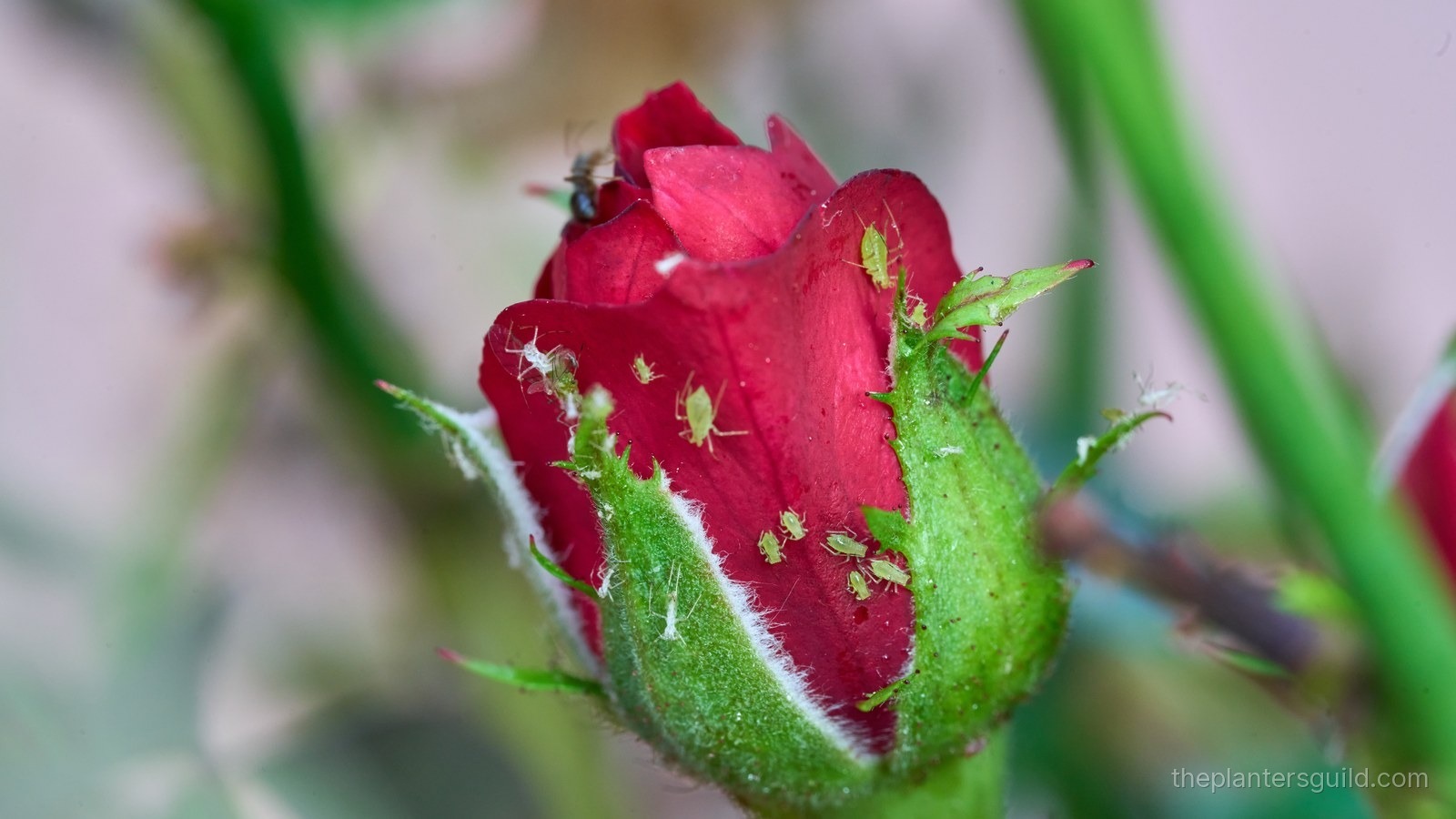
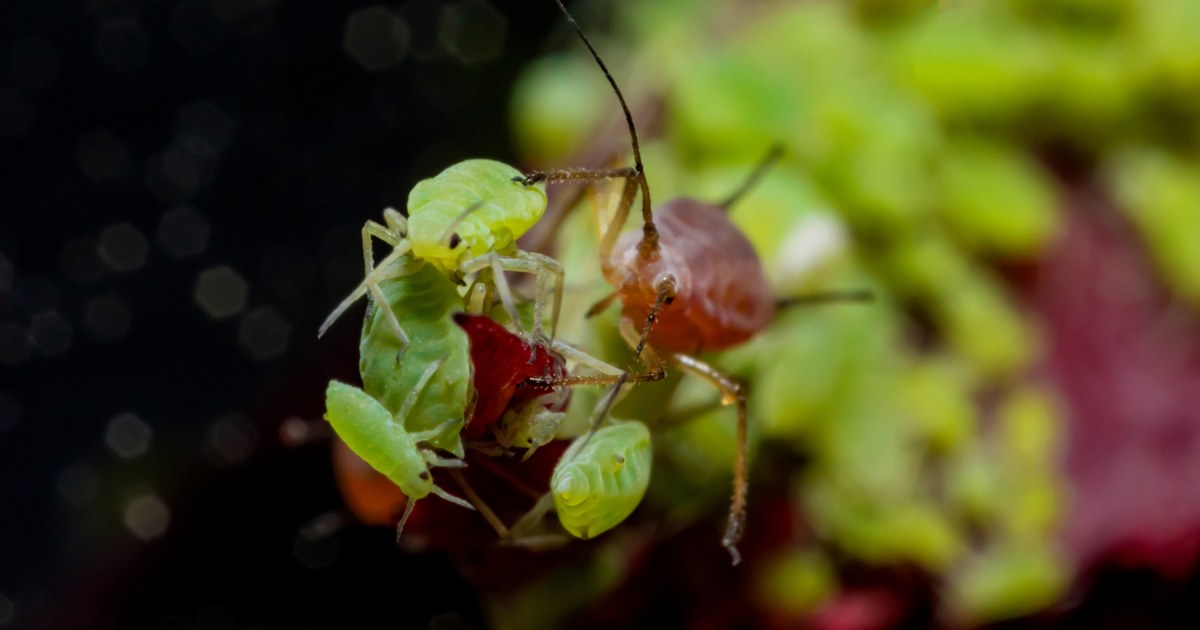 Mug Shot Several aphids, species not identified
Vital Statistics
- Family
- Aphididae
- Adult size
- about 1/25 to 1/4 in (1 to 6 mm), by species
- Color
- green, yellow, pink or black, by species
- The tell
- two cornicles, in most species
- Reproduction
- live young, mostly without mating
- Newborn to adult
- about 10 to 14 days
Modus Operandi
Feeds on sap from the phloem, the tissue that carries sugars through the plant, using slender, threadlike mouthparts and gives off the excess as sticky honeydew, which attracts ants and can grow black sooty mold. Most colonies cause little or no harm to the plant; heavy ones can curl, yellow and stunt new growth.
Last Seen
Soft, tender new growth: unopened flower buds, the undersides of young leaves and developing stems. Outdoors, look on roses, the cabbage family, peppers, tomatoes and milkweed; indoors, on any plant putting out new growth, and on plants just brought in from outside.
Apprehension Protocol
The Mug Shot
Aphids are small, pear-shaped insects with soft bodies, roughly 1/25 to 1/4 inch (1 to 6 mm) long, depending on species (Barrett, 2017). Colors vary widely among species, from very pale yellow to nearly black, with most in green or orange shades and a handful bright red (Colorado State University Extension, 2025a). Because the color depends on the species, it won't tell you on its own that a bug is an aphid.
What usually does is a pair of tubes at the rear of the abdomen, the cornicles (also called siphunculi). The University of Minnesota calls checking for "two tail pipes (cornicles) found at the end of the abdomen" the best way to identify aphids (Hahn & Wold-Burkness, n.d.). Their form varies a lot, "from long cylinders to short cones to mere pores," and some species have none (U.S. Department of Agriculture, APHIS, n.d.). So cornicles confirm most aphids, but no cornicles doesn't rule one out. Grape phylloxera, an aphid-like insect, has no cornicles, which is one way to tell it from true aphids (Townsend, n.d.).
The cornicles are part of the aphid's defense. As Alfaress and colleagues summarize the earlier research in their paper's introduction, the tubes secrete a sticky droplet that binds a predator's legs and mouthparts and release an alarm pheromone, (E)-beta-farnesene, that aphids use to signal one another (Alfaress et al., 2018).
Most of a colony is usually wingless. The wingless aphids stay and reproduce on the plant, and more winged ones are produced when a colony gets crowded, the plant declines, or conditions favor moving on (Colorado State University Extension, 2025a). The winged ones are how a colony reaches new plants.
Four you're likely to meet:
- Green peach aphid (Myzus persicae): the wingless adults are yellowish or greenish and about 1/16 inch (1.7 to 2.0 mm) long (Capinera, n.d.). It feeds on hundreds of plants, including peppers, cabbage, spinach and asters (Hahn & Wold-Burkness, n.d.).
- Melon or cotton aphid (Aphis gossypii): a common vegetable-garden aphid that can be a severe problem on watermelons, muskmelons, cucumbers and squash (Clemson Cooperative Extension, 2019).
- Potato aphid (Macrosiphum euphorbiae): commonly on potatoes, tomatoes, peppers, eggplant and morning glory (Hahn & Wold-Burkness, n.d.).
- Oleander aphid (Aphis nerii): about 1/8 inch (3 mm) long and bright yellow, with black legs and black cornicles and long antennae, and a regular on milkweed through spring and summer (Hahn & Wold-Burkness, n.d.). Here the color does help: once you know it's an aphid, bright yellow with black legs points to this species.
Why a few become a colony
Essentially all aphids you'll see in a season are females. Where males occur at all, they appear only in late summer or early fall, in the last outdoor generation; the rest of the time a female gives live birth to genetically identical daughters without mating (Colorado State University Extension, 2025a).
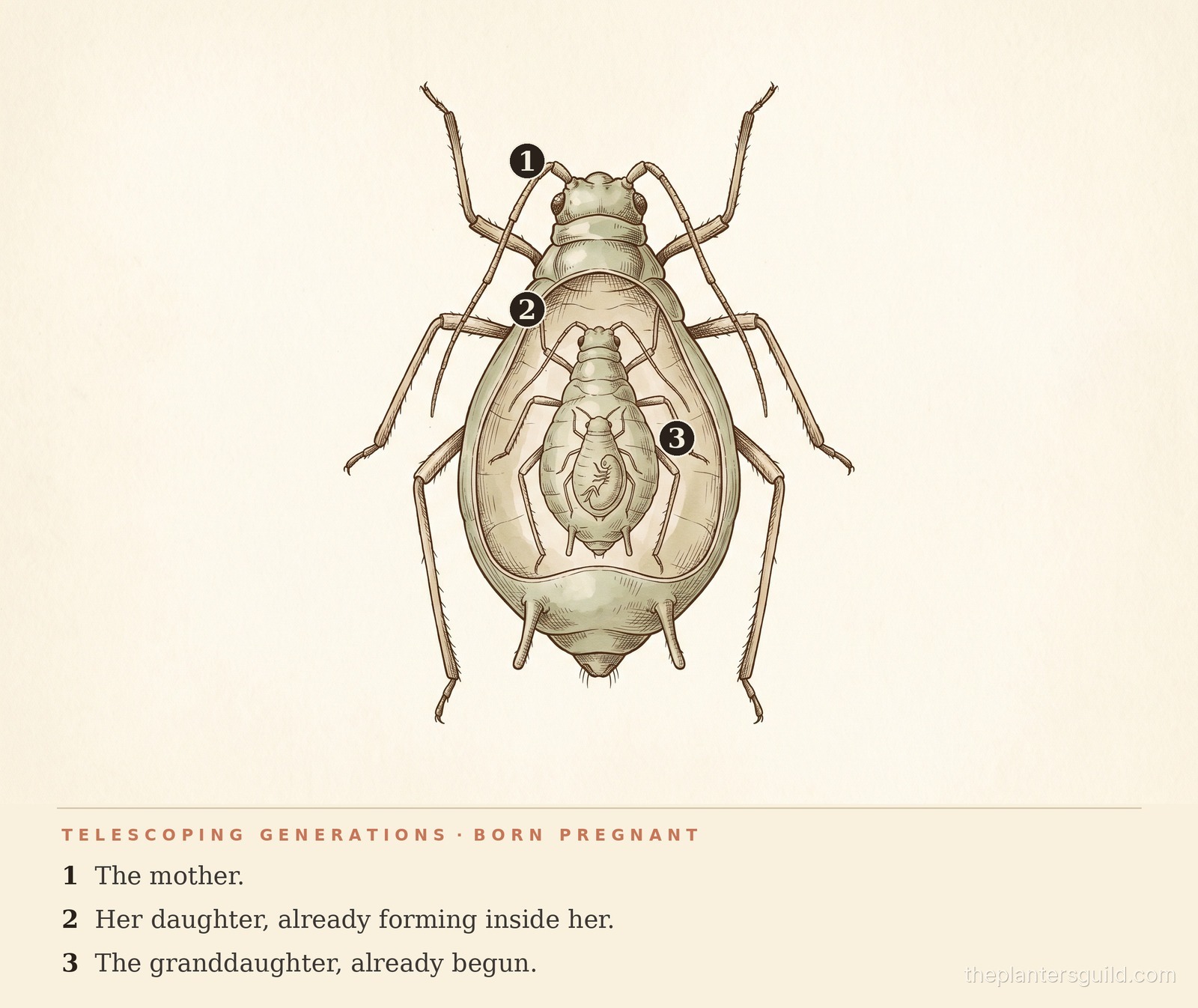
The daughters are further along than that suggests. When a mother aphid reaches adulthood, her first daughters are ready to be born, and those daughters already carry the embryos of her first granddaughters (Blackman, n.d.). Ogawa and Miura call this a telescoping association, a set of generations nested one inside the next (Ogawa & Miura, 2014).
Put those together and numbers climb fast. A newborn aphid typically reaches full size in about 10 to 14 days, and adults can produce three to five young a day for a life that can stretch to about a month, though natural enemies usually shorten it (Colorado State University Extension, 2025a). For green peach aphid, a complete generation often takes 10 to 12 days (Capinera, n.d.). In a 1924 study on radish in Pennsylvania, which Capinera summarizes, females first gave birth at an average age of 10.8 days (Capinera, n.d.). Clemson puts the effect plainly: in summer temperatures, aphid populations can grow exponentially within a few days (Clemson Cooperative Extension, 2019).
Many species switch in fall. As the days shorten, the live-bearing females produce males and egg-laying females (Ogawa & Miura, 2014). Not every aphid does, though. The oleander aphid has no males and no egg stage at all; its females produce only female nymphs, or young (Baker, 2019). Green peach aphid has a sexual generation only in the autumn of colder places, and in Florida its populations cycle continuously on annual plants (Capinera, n.d.). Indoors, one houseplant aphid, Myzus ornatus, keeps breeding through winter on ornamental plants in greenhouses and houses (Durak & Borowiak-Sobkowiak, 2011).
Where to find them
Aphids gather on soft, tender new growth: unopened flower buds, the undersides of young leaves, and developing stems and twigs (Hahn & Wold-Burkness, n.d.). Check there first.
Outdoors, Clemson lists peppers, tomatoes, cabbage, kale, basil and leafy greens as key vegetable-garden hosts, and zinnias, roses, coreopsis and fruit trees in the landscape (Clemson Cooperative Extension, 2019). Oleander aphids usually settle on the shoot tips (Baker, 2019).
Indoors, aphids can come in on plants or through open windows, and they move between plants by crawling or flying (Washington State University Extension, 2025). When you bring plants inside after a summer outdoors, keep them apart from your other houseplants, for example in a spare room, for about a month (Washington State University Extension, 2025).
What they do to plants
Aphids don't chew. They feed on sap from the phloem through slender, threadlike mouthparts (Baker, 2019). In many cases the feeding leaves no visible symptoms (Hahn & Wold-Burkness, n.d.). Some aphids curl leaves when they infest them as they emerge, and when numbers stay very high for a long time, feeding can make shoots and buds wilt and sometimes wither back (Colorado State University Extension, 2025a).
After feeding, aphids give off a sticky, sugar-rich waste called honeydew, which attracts ants and other insects that feed on it (Hahn & Wold-Burkness, n.d.). Black sooty mold can grow on the honeydew. The mold doesn't infect plant tissue, but a heavy coating blocks sunlight from reaching the leaf (Nelson, 2008), and indoors it can mark the surfaces under the plant (Washington State University Extension, 2025).
Aphids also spread plant viruses. Many regard green peach aphid as the most important virus vector in the world, and it carries both viruses that pass through its feeding secretions and viruses that ride only briefly on its mouthparts (Capinera, n.d.). A spray may not stop a winged aphid that lands and quickly passes on a mouthpart-borne virus. It can stop the aphids that settle in from spreading a virus within a crop (Capinera, n.d.). This matters most in vegetable gardens.
Ants and aphids
Honeydew draws ants, and the relationship that follows varies. Stadler and Dixon's review describes aphid and ant interactions running the whole range, from ants preying on aphids to the two benefiting each other, with only some aphids entering that kind of partnership with ants (Stadler & Dixon, 2005).
Where ants do tend aphids, the arrangement isn't one-sided. Ants have been recorded carrying aphids directly to high-quality host plants (Oliver et al., 2007, summarizing earlier work by Collins and Leather). They also eat the aphids they tend. In a laboratory study of Lasius ants, predation on aphids rose eightfold when the ants were given sugar as an alternative food (Offenberg, 2001).
Tending ants can also get in the way of the insects that keep aphids in check. In a five-year study in an organic mandarin orchard in Spain, keeping ants out of the tree canopies increased the numbers of parasitic wasps (Bañol et al., 2015). If ants are running up and down a shrub or tree that has an aphid colony, keeping them off the plant is worth trying, though the published evidence we found comes from orchards rather than home gardens.
The Apprehension Protocol
Four tiers, gentlest first. Move up a tier only when the one you're on isn't keeping the colony down, and remember that contact sprays can also harm the beneficial insects they hit (Clemson Cooperative Extension, 2019).
Tier 1: Rub off, rinse, repeat
On a small colony, rub the aphids off with your fingers or a wet cloth. Clemson finds this effective on small populations and very early infestations, though not on large ones (Clemson Cooperative Extension, 2019).
Indoors, wash the plant with lukewarm water in a shower or sink, which takes off the aphids along with honeydew and sooty mold, and pay attention to the undersides of the leaves. Aphids tend to drop off when disturbed and climb back up later, so repeat the wash regularly (Washington State University Extension, 2025).
Outdoors, on shrubs and sturdy garden plants, a forceful jet of water can wash aphids off, and very few of the survivors knocked to the ground find their way back onto the plant (Colorado State University Extension, 2025a). A hose nozzle with adequate pressure is enough; a pressure washer is far too strong (Clemson Cooperative Extension, 2019). Repeat while the colony is active.
Tier 2: A labeled insecticidal soap or oil
When hands and water aren't keeping up, step up to a contact spray. Insecticidal soaps and horticultural oils coat the aphid and suffocate it, and they have no residual activity, so they work only on the aphids the spray actually wets (Clemson Cooperative Extension, 2019). That's also their limit. They can harm beneficial insects they touch (Clemson Cooperative Extension, 2019). In a laboratory study, sprays of Marseille soap increased the mortality of lady beetle larvae (Lami et al., 2024).
Read the label for your setting. Indoors, use only a product whose label lists aphids and an indoor or houseplant site. One soap's houseplant directions say to spray to thoroughly wet all plant surfaces and, for aphids, to "spray again after 2 or 3 days or when insects return" (U.S. Environmental Protection Agency, 2008). Another soap's label says to "Repeat treatment weekly or bi-weekly if needed" (U.S. Environmental Protection Agency, 2021). So the interval comes from the bottle in your hand, not from a rule of thumb. Colorado State adds that leaf damage can build up with repeated soap sprays, so limit the number of applications (Colorado State University Extension, 2025b).
Coverage differs too. One horticultural oil label says to spray to wet the entire surface of the plant, and its summer directions for ornamentals, trees and shrubs add to cover the tops and bottoms of the leaves until wet but without significant runoff (U.S. Environmental Protection Agency, 2024). A pyrethrin and canola oil spray says not to wet plants to the point of runoff or drip (U.S. Environmental Protection Agency, 2025).
Check the plant cautions. One houseplant soap label says not to use it on euphorbias, gardenias or delicate ferns, and to test first on azaleas, begonias, camellias, fuchsias, impatiens, jade plants and palms (U.S. Environmental Protection Agency, 2008). Another lists sweet peas, nasturtiums and delicate ferns (U.S. Environmental Protection Agency, 2021). The oil label says not to apply it to plants in direct sunlight behind glass (U.S. Environmental Protection Agency, 2024). Don't apply soap in full sun or above 90 °F (32 °C); early morning or late in the day is best (Clemson Cooperative Extension, 2021).
On edibles, some soap labels allow use on edible crops up to and including the day of harvest (U.S. Environmental Protection Agency, 2021). For edibles grown indoors, such as herbs and salad greens, Washington State doesn't recommend chemical controls at all (Washington State University Extension, 2025). Washington State also suggests, when practical, taking a houseplant outdoors to a shady spot to spray it and letting it dry before bringing it back in (Washington State University Extension, 2025).
Label note. The labels behind this tier, by EPA registration number:
- 42697-59, an insecticidal soap sold for houseplants (U.S. Environmental Protection Agency, 2008)
- 67702-21, an insecticidal soap for indoor, outdoor and home greenhouse use (U.S. Environmental Protection Agency, 2021)
- 4-419, a horticultural spray oil whose label covers houseplants (U.S. Environmental Protection Agency, 2024)
- 67702-35, a pyrethrins-with-canola-oil spray with indoor directions (U.S. Environmental Protection Agency, 2025)
- 70051-6, an azadirachtin product whose house plant directions list aphids (U.S. Environmental Protection Agency, 2018)
Formulations change, so check the label on the bottle in your hand for an indoor site and for aphids.
Tier 3: Protect the natural enemies
Outdoors, the most useful thing you can do is protect what's already eating your aphids. Lady beetles, adults and larvae alike, eat many kinds of aphids, and Clemson advises encouraging them by cutting back on broad-spectrum insecticides (Clemson Cooperative Extension, 2019). Longer-lasting insecticides also take out natural enemies, which can make aphid problems worse (Hahn & Wold-Burkness, n.d.).
Buying predators is less reliable than it sounds. In one South Dakota study, released lady beetles dispersed rapidly and weren't found at the release sites after 4 days (Kieckhefer & Olson, 1974), and Cornell notes that this tendency to disperse affects how reliable released adults are (Weeden et al., n.d.). Oregon State says releases of predators are used in greenhouses and other enclosed areas, and that insects released outdoors may not stay where you put them (Oregon State University Extension Service, n.d.).
If you're treating an enclosed space, such as a sunroom or a grow area, match what you buy to the aphid. Each Aphidius wasp species attacks particular aphids, so Clemson advises getting the aphid identified before buying (Clemson Cooperative Extension, 2019). Aphidius colemani prefers green peach and melon aphids, while Aphidius ervi prefers potato and foxglove aphids (Cloyd, n.d.). Green lacewing larvae can also be bought; Clemson calls them extremely aggressive, eating numerous aphids a day, and warns that they're extremely sensitive to insecticides, even drift (Clemson Cooperative Extension, 2019). Don't spray where you've released them.
Tier 4: A systemic, as a last resort indoors only
A systemic insecticide moves into the plant, and soil-applied products can control aphids for several weeks and possibly as long as two months, though that persistence can also increase harm to beneficial insects (Colorado State University Extension, 2025a). The Guild treats one systemic as a true last resort, for a non-edible houseplant that the first three tiers haven't helped.
That product is the imidacloprid granule sold for houseplants. Its label covers potted plants indoors and outdoors, lists aphids, excludes edible plants, and calls for application every 8 weeks during the growing season (U.S. Environmental Protection Agency, 2019).
Imidacloprid is highly toxic to bees (Gervais et al., 2010). The amount a bee has to swallow to be lethal to half of those tested ranges from 3.7 to 40.9 nanograms, billionths of a gram (Gervais et al., 2010); across the studies in one review, values run from about 4 to over 80 nanograms (Blacquière et al., 2012). The University of Minnesota advises either avoiding imidacloprid on plants that attract bees or waiting until they've finished blooming (Hahn & Wold-Burkness, n.d.). Soil-applied imidacloprid also moves into the flowers of treated plants (Krischik et al., 2015). Keep a treated houseplant indoors and away from any plant pollinators visit.
Outdoors in California it's not a homeowner option. Since January 1, 2025, neonicotinoid products (the insecticide group imidacloprid belongs to) for non-agricultural use on outdoor ornamental plants, trees or turf may be sold only by licensed dealers and possessed or used only by certified commercial applicators (California Department of Pesticide Regulation, 2024). The thrips dossier covers the same product and restriction.
Never use a systemic on milkweed. In greenhouse tests, monarch and painted lady larvae fed plants treated with imidacloprid at one and two times the label rate were significantly less likely to survive to day 7 than larvae on untreated plants (Krischik et al., 2015).
The natural enemies
Aphids are fairly defenseless, and many insects feed on them (Colorado State University Extension, 2025a). Learning to recognize them tells you when a colony is already being handled.
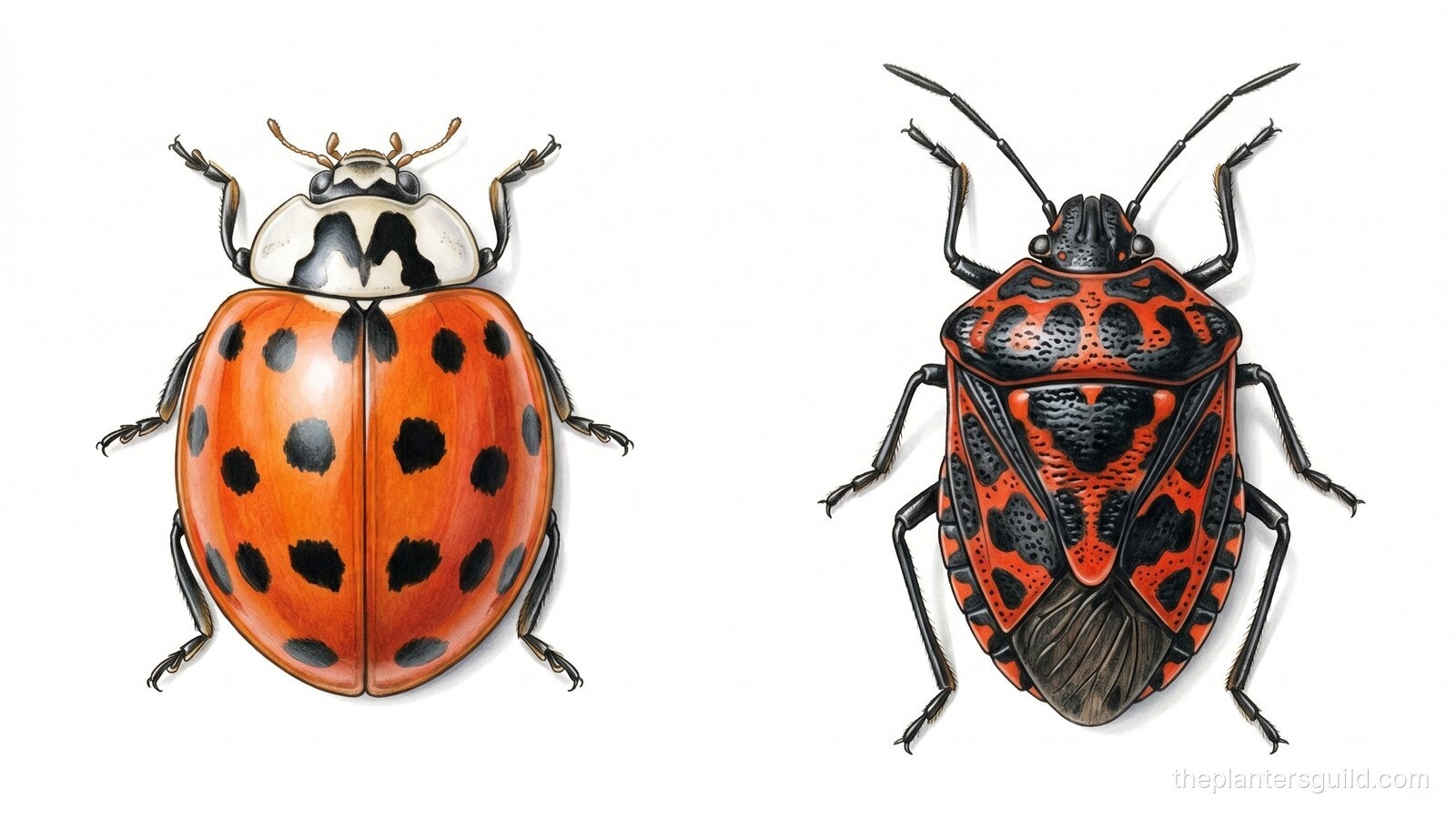
Lady beetles. The larvae are particularly voracious predators of aphids (Colorado State University Extension, 2025a). Cornell reports that a single sevenspotted lady beetle larva eats 200 to 300 aphids over its development (Weeden et al., n.d.). Our Harlequin vs. Ladybug dossier shows what the larva looks like, so you know to leave it alone.
Green lacewings and flower flies. Their larvae are other common aphid predators (Colorado State University Extension, 2025a). Flower flies are also called hover flies or syrphid flies.
Parasitic wasps. These tiny wasps lay their eggs inside an aphid, and the larva consumes it from the inside. The aphid becomes a bloated mummy, light brown or black and stuck to the plant (Colorado State University Extension, 2025a). The adult wasp emerges from the mummy (McAuslane, 2001). Mummies on a leaf mean parasitic wasps have found the colony.
Milkweed
If you grow milkweed for monarchs, you'll probably meet the oleander aphid, which often reaches high densities on milkweed in nurseries and urban landscapes (Mach et al., 2023). Because the species has no males, its colonies are all females, which partly explains how quickly they build (Boggs, 2022).
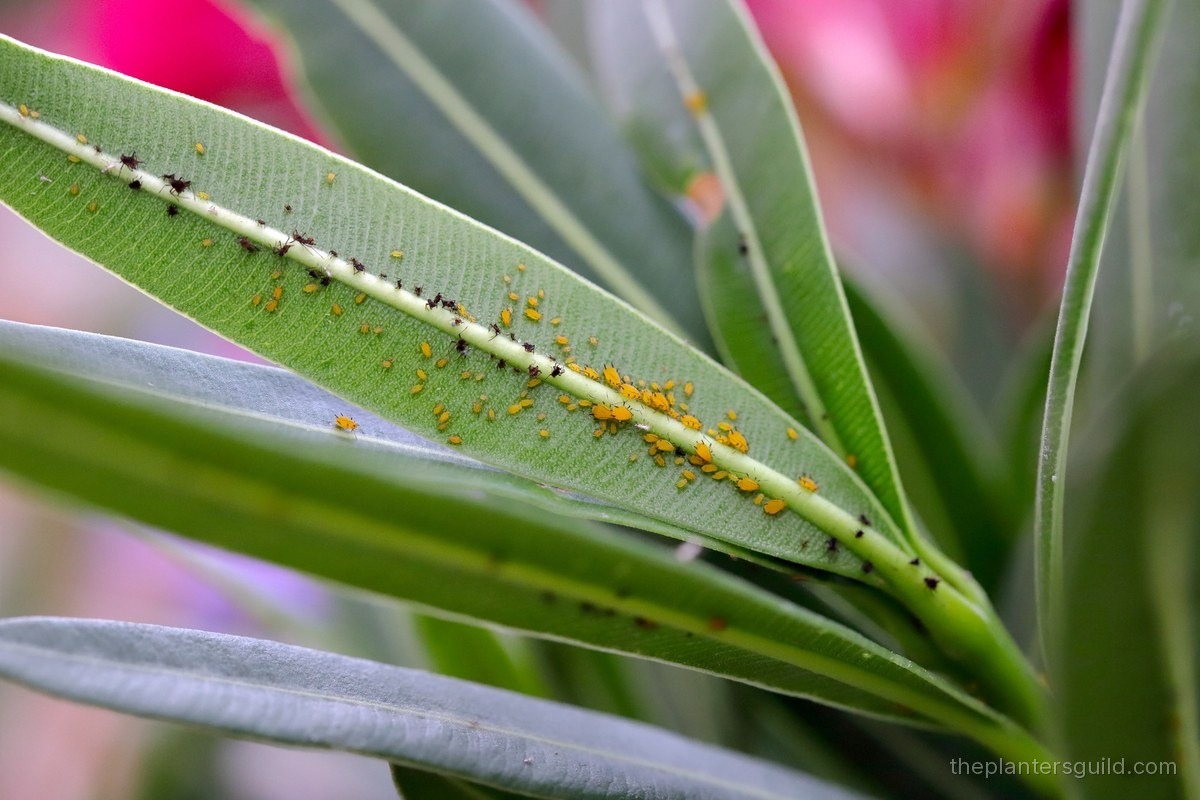
Whether the aphids hurt monarchs depends on the milkweed and the numbers. On tropical milkweed in cage tests, monarchs laid three times more eggs on aphid-free plants than on infested ones, and in laboratory feeding trials larvae on aphid-free leaves ate and weighed twice as much (Mach et al., 2023). Mach and colleagues note that earlier work on two native milkweeds found the aphids helped or made no difference to monarch larvae, depending on the species (Mach et al., 2023). In one of those studies, larvae grew 38 percent faster on aphid-infested common milkweed (Ali & Agrawal, 2014). Monarch Joint Venture says the aphids themselves don't harm monarchs unless they're at extremely high densities (Monarch Joint Venture, n.d.).
The Guild recommends keeping sprays off milkweed entirely. That's our position, not what every source requires. The sources we checked accept a soap spray here: Mach and colleagues call insecticidal soap a low-impact alternative that "does not leave insecticide residues that may harm monarch eggs or larvae," and Monarch Joint Venture suggests spraying a soapy mix directly on the aphids when there are too many to squish (Mach et al., 2023; Monarch Joint Venture, n.d.). We recommend physical methods because a spray can't sort aphids from monarch eggs and small caterpillars, and hand work can.
What we recommend instead:
- Check the plant for monarch eggs and caterpillars before you start.
- Squish the aphids with your fingers, then rinse the plant with water to dislodge the rest (Monarch Joint Venture, n.d.).
- Prune out a badly infested shoot and discard it (McAuslane, 2001).
- Leave the lady beetles, lacewings and parasitic wasps to work. One caution: adults and larvae of the multicolored Asian lady beetle also eat young monarch caterpillars, and lacewing larvae may occasionally take one (Boggs, 2022).
And no systemics, for the reasons in Tier 4. Milkweeds bought at retail nurseries have carried an average of about 12 pesticides per plant (Halsch et al., 2022), so a new milkweed is worth asking about before you bring it home.
Predictable mistakes
Treating every colony. Most aphids cause little or no harm to a plant's health (Hahn & Wold-Burkness, n.d.). Look first, and act when the colony is damaging new growth or sitting on a plant that can't spare it.
Waiting until the colony is large. Rubbing and rinsing work on small, early colonies and fail on large ones (Clemson Cooperative Extension, 2019).
Washing once. Indoors, rinsed-off aphids climb back, so the wash has to be repeated (Washington State University Extension, 2025).
Spraying by habit, not by label. Repeat intervals, runoff directions and plant cautions differ from product to product (U.S. Environmental Protection Agency, 2008; U.S. Environmental Protection Agency, 2021; U.S. Environmental Protection Agency, 2024).
Reaching for a broad-spectrum insecticide first. Longer-lasting products take out natural enemies too, which can make aphid problems worse (Hahn & Wold-Burkness, n.d.).
The takeaway
Aphids build fast because nearly all of them are females bearing live young that already carry the next generation, but most colonies do the plant little harm. When one needs handling, rub it off and rinse, indoors in the sink or shower and outdoors with a strong jet from the hose, and repeat. Step up to a soap or oil whose label fits your plant and setting, and follow that label. Protect the predators and parasitic wasps. Keep milkweed to hand work, and keep systemics to a last resort on a non-edible houseplant that stays indoors.
We review our guides against the research and extension guidance available at the time, and we correct them when a source doesn't say what we took it to say or when we can't find support for a point. In this review we corrected the guide's pest-control and safety advice, including spray directions and repeat intervals, what labels allow indoors and on edibles, buying predators, systemic insecticides and what our sources say about spraying milkweed, and its account of aphid identification and biology, including how fast they reproduce. We also fixed points we'd credited to sources that don't make them and removed claims we couldn't source, including some of what we said about ants.
Alfaress, S., Brodersen, C. R., Ammar, E.-D., Rogers, M. E., & Killiny, N. (2018). Laser surgery reveals the biomechanical and chemical signaling functions of aphid siphunculi (cornicles). PLOS ONE, 13(10), e0204984. [link]
Ali, J. G., & Agrawal, A. A. (2014). Asymmetry of plant-mediated interactions between specialist aphids and caterpillars on two milkweeds. Functional Ecology, 28(6), 1404–1412. Abstract only consulted. [link]
Baker, J. (2019). Oleander aphid. Entomology Insect Notes, NC State Extension. [link]
Barrett, B. A. (2017, reviewed 2022). Least-toxic control methods to manage indoor plant pests (G7273). University of Missouri Extension. [link]
Bañol, C., Barrientos, J. A., & Piñol, J. (2015). Efecto de la exclusión de hormigas sobre la abundancia y diversidad de Hymenoptera Parasitica en un cultivo ecológico de mandarinos (La Selva del Camp, Tarragona, España). Orsis, 29, 119–160. [link]
Blacquière, T., Smagghe, G., van Gestel, C. A. M., & Mommaerts, V. (2012). Neonicotinoids in bees: A review on concentrations, side-effects and risk assessment. Ecotoxicology, 21(4), 973–992. [link]
Blackman, R. L. (n.d.). Eggs and embryos: How aphids develop without sex. Aphids on the World’s Plants. [link]
Boggs, J. (2022, August 9). Oleander aphids and monarchs. Buckeye Yard & Garden onLine, The Ohio State University. [link]
California Department of Pesticide Regulation. (2024, September 30). Notice of new law regarding neonicotinoid pesticides for non-agricultural outdoor use. [link]
Capinera, J. L. (n.d.). Green peach aphid, Myzus persicae (Sulzer) (EENY-222). University of Florida IFAS Extension. [link]
Clemson Cooperative Extension. (2019). Integrated pest management (IPM) for aphids. Home & Garden Information Center. [link]
Clemson Cooperative Extension. (2021). Insecticidal soaps for garden pest control. Home & Garden Information Center. [link]
Cloyd, R. A. (n.d.). Aphidius colemani and Aphidius ervi: Biological control agents of aphids (MF3653). Kansas State University Research and Extension. [link]
Colorado State University Extension. (2025a). Aphids on shade trees and ornamentals (Fact Sheet 5.511). [link]
Colorado State University Extension. (2025b). Insect control: Insecticidal soap (Fact Sheet 5.547). [link]
Durak, R., & Borowiak-Sobkowiak, B. (2011). Selected elements of the biology and demographic parameters of the anholocyclic species Myzus ornatus (Laing, 1932). Journal of Plant Protection Research, 51(4). [link]
Gervais, J. A., Luukinen, B., Buhl, K., & Stone, D. (2010). Imidacloprid technical fact sheet. National Pesticide Information Center, Oregon State University Extension Services. [link]
Hahn, J., & Wold-Burkness, S. (n.d.). Aphids. University of Minnesota Extension. [link]
Halsch, C. A., Hoyle, S. M., Code, A., Fordyce, J. A., & Forister, M. L. (2022). Milkweed plants bought at nurseries may expose monarch caterpillars to harmful pesticide residues. Biological Conservation, 273, 109699. [link]
Kieckhefer, R. W., & Olson, G. A. (1974). Dispersal of marked adult coccinellids from crops in South Dakota. Journal of Economic Entomology, 67(1), 52–54. [link]
Krischik, V., Rogers, M., Gupta, G., & Varshney, A. (2015). Soil-applied imidacloprid translocates to ornamental flowers and reduces survival of adult Coleomegilla maculata, Harmonia axyridis, and Hippodamia convergens lady beetles, and larval Danaus plexippus and Vanessa cardui butterflies. PLOS ONE, 10(3), e0119133. [link]
Lami, F., Burgio, G., Magagnoli, S., et al. (2024). The effects of natural insecticides on the green peach aphid Myzus persicae (Sulzer) and its natural enemies Propylea quatuordecimpunctata (L.) and Aphidius colemani Viereck. Insects. [link]
Mach, B. M., Long, W., Daniels, J. C., & Dale, A. G. (2023). Aphid infestations reduce monarch butterfly colonization, herbivory, and growth on ornamental milkweed. PLOS ONE, 18(7), e0288407. [link]
McAuslane, H. J. (2001). Oleander aphid, Aphis nerii Boyer de Fonscolombe (EENY-247). University of Florida IFAS Extension. Archival copy. [link]
Monarch Joint Venture. (n.d.). Are aphids on milkweed harmful to monarchs? [link]
Nelson, S. (2008). Sooty mold (PD-52). University of Hawaii at Manoa, College of Tropical Agriculture and Human Resources. [link]
Offenberg, J. (2001). Balancing between mutualism and exploitation: The symbiotic interaction between Lasius ants and aphids. Behavioral Ecology and Sociobiology, 49, 304–310. [link]
Ogawa, K., & Miura, T. (2014). Aphid polyphenisms: Trans-generational developmental regulation through viviparity. Frontiers in Physiology, 5, 1. [link]
Oliver, T. H., Mashanova, A., Leather, S. R., Cook, J. M., & Jansen, V. A. A. (2007). Ant semiochemicals limit apterous aphid dispersal. Proceedings of the Royal Society B, 274(1629), 3127–3131. [link]
Oregon State University Extension Service. (n.d.). Biological pest control. Solve Pest Problems. [link]
Stadler, B., & Dixon, A. F. G. (2005). Ecology and evolution of aphid–ant interactions. Annual Review of Ecology, Evolution, and Systematics, 36, 345–372. Abstract only consulted. [link]
Townsend, L. H. (n.d.). Grape phylloxera (ENTFACT-222). University of Kentucky Entomology. [link]
U.S. Department of Agriculture, APHIS. (n.d.). Siphunculus. AphID: Aphid identification glossary. [link]
U.S. Environmental Protection Agency. (2008). Safer brand insect killer RTU (potassium salts of fatty acids; EPA Reg. No. 42697-59; alternate brand names include Houseplant Insect Killing Soap II) [Pesticide label]. [link]
U.S. Environmental Protection Agency. (2018). MEEN (azadirachtin; EPA Reg. No. 70051-6) [Pesticide label]. [link]
U.S. Environmental Protection Agency. (2019). IMI 0.22G plant granules (EPA Reg. No. 53883-217) [Pesticide label]. [link]
U.S. Environmental Protection Agency. (2021). Neudorff’s insecticidal soap ready-to-use (potassium salts of fatty acids; EPA Reg. No. 67702-21) [Pesticide label]. [link]
U.S. Environmental Protection Agency. (2024). All Seasons horticultural spray oil RTU (mineral oil; EPA Reg. No. 4-419) [Pesticide label]. [link]
U.S. Environmental Protection Agency. (2025). PYROL-O RTU (pyrethrins and canola oil; EPA Reg. No. 67702-35) [Pesticide label]. [link]
Washington State University Extension. (2025). Aphids [Houseplant pests fact sheet]. PestSense. [link]
Weeden, C. R., Shelton, A. M., & Hoffmann, M. P. (n.d.). Lady beetles (Coleoptera: Coccinellidae). Biological Control: A Guide to Natural Enemies in North America, Cornell University. [link]