A grower's guide to finding spider mites on indoor plants and treating them with water, products labeled for indoor use, and predatory mites, without burning the leaves along the way.
Corrected October 2026: we've revised parts of this guide. See the correction note at the end.
You'll see the damage first
Adult female two-spotted spider mites are about 1/50 inch (0.4 to 0.6 mm) long (Fasulo & Denmark, 2000; Hoover, n.d.). Because they're that small and feed on the undersides of leaves, a population can go unnoticed until it has done serious damage to a plant (Hoover, n.d.).
So what you notice first is usually the leaf. Feeding leaves tiny white or yellow spots that give it a stippled, mottled look (University of Minnesota Extension, 2020). As feeding goes on, the leaf takes on a stippled, bleached look and later turns yellow, gray or bronze (Fasulo & Denmark, 2000). Many spider mites spin webbing, particularly when their numbers are high (Colorado State University Extension, 2025), and a severely infested plant usually looks as if fine cobweb has been laid over it (Hoover, n.d.).
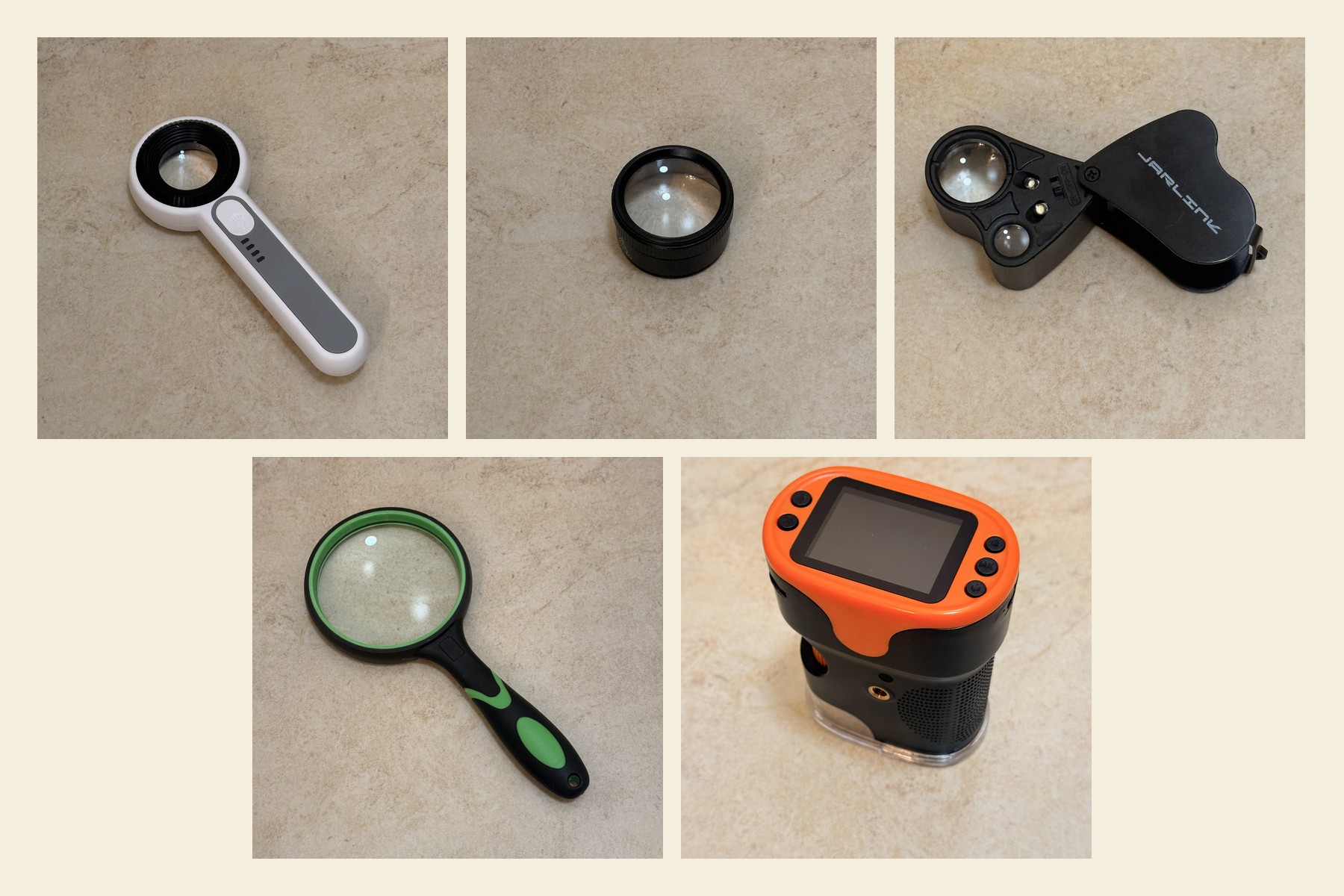
To see the mites themselves, UF/IFAS (the University of Florida's Institute of Food and Agricultural Sciences) calls a 10× to 15× magnifier a necessity, and suggests checking the undersides of leaves for mites, cast skins and webbing (Fasulo & Denmark, 2000). Our Workshop review of hand lenses covers the magnifiers we use.
A simpler check costs a sheet of paper. Hold white paper under a leaf and strike the foliage sharply. Mites that fall are easier to see and identify on the paper than on the green leaf (Fasulo & Denmark, 2000), and if they're present they show up as tiny, moving specks (Hoover, n.d.). Do this before you treat anything.
Indoor Pests · Class Arachnida (Acari)
Spider Mites
Tetranychus urticae
 Mug Shot Adult female, under 1/40 inch (0.4 to 0.6 mm)
Vital Statistics
- Class
- Arachnida (Acari), not an insect
- Adult size
- about 1/50 inch (0.4 to 0.6 mm)
- Color
- green, greenish-yellow or almost translucent, two dark spots; overwintering females orange-red
- Egg to adult
- 5 to 20 days at about 80°F (27°C); varies with temperature
- Adult female lifespan
- 2 to 4 weeks
- Eggs per female
- up to about 100 (Penn State); several hundred (UF/IFAS)
Modus Operandi
Feeds with needle-like, piercing-sucking mouthparts, mostly on the undersides of leaves. Each feeding site becomes a small pale spot, and continued feeding leaves a stippled, bleached look before the leaves turn yellow, gray or bronze. Heavy populations spin fine webbing.
Last Seen
Leaf undersides, with eggs usually laid near the veins; fine silk over leaves and stems once numbers are high. Not on sticky cards: spider mites don't fly.
Apprehension Protocol
The Mug Shot
Spider mites aren't insects. The two-spotted spider mite, Tetranychus urticae, is an arachnid, in the same group as spiders and ticks (University of Minnesota Extension, 2020), and it's classed among the mites, the Acari (Fasulo & Denmark, 2000). That matters for control: few insecticides work on spider mites, and many make the problem worse (Colorado State University Extension, 2025).
The two-spotted spider mite is the most important species on houseplants (Colorado State University Extension, 2025). Its two dark spots are food showing through a transparent body wall (Hoover, n.d.). Green, greenish-yellow or almost translucent is the most common color, and overwintering females are orange to orange-red (Fasulo & Denmark, 2000). A 2013 review concludes that the red form once named T. cinnabarinus should be considered a synonym of T. urticae, though its status remains uncertain for some acarologists, the scientists who study mites (Auger et al., 2013).
The life cycle runs from egg to a six-legged larva, then through two eight-legged nymphal stages, the protonymph and deutonymph, to the eight-legged adult (Walgenbach, 2015). Eggs hatch in about three days (Fasulo & Denmark, 2000); Penn State gives two to six (Hoover, n.d.). The time from egg to adult varies greatly with temperature; under optimum conditions, about 80°F (27°C), it takes five to twenty days (Fasulo & Denmark, 2000). Adult females live two to four weeks (Fasulo & Denmark, 2000). Penn State puts the total at up to 100 eggs per female (Hoover, n.d.); UF/IFAS says several hundred (Fasulo & Denmark, 2000).
Speed is the problem. At temperatures above 90°F (32°C), Minnesota Extension says, colonies can grow to high numbers in under two weeks (University of Minnesota Extension, 2020).
Speed is also why resistance comes quickly. Among arthropods (insects, mites and their relatives), T. urticae has the highest incidence of pesticide resistance (Grbić et al., 2011). A review of its resistance mechanisms names high fecundity (heavy egg-laying), inbreeding, a very short life cycle and arrhenotoky, in which unfertilized eggs become males, as the traits that speed up selection for resistance (Van Leeuwen et al., 2010; Walgenbach, 2015).
Where to find them
Look under the leaves. Spider mites are found mainly on the undersides (Fasulo & Denmark, 2000), and their eggs are usually laid near the veins (Colorado State University Extension, 2025). The fine silk threads they lay down as they move can cover leaves and stems (Hoover, n.d.).
Hot, dry weather favors them (Barrett, 2017), so we check the plants in the warmest, driest spots first.
Sticky cards won't help. Spider mites don't fly, so they aren't caught on sticky cards (Pundt, 2019). They get from plant to plant mainly where leaves touch, by walking, or by drifting through the air on strands of webbing (Washington State University Extension, n.d.).
Colorado State suggests examining the undersides of leaves for mites each week with a 10× hand lens (Colorado State University Department of Agricultural Biology, n.d.).
How they damage plants
Spider mites feed with needle-like, piercing-sucking mouthparts (Fasulo & Denmark, 2000). As they take the sap, the tissue inside the leaf collapses and a small pale spot forms at each feeding site; UF/IFAS gives an estimate of 18 to 22 cells destroyed each minute (Fasulo & Denmark, 2000). Left unchecked, a plant can lose all its leaves (Fasulo & Denmark, 2000).
The webbing works in the mites' favor. It shields the mites and their eggs, to a degree, from natural enemies and from swings in the environment (Colorado State University Extension, 2025). It can also stop insecticidal soap from reaching them (Colorado State University Extension, 2025).
A stressed plant is more at risk. Spider mites thrive on plants under stress, and Minnesota Extension advises keeping plants well watered to reduce the chances of an attack (University of Minnesota Extension, 2020).
The Apprehension Protocol
There are four tiers, as in the other dossiers. This is the Guild's approach, built around one rule: use a product only where its label covers the plant and the place it's growing. Expect houseplants to take patience. Colorado State calls control on houseplants particularly frustrating, with generally no biological controls and few effective chemical ones, mainly soaps and horticultural oils (Colorado State University Extension, 2025).
Tier 1: Isolate, check the neighbors, raise the humidity
Move the plant away from your other plants, and check the ones nearby, especially any in the same warm, dry spot. Colorado State's advice for houseplants is to treat all the susceptible plants at the same time (Colorado State University Extension, 2025).
Raise the humidity around the plant. Missouri Extension suggests misting foliage to increase humidity and avoiding high temperatures and soil-moisture stress (Barrett, 2017). Washington State suggests resting pots on, not in, trays of pebbles and water, or misting daily (Washington State University Extension, n.d.).
Be realistic about a plant that's covered. Colorado State suggests trimming, bagging and removing heavily infested leaves and discarding severely infested plants (Colorado State University Extension, 2025), and Missouri suggests weighing whether plants that are especially prone to spider mites are worth their keep (Barrett, 2017).
Prevention starts at the door: Missouri advises quarantining new plants and treating them before they go in with established ones (Barrett, 2017).
Tier 2: Water, then an indoor-labeled soap or oil
Start with water. Colorado State suggests hosing small plants in the sink or shower, wiping the leaves of larger ones with a soft, damp cloth, and repeating at one- to two-week intervals while the mites persist (Colorado State University Extension, 2025). Washington State says a thorough rinse with lukewarm water in a sink or shower may be enough for light to moderate infestations, with attention to the undersides of the leaves, repeated at least weekly (Washington State University Extension, n.d.). A forceful spray dislodges mites and can wash away their webbing (University of Minnesota Extension, 2020). Rinsing is less effective on heavily infested plants (Colorado State University Department of Agricultural Biology, n.d.).
If water isn't enough, add an insecticidal soap or a horticultural oil whose houseplant directions list mites. Colorado State rates horticultural oil, used at the 2 percent "summer oil" rate, as "perhaps the most effective miticide available for home use," and soap as only marginally effective against two-spotted spider mite (Colorado State University Extension, 2025).
Sources disagree on the oil rate. Missouri suggests a 2 percent solution (Barrett, 2017), and Colorado State calls 2 percent the "summer oil" rate (Colorado State University Extension, 2025). Maryland calls 1 percent the commonly used in-season rate, less likely to damage foliage, and 2 to 3 percent a dormant rate (University of Maryland Extension, 2026), and UF/IFAS notes that burning and stunting are more likely at 2 percent (Fasulo & Denmark, 2000). Use the rate on your label; a ready-to-use product is already mixed.
Both work only on the mites they touch and have no residual activity, meaning nothing keeps working after the spray (University of Minnesota Extension, 2020). Soap's fatty acids damage insects' cell membranes and make them leaky, and soap has less effect against insect eggs (Pundt, 2023). One oil label we checked, for interior plantscapes among other sites, says it works by suffocation, on the eggs, larvae and nymphs of mites and insects (U.S. Environmental Protection Agency, 2026). Coverage matters: target the undersides of the leaves as well as the tops (University of Minnesota Extension, 2020).
Plan on repeats. Most miticides don't affect eggs, so a repeat application is usually needed (Colorado State University Extension, 2025); UF/IFAS gives five-day intervals in summer and seven in winter for miticides in general (Fasulo & Denmark, 2000). With soap or oil, follow the interval and count on the label you're using:
- An insecticidal soap labeled for houseplants says to spray weekly for mites (U.S. Environmental Protection Agency, 2008). A soap concentrate's indoor-plant directions say to spray weekly, at 7- to 10-day intervals, as needed up to three times, and not to "make repeated sprays at short intervals without thoroughly rinsing foliage" (U.S. Environmental Protection Agency, 2015).
- A horticultural oil whose houseplant directions list spider mites says to allow at least two weeks after three consecutive applications before making a fourth (U.S. Environmental Protection Agency, 2024a).
Read the cautions as closely as the directions:
- Heat. The soap concentrate says to avoid application above 90°F (32°C), and the oil says not to apply above 90°F (32°C) or below 40°F (4°C) (U.S. Environmental Protection Agency, 2015; U.S. Environmental Protection Agency, 2024a). Maryland Extension is more cautious with oil, advising against applying it above 85°F (29°C) because the risk of leaf injury is high (University of Maryland Extension, 2026). For oil, we use Maryland's 85°F (29°C).
- Sun and stress. The oil label says "Do not apply to plants in direct sunlight behind glass," and not to spray a plant under moisture stress (U.S. Environmental Protection Agency, 2024a). The soap concentrate says not to use it "on new transplants, newly rooted cuttings or plants stressed by drought" (U.S. Environmental Protection Agency, 2015). Minnesota advises watering plants thoroughly before spraying, and spraying in the early morning or early evening (University of Minnesota Extension, 2020).
- Sensitive plants. The soap concentrate says not to use it "on dracaena, delicate ferns, dieffenbachia, ornamental ivies, palms or succulents without testing" (U.S. Environmental Protection Agency, 2015). The oil says not to use it on coconut palms or maidenhair ferns (U.S. Environmental Protection Agency, 2024a). UConn notes that oil sprays may pit and speckle the leaves of wax begonia and coleus, and advises against oil on ferns (UConn Home & Garden Education Center, 2022), though the houseplant oil label lists ferns other than maidenhair among the plants it covers (U.S. Environmental Protection Agency, 2024a). Plant varieties differ in how easily soaps and oils burn their leaves (Fasulo & Denmark, 2000), so test one leaf first.
Label note. The labels behind this tier, by U.S. Environmental Protection Agency (EPA) registration number:
- 42697-59, an insecticidal soap, ready to use
- 42697-60, Safer Brand Insect Killing Soap Concentrate II
- 4-419, a horticultural oil, ready to use, with houseplant directions
- 48813-1, a horticultural oil labeled for interior plantscapes
Formulations change, so check the label on the bottle in your hand for an indoor site and for mites.
Tier 3: Predatory mites matched to the room
Missouri Extension says predatory mites are sold commercially to release onto infested plants, in homes as well as greenhouses (Barrett, 2017). Colorado State's houseplant advice is more doubtful, noting that houseplants generally have no biological controls (Colorado State University Extension, 2025). If you try them, match the species to the room.
- Phytoseiulus persimilis is a spider mite specialist: Kansas State says it feeds only on two-spotted spider mite (Cloyd, 2011), and its supplier lists two-spotted spider mite and other Tetranychus species, except T. evansi, as its targets (Koppert, n.d.-b). Its supplier says it's most effective at 55 to 81°F (13 to 27°C), isn't effective above 86°F (30°C), and is sensitive to relative humidity below 70% (Koppert, n.d.-b). UF/IFAS calls it the most common predator, preying on all stages of the mite (Fasulo & Denmark, 2000).
- Neoseiulus californicus is more tolerant of high temperatures and low humidity than P. persimilis (Koppert, n.d.-a). Its supplier says it's most effective at 55 to 90°F (13 to 32°C) and sensitive to relative humidity below 60% (Koppert, n.d.-a). It survives longer without prey than P. persimilis and also feeds on other mites and on thrips (Cloyd, 2011).
Releases are repeated. The supplier's guidance is once or twice more at weekly intervals for P. persimilis, and at least five times at weekly intervals for N. californicus (Koppert, n.d.-a; Koppert, n.d.-b). In one greenhouse study, both species controlled spider mites even though daytime humidity was low, possibly because humidity rose and fell between day and night (Messelink & Leman, 2020).
Time them around your sprays. UConn warns that soap sprayed straight onto predatory mites, nymphs and adults alike, does them serious harm, though soap has no residual activity once the spray has dried (Pundt, 2023). Oil harms predatory mite eggs as readily as spider mite eggs, but it evaporates quickly and has little activity once dry (UConn Home & Garden Education Center, 2022). So release predators after a soap or oil spray has dried, not into a wet one.
Tier 4: A labeled miticide, rotated
This tier depends entirely on what the labels allow.
Abamectin. None of the abamectin labels we checked lets a home grower use it on indoor plants. Avid, an abamectin product for ornamentals, is "Recommended for Agricultural/Commercial Use," for greenhouse, shadehouse and field-grown ornamentals (U.S. Environmental Protection Agency, 2025), and Colorado State lists abamectin as for commercial use only on ornamental plants (Colorado State University Extension, 2025). Several other abamectin products we checked are restricted-use pesticides, for certified applicators only.
Bifenazate. Two bifenazate labels we checked list interiorscapes (indoor plantings in buildings) and residences among their sites; one of them is marked as intended for commercial use. The other calls for long sleeves, long pants, shoes and socks, and allows no more than two applications per crop per year (U.S. Environmental Protection Agency, 2024b). Its requirements for non-agricultural use say to keep unprotected people out of treated areas until sprays have dried, and it recommends only one application before rotating to a different chemical class (U.S. Environmental Protection Agency, 2024b). The label says it has activity against spider mite eggs as well as the mobile stages, and that, used as directed, it doesn't adversely affect predatory mites, P. persimilis among them (U.S. Environmental Protection Agency, 2024b).
Rotation. Miticides are grouped by mode of action, the way they work on the pest: abamectin is in Group 6 and bifenazate in Group 20D (U.S. Environmental Protection Agency, 2025; U.S. Environmental Protection Agency, 2024b). The Insecticide Resistance Action Committee, which maintains those groups, advises that successive generations of a pest generally shouldn't be treated with compounds from the same mode-of-action group (Insecticide Resistance Action Committee, 2019).
Spinosad. Some outdoor spinosad labels list spider mites (U.S. Environmental Protection Agency, 2009), and laboratory tests support its activity against the two-spotted spider mite (Marčić et al., 2025). But the home spinosad labels we checked don't cover indoor plants (see the thrips dossier), and in one trial on infested Buddleia cuttings it didn't suppress two-spotted spider mite at the rates tested (Cote, 2001). It isn't part of this protocol.
Systemics. Soil applications of imidacloprid, a systemic insecticide that the plant takes up into its tissues, have contributed to some spider mite outbreaks (Colorado State University Extension, 2025). In one study, spider mites fed foliage from imidacloprid-treated elms laid more eggs than mites fed untreated leaves (Szczepaniec et al., 2011). The Guild's position on systemics is in the thrips dossier.
Dry air and humidity
Dry conditions greatly favor spider mites, and they feed more in dry air (Colorado State University Extension, 2025). Hot, dry weather favors fast development, while high humidity and excess moisture are unfavorable (Barrett, 2017). In one greenhouse study, spider mite densities were up to three times higher on plants kept at low humidity than on plants at high humidity (Messelink & Leman, 2020).
So humidity belongs in the protocol. Mist the foliage, or set pots on pebble trays (Barrett, 2017; Washington State University Extension, n.d.). Keep the plant out of high heat and keep its watering steady, since mites thrive on stressed plants (Barrett, 2017; University of Minnesota Extension, 2020). None of it replaces the rinse and the label's spray schedule.
Predictable mistakes
Spraying once. Most miticides don't affect eggs, so a repeat application is usually needed (Colorado State University Extension, 2025). Follow the label's repeat schedule.
Missing the undersides. Soaps and oils work only where they land (University of Minnesota Extension, 2020).
Oiling a plant in the sun or the heat. Two labels we checked say not above 90°F (32°C), one oil adds not in direct sun behind glass, and we keep oil under 85°F (29°C).
Using an outdoor product indoors. If the label doesn't list an indoor site, it isn't an indoor product.
Leaning on one chemistry. Rotate by mode-of-action group, not just by brand.
The takeaway
Confirm spider mites with the paper tap and a magnifier, then rinse the plant, raise the humidity, and add an indoor-labeled soap or oil on that label's schedule. If predators fit your room, release them once a soap or oil spray has dried. Save miticides for what their labels actually allow.
We review our guides against the research and extension guidance available at the time, and we correct them when a source doesn't say what we took it to say or when we can't find support for a point. In this review we corrected the guide's pest-control and safety advice to follow what product labels allow indoors, including spray schedules, temperature limits and miticides, and its account of spider mite biology, including the life cycle, humidity and predatory mites. We also fixed points we'd credited to sources that don't make them and removed claims we couldn't source.
Auger, P., Migeon, A., Ueckermann, E. A., Tiedt, L., & Navajas, M. (2013). Evidence for synonymy between Tetranychus urticae and Tetranychus cinnabarinus (Acari, Prostigmata, Tetranychidae): Review and new data. Acarologia, 53(4), 383–415. [link]
Barrett, B. A. (2017, reviewed 2022). Least-toxic control methods to manage indoor plant pests (G7273). University of Missouri Extension. [link]
Cloyd, R. A. (2011). Twospotted spider mite management in greenhouses and nurseries (MF2997). Kansas State University Agricultural Experiment Station and Cooperative Extension Service. [link]
Colorado State University Department of Agricultural Biology. (n.d.). Twospotted spider mite. [link]
Colorado State University Extension. (2025). Spider mites (Fact sheet 5.507). [link]
Cote, K. W. (2001). Using selected acaricides to manipulate Tetranychus urticae Koch populations in order to enhance biological control provided by phytoseiid mites [Master’s thesis, Virginia Polytechnic Institute and State University]. VTechWorks. [link]
Fasulo, T. R., & Denmark, H. A. (2000, revised 2025). Twospotted spider mite, Tetranychus urticae Koch (Arachnida: Acari: Tetranychidae) (EENY-150). UF/IFAS Extension. [link]
Grbić, M., Van Leeuwen, T., Clark, R. M., Rombauts, S., Rouzé, P., Grbić, V., et al. (2011). The genome of Tetranychus urticae reveals herbivorous pest adaptations. Nature, 479, 487–492. [link]
Hoover, G. (n.d.). Twospotted spider mite. Penn State Extension. [link]
Insecticide Resistance Action Committee. (2019). Mode of action classification (6th ed.) [Brochure]. [link]
Koppert. (n.d.-a). Spical (Neoseiulus californicus) [Product page]. Retrieved October 8, 2026, from [link]
Koppert. (n.d.-b). Spidex (Phytoseiulus persimilis) [Product page]. Retrieved October 8, 2026, from [link]
Marčić, D., Döker, I., Tsolakis, H., & Kavallieratos, N. G. (2025). Bioacaricides in crop protection: What is the state of play? Insects, 16(1), 95. [link]
Messelink, G., & Leman, A. (2020). Are low humidity levels a limiting factor for spider mite control by phytoseiid predators under fluctuating climatic conditions? IOBC-WPRS Bulletin, 149, 101–102. [link]
Pundt, L. (2019). Using sticky cards to monitor greenhouse pests [Fact sheet]. UConn Extension Integrated Pest Management Program. [link]
Pundt, L. (2023). Insecticidal soaps [Fact sheet]. UConn Extension Integrated Pest Management Program. [link]
Szczepaniec, A., Creary, S. F., Laskowski, K. L., Nyrop, J. P., & Raupp, M. J. (2011). Neonicotinoid insecticide imidacloprid causes outbreaks of spider mites on elm trees in urban landscapes. PLoS ONE, 6(5), e20018. [link]
UConn Home & Garden Education Center. (2022). Horticultural oils [Fact sheet]. University of Connecticut. [link]
University of Maryland Extension. (2026). Pesticide profile: Horticultural oil. [link]
University of Minnesota Extension. (2020). Twospotted spider mites in home gardens. [link]
U.S. Environmental Protection Agency. (2008). Safer Brand Insect Killing Soap, ready to use (EPA Reg. No. 42697-59) [Pesticide label]. Pesticide Product Label System.
U.S. Environmental Protection Agency. (2009). Bonide Captain Jack’s Deadbug Brew, ready to use (EPA Reg. No. 4-472) [Pesticide label]. Pesticide Product Label System.
U.S. Environmental Protection Agency. (2015). Safer Brand Insect Killing Soap Concentrate II (EPA Reg. No. 42697-60) [Pesticide label]. Pesticide Product Label System.
U.S. Environmental Protection Agency. (2024a). Bonide All Seasons Horticultural & Dormant Spray Oil, ready to use (EPA Reg. No. 4-419) [Pesticide label]. Pesticide Product Label System.
U.S. Environmental Protection Agency. (2024b). Floramite SC (EPA Reg. No. 70506-537) [Pesticide label]. Pesticide Product Label System.
U.S. Environmental Protection Agency. (2025). Avid 0.15 EC (EPA Reg. No. 100-896) [Pesticide label]. Pesticide Product Label System.
U.S. Environmental Protection Agency. (2026). Brandt STS Horticultural Oil (EPA Reg. No. 48813-1) [Pesticide label]. Pesticide Product Label System.
Van Leeuwen, T., Vontas, J., Tsagkarakou, A., Dermauw, W., & Tirry, L. (2010). Acaricide resistance mechanisms in the two-spotted spider mite Tetranychus urticae and other important Acari: A review. Insect Biochemistry and Molecular Biology, 40(8), 563–572. [link]
Walgenbach, J. (2015). Twospotted spider mite. NC State Extension. [link]
Washington State University Extension. (n.d.). Spider mites [Pestsense fact sheet]. [link]