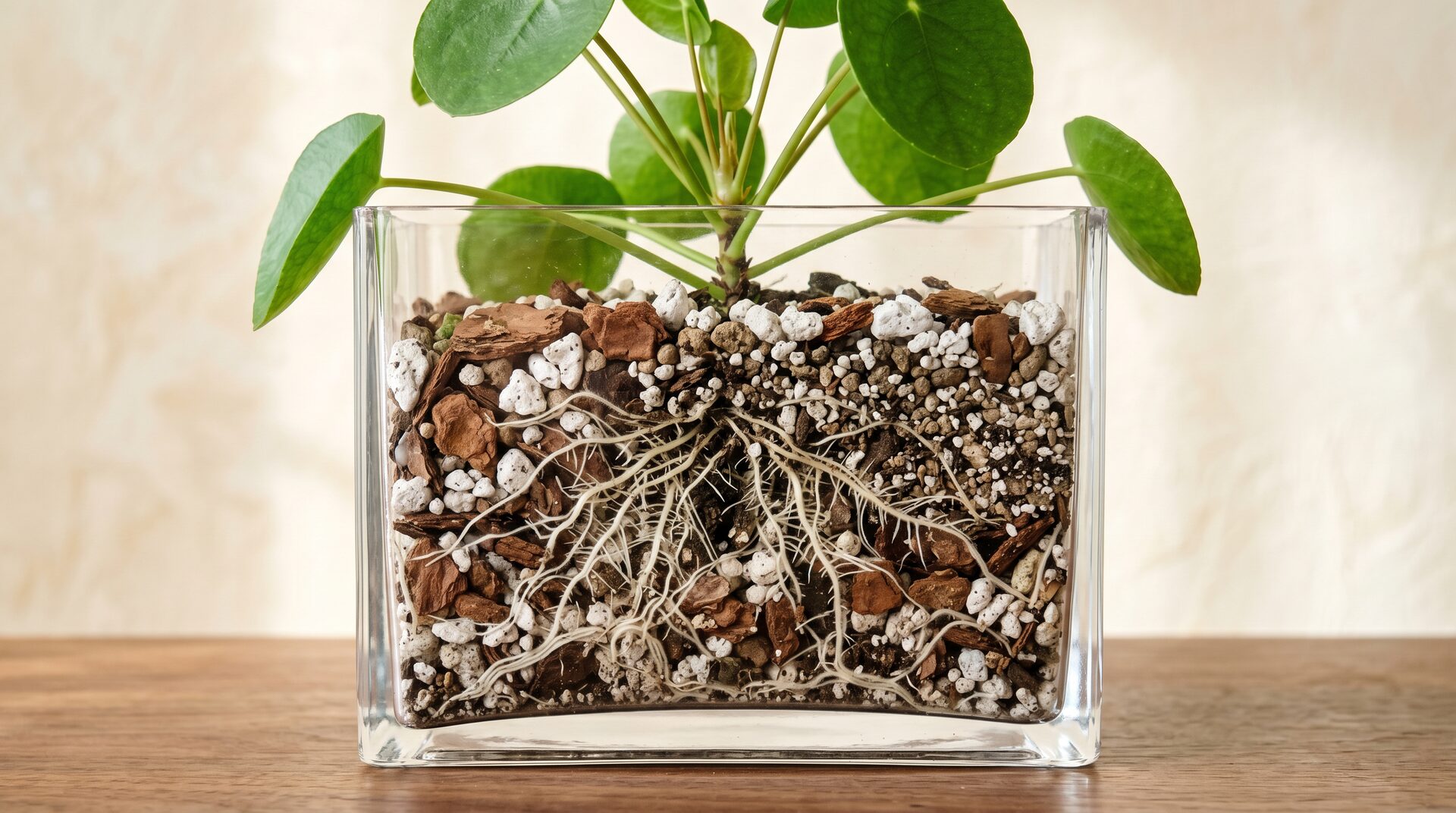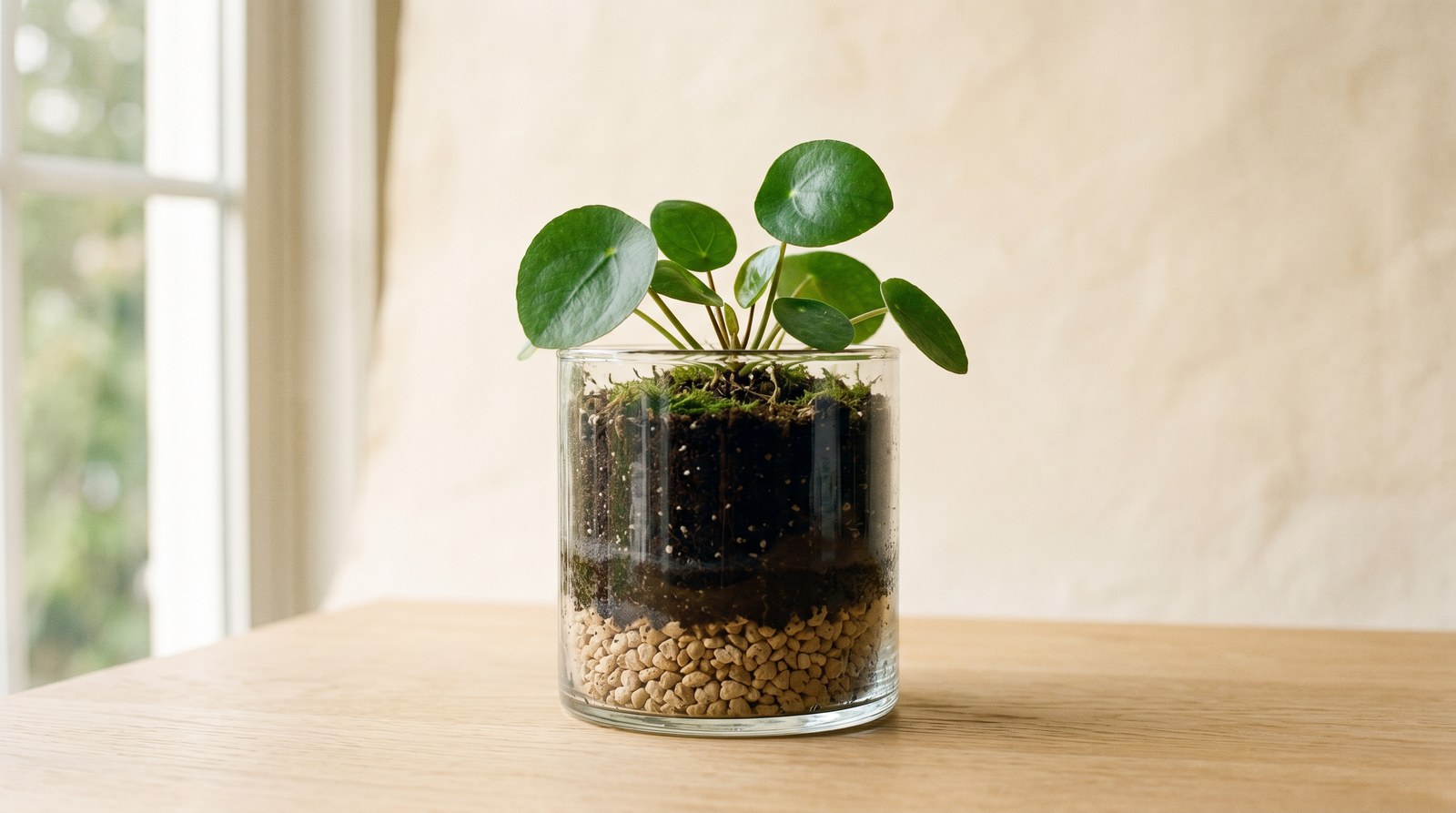
Put a layer of gravel in the bottom of the pot for better drainage. It's a common practice among home gardeners (Rowe, 2025), and extension services warn that it does the opposite, holding water up in the mix above it. When a 2025 study tested that in pots, the warning mostly didn't hold. In two peat-free mixes, most layers left the pot holding less water and none left it holding significantly more. In a loam-based (soil-based) mix, most layers made no significant difference. We still don't add one for drainage, and we'll explain why.
On this page
8 sections
Corrected August and September 2026: we've revised this guide twice. See the correction note at the end.
The claim
The advice goes like this. Put a layer of sand, gravel, pebbles or broken pot shards in the bottom of the pot. Those are the materials most often recommended, according to Washington State University's myth sheet (Chalker-Scott, n.d.). Water drains out of the mix, collects in the layer and runs out the hole, and the roots stay out of the wet. It's a common practice among home gardeners (Rowe, 2025).
Where the warning comes from
Extension services call this a myth, and their reasoning starts with something every pot has. After watering, some of the mix at the bottom of a container doesn't drain and stays saturated, and that wet zone is a larger share of the mix in a shorter pot (Fonteno et al., 1995). It's often called the perched water table.
The warning says a drainage layer makes that worse. David Trinklein of the University of Missouri writes that a layer of coarse material shortens the column of mix and "shifts the saturated part of the growing medium upward" (Trinklein, 2023). University of Illinois Extension says the extra water doesn't move into the gravel right away; it "perches," gathering in the soil just above it (University of Illinois Extension, n.d.-a).
Behind that is an effect soil scientists call a capillary barrier. WSU's sheet puts it simply: the coarser the material underneath, the harder it is for water to cross the boundary into it (Chalker-Scott, n.d.). Among the oldest work Rowe cites is a 1959 film by Hsieh and Gardner. It showed water moving down through soil and stopping where it met soil of a different porosity (a different size and amount of pore space), until the soil above was nearly saturated (Hsieh & Gardner, 1959, as cited in Rowe, 2025). Rowe also cites field work in which a coarse layer acted as a barrier to water, and a study in which more moisture stayed in root-zone soil with gravel beneath it (Rowe, 2025). WSU's sheet points to a study where soil over gravel held more moisture than soil over sand (Chalker-Scott, n.d.).
The warning had real evidence behind it from soil physics and layered field soils. It just hadn't been tested much in actual pots (Rowe, 2025).
What happened when someone tested it in pots
Avery Rowe's 2025 study in PLOS ONE tested the warning in pots set up to closely replicate real growing containers, so that nurseries and home gardeners could use the results. The test pots were clear plastic, about 6.9 inches (175 mm) tall, holding a little under 1.4 quarts (1.29 L), with a single hole about 0.4 inch (10 mm) across. Rowe used three potting mixes. Two were coir-based (coconut fiber) and peat-free, one with perlite and bark and one with vermiculite. The third was a loam-based (soil-based) mix called John Innes. Under the mix went one of four drainage materials: horticultural gravel, LECA (lightweight expanded clay balls) in two sizes, and 1 to 2 mm aquarium gravel, which the paper calls sand. Each went in about 1.2 or 2.4 inches (30 or 60 mm) deep. Each pot was flooded with the hole taped until it was fully saturated, then unsealed and left to drain on a grate until it stopped dripping (Rowe, 2025). Rowe reports the result as water-holding capacity: how much water the pot held relative to the volume of its contents.
The peat-free mixes held less water over most layers, and never significantly more. In the coir, perlite and bark mix, all eight layers lowered it. In the coir and vermiculite mix, five of eight did, and the other three made no significant difference. The loam-based mix went differently. Six of its eight layers made no significant difference. One, about 2.4 inches (60 mm) of the aquarium gravel, lowered the water held, and one, about 1.2 inches (30 mm) of LECA, raised it (Rowe, 2025).
Two photos in the paper, both with the same layer, show how differently the mixes behaved. Over about 2.4 inches (60 mm) of the smaller LECA, the saturated zone in the coir, perlite and bark mix looked "completely eliminated." In the loam-based mix, that same layer of smaller LECA still looked fully saturated after draining. Rowe concludes that the result "can be taken to show that warnings about the raised perched water table and increased water retention should be considered inaccurate" (Rowe, 2025).
Why the physics could point either way
Rowe writes that related research in other fields has given conflicting predictions on whether a drainage layer adds water to the soil above it or takes water away (Rowe, 2025).
Rowe's theoretical case for a layer drawing water away comes from an analysis of capillary barriers. It predicted that a barrier works best when the difference in particle size between the two layers is infinite (Smesrud & Selker, 2001, as cited in Rowe, 2025). Rowe reads that extreme as soil sitting over open air, and points out that every pot of a single mix already has that boundary at its drainage hole. On that reasoning, mix over gravel would perch less water than mix over the open air of the hole, not more (Rowe, 2025). An earlier thesis Rowe cites points the same way. Setting a fabric-bottomed container on a column of sand removed the perched water in the mix altogether. Rowe notes, though, that the sand column was many times deeper than the container and that the fabric bottom may have affected the result (Ruter, 1986, as cited in Rowe, 2025).
That's a prediction carried over from a different setting, and the field studies above pointed the other way. The pot results are the better guide, and in the loam-based mix they didn't all follow the prediction either.
What this doesn't settle
It's one study. Rowe measured water in containers with no plants in them, and writes that the results "cannot be used to predict whether a given plant will benefit from this intervention." The pots were fully saturated before draining, and Rowe notes that pots watered from above don't reach full saturation, because water starts running out before that point. The paper calls for further replication (Rowe, 2025).
Rowe weighed the whole pot, so the measurements cover everything in it, layer included. Rowe also estimated the water in the mix alone with two simple models. In the peat-free mixes, both suggested the mix itself held less water over every layer. Those figures are modeled, not measured (Rowe, 2025). Nursery research on layered, or stratified, mixes suggests layers can also change where in the pot water and air sit. In one trial with shrub roses, the bottom half of each container held coarse bark and the top half a finer bark or bark-and-peat mix. Working from each layer's measured properties, the researchers estimated this put more air at the bottom and more water in the upper half (Fields et al., 2021).
Rowe reads the results as a case for layers. The paper calls drainage layers "a potentially useful tool" for making a pot hold less water. Its best single recommendation is about 2.4 inches (60 mm) of what it calls coarse sand, the only layer that significantly reduced the water held in all three mixes (Rowe, 2025). That material was the 1 to 2 mm aquarium gravel, held in by a fiberglass mesh over the hole, and it filled about a third of the height of a 6.9-inch pot. A bag sold as coarse sand may be a different material, so check the grain size before assuming it matches.
When a pot stays wet
The evidence here doesn't depend on a layer. A mix holds water in its narrow pores and drains through its large ones, where gravity wins over the pull of the mix (Nemali, 2018). Mixes made mostly of fine particles or fibers, like peat and coir, tend to hold more water and less air, while mixes built from coarser materials like bark or perlite drain readily after watering (Criscione & Holliday-Goulart, 2026). Pot height matters too, since the saturated zone takes up more of a shorter pot (Fonteno et al., 1995), and so does pot size: Illinois Extension warns that a small plant in a large pot leaves the soil too wet for too long (University of Illinois Extension, n.d.-b).
When a pot does stay wet, Virginia Cooperative Extension lists clearing blocked drainage holes, letting the mix dry out and repotting into fresh potting soil (Criscione & Holliday-Goulart, 2026). Iowa State's Aaron Steil adds that potting soil that's old and broken down compacts and holds more water, and recommends repotting in fresh, well-drained soil (Steil, n.d.). Steil also says not to let saucers and outer pots hold water, and Virginia Cooperative Extension says not to leave a pot sitting in a tray of water for more than 60 minutes (Criscione & Holliday-Goulart, 2026).
On covering the hole, the sources split. Illinois Extension's drainage page says small holes lose very little soil and a coffee filter over a large hole is not necessary (University of Illinois Extension, n.d.-a), while an Illinois Extension repotting post suggests a coffee filter or paper towel to keep the mix in (Enroth, 2018). Trinklein says a pot shard laid across the hole aids drainage (Trinklein, 2023), and Purdue Extension says holes wider than 1/4 inch let too much soil escape and suggests a layer of gravel or broken pottery to stop it (Lerner, 2002).
What the Guild does
This part is our practice, a preference rather than a finding.
We don't add a drainage layer. Most of the pots we buy have many small holes or slits across the base rather than a few big ones, so we leave the base uncovered and fill the pot with mix from top to bottom. When a pot has large holes that our mix would fall through, we lay a single layer of LECA across the bottom, one ball deep and well under half an inch, to hold the mix in, not to help it drain.
Our reason for skipping a deeper layer is room. In a 6-inch pot, 2 inches of gravel is 2 inches we'd rather give to the mix. Our own mixes lean mineral, built around coarse aggregates (gritty mineral ingredients). That's our approach, not a requirement. As the evidence above shows, a mix that drains can be built more than one way. If a pot is staying wet, we change what's in it, or the pot, before we'd think about a layer.
Already have a gravel layer? In a peat-free mix like the ones Rowe tested, where layers mostly left the pot holding less water, we wouldn't repot the plant just to take it out. In the loam-based mix the results were less consistent.
The verdict
It's complicated, and we'd rather say that than keep a clean answer that isn't true.
The confident version of this myth-bust, that gravel keeps a pot wetter, didn't hold up when pots were weighed. In the two peat-free mixes tested a layer mostly left the pot holding less water, and in the loam-based mix it mostly made no difference. It's one study, and it didn't grow any plants. We still skip the layer, and put our attention on the mix, the size of the pot and a clear set of holes.
We review our guides against the research and extension guidance available at the time, and we correct them when a source doesn't say what we took it to say or when we can't find support for a point. In August we changed this guide's verdict from False after a 2025 study found drainage layers mostly didn't keep pots wetter, and in this review we corrected how we described that study's results, the theory behind the old warning, and our advice on covering drainage holes. We also fixed points we'd credited to sources that don't make them and removed claims we couldn't source.
Chalker-Scott, L. (n.d.). The myth of drainage material in container plantings. Puyallup Research and Extension Center, Washington State University. wpcdn.web.wsu.edu
Criscione, K. S., & Holliday-Goulart, A. (2026). Properly watering container houseplants (SPES-804P). Virginia Cooperative Extension. pubs.ext.vt.edu
Enroth, C. (2018, March 19). Tips for repotting houseplants. Good Growing. University of Illinois Extension. extension.illinois.edu
Fields, J. S., Owen, J. S., Jr., & Altland, J. E. (2021). Substrate stratification: Layering unique substrates within a container increases resource efficiency without impacting growth of shrub rose. Agronomy, 11(8), 1454. doi.org/10.3390/agronomy11081454
Fonteno, W. C., Bailey, D. A., & Nelson, P. V. (1995). Properties of greenhouse substrates. N.C. Flower Growers’ Bulletin, 40(4). hortscans.ces.ncsu.edu
Hsieh, J. C., & Gardner, W. H. (1959). Water movement in soils [Film]. Washington State University. (Cited in Rowe, 2025.)
Lerner, B. R. (2002). Container and raised bed gardening (HO-200-W). Purdue University Cooperative Extension Service. extension.purdue.edu
Nemali, K. (2018). Understanding the pores of a soilless substrate (HO-287-W). Purdue Extension. extension.purdue.edu
Rowe, A. (2025). Effect of drainage layers on water retention of potting media in containers. PLOS ONE, 20(2), e0318716. doi.org/10.1371/journal.pone.0318716
Ruter, J. M. (1986). The effects of edaphic parameters on the application of an electronic moisture controlling device [Master’s thesis, University of Tennessee]. (Cited in Rowe, 2025.)
Smesrud, J. K., & Selker, J. S. (2001). Effect of soil-particle size contrast on capillary barrier performance. Journal of Geotechnical and Geoenvironmental Engineering, 127(10), 885–888. (Cited in Rowe, 2025.)
Steil, A. (n.d.). Why is my houseplant wilting? Yard and Garden, Iowa State University Extension and Outreach. yardandgarden.extension.iastate.edu
Trinklein, D. (2023, January 9). Gardening advice: Fact or fiction. Missouri Environment and Garden. University of Missouri Integrated Pest Management. ipm.missouri.edu
University of Illinois Extension. (n.d.-a). Container drainage options. Successful Container Gardens. extension.illinois.edu
University of Illinois Extension. (n.d.-b). Get started. Houseplants. extension.illinois.edu