
Begonia spans three continents and more than two thousand species. It also has seeds that rarely travel far, and species known from a single hill. Both are true, and the tension between them is the story.
Corrected September 2026: we've revised this essay. See the correction note at the end.
The Shape of the Range
Kew's Plants of the World Online sums up the native range of Begonia in six words: "Tropics & Subtropics to Central China." That one line covers 2,171 accepted species across 116 botanical regions (Royal Botanic Gardens, Kew, 2026). A 2024 survey of the world's biggest plant genera ranked Begonia eighth, with 2,144 species, though it counted from World Flora Online rather than Kew's list, so the exact rank shifts with the checklist (Moonlight et al., 2024).
The edges of that range are where it gets interesting. Begonias are native across the American tropics, tropical Africa and Madagascar, southern China and Vietnam, and the islands of Southeast Asia. They run east through New Guinea, the Solomon Islands and Vanuatu as far as Fiji (Govaerts et al., 2021). East of Fiji, the genus is absent across the Pacific all the way to the Galápagos Islands (Thomas, 2010). And no begonia is native anywhere in Australia, even though New Guinea, just to the north, is full of them (Govaerts et al., 2021).
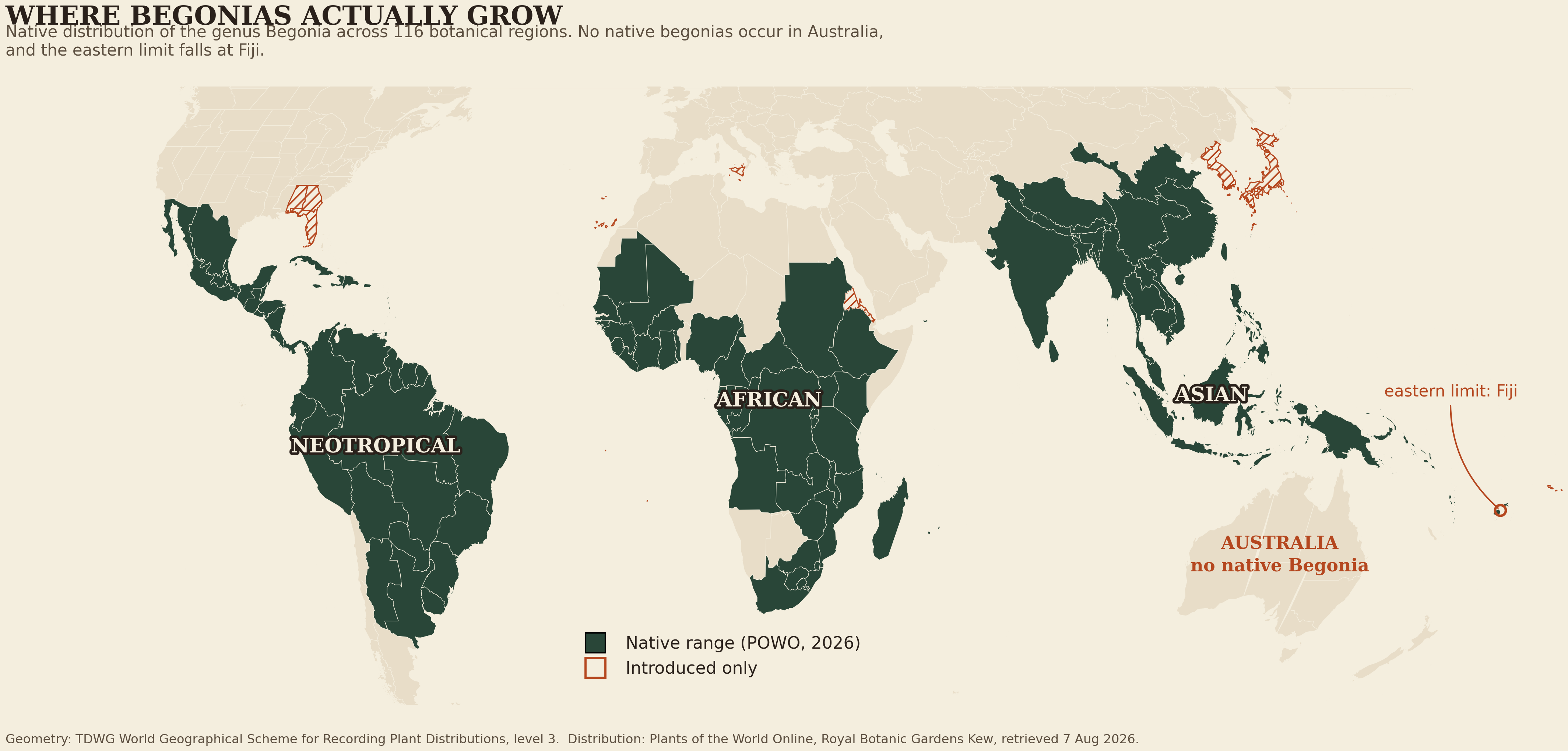
A genus that reaches Fiji but never Queensland is worth a closer look.
It Started in Africa
The African origin surprises most growers, because Africa now has the fewest begonias of the three regions. The Americas and Asia each carry several times as many (Thomas, 2010). The figure long quoted for Africa, about 160 species, comes from monographs of the 1990s and early 2000s (Thomas, 2010). Kew's current checklist counts 179 species native to Africa and its islands, so the older number has crept up (Govaerts et al., 2021).
The family trees still point to Africa. A 2022 study that sequenced Begonia genomes built one tree from chloroplast (plastid) DNA, the small separate genome carried inside each chloroplast, and that tree supports an African origin, with the American and Asian lineages branching off afterward. Its trees from nuclear DNA are less tidy: they place a weakly supported African group beside the American and Asian ones (Li et al., 2022). So the African origin is the best-supported reading, and the nuclear data leave a little room.
The Crossing to Asia
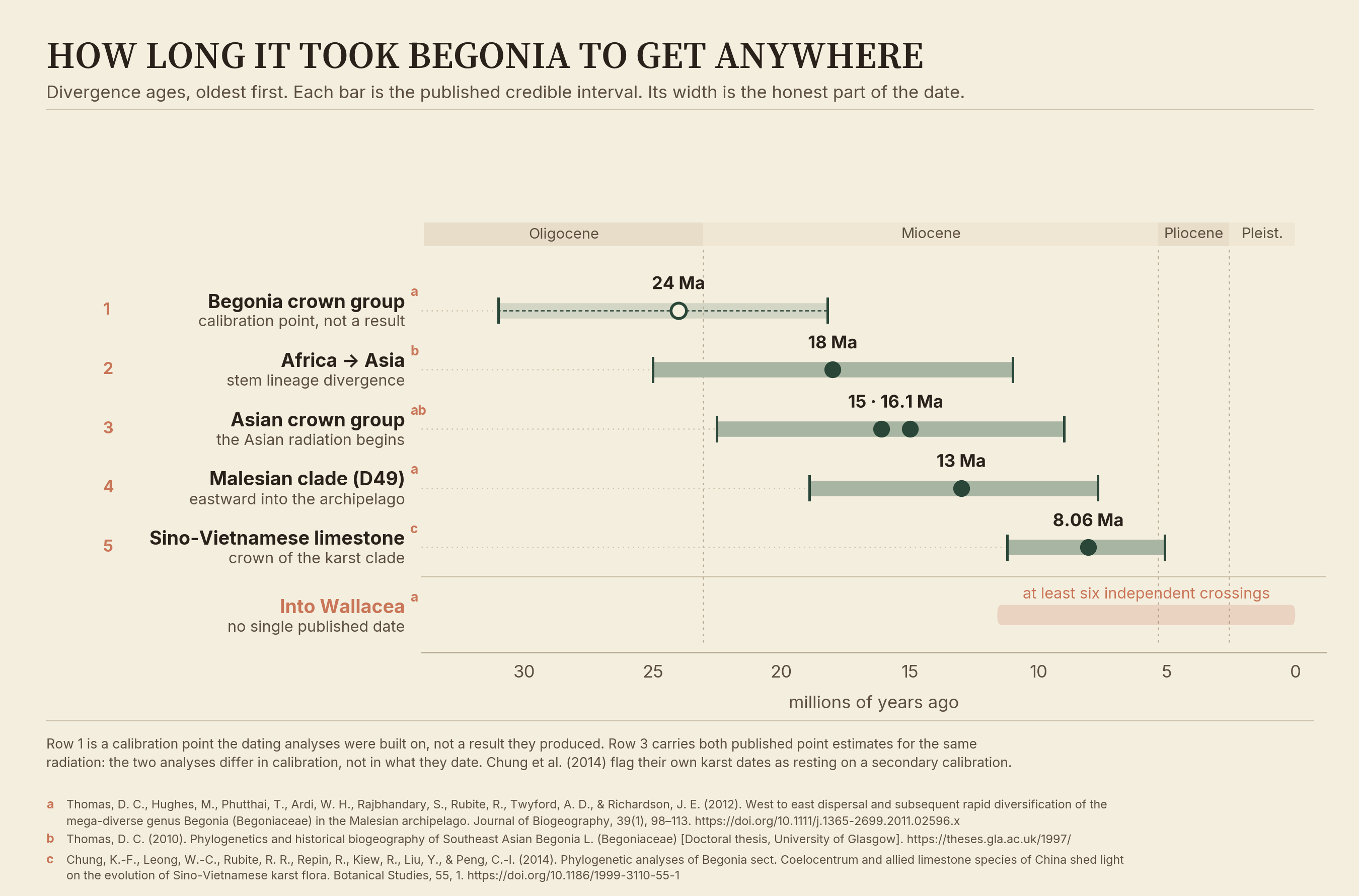
The dating puts the move from Africa to Asia in the early to middle Miocene, the epoch that ran from about 23 to 5.3 million years ago. The lineage that holds the Asian and Socotran begonias split from its African relatives about 18 to 20 million years ago. That's the stem age, the point where a lineage first branches off from its nearest living relatives. It began splitting internally about 15 to 16 million years ago. That's its crown age, the point where the surviving members started splitting from each other. Both figures depend on which calibration the analysis used (Thomas, 2010).
Treat those numbers loosely. The published 95% intervals run roughly 12 to 16 million years wide, and the authors say plainly how uncertain the dates are (Chung et al., 2014; Thomas, 2010).
How they got across is still open. Thomas reviews two ideas raised in earlier work: a long-distance jump, or an overland route through Arabia when it was wetter than it is now. He leans against the overland route, since most living Asian begonias need shady, humid habitats (Thomas, 2010).
West to East Across Malesia
Once on the Asian mainland and the Indian subcontinent, begonias diversified through the Miocene and then spread into Malesia, the region running from the Malay Peninsula through Indonesia, Borneo and the Philippines to New Guinea. Most of the movement ran west to east (Thomas, 2010).
Thomas found at least four separate crossings into Wallacea, the belt of islands (Sulawesi, the Moluccas and the Lesser Sundas) between the Asian and Australian continental shelves. Wallacea was never joined to either shelf by land, even when ice-age sea levels were at their lowest. All four crossings fall within the last 10 million years: one in the late Miocene, one in the Pliocene and two in the Pleistocene (Thomas, 2010). That also means begonias crossed Wallace's Line, the classic boundary between Asian and Australian animals, at least four times.
Thomas's phrase for those seas is worth quoting. The waters between the Sunda Shelf and Wallacea have been "distinct, yet porous barriers to dispersal in Begonia" (Thomas, 2010, p. 117). Begonias got across, rarely, and each arrival had room to found something new.
Section Petermannia shows what one of those arrivals can turn into. It began in western Malesia and spread to Wallacea, New Guinea and the Philippines. Thomas counted more than 270 species in it in 2010 (Thomas, 2010), and a 2025 preprint, working from figures in the Begonia Resource Centre, puts it at about 434 (Campos-Dominguez et al., 2025). Its lineages diversified fast from the Pliocene, peaking in the Pleistocene, while mountains were rising on Sulawesi and New Guinea and the ice ages swung sea level and climate back and forth (Thomas, 2010). New mountains meant new habitats, and new barriers between populations that were already slow to cross them.
Which brings us back to Australia. Begonias crossed Wallace's Line, reached New Guinea, the Solomons and Fiji, and never established in Australia. None of the studies we worked from explains why, and we won't invent a reason.
The Seed Problem
Begonia seeds are dust seeds, usually about 0.01 to 0.02 inch long (0.3 to 0.6 mm), at roughly 850,000 to 2 million to the ounce (30,000 to 70,000 per gram). A single winged capsule can hold hundreds to thousands of them (Thomas, 2010). They look built for travel, but mostly they don't travel far.
Thomas describes dispersal in Begonia as predominantly by wind, though rain-wash and animals seem to play a bigger part in many African species. In the wind-dispersed species the capsule dries papery and winged, and seed trickles out through slits along the wings whenever wind shakes it. The catch is where most Asian begonias grow: the sheltered, moist ground layer of the forest, where wind is unlikely to carry seed far (Thomas, 2010).
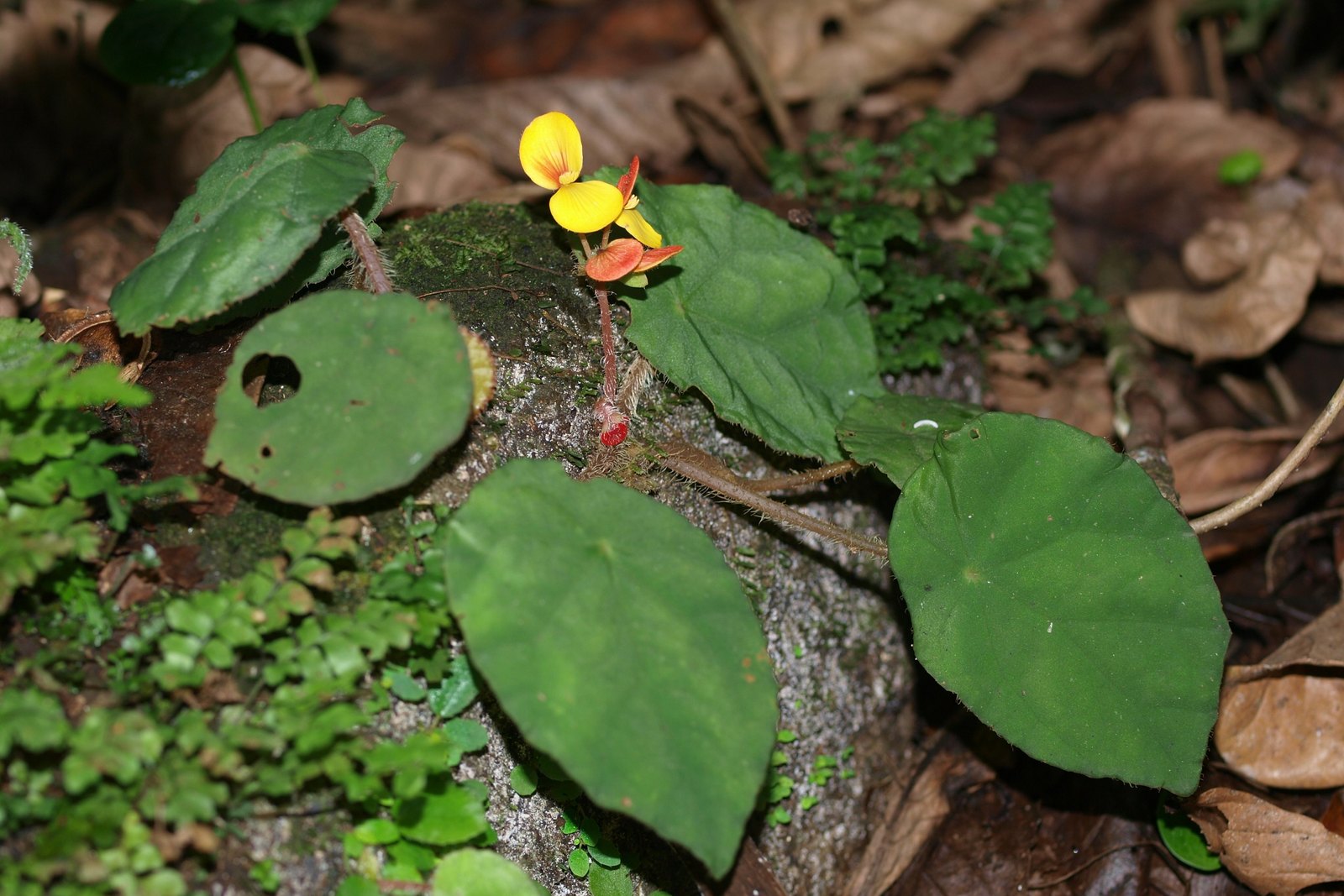
Some Asian begonias use rain instead. Most species in section Platycentrum, and some in Parvibegonia, have a curved fruit stalk that turns the capsule into a splash cup. A raindrop lands, the capsule bounces, and seed shakes out (Thomas, 2010).
Animals are the third option, and the literature is careful here. Some Asian begonias have fleshy fruits, the shape you'd expect from a plant that animals eat and spread. As of 2010, though, no one had recorded animals dispersing Asian begonias. In African species, animal transport seems to be more common (Thomas, 2010).
The genetics fit a plant that stays put. Studies of some begonia species, which Thomas reviews, found strong genetic differences between subpopulations at very local scales, meaning little gene flow between nearby populations (Thomas, 2010).
A Hill Is an Island
Now put a poor traveler into broken country. Across southern China and northern Vietnam runs a belt of karst, limestone worn into hills, caves, fissures and crevices. About a third of China's begonia species, roughly 60, are known mainly from limestone (Chung et al., 2014). The rock itself is a hard place to live: highly alkaline, thin-soiled and quick to dry out. The begonias mostly don't sit on it in the open. They grow in the shaded, humid "twilight zone" of caves and in cave-like cracks and fissures, which Chung and colleagues describe as shelters from the bare rock (Chung et al., 2014).
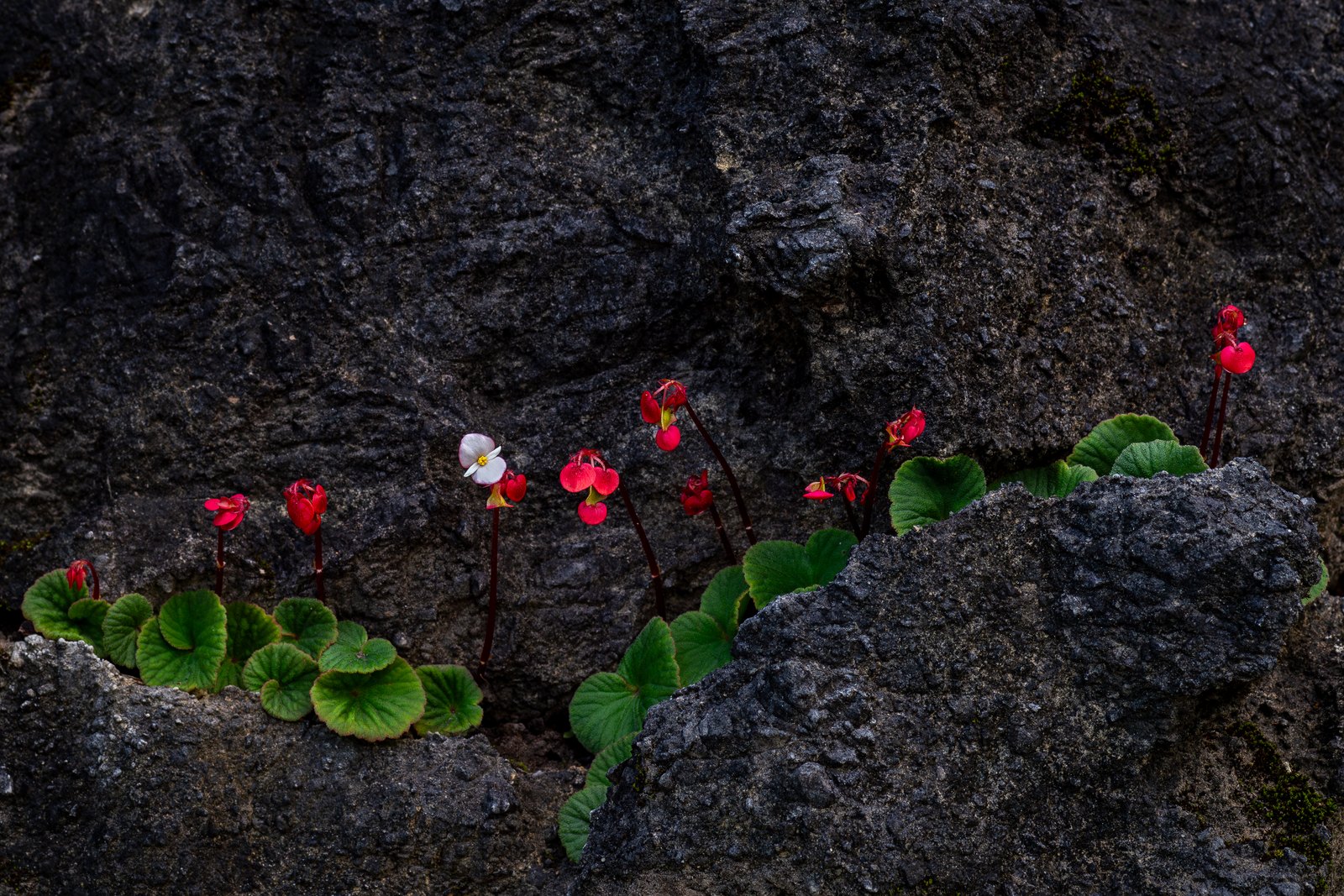
Chung and colleagues sequenced the limestone begonias of this belt. Most of them, the rhizomatous ones, form a single strongly supported clade, a group made up of one ancestor and all its descendants. That points to one move onto limestone for that group. It wasn't the only one: by their reading, Begonia took to these limestone karsts four separate times (or three, if one tuberous lineage later moved back off limestone): twice in tuberous, deciduous species, once in an upright-stemmed species and once in the ancestor of the big rhizomatous group. That last one is the lineage that took off (Chung et al., 2014). The pattern repeats elsewhere. A 2026 preprint finds three separate moves onto limestone among the begonias of Peninsular Malaysia (Kiew et al., 2026).
They dated the crown of the big rhizomatous group to about 8 million years ago, with a range of about 5 to 11 million, and note that their dates rest on calibrations borrowed from earlier studies (Chung et al., 2014).
The interesting part is how the group got so big. The authors call it a non-adaptive radiation. In an adaptive radiation, one lineage splits into many species by moving into many different ways of life. In a non-adaptive one, the species all live the same way in the same kind of place, and geography is what keeps them apart long enough to diverge. These begonias differ mainly in leaf traits. Studies of begonia leaf variegation have found no apparent adaptive differences, though the authors say the non-adaptive nature of leaf shape in this group still needs testing (Chung et al., 2014). Many species, one niche.
The timing matters too. Karst formation in the region, driven by the East Asian monsoon from the late Miocene, was extensive and continuous, and the crown age of the group lines up with its most extensive stage. Cave shelters kept collapsing and forming. So the country kept breaking into new fragments while these begonias were radiating (Chung et al., 2014). The authors argue that this mode of speciation is underappreciated as a way species pile up fast in poor dispersers tied to one habitat.
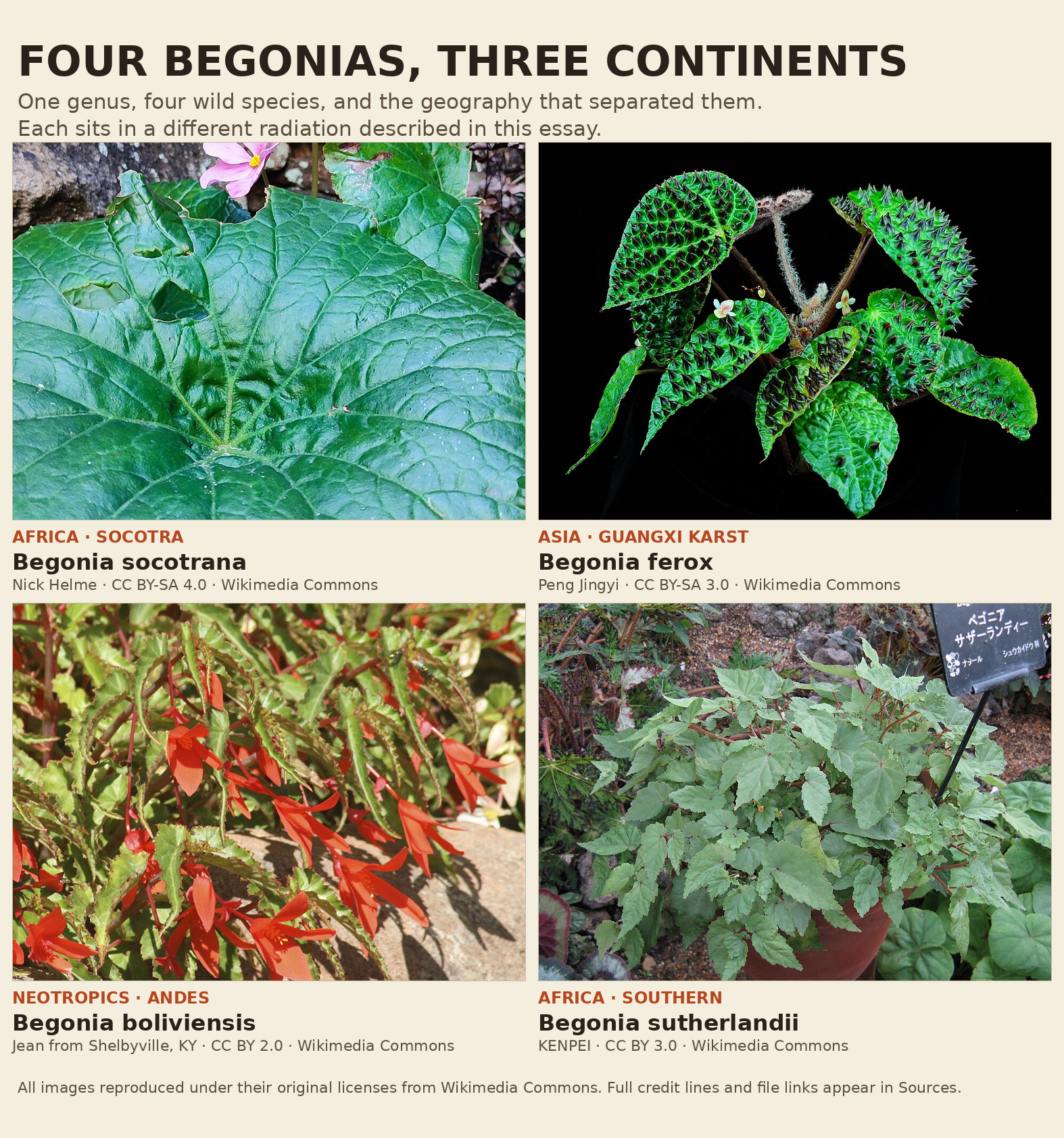
When a description says a species is "known only from the type locality," meaning the one place the specimens that define the species were collected, that often does mean a tiny wild range in this terrain. Chung and colleagues note that site-endemics are very common among these cave plants (Chung et al., 2014). But Peng and colleagues note that inventory of the region's biodiversity is still largely insufficient, so a range recorded today may be incomplete (Peng et al., 2013). Begonia ferox is described in exactly those words: "Known only from the type locality in southwestern Guangxi," found "on limestone rocks with abundant leaf litter or on bare rocky slopes," and "very rare" (Peng et al., 2013).
Socotra, and Why Your Florist Has Winter Begonias
One of the strangest corners of the range is an island in the Arabian Sea. Socotra, off the Horn of Africa, holds two endemic begonias. Begonia socotrana grows only in the granite Haggier mountains and the high limestone plateaus beside them in eastern Socotra. B. samhaensis, described in 2002 from the neighboring island of Samha, numbers fewer than a thousand plants (Hughes & Miller, 2002).
Geography says Africa. The family tree says Asia. In Thomas's chloroplast-DNA tree, the Socotran pair sits inside a well-supported group with the Asian begonias, and its closest relative, Begonia dipetala, grows more than 1,240 miles (2,000 km) away in southern India and Sri Lanka (Thomas, 2010).
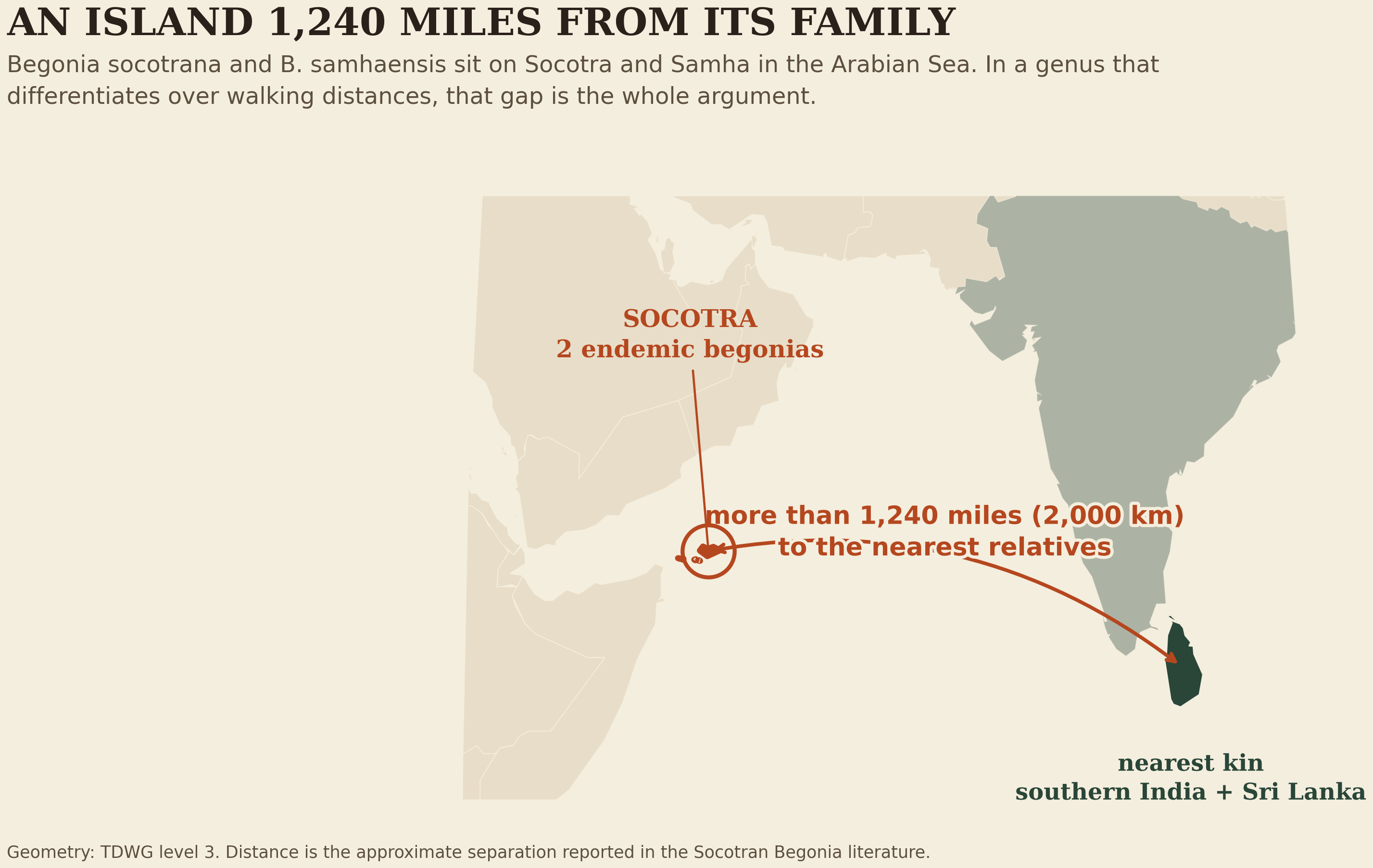
How they got there is still open. In Thomas's tree, Socotra's begonias look like an old, long-isolated lineage. Thomas sets out two explanations: a rare long-distance jump from the southern India and Sri Lanka region, or a once-wider range across drier country to the west that later shrank and left Socotra's plants behind as relics. He calls both scenarios tentative (Thomas, 2010). Hughes and Miller judge B. samhaensis likely to be a relict on Samha rather than a recent offshoot (Hughes & Miller, 2002).
Then horticulture got involved. Begonia socotrana is a strictly short-day plant, meaning it flowers in response to long nights, and that trait made the first winter-flowering cultivars possible (Hughes & Miller, 2002). Crossed with tuberous begonias (Begonia × tuberhybrida), it produced Begonia × hiemalis, the Elatior or Rieger begonias, a crop grown especially for the winter season. In those hybrids, how strongly short days push flowering depends on temperature (Gislerød & Jørgensen, 1986). So the florist begonia on a table at Christmas gets its short-day flowering from a parent that grows wild on Socotra.
What This Means for a Collection
We take three things from all this into our own growing.
The wild range is worth a look before you buy. In our experience, begonias with broad natural ranges tend to cope with ordinary household conditions better than narrow endemics, so we look up a species' wild range before we bring it home. It's a rule of thumb, not a law. Kiew describes Begonia keithii, a Sabah limestone species, growing in light shade or full sun on exposed rock, and expects that its harsh habitat probably makes it easier to cultivate than the forest species of deep shade (Kiew, 2001).
Drainage first, chemistry second. A limestone begonia grows over alkaline rock, but usually in shaded fissures and crevices (Chung et al., 2014), and B. ferox grows on limestone among abundant leaf litter (Peng et al., 2013). A 2026 preprint, citing a personal communication, reports that Peninsular Malaysia's limestone begonias are not obligate limestone plants: they grow on other media as long as the mix drains freely, though watering with a weak calcium carbonate solution markedly improves their growth (Kiew et al., 2026). When a limestone species struggles, we check drainage and humidity before we suspect pH.
The conservation stakes are concentrated. Many limestone begonias live on a single hill. Of the 18 begonias Kiew records from limestone in Sabah, 12 are known from single hills. The biggest threat there is fire, which spreads more easily once the surrounding forest has been disturbed, and some hills are quarried for cement, marble and road metal (Kiew, 2001). Begonia keithii is known from Batu Tengar, one of the hills Kiew lists as under threat from cement quarrying (Kiew, 2001). Many of these limestone plants are also highly ornamental and have long been exploited commercially (Chung et al., 2014). We think growing them well, and propagating them freely rather than hoarding them, is a small piece of conservation.
The Takeaway
From far away, Begonia looks like a champion traveler: three continents, more than two thousand species, tropics all the way around. Up close it's one of the most parochial genera in cultivation. Its seeds rarely travel far, and in some species the populations drift apart over short distances (Thomas, 2010). Its long crossings, from Africa to Asia and into Wallacea, happened rarely, and each one had room to found something new. Researchers have offered several explanations for the genus's size, including hybridization and doubled chromosome sets (Li et al., 2022). One of them is that it travels badly: in fragmented habitats, populations cut off from one another can drift apart into new species. Thomas proposes this for Asian begonias, and Chung and colleagues describe it in the limestone group (Chung et al., 2014; Thomas, 2010). Two thousand species is what you get when a plant that stays put spends twenty-odd million years in broken country.
We review our essays against the research available at the time, and we correct them when a source doesn't say what we took it to say or when we can't find support for a point. In this review we corrected our account of when and how often begonias spread, including where Socotra's begonias came from, and our species counts, the conditions limestone species grow in, what a single-hill record tells you, and how the winter-flowering hybrids came about and what controls their flowering. We also fixed points we'd credited to sources that don't make them, replaced illustrative images with photographs, and removed claims we couldn't source.
Go deeper in the free Apprenticeship: Module I, How a Plant Works →
Brummitt, R. K. (2001). World geographical scheme for recording plant distributions (2nd ed.). Hunt Institute for Botanical Documentation. Map geometry: https://github.com/tdwg/wgsrpd
Campos-Dominguez, L., Kongsted, T. E., Cure, L., Downie, M., Martinez-Martinez, A., Fan, C., Dong, L.-N., Tseng, Y.-H., Hu, A.-Q., Chung, K.-F., Pellicer, J., Leitch, I. J., Bombarely, A., Twyford, A. D., & Kidner, C. A. (2025). Genome dynamics across the radiation of a mega-diverse genus [Preprint]. bioRxiv. https://doi.org/10.1101/2025.09.17.676772
Chung, K.-F., Leong, W.-C., Rubite, R. R., Repin, R., Kiew, R., Liu, Y., & Peng, C.-I. (2014). Phylogenetic analyses of Begonia sect. Coelocentrum and allied limestone species of China shed light on the evolution of Sino-Vietnamese karst flora. Botanical Studies, 55, 1. https://doi.org/10.1186/1999-3110-55-1
Gislerød, H. R., & Jørgensen, S. (1986). The culture of Elatior-begonia. North Carolina Flower Growers’ Bulletin, 30(6). NC State Extension HortScans. https://hortscans.ces.ncsu.edu/uploads/t/h/the_cult_53e1081acf2f9.pdf
Govaerts, R., Nic Lughadha, E., Black, N., Turner, R., & Paton, A. (2021). The World Checklist of Vascular Plants, a continuously updated resource for exploring global plant diversity. Scientific Data, 8, 215. https://doi.org/10.1038/s41597-021-00997-6 (data: WCVP bulk download, Royal Botanic Gardens, Kew, June 2026)
Hughes, M., & Miller, A. G. (2002). A new endemic species of Begonia (Begoniaceae) from the Socotra archipelago. Edinburgh Journal of Botany, 59(2), 273–281. https://www.rbge.org.uk/media/8084/hughes-miller-2002-a-new-endemic-species-of-begonia-begoniaceae-from-the-socotra-archipelago.pdf
Kiew, R. (2001). The limestone begonias of Sabah, Borneo: Flagship species for conservation. Gardens’ Bulletin Singapore, 53, 241–286. https://www.nparks.gov.sg/sbg/research/publications/gardens-bulletin-singapore/-/media/sbg/gardens-bulletin/4-4-53-1-2-07-y2001-v53-p1-p2-gbs-pg-241.pdf
Kiew, R., Fareed, F. S., Foong, L. C., & Tam, S. M. (2026). Comparative phylogenetic analyses of limestone and non-limestone Begonias in Peninsular Malaysia [Preprint]. bioRxiv. https://doi.org/10.64898/2026.09.10.750513
Li, L., Chen, X., Fang, D., Dong, S., Guo, X., Li, N., Campos-Domínguez, L., Wang, W., Liu, Y., Lang, X., Peng, Y., Tian, D., Thomas, D. C., Mu, W., Liu, M., Wu, C., Yang, T., Zhang, S., Yang, L., … Liu, H. (2022). Genomes shed light on the evolution of Begonia, a mega-diverse genus. New Phytologist, 234(1), 295–310. https://doi.org/10.1111/nph.17949
Moonlight, P. W., Baldaszti, L., Cardoso, D., Elliott, A., Särkinen, T., & Knapp, S. (2024). Twenty years of big plant genera. Proceedings of the Royal Society B, 291(2023), 20240702. https://doi.org/10.1098/rspb.2024.0702
Peng, C.-I, Yang, H.-A., Kono, Y., Chung, K.-F., Huang, Y.-S., Wu, W.-H., & Liu, Y. (2013). Novelties in Begonia sect. Coelocentrum: B. longgangensis and B. ferox from limestone areas in Guangxi, China. Botanical Studies, 54, 44. https://doi.org/10.1186/1999-3110-54-44
Royal Botanic Gardens, Kew. (2026). Begonia L. Plants of the World Online. Retrieved September 30, 2026, from https://powo.science.kew.org/taxon/urn:lsid:ipni.org:names:327437-2
Thomas, D. C. (2010). Phylogenetics and historical biogeography of Southeast Asian Begonia L. (Begoniaceae) [Doctoral thesis, University of Glasgow]. https://theses.gla.ac.uk/1997/


