California Natives · No. 04
Toyon: The California Holly That Needed a State Law to Save It
A field guide to Heteromeles arbutifolia, the chaparral evergreen whose Christmas berries fed Indigenous Californians for ten thousand years, drew so much holiday vandalism in the 1920s that the state legislature passed Penal Code 384a, and still feeds cedar waxwings and robins through January.
On this page
13 sections
About the Plant
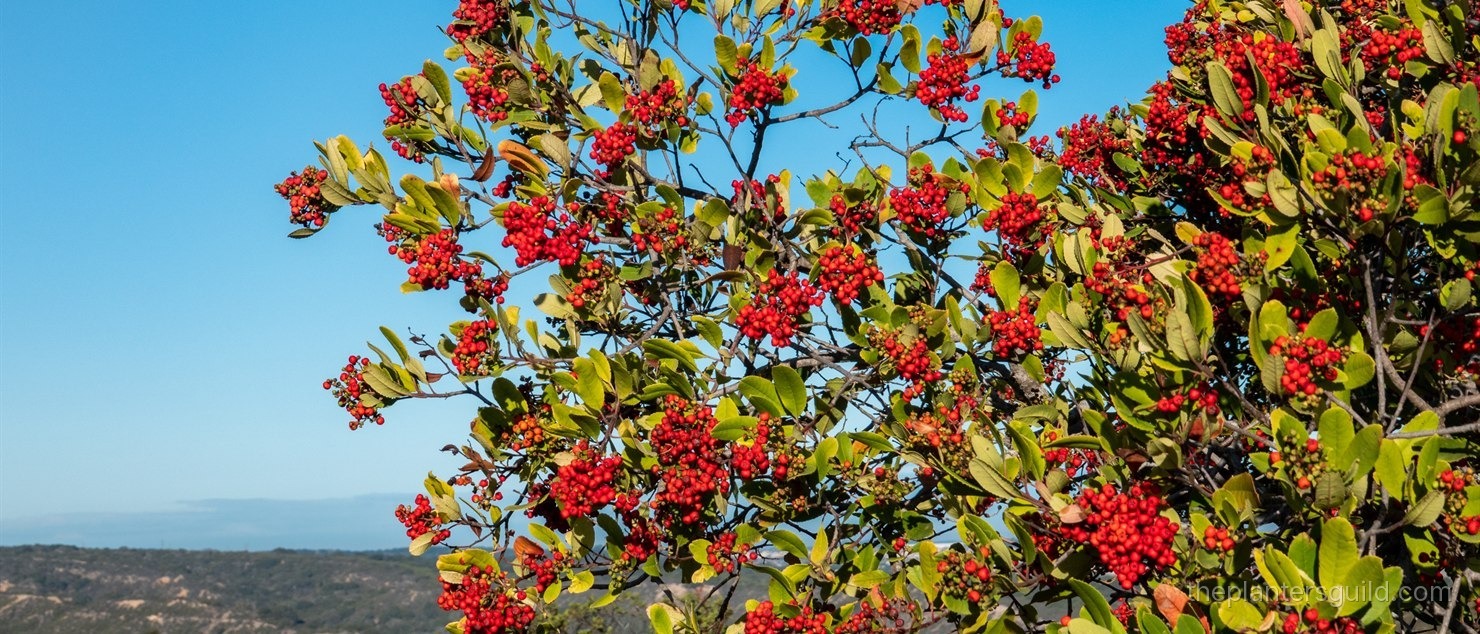
Walk into the chaparral (California's evergreen drought-adapted shrubland of hard-leaved shrubs) in November and the hillside lights up. Bright red clusters the size of marbles, hung in dense bunches against dark serrated evergreen leaves, scattered across the dry slopes the way scarlet pyracantha gets scattered across suburban driveways. That's toyon. The same plant sold as California holly at Christmas, cooked into Christmas berry, and known as ashuwet to the Tongva and Cahuilla and qwe' to the Chumash, who were eating it for ten thousand years before any of the rest of the names existed.
Toyon (Heteromeles arbutifolia) is the only species in its genus. It sits in Rosaceae, the rose family, on the same branch as apples, hawthorns, pears, and almonds. The small red fruits are technically pomes (small apple-like fruits with seeds in a chambered core) rather than true berries. In everyday conversation, "berry" is the word everyone uses, and we will too.
The reason most people end up here, though, is the story. In the early 1920s, families across Los Angeles and the Bay Area figured out they could harvest toyon branches by the truckload from the public hillsides above their cities and either decorate their own homes or sell the cuttings on the corner. Wild populations crashed inside a single decade. The California State Legislature responded in 1921 with a law specifically protecting California holly (toyon) on public lands. That protection got broadened and codified into the modern statute over the following years and is now California Penal Code § 384a, which makes it a misdemeanor to cut or remove plant material from public land or from anyone else's land without written permission (California Penal Code, 1923/2016). More on that below.
What You're Looking At
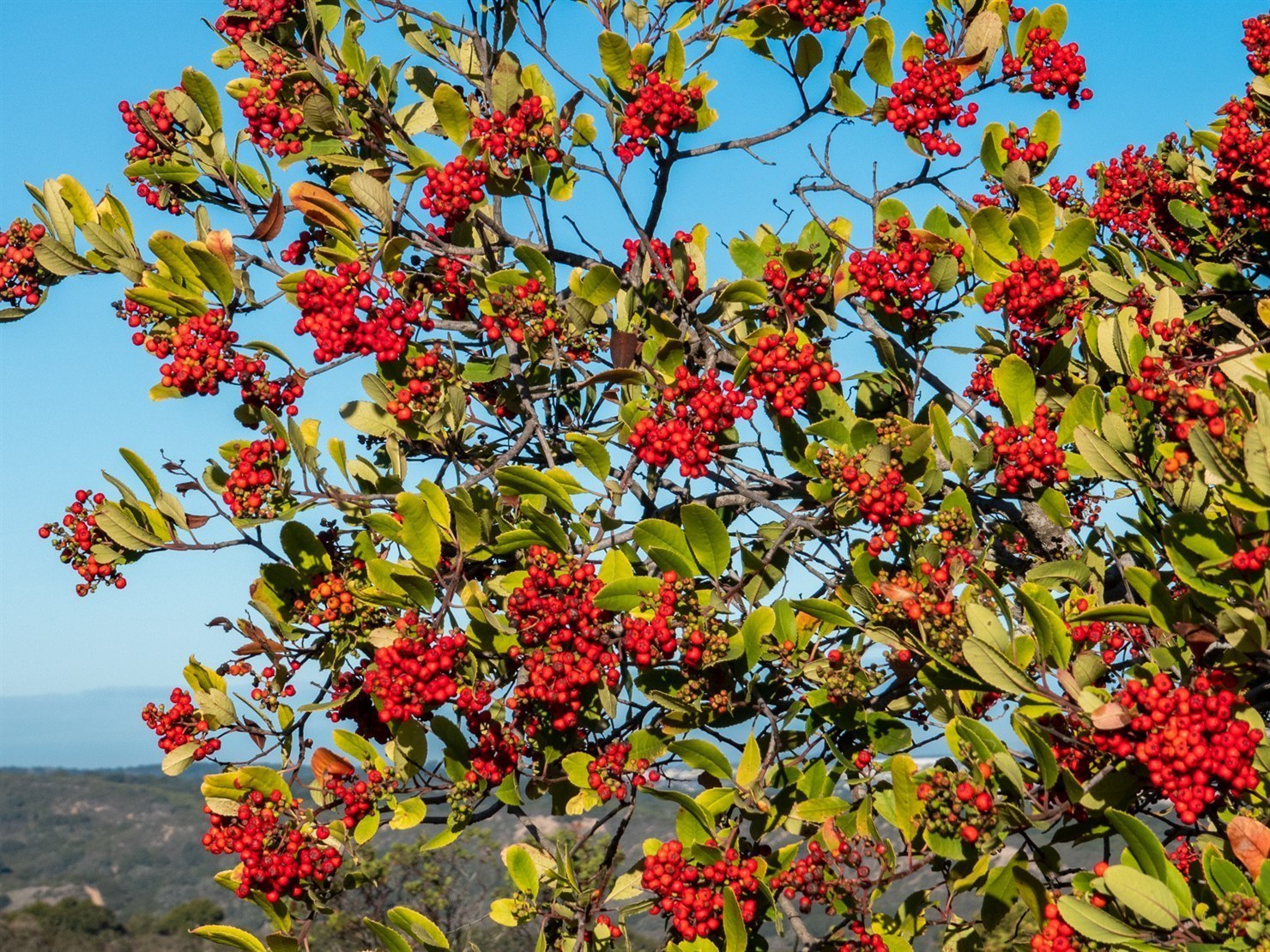
A mature toyon is a large evergreen shrub or a small multi-trunked tree, typically six to fifteen feet tall (two to five meters), occasionally reaching twenty-five feet over decades in a shaded canyon (Phipps, 2014). The leaves are leathery, dark green, and arranged alternately along the stem (single leaves staggered up the stem, not paired across from each other), about two to four inches long (5 to 10 cm), with sharply toothed margins that look almost saw-edged up close. They stay on the plant year-round.
The flowers open in May and peak through June. They are small (about ¼ to ⅜ inch across, 6 to 10 mm), white, five-petaled, and arranged in flat-topped clusters called corymbs (rounded or flat-topped flower clusters where the outer flowers sit on longer stalks than the inner ones, so the whole cluster makes a single plane). The scent is hawthorn-like, slightly musky, and not everyone finds it pleasant. The bees do not care.
Then the show. By October the spent flowers ripen into bright red pomes about ¼ to ⅜ inch across (6 to 10 mm), hung in dense clusters where the corymbs were. The fruit holds on the plant from October through January in a normal year, longer in a cool one, far shorter once the birds find it.
Where It Comes From
Toyon belongs to the California Floristic Province, the botanical region with one of the highest concentrations of plants found nowhere else on Earth. Its native range extends from extreme southwestern Oregon south through California and well into the Baja California Peninsula. Within California, it is a prominent component of three habitat types: chaparral, coastal sage scrub (the lower-elevation soft-leaved aromatic shrubland that fringes the coast), and mixed oak woodland (open woodland dominated by California's native oaks, with a grass or shrub understory) (Phipps, 2014).
Read the habitat and the plant's preferences come into focus: well-drained slopes, rocky or decomposed-granite soils, full sun or canyon-edge dappled shade, winter rain and bone-dry summers. Toyon evolved in a fire-cycled landscape, meaning one where periodic wildfire is part of the normal ecological rhythm and the plants are adapted to it. It resprouts vigorously from a root crown (the woody base of the plant at soil level, where stems meet roots) after a burn. Its leaves hold high moisture content even in late summer, which makes it one of the less fire-prone chaparral shrubs. No shrub in a Mediterranean-climate region (winter rains, dry summers) should be treated as fireproof, but toyon is closer to that end of the spectrum than most.
The Mistake Most People Make
Two mistakes, and they are usually made together. The first is summer water. People plant toyon, see it sulk in its first summer (because every chaparral native sulks in its first summer), and start watering. By year three the plant has either rotted out at the crown or developed weak floppy growth and become susceptible to fire blight, a bacterial disease (caused by Erwinia amylovora) that is the standard pathogen of overwatered, overfed Rosaceae plants.
The second is shearing. Toyon flowers, and therefore fruits, on the previous year's growth. Hedge-trimming the plant into a tight ball every spring removes the wood that would have carried this winter's berries. The result is a green meatball with no berry display and no value to birds.
The fix in both cases starts with siting. Put it where you actually want a fifteen-foot shrub, because that's what you're going to get. Water it deeply once a week through year one, then turn the irrigation off and don't turn it back on. If you have to prune, do it lightly in early summer right after flowering, taking individual branches back to their points of origin rather than clipping the canopy into a shape.
Sun
Full sun is ideal. Six or more hours of direct light produces the densest canopy and the heaviest berry crop. Toyon will tolerate two or three hours of afternoon shade inland and will grow taller (and leggier, meaning spindly with longer gaps between leaves) in a shaded canyon setting, but the berry display drops in proportion to the light.
Water
Through year one, water deeply once a week through the dry season. Two or three gallons applied slowly at the dripline (the outer edge of the leaf canopy, where rainwater naturally drips off the leaves and where most of the actively absorbing roots are concentrated) is enough. From year two forward, an established plant wants nothing. The most common way people kill a healthy toyon in its third or fourth year is tap water from a summer-running sprinkler system. If it lives next to a lawn, run the irrigation around it, not over it.
In a wet winter, toyon takes whatever rain falls and goes about its business. In a dry winter, an established plant still does not need supplemental water; the deep root system reaches moisture other plants cannot.
Soil
Well-drained, lean, on the alkaline side of neutral (soil pH slightly above 7). Decomposed-granite slopes (the sandy, fast-draining substrate of weathered granite that covers many California foothills), rocky hillsides, coarse loams (soils with a roughly even mix of sand, silt, and clay, on the sandy side), gravelly clay-loams. Toyon will struggle in heavy adobe clay without active drainage, which means siting on a slope, building a raised berm (a low mound of soil that lifts the root zone above wet ground), or picking a different species (the Bay Area's South Bay flats are toyon-hostile without intervention). Don't mix compost or fertilizer into the planting hole. The plant is built for poor soil and underperforms in rich soil.
Hardiness
USDA (United States Department of Agriculture) hardiness zones 7 through 10. Mature plants reliably tolerate temperatures down to about 10 °F (−12 °C), with reports from sheltered sites of survival closer to 5 °F (−15 °C); the 10 °F figure is the safer planning number, and local microclimates (small pockets of distinct local climate within a larger region, like a frost-pocket valley or a south-facing courtyard) move it either way. Every California microclimate is well within range, and the plant is appropriate across most of the coastal Pacific Northwest and the Mediterranean climates of the Mediterranean Basin itself, where it has been cultivated as an ornamental as far north as southern England.
One Honest Caveat: The Flowers Smell Strange
The June flower flush has a scent that some people find pleasant in a hawthorn-meadow sort of way and some people find vaguely fishy. It is genuinely strange. If your toyon is in full bloom and a visitor asks what the smell is, that is the smell. Plant the shrub more than fifteen feet from a deck or a bedroom window if you garden with the windows open, and the question never comes up. The bees and the early-summer flies that pollinate the plant are not bothered.
The other honest thing to know, given how much of this article is about berries: a healthy mature toyon can produce a berry crop that lasts from October through January, but in a year when the cedar waxwings arrive in number, the entire crop can be stripped in three or four days. There is no preventing it. The berries are for the birds. The November-to-January display is for you only until the flock arrives.
Sourcing and Planting Window
Plant October through January, with November and December the sweet spot. Fall planting lets the root system establish through the entire winter rainy season before the plant has to face its first dry summer.
Source from a California Native Plant Society chapter sale. In the Bay Area that means the Santa Clara Valley chapter, the East Bay chapter, and the Yerba Buena chapter in San Francisco. California-native specialty nurseries carry toyon year-round in one-gallon and five-gallon sizes; the one-gallon often establishes faster than the five-gallon (smaller root balls root out into native soil more quickly, given good nursery stock and a clean planting) and costs a third as much. For a long-lived chaparral native that you are putting in for decades, the smaller pot is usually the right call.
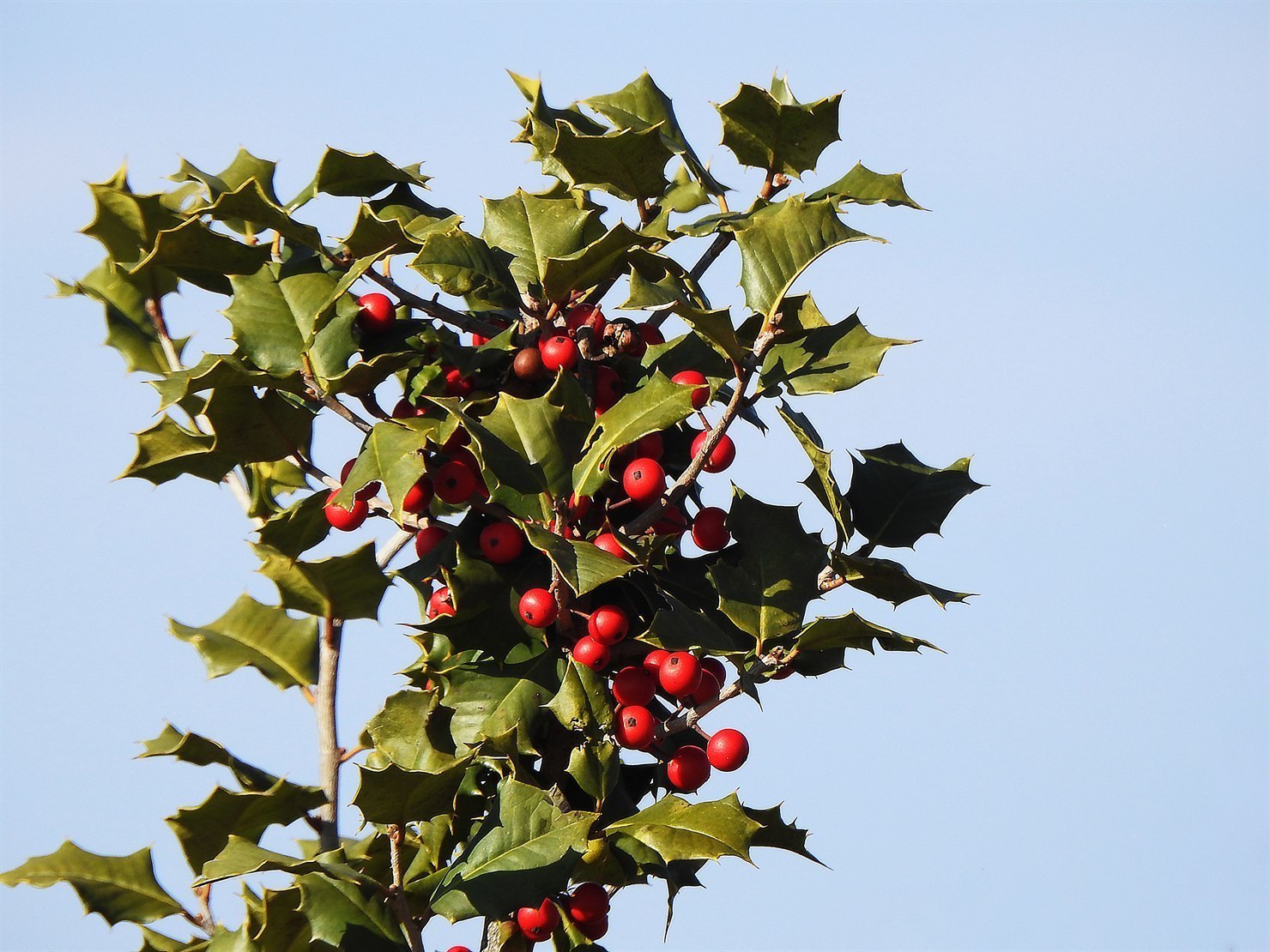
Ask by Latin name. "California holly" gets used as a label for English holly (Ilex aquifolium) often enough at chain nurseries that the common name has stopped being a reliable signal. English holly is a Northern European tree in a different family (Aquifoliaceae), it's invasive in parts of the Pacific Northwest, and it's not what you want. Heteromeles arbutifolia is.
The Christmas Berry Story
The reason the law had to be passed in 1921 is the reason the plant still matters today.
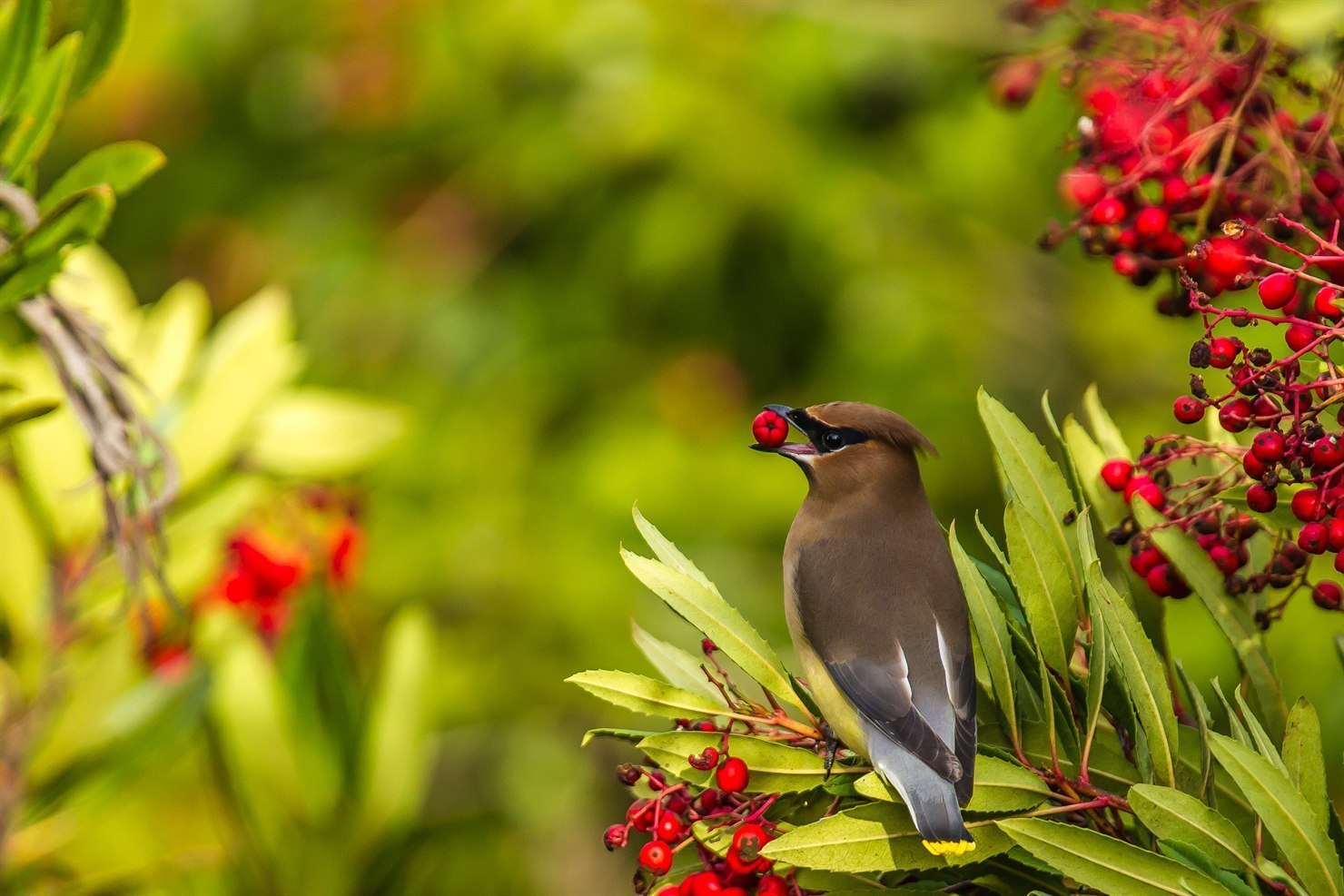
In a California winter, almost nothing else fruits. The poppies are long gone. The buckwheat has dried to rust. The grasslands have gone tan. Cedar waxwings (Bombycilla cedrorum) and American robins (Turdus migratorius) move through the landscape in flocks of fifteen to forty, looking for fruit, and they find toyon. Hermit thrushes and Northern mockingbirds also use toyon as a winter food source (Hawkes, 2016), and Western bluebirds and Black-headed grosbeaks work the same plant on overlapping schedules (Bornstein, Fross, & O'Brien, 2005). When the waxwing flocks arrive, they strip a shrub in days. The seeds pass through the gut and get dropped, often miles away, in scat that fertilizes the new seedling.
This is what the berries evolved to do. The bright red is advertising; the timing is calibrated to the migratory and resident birds that move through California in midwinter; the cyanogenic glycosides in the leaves and unripe fruit (plant defense compounds that release small amounts of hydrocyanic acid when broken down by digestion) discourage most herbivores from eating the plant in summer when the seeds are not yet ready (Wang et al., 2016). Indigenous Californians knew this. The Chumash, Tongva, Tataviam, and Cahuilla ate the berries after parching them over a fire, boiling them, or burying them in earth ovens for two to three days, all techniques that drive off whatever cyanogenic compounds are present and leave a tart, mealy fruit roughly comparable to a small dry apple (Wang et al., 2016).
Analytical reports of cyanogenic compound levels in toyon vary between studies; some samples test low or undetectable, others measurable. The traditional precaution is still the right one. Do not eat toyon berries raw. If you want to try them as food, process them the way the Chumash and the Tongva did: parch them over a fire, boil them, or cook them in an earth oven before eating.
What the 1920s collectors discovered was that the branches travel well and look spectacular over a mantelpiece for two weeks. What the legislature noticed, by 1921, was that the species was vanishing from the public hills where Californians had always seen it. Penal Code 384a is what came out of that. It's one of the oldest active native-plant protection statutes in the country, and it covers every California native, not just toyon. The Los Angeles City Council made toyon the official native plant of the City of Los Angeles on April 17, 2012, almost a century to the day after the law that saved it.
Put one in your yard and the rest takes care of itself. The waxwings already know the route. The law is already on the books. You're just adding a stop.
Quick Reference
- Sun: Full sun preferred; tolerates light afternoon shade inland.
- Water: Year 1 weekly deep water; established plants want nothing through summer.
- Soil: Well-drained, lean. Tolerates rocky and decomposed-granite slopes; struggles in heavy adobe clay without drainage.
- Hardiness: USDA zones 7 to 10; hardy to about 10 °F.
- Bloom: Small white flowers in flat-topped clusters, peak in June.
- Berry: Bright red pomes, ripen October–December, persist into January or until birds strip them.
- Size: Typical 6 to 15 ft (2–5 m); can reach 25 ft in shaded canyon settings over decades.
- Habit: Large evergreen shrub or small multi-trunk tree. Slow first 2–3 years; long-lived after.
- Plant in: October through January, before the first dry summer.
- Source from: Local California Native Plant Society chapter sales; California-native specialty nurseries; ask by Latin name (Heteromeles arbutifolia).
- What to avoid: Summer water on established plants; heavy shearing; eating the berries raw; chain-nursery 'holly' that turns out to be English holly (Ilex aquifolium).
The Takeaway
Toyon is the closest thing California has to a state Christmas tree, and one of the few chaparral natives that hands you a flush of bright red against dark evergreen leaves in November, when the rest of the garden has gone brown. Site it on a well-drained slope in fall, water deeply once a week through year one, then turn the irrigation off and leave it alone. Year two it's a tough drought-tolerant anchor. Five years in, it's a small tree the cedar waxwings have added to their winter route. When a flock finally arrives in early January and clears the entire berry crop in three days, that's not a problem to solve. That's what the berries are for.
Sources
Bornstein, C., Fross, D., & O'Brien, B. (2005). California native plants for the garden. Cachuma Press.
California Native Plant Society. (n.d.). Heteromeles arbutifolia (Toyon). Calscape. Retrieved June 2, 2026, from https://calscape.org/Heteromeles-arbutifolia-(Toyon)
California Penal Code § 384a. (1923, amended through 2016). Cutting, destroying, mutilating, or removing plant material. Retrieved June 2, 2026, from https://leginfo.legislature.ca.gov/faces/codes_displaySection.xhtml?lawCode=PEN§ionNum=384a.
Hawkes, A. (2016, December 22). Ask the Naturalist: How important are red toyon berries to the winter food chain? Bay Nature. https://baynature.org/article/ask-the-naturalist-how-important-are-all-those-red-berries-we-see-to-the-winter-food-chain/
Los Angeles City Council. (2012, April 17). Toyon designated official native plant of the City of Los Angeles (Council File No. 12-0353). Office of the City Clerk. https://clkrep.lacity.org/onlinedocs/2012/12-0353_CA_04-17-12.pdf
Phipps, J. B. (2014). Heteromeles arbutifolia (Lindley) M. Roemer. In Flora of North America Editorial Committee (Eds.), Flora of North America North of Mexico (Vol. 9, p. 437). Oxford University Press. http://floranorthamerica.org/Heteromeles_arbutifolia
Wang, X., Dubois, R., Young, C., Lien, E. J., & Adams, J. D. (2016). Heteromeles arbutifolia, a traditional treatment for Alzheimer's disease, phytochemistry and safety. Medicines, 3(3), 17. https://doi.org/10.3390/medicines3030017