Light
Bright, indirect for green types; bright, filtered light for variegated (patterned) ones. No full sun.
 The Planters' Guild
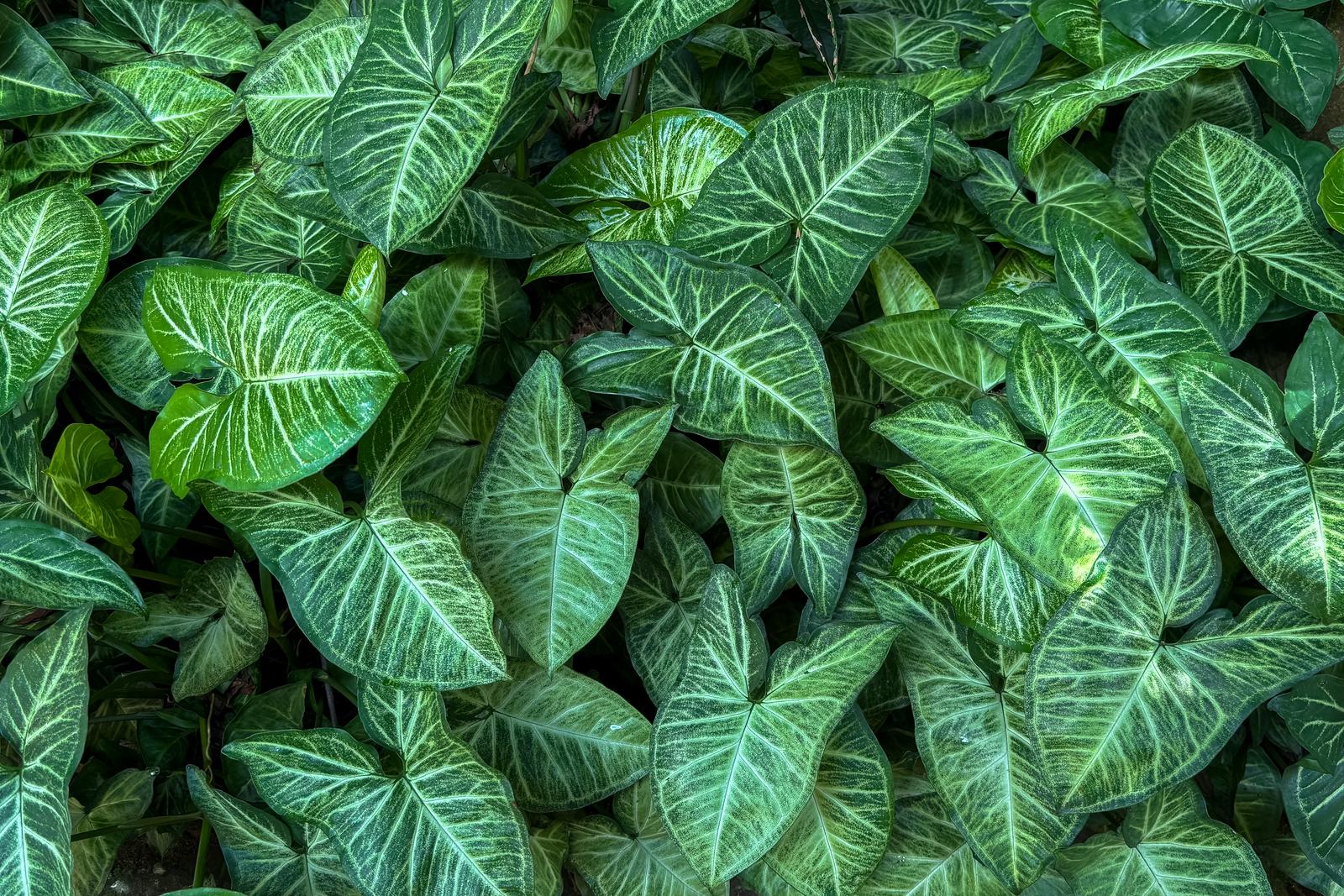 The arrowhead leaf and bright white veining typical of Syngonium podophyllum.
The Planters' Guild
Where they come from. Syngonium is a genus of about 42 climbing aroids native to tropical America, from Mexico south to Bolivia and Brazil, with one species in the Greater Antilles (Plants of the World Online, n.d.; Croat, 1981). An earlier revision of the genus recognized 33 (Croat, 1981). In the wild the seed sprouts in soil and the young plant sits as a small rosette (a low ring of leaves) on the forest floor; once its stem reaches a tree, it climbs, growing thicker and producing larger leaves (Croat, 1981). Leaf shape changes as the plant matures: young leaves are heart- or arrow-shaped, and on a plant allowed to climb, adult leaves divide into 5 to 11 leaflets, so a young plant and a mature one can look like two different things (North Carolina State Extension, n.d.).
Commercial cultivars come largely from Syngonium podophyllum, the arrowhead vine, which is the most widely produced species in the foliage plant trade (Chen et al., 2004). Tissue culture of this species (growing new plants from tiny pieces of tissue) has produced many new cultivars (Chen et al., 2004). For plants grown under glass, the RHS gives green-leaved cultivars bright, indirect light and variegated cultivars bright, filtered light (Royal Horticultural Society, n.d.-a).
The arrowhead vine roots easily from cuttings (Chen et al., 2004) and is low-maintenance indoors (North Carolina State Extension, n.d.). Young plants are shrubby and turn vining with age; give one a totem (a moss pole or other upright support) or trellis if you want it to climb rather than trail (North Carolina State Extension, n.d.; Chen et al., 2004). In Florida it has escaped gardens, and the Florida Invasive Species Council lists it as a Category I invasive; the University of Florida (UF/IFAS) does not recommend it for use there (Khamare & Marble, 2023).
Light. Green-leaved cultivars want bright, indirect light, and variegated ones bright, filtered light (Royal Horticultural Society, n.d.-a). Keep it out of full sun, which tends to burn or bleach the leaves (North Carolina State Extension, n.d.). In low light the stems stretch and grow weak (Chen et al., 2004), and plants grown in a shaded garden can lose their variegation and turn all green (Queensland Poisons Information Centre, n.d.).
Water. Keep it evenly moist: water when the surface of the mix has dried slightly, then let the excess drain, and in winter water less often without letting it dry out (Chen et al., 2004). A mix that runs too dry yellows the older leaves (Chen et al., 2004).
Humidity, warmth, feeding and support. Plants look their best at 40–60% relative humidity (Chen et al., 2004). Keep them at 65–80°F (18–27°C) to hold leaf color; chilling injury can start below 55°F (13°C) (Chen et al., 2004). The RHS gives a winter minimum of 59°F (15°C) (Royal Horticultural Society, n.d.-a). Pot it in houseplant potting mix and feed a balanced liquid fertilizer every 3–4 weeks while it grows (Royal Horticultural Society, n.d.-a). It can trail or climb a moss pole (Royal Horticultural Society, n.d.-b); in the wild, climbing stems produce larger leaves (Croat, 1981).
The pink and cream are cultivar traits, but how strongly they show depends on conditions. Variegated plants grown in a shaded garden can turn all green (Queensland Poisons Information Centre, n.d.). Warmth plays a part too: keeping them at 65–80°F (18–27°C) helps hold leaf color (Chen et al., 2004). In 'Infra-Red', young solid pink leaves mature to solid green (Chen et al., 2004). Give a fading plant bright light, but keep it out of full sun, which can bleach the leaves (North Carolina State Extension, n.d.).
| What you see | Likely cause | What to do |
|---|---|---|
| Faded, greener leaves | In the garden, variegated plants grown in shade can turn all green. In 'Infra-Red', it may be young pink leaves maturing to green | Move it somewhere brighter, but out of full sun. |
| Stretched stems with long gaps | Low light | Give it more light; cut back long stems to keep it bushy. |
| Yellowing older leaves | A mix run too dry, or too little nitrogen | Keep the mix evenly moist and feed regularly. |
| Burned or bleached patches | Full sun | Move it to bright, indirect light. |
| Spider mites or mealybugs | Pests to watch for, though in commercial production they're relatively rare when growers keep the humidity up | Isolate it and see our Field Manual's spider mite guide or mealybug guide. |
The Planters' GuildAll parts of a Syngonium contain calcium oxalate crystals. In people, chewing or eating it can cause salivation and a tingling or burning feeling in the lips, mouth, tongue and throat, then swelling (Queensland Poisons Information Centre, n.d.). Seek urgent medical help if the lips or tongue swell, or if breathing or swallowing becomes hard (Queensland Poisons Information Centre, n.d.). UF/IFAS warns that the sap can cause severe skin burning and eye damage (Khamare & Marble, 2023), and the RHS advises gloves when handling it (Royal Horticultural Society, n.d.-a). The ASPCA's entry covers the arrowhead vine, S. podophyllum, and lists it as toxic to dogs, cats and horses, with "oral irritation, pain and swelling of mouth, tongue and lips," heavy drooling, difficulty swallowing and, in dogs and cats, vomiting (ASPCA, n.d.). Keep them away from children and pets, and keep the sap off your skin and out of your eyes when taking cuttings. If a person eats any part of one, call Poison Control at 1-800-222-1222 in the US or use its online tool for expert help (National Capital Poison Center, n.d.). If you think a pet has eaten any, call your vet or the ASPCA Animal Poison Control Center as soon as you suspect it, without waiting for symptoms (ASPCA, n.d.).
ASPCA. (n.d.). Arrow-head vine (Syngonium podophyllum). Toxic and non-toxic plants. Retrieved October 13, 2026. aspca.org/pet-care/aspca-poison-control/toxic-and-non-toxic-plants/arrow-head-vine
Chen, J., McConnell, D. B., & Everitt, K. C. (2004). Cultural guidelines for commercial production of interiorscape Syngonium (ENH993). UF/IFAS Extension. Retrieved October 13, 2026. edis.ifas.ufl.edu/publication/EP244
Croat, T. B. (1981). A revision of Syngonium (Araceae). Annals of the Missouri Botanical Garden, 68(4), 565–651. Retrieved October 13, 2026. archive.org/download/biostor-12284/biostor-12284.pdf
Khamare, Y., & Marble, C. (2023). Common poisonous houseplant species in Florida (ENH1375). UF/IFAS Extension. https://doi.org/10.32473/edis-ep639-2023
National Capital Poison Center. (n.d.). Poisonous and non-poisonous plants: An illustrated list. Poison Control. Retrieved October 13, 2026. poison.org/articles/plant
North Carolina State Extension. (n.d.). Syngonium podophyllum. North Carolina Extension Gardener Plant Toolbox. Retrieved October 13, 2026. plants.ces.ncsu.edu/plants/syngonium-podophyllum
Plants of the World Online. (n.d.). Syngonium Schott. Royal Botanic Gardens, Kew. Retrieved October 13, 2026. powo.science.kew.org
Queensland Poisons Information Centre. (n.d.). Arrowhead vine (Syngonium). Queensland Health. Retrieved October 13, 2026. poisonsinfo.health.qld.gov.au/plants-and-mushrooms/arrowhead-vine-syngonium
Royal Horticultural Society. (n.d.-a). Syngonium podophyllum. RHS Find a Plant. Retrieved October 13, 2026. rhs.org.uk/plants/17899/details
Royal Horticultural Society. (n.d.-b). Syngonium podophyllum 'Neon Robusta'. RHS Find a Plant. Retrieved October 13, 2026. rhs.org.uk/plants/361707/details
Royal Horticultural Society. (2026). RHS Find a Plant search results for "syngonium". Retrieved October 13, 2026. rhs.org.uk/plants/search-results
Care and range for the genus come from botanical, horticultural and toxicology references; the cards note only what differs. Cultivar details follow UF/IFAS (Chen et al., 2004) and the RHS (Royal Horticultural Society, n.d.-b; Royal Horticultural Society, 2026); species details follow Croat's revision of the genus (Croat, 1981).