Light
Bright, indirect. It turns leggy in lower light.
 The Planters' Guild
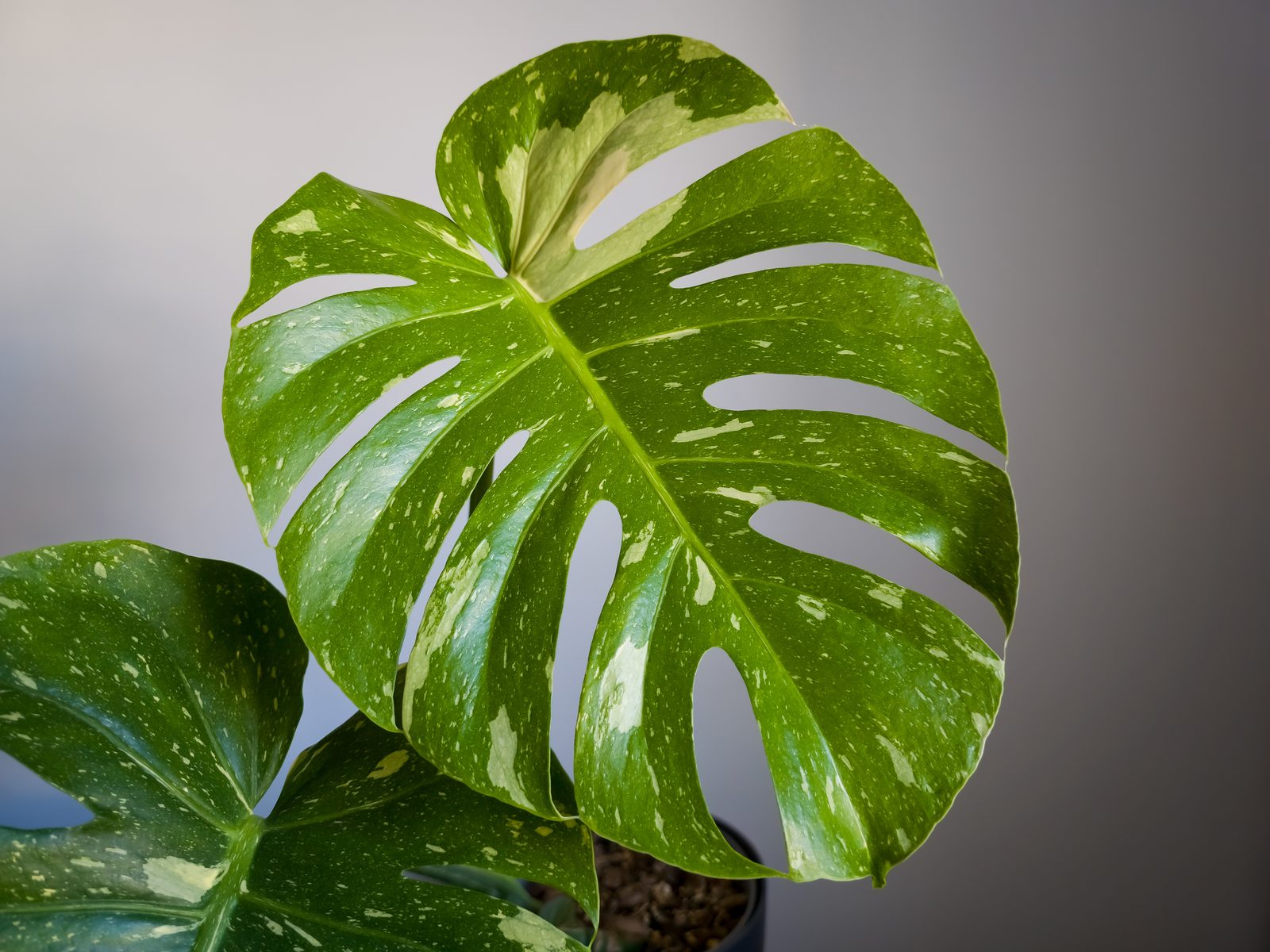 Split, holed foliage, the signature of a mature Monstera.
The Planters' Guild
One rhythm across the genus. Monstera is a genus of about 73 climbing aroids native to the tropical forests of the Americas, from Mexico and the Caribbean down into South America (Plants of the World Online, n.d.). Botanists call them hemi-epiphytes: they start on the ground and climb, rooting onto the lower and middle trunks of trees below the canopy (Madison, 1977). M. deliciosa climbs by aerial roots in search of light, and its leaves become deeply cut and holed as the plant matures (University of Oxford, n.d.).
The commonly grown species want the same things indoors: bright indirect light, a well-draining mix, and something to climb (Marquesen, 2024). Species differ in leaf size and shape, in how early the holes appear, and in variegation (Croat et al., 2024); those differences live on the cards below.
Light. Give it bright light near a sunny window, but out of direct sun (Marquesen, 2024). In lower light it grows leggy, and variegated cultivars need more light than plain green ones (Marquesen, 2024; North Carolina State Extension, n.d.-b). Light shapes the leaves too, though the evidence comes from outdoor plants in Costa Rica: M. deliciosa leaves grown in sun had more hole area than leaves in shade, but were cut just as deeply and were about the same size overall (Díaz-Valverde et al., 2025).
Water. Water thoroughly, then let the top 1–2 inches (2.5–5 cm) dry (Marquesen, 2024); NC State Extension waits for the top quarter to third of the pot (North Carolina State Extension, n.d.-b). Overwatering can rot the roots (Marquesen, 2024).
Humidity, warmth, feeding and support. Aim for humidity above 50% (Marquesen, 2024); the RHS keeps the variegated M. deliciosa 'Variegata' at 60–80% (Royal Horticultural Society, n.d.-a). Keep it at 60–85°F (16–29°C), out of cold drafts (Marquesen, 2024). Growth stops at 50°F (10°C), and about 68°F (20°C) is the preferred minimum (University of Oxford, n.d.). Feed a balanced houseplant fertilizer every two weeks while it grows and monthly in winter (Marquesen, 2024); the RHS feeds M. standleyana monthly in growth (Royal Horticultural Society, n.d.-b). Give it a moss pole or other sturdy support, which keeps the heavy stems from breaking (North Carolina State Extension, n.d.-b); in M. siltepecana, a staked plant makes larger, holed adult leaves (North Carolina State Extension, n.d.-c).
Young Monstera leaves are often entire, with no holes at all (Marquesen, 2024). The splits and holes arrive as the plant matures (University of Oxford, n.d.). The change is linked both to contact with a support and to the plant reaching a certain maturity (Ray, 1990). A plant making small, solid leaves is still in its juvenile phase; in M. siltepecana, staking it so it climbs brings on the larger adult leaves (North Carolina State Extension, n.d.-c).
| What you see | Likely cause | What to do |
|---|---|---|
| Small, solid leaves | A juvenile plant without support | Add a pole; give brighter, indirect light. |
| Brown, crisp edges | Low humidity or uneven watering | Raise humidity; water on a steadier rhythm. |
| Yellowing leaves | Overwatering or underwatering | Check how wet the mix stays; if it is soggy, let it dry more and open the mix with bark. |
| Fine webbing, stippling | Spider mites, which thrive in dry air | Isolate it and follow our Field Manual's spider mite guide. |
| Cottony white tufts | Mealybugs | Follow our Field Manual's mealybug guide. |
The Planters' GuildEvery part of a Monstera holds calcium oxalate raphides, needle-like crystals (Madison, 1977), and every part is toxic if eaten except the fully ripe fruit, which a houseplant rarely makes (Marquesen, 2024). In people, chewing any part can cause burning pain at once, with a swollen mouth, lips, tongue and throat, and the swelling may cause heavy drooling and difficulty breathing, swallowing or speaking (Queensland Poisons Information Centre, n.d.). The sap can irritate skin and eyes, so wear gloves when handling it (Royal Horticultural Society, n.d.-b; Marquesen, 2024). ASPCA's entry for Monstera deliciosa (listed as cutleaf philodendron) says it is toxic to dogs and cats, with oral irritation, intense burning of the mouth, tongue and lips, heavy drooling, vomiting and difficulty swallowing (ASPCA, n.d.). UF/IFAS counts all Monstera species as toxic to dogs, cats and people (Khamare & Marble, 2023). Keep it away from children and pets. If a person eats any of it, call Poison Control at 1-800-222-1222 in the US or use its online tool for expert help (National Capital Poison Center, n.d.). Seek urgent medical help if the lips or tongue swell, or if breathing or swallowing becomes hard (Queensland Poisons Information Centre, n.d.). If you think a pet has eaten any, call your vet or the ASPCA Animal Poison Control Center as soon as you suspect it, without waiting for symptoms (ASPCA, n.d.).
ASPCA. (n.d.). Cutleaf philodendron. Toxic and non-toxic plants. Retrieved October 13, 2026. aspca.org/pet-care/aspca-poison-control/toxic-and-non-toxic-plants/cutleaf-philodendron
Croat, T. B., Cedeño-Fonseca, M., & Ortiz, O. O. (2024). Revision of Monstera (Araceae: Monsteroideae) of Central America. Phytotaxa, 656(1), 1–197. https://doi.org/10.11646/phytotaxa.656.1.1
Díaz-Valverde, V., Avalos, G., & Quesada-Fonseca, J. (2025). Phenotypic differences in sun and shade leaves of Monstera deliciosa (Araceae). Revista de Biología Tropical, 73, e56794. https://doi.org/10.15517/rev.biol.trop..v73i1.56794
Hahn, J., & Weisenhorn, J. (2026). Insects on indoor plants. University of Minnesota Extension. Retrieved October 13, 2026. extension.umn.edu/product-and-houseplant-pests/insects-indoor-plants
Khamare, Y., & Marble, C. (2023). Common poisonous houseplant species in Florida (ENH1375/EP639). UF/IFAS Extension. https://doi.org/10.32473/edis-EP639-2023
Madison, M. (1977). A revision of Monstera (Araceae). Contributions from the Gray Herbarium of Harvard University, 207, 3–100. Retrieved October 13, 2026. archive.org/details/mobot31753002286794
Marquesen, S. (2024, December 13). Monstera as a houseplant. Penn State Extension. Retrieved October 13, 2026. extension.psu.edu/monstera-as-a-houseplant
North Carolina State Extension. (n.d.-a). Monstera adansonii. North Carolina Extension Gardener Plant Toolbox. Retrieved October 13, 2026. plants.ces.ncsu.edu/plants/monstera-adansonii
North Carolina State Extension. (n.d.-b). Monstera deliciosa. North Carolina Extension Gardener Plant Toolbox. Retrieved October 13, 2026. plants.ces.ncsu.edu/plants/monstera-deliciosa
North Carolina State Extension. (n.d.-c). Monstera siltepecana. North Carolina Extension Gardener Plant Toolbox. Retrieved October 13, 2026. plants.ces.ncsu.edu/plants/monstera-siltepecana
Plants of the World Online. (n.d.). Monstera Adans. Royal Botanic Gardens, Kew. Retrieved October 13, 2026. powo.science.kew.org
Queensland Poisons Information Centre. (n.d.). Fruit salad plant (Monstera deliciosa). Queensland Health. Retrieved October 13, 2026. poisonsinfo.health.qld.gov.au/plants-and-mushrooms/fruit-salad-plant-monstera-deliciosa
Ray, T. S. (1990). Metamorphosis in the Araceae. American Journal of Botany, 77(12), 1599–1609. Retrieved October 13, 2026. tomray.me/pubs/botany/Ray1990MetamorphosisInTheAraceae.pdf
Royal Horticultural Society. (n.d.-a). Houseplants for humidity. RHS Urban Show houseplant profiles. Retrieved October 13, 2026. rhs.org.uk/shows-events/rhs-urban-show/houseplant-profiles/houseplants-for-humidity
Royal Horticultural Society. (n.d.-b). Monstera standleyana. Plant details. Retrieved October 13, 2026. rhs.org.uk/plants/386880/monstera-standleyana/details
Steil, A. (2026). Why does my houseplant have brown leaf tips and edges? Iowa State University Extension and Outreach. Retrieved October 13, 2026. yardandgarden.extension.iastate.edu/faq/why-does-my-houseplant-have-brown-leaf-tips-and-edges
University of Oxford. (n.d.). Monstera. Plants 400 profiles, Oxford University Herbaria. Retrieved October 13, 2026. herbaria.plants.ox.ac.uk/bol/plants400/Profiles/MN/Monstera
National Capital Poison Center. (n.d.). Poisonous and non-poisonous plants: An illustrated list. Poison Control. Retrieved October 13, 2026. poison.org/articles/plant
Our genus care and range come from botanical and toxicology references; the cards carry the species details. Species notes follow extension profiles (North Carolina State Extension, n.d.-a; Marquesen, 2024) and the RHS, and problem notes also draw on general houseplant guidance (Hahn & Weisenhorn, 2026; Steil, 2026).