Light
Bright, indirect, for flowering and velvet-leaf types alike. Direct sun can scorch the leaves.
 The Planters' Guild
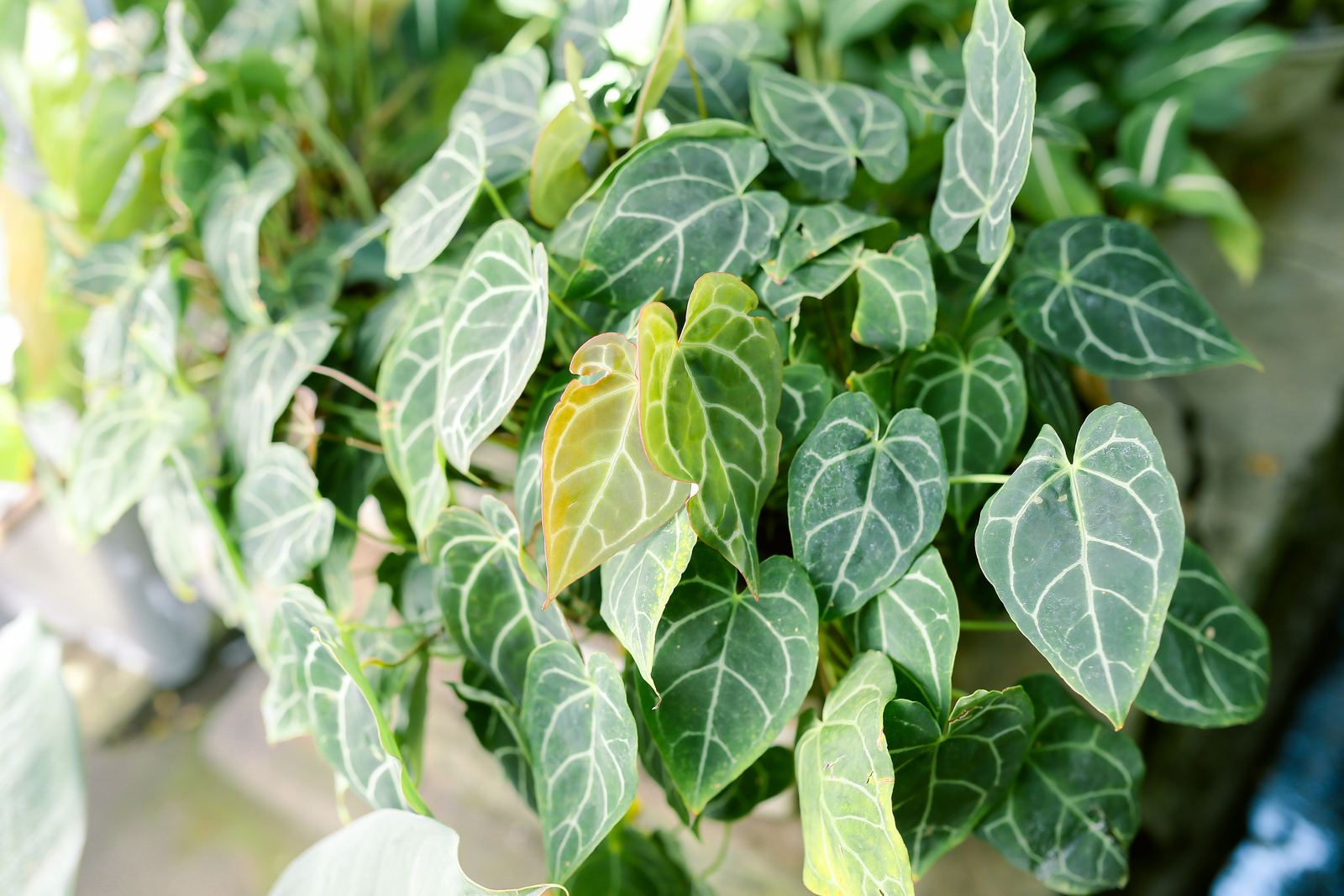 A velvet, white-veined leaf, the foliage side of the genus.
The Planters' Guild
Where they come from. Anthurium has about 1,460 accepted species, native to tropical America from Mexico and the Caribbean south to Bolivia and northeastern Argentina (Plants of the World Online, n.d.). Botanists expect many more: one Missouri Botanical Garden curator puts the eventual total at perhaps 3,000 (Croat, n.d.). Most are epiphytes, growing on trees instead of in soil, with fleshy roots gripping mossy bark (Royal Horticultural Society, n.d.-f); others grow in the ground or climb (Chen et al., 2003).
The bloom that isn't a flower. The glossy, colored “flower” of the flamingo flowers is really a spathe, a leaf-like structure at the base of the spadix, the central spike that carries the tiny true flowers (Royal Horticultural Society, n.d.-f; North Carolina State Extension, n.d.-b). A few species are grown instead for their foliage: large, velvety leaves crossed with pale veins (Royal Horticultural Society, n.d.-f; Royal Horticultural Society, n.d.-c).
Indoors, both kinds want the same things: bright, indirect light, an open mix that drains well, warmth and high humidity (Royal Horticultural Society, n.d.-d). The cards below note what differs.
Light. Bright, indirect light is the target: an east- or west-facing window, or a south-facing one shaded by a sheer curtain (Royal Horticultural Society, n.d.-f). Too little light means fewer blooms and slower growth, and direct sun can scorch the leaves (North Carolina State Extension, n.d.-a). Blooming does not take very bright light, though: in a University of Florida (UF/IFAS) study, several cultivars flowered without a break for over a year and a half under indoor light of 100 foot-candles, a unit of light intensity (Chen et al., 2003).
Water and humidity. Water once the mix is nearly dry about 2 in (5 cm) down, then let it drain; roots left sitting wet for long periods can rot (Royal Horticultural Society, n.d.-f; Royal Horticultural Society, n.d.-d). Anthuriums like very humid air, and low humidity turns the leaf tips brown (North Carolina State Extension, n.d.-a). Aim for 60–80% for A. andraeanum (North Carolina State Extension, n.d.-b) and around 70% or higher for A. crystallinum (Royal Horticultural Society, n.d.-e). Rainwater or filtered water suits them better than tap water (Royal Horticultural Society, n.d.-f).
Warmth, potting mix and feeding. Keep them at 65–85°F (18–29°C) (North Carolina State Extension, n.d.-a), out of cold drafts and away from radiators (Royal Horticultural Society, n.d.-f). Keep A. andraeanum above 64°F (18°C) in winter (Royal Horticultural Society, n.d.-a); A. scherzerianum prefers 60°F (16°C) or above (North Carolina State Extension, n.d.-c). The RHS pots A. andraeanum in an acidic mix of two parts ericaceous (lime-free) peat-free potting mix plus one part each of perlite and orchid bark (Royal Horticultural Society, n.d.-a). Sources split on feeding: UF/IFAS suggests a dilute balanced fertilizer once a month indoors (Chen et al., 2003), while the RHS uses an orchid fertilizer every two weeks from spring to fall (Royal Horticultural Society, n.d.-a). A high-phosphorus feed, along with removing spent blooms, encourages flowering (North Carolina State Extension, n.d.-a).
It helps to know which anthurium you have. The flowering types, like A. andraeanum, are grown for the waxy spathe, and too little light means fewer blooms (North Carolina State Extension, n.d.-a). Velvet-leaved species such as A. clarinervium and A. warocqueanum are grown mainly for their foliage; in A. warocqueanum the leaves hang vertically. The RHS gives them the same bright, indirect light and high humidity (Royal Horticultural Society, n.d.-b; Royal Horticultural Society, n.d.-d). Same core care, different reasons to grow them.
| What you see | Likely cause | What to do |
|---|---|---|
| Brown leaf tips | Low humidity, or salt buildup from too much fertilizer | Raise the humidity; flush the pot with water and feed less. |
| Yellowing leaves | Overwatering or poor drainage | Let the mix dry well between waterings; use an airier, well-drained mix. |
| Plenty of leaves, few or no blooms | Too little light | Give it more light, still indirect. |
| Broad, dry, tan blotches | Sunburn | Move it out of direct sun. |
| Spider mites or mealybugs | Pests to watch for on anthuriums | Isolate it and see our Field Manual's spider mite guide or mealybug guide. |
The Planters' GuildEvery part of an anthurium holds calcium oxalate crystals (North Carolina State Extension, n.d.-a). In people, chewing any part can cause a painful burning feeling in the lips, mouth, tongue and throat, and sometimes blistering and swelling (Queensland Poisons Information Centre, n.d.). Seek urgent medical help if the lips or tongue swell, or if breathing or swallowing becomes hard (Queensland Poisons Information Centre, n.d.). Contact with the sap can irritate the skin and eyes, causing redness and stinging (North Carolina State Extension, n.d.-a), and the RHS advises gloves when handling the plant (Royal Horticultural Society, n.d.-a). The ASPCA's entry covers the flamingo flower, A. scherzerianum, and lists it as toxic to dogs, cats and horses, with "oral irritation, pain and swelling of mouth, tongue and lips," heavy drooling, difficulty swallowing and, in dogs and cats, vomiting (ASPCA, n.d.). Keep them away from children and pets. If a person eats any part of one, call Poison Control at 1-800-222-1222 in the US or use its online tool for expert help (National Capital Poison Center, n.d.). If you think a pet has eaten any, call your vet or the ASPCA Animal Poison Control Center as soon as you suspect it, without waiting for symptoms (ASPCA, n.d.).
ASPCA. (n.d.). Flamingo flower (Anthurium scherzeranum). Toxic and non-toxic plants. Retrieved October 13, 2026. aspca.org/pet-care/aspca-poison-control/toxic-and-non-toxic-plants/flamingo-flower
Chen, J., McConnell, D. B., Henny, R. J., & Everitt, K. C. (2003). Cultural guidelines for commercial production of interiorscape Anthurium (ENH956). UF/IFAS Extension. Retrieved October 13, 2026. edis.ifas.ufl.edu/publication/EP159
Croat, T. B. (n.d.). Aroid species diversity: Are we underestimating the number of aroids? [Presentation]. Missouri Botanical Garden. Retrieved October 13, 2026. missouribotanicalgarden.org/Portals/0/staff/PDFs/croat/UnderestimatingDiversityOfAraceae.pdf
National Capital Poison Center. (n.d.). Poisonous and non-poisonous plants: An illustrated list. Poison Control. Retrieved October 13, 2026. poison.org/articles/plant
National Parks Board. (2021). Anthurium veitchii. Flora & Fauna Web. Retrieved October 13, 2026. nparks.gov.sg/florafaunaweb/flora/7/0/7091
North Carolina State Extension. (n.d.-a). Anthurium. North Carolina Extension Gardener Plant Toolbox. Retrieved October 13, 2026. plants.ces.ncsu.edu/plants/anthurium
North Carolina State Extension. (n.d.-b). Anthurium andraeanum. North Carolina Extension Gardener Plant Toolbox. Retrieved October 13, 2026. plants.ces.ncsu.edu/plants/anthurium-andraeanum
North Carolina State Extension. (n.d.-c). Anthurium scherzerianum. North Carolina Extension Gardener Plant Toolbox. Retrieved October 13, 2026. plants.ces.ncsu.edu/plants/anthurium-scherzerianum
Plants of the World Online. (n.d.). Anthurium Schott. Royal Botanic Gardens, Kew. Retrieved October 13, 2026. powo.science.kew.org
Queensland Poisons Information Centre. (n.d.). Flamingo flower (Anthurium andraeanum). Queensland Health. Retrieved October 13, 2026. poisonsinfo.health.qld.gov.au/plants-and-mushrooms/flamingo-flower-anthurium-andraeanum
Royal Horticultural Society. (n.d.-a). Anthurium andraeanum. RHS Find a Plant. Retrieved October 13, 2026. rhs.org.uk/plants/1349/details
Royal Horticultural Society. (n.d.-b). Anthurium clarinervium. RHS Find a Plant. Retrieved October 13, 2026. rhs.org.uk/plants/84264/details
Royal Horticultural Society. (n.d.-c). Anthurium crystallinum. RHS Find a Plant. Retrieved October 13, 2026. rhs.org.uk/plants/25099/details
Royal Horticultural Society. (n.d.-d). Anthurium warocqueanum. RHS Find a Plant. Retrieved October 13, 2026. rhs.org.uk/plants/1361/details
Royal Horticultural Society. (n.d.-e). Houseplants for humidity. RHS Urban Show houseplant profiles. Retrieved October 13, 2026. rhs.org.uk/shows-events/rhs-urban-show/houseplant-profiles/houseplants-for-humidity
Royal Horticultural Society. (n.d.-f). How to grow anthuriums. Retrieved October 13, 2026. rhs.org.uk/plants/anthuriums/how-to-grow-anthuriums
Care and range for the genus come from botanical and horticultural references; the cards note only what differs. Species details follow the RHS plant entries (Royal Horticultural Society, n.d.-b; Royal Horticultural Society, n.d.-c), NC State Extension (North Carolina State Extension, n.d.-a) and the National Parks Board of Singapore (National Parks Board, 2021).