Light
Bright, indirect; some varieties, including variegated ones, need more.
 The Planters' Guild
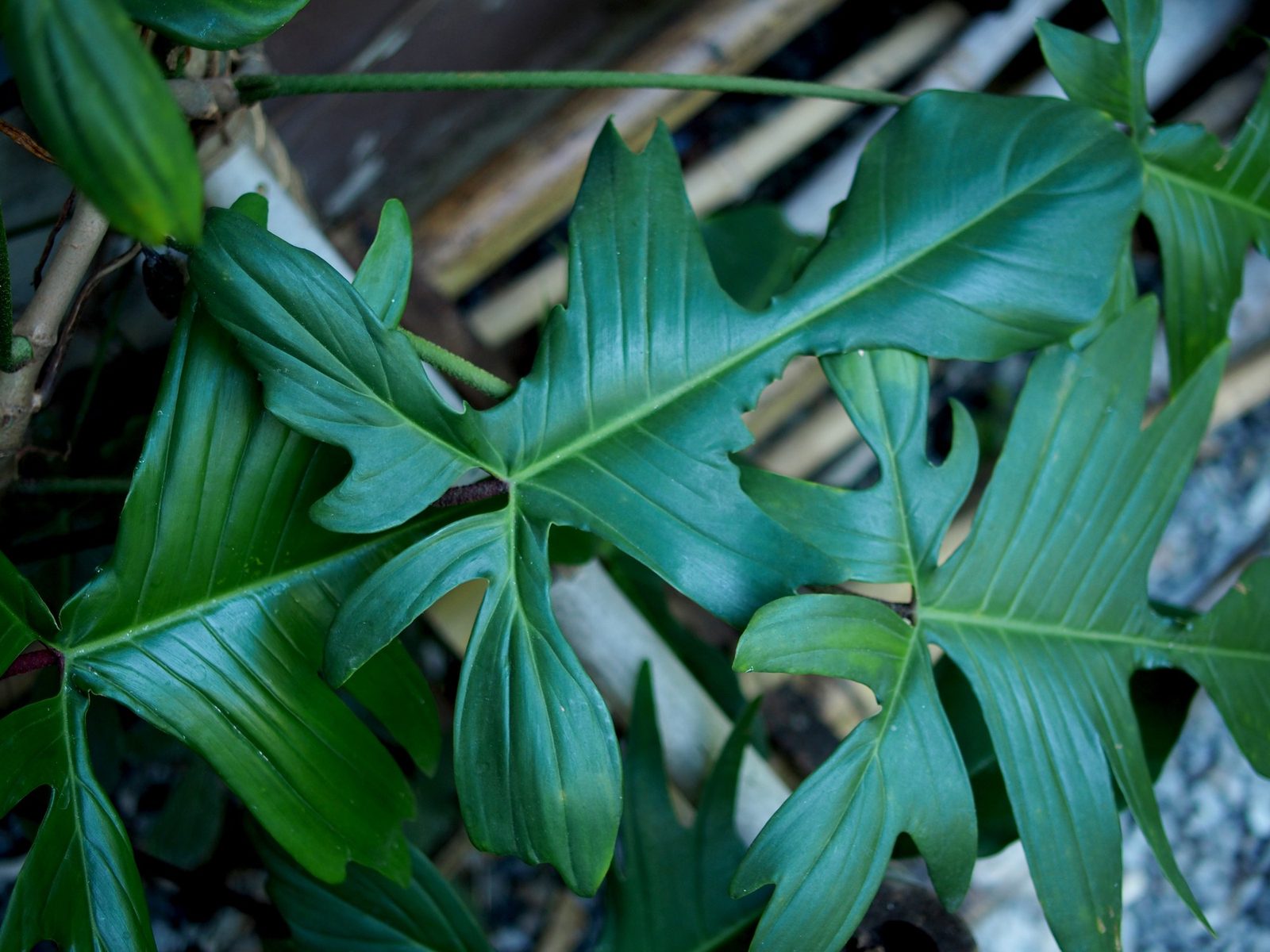 A deeply cut, cream-splashed leaf, one of many leaf shapes in a very large genus.
The Planters' Guild
One rhythm, two habits. Philodendron is a large genus of about 630 species (Plants of the World Online, n.d.), though Missouri Botanical Garden's Thomas Croat estimates some 400 more are still to be described (Croat, n.d.). They are native to the tropical Americas, from Mexico and the Caribbean south through Central and South America (Plants of the World Online, n.d.). Most are hemi-epiphytes, plants that either start in the ground and then climb and root onto trees, or start on a branch and send roots down to the soil (Royal Horticultural Society, n.d.-b). The genus is usually split into two growth habits: climbers, which attach to trees by aerial roots, and self-headers, whose very short stems hold the leaves in a rosette (North Carolina State Extension, n.d.-a).
One care rhythm carries across the genus: bright indirect light, a free-draining mix, steady warmth, and, for the climbers, something to climb (North Carolina State Extension, n.d.-a; Royal Horticultural Society, n.d.-b). The same basics hold from a common heartleaf to the collector plants, though the velvet-leaved 'Micans' handles stress less well than the adult heartleaf form (McConnell et al., 2003).
Species differ in size and habit and above all in the leaf: heart-shaped or deeply cut, plain green or variegated, glossy or velvety (North Carolina State Extension, n.d.-a). Those differences, and the handful that change care, live on the species cards in this guide.
Light. Philodendrons prefer bright, indirect light (North Carolina State Extension, n.d.-a). Without enough, philodendrons turn leggy and make fewer, smaller leaves (Royal Horticultural Society, n.d.-b), and variegated cultivars such as 'Birkin' can lose their variegation (North Carolina State Extension, n.d.-b). Most will put up with a dim room, but they keep their color and leaf size only in brighter light (McConnell et al., 2003). Keep direct sun off the leaves; it can scorch them (North Carolina State Extension, n.d.-a).
Water, mix and feeding. Let the surface of the mix dry between waterings (Royal Horticultural Society, n.d.-b); UF/IFAS keeps the mix moist for best growth indoors (McConnell et al., 2003). Either way, never leave it standing in water: saturated mix can rot the roots, which yellows the leaves (Royal Horticultural Society, n.d.-b). Pot it in a loose, free-draining, slightly acidic mix; the RHS suggests a 2:1 blend of orchid potting mix and peat-free acidic potting mix (Royal Horticultural Society, n.d.-b). Feed with a general houseplant fertilizer from April to September (Royal Horticultural Society, n.d.-b).
Humidity, warmth and support. Philodendrons prefer high humidity but usually adapt to an average home (North Carolina State Extension, n.d.-a). One velvet climber is an exception: the RHS keeps P. melanochrysum at 60–80% humidity (Royal Horticultural Society, n.d.-a). Keep it at 65–85°F (18–29°C), and never below 59°F (15°C), clear of cold drafts and hot radiators; it's very sensitive to cold (North Carolina State Extension, n.d.-a; Royal Horticultural Society, n.d.-b). Give the climbers a moss pole, which they will root into if it's kept moist (Royal Horticultural Society, n.d.-b). In production, when larger-leaved cuttings are wanted for totems (plants grown up a central support pole), growers grow stock plants on a pole and take tip cuttings (McConnell et al., 2003). Self-heading types generally don't need support (Royal Horticultural Society, n.d.-b).
The genus is usually divided into climbing and self-heading habits (North Carolina State Extension, n.d.-a). Climbers like heartleaf and P. erubescens want a pole to grow up. Self-headers like 'Birkin' hold their leaves in a rosette (North Carolina State Extension, n.d.-a). P. gloriosum has a creeping stem (CATE Araceae, n.d.). UF/IFAS adds a third group instead: upright, tree-like types (McConnell et al., 2003).
| What you see | Likely cause | What to do |
|---|---|---|
| Fewer, smaller leaves; leggy stems | Too little light | Move it to brighter, indirect light. |
| Scorched, browning patches | Direct sun | Filter the light; move it off the direct beam. |
| Brown leaf tips | Low humidity or uneven watering | Raise humidity; water on a steadier rhythm. |
| Yellowing leaves | Overwatering or poorly draining mix, which can rot the roots | Let the surface dry between waterings, never leave it standing in water, and use a looser mix. |
| Fine webbing, stippling | Spider mites, which thrive in dry, warm air | Isolate it and follow our Field Manual's spider mite guide. |
The Planters' GuildPhilodendrons contain calcium oxalate, which forms raphides, tiny needle-like crystals (National Capital Poison Center, n.d.). In people, swallowing the plant can bring swelling, drooling and even loss of speech, and sap on the skin or in the eyes can cause swelling, redness and irritation (National Capital Poison Center, n.d.). Sap rubbed into an eye can scratch the cornea and, rarely, cause permanent eye damage (National Capital Poison Center, n.d.; Chong et al., 2022). If sap gets on skin, wash the area for 15 minutes with soap and water; if it gets in an eye, flush the eye with water for at least 15 minutes (National Capital Poison Center, n.d.). Wear gloves when handling and pruning philodendrons (Royal Horticultural Society, n.d.-b). Heartleaf philodendron (P. hederaceum) is toxic to dogs, cats and horses; signs include oral irritation, a painful, swollen mouth, tongue and lips, heavy drooling, vomiting (not in horses) and difficulty swallowing (ASPCA, n.d.). Keep it away from children and pets. If you are worried that a person has been exposed, call Poison Control at 1-800-222-1222 in the US or use its online tool (National Capital Poison Center, n.d.). Call 911 if they are drooling heavily, have severe mouth swelling, or have trouble swallowing or breathing (National Capital Poison Center, n.d.). If you think a pet has eaten any, call your vet or the ASPCA Animal Poison Control Center as soon as you suspect it, without waiting for symptoms (ASPCA, n.d.).
ASPCA. (n.d.). Heartleaf philodendron. Toxic and non-toxic plants. Retrieved October 13, 2026. aspca.org/pet-care/aspca-poison-control/toxic-and-non-toxic-plants/heartleaf-philodendron
CATE Araceae. (n.d.). Philodendron gloriosum André [Species description]. GBIF. Retrieved October 13, 2026. api.gbif.org/v1/species/2870786/descriptions
Chong, S. H., Ch'ng, T. W., & Mustapha, M. (2022). Dieffenbachia-induced transient crystalline keratopathy: A case report and review of previously reported cases. Cureus, 14(1), e21146. https://doi.org/10.7759/cureus.21146
Croat, T. B. (n.d.). A primer on the genus Philodendron [Presentation]. Missouri Botanical Garden. Retrieved October 13, 2026. missouribotanicalgarden.org/Portals/0/staff/PDFs/croat/APrimerOnGenusPhilodendron.pdf
Hahn, J., & Weisenhorn, J. (2026). Insects on indoor plants. University of Minnesota Extension. Retrieved October 13, 2026. extension.umn.edu/product-and-houseplant-pests/insects-indoor-plants
McConnell, D. B., Chen, J., Henny, R. J., & Everitt, K. C. (2003). Cultural guidelines for commercial production of interiorscape Philodendron (ENH893/EP150). UF/IFAS Extension. Retrieved October 13, 2026. edis.ifas.ufl.edu/publication/EP150
National Capital Poison Center. (n.d.). Dieffenbachia and Philodendron: Popular but poisonous. Poison Control. Retrieved October 13, 2026. poison.org/articles/dieffenbachia-and-philodendron-202
North Carolina State Extension. (n.d.-a). Philodendron. North Carolina Extension Gardener Plant Toolbox. Retrieved October 13, 2026. plants.ces.ncsu.edu/plants/philodendron
North Carolina State Extension. (n.d.-b). Philodendron 'Birkin'. North Carolina Extension Gardener Plant Toolbox. Retrieved October 13, 2026. plants.ces.ncsu.edu/plants/philodendron-birkin
North Carolina State Extension. (n.d.-c). Philodendron erubescens. North Carolina Extension Gardener Plant Toolbox. Retrieved October 13, 2026. plants.ces.ncsu.edu/plants/philodendron-erubescens
North Carolina State Extension. (n.d.-d). Philodendron hederaceum. North Carolina Extension Gardener Plant Toolbox. Retrieved October 13, 2026. plants.ces.ncsu.edu/plants/philodendron-hederaceum
Plants of the World Online. (n.d.). Philodendron Schott. Royal Botanic Gardens, Kew. Retrieved October 13, 2026. powo.science.kew.org
Royal Horticultural Society. (n.d.-a). Houseplants for humidity. RHS Urban Show houseplant profiles. Retrieved October 13, 2026. rhs.org.uk/shows-events/rhs-urban-show/houseplant-profiles/houseplants-for-humidity
Royal Horticultural Society. (n.d.-b). Philodendron: Growing guide. Retrieved October 13, 2026. rhs.org.uk/plants/philodendron/growing-guide
Steil, A. (2026). Why does my houseplant have brown leaf tips and edges? Iowa State University Extension and Outreach. Retrieved October 13, 2026. yardandgarden.extension.iastate.edu/faq/why-does-my-houseplant-have-brown-leaf-tips-and-edges
Our genus care and range come from botanical, horticultural and toxicology references; the cards carry the species-specific notes. Species and cultivar notes follow NC State plant profiles (North Carolina State Extension, n.d.-b; North Carolina State Extension, n.d.-c; North Carolina State Extension, n.d.-d), UF/IFAS (McConnell et al., 2003) and a botanical description (CATE Araceae, n.d.). Problem notes also draw on general houseplant guidance (Hahn & Weisenhorn, 2026; Steil, 2026).