Light
Low to bright, indirect. Best in bright, indirect light; tolerates very low light.
 The Planters' Guild
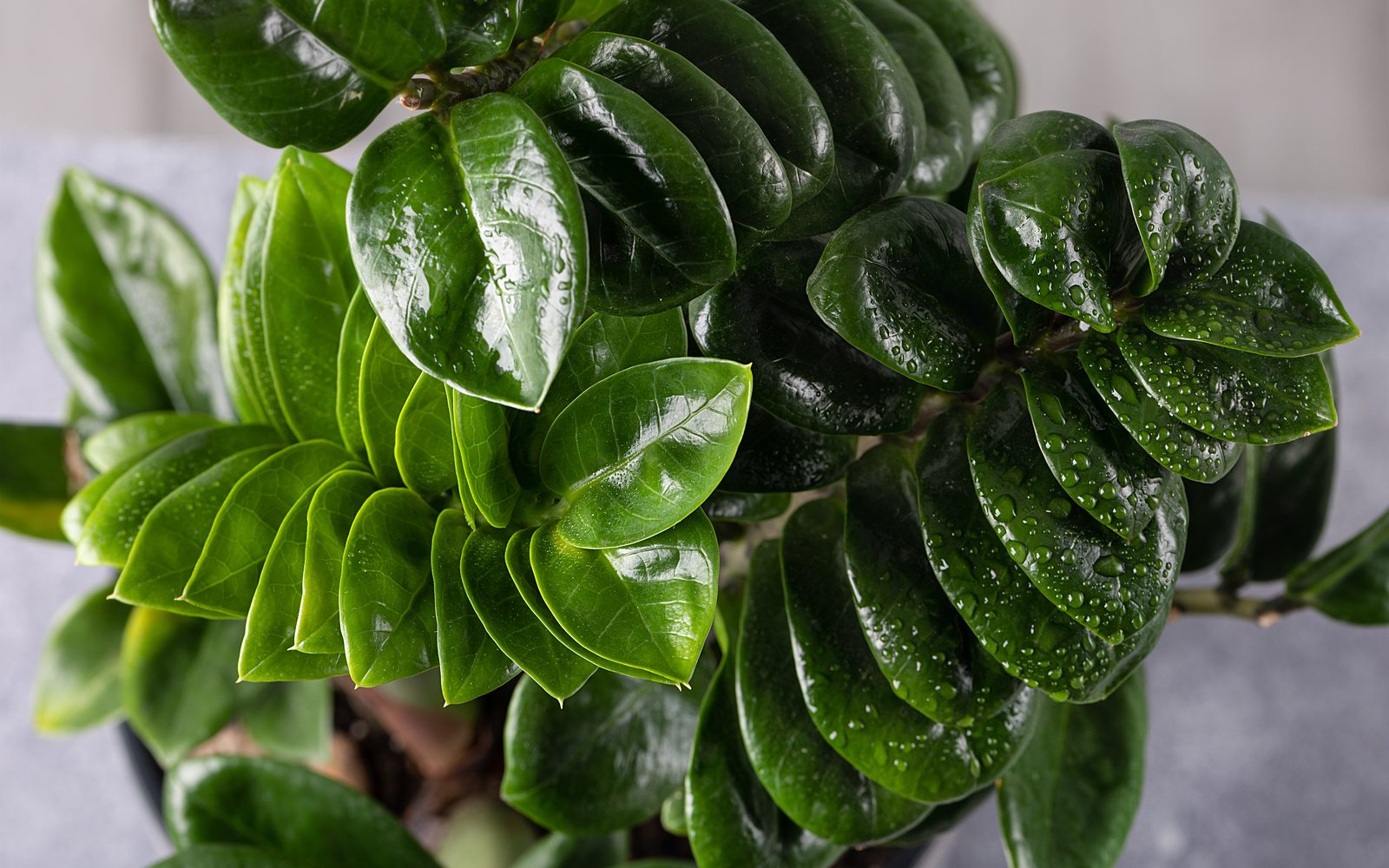 The glossy, feather-like foliage of a ZZ plant.
The Planters' Guild
One species. The ZZ plant is Zamioculcas zamiifolia, the only species in its genus, an aroid native to eastern Africa from Kenya south to KwaZulu-Natal in South Africa (Plants of the World Online, n.d.). In the wild it grows in humid to dry evergreen forest, woodland, dry wooded grassland and thicket, often on rocks (CATE Araceae, n.d.). Its glossy “stems” are really whole leaves, each up to about 2 ft (60 cm) long and divided into 6 to 8 pairs of leaflets (Queensland Poisons Information Centre, n.d.).
Built for drought. Its drought tolerance probably comes from water stored in its thick rhizomes plus waxy leaves and fleshy stems that lose little water, and it can go 3 to 4 months without water, according to the University of Florida (UF/IFAS) (Chen et al., 2004). Those reserves are also why it should be watered sparingly: overwatering is just about the only thing that brings one down (UConn Home & Garden Education Center, n.d.).
Growth is slow and comes in spurts (Jauron, 2009), and the leaves rise straight from the rhizome (Henny & Chen, 2013). A handful of patented cultivars vary the color and size, from the near-black Raven ('Dowon') to the compact 'HANSOTI13' (Lee, 2018; Hansoti, 2016). The RHS gives Raven the same growing advice as the species (Royal Horticultural Society, n.d.-b).
Light. The ZZ plant does best in bright, indirect light but tolerates very low light (Jauron, 2009). It grows much more slowly in the dim light of many homes (UConn Home & Garden Education Center, n.d.), yet in UF/IFAS trials it kept producing new leaves for more than a year at 25 foot-candles, a dim indoor light level (Chen et al., 2004). Keep it out of direct sun, which can scald the leaves white and make them curl (UConn Home & Garden Education Center, n.d.).
Water and the rhizome. Let the mix dry out completely, then water thoroughly until some runs out of the bottom of the pot, and discard the excess (North Carolina State Extension, n.d.; Jauron, 2009). Sources differ on how often: NC State suggests watering about once a month in winter and twice a month in summer (North Carolina State Extension, n.d.), while Iowa State suggests every 7 to 14 days once the mix has dried (Jauron, 2009). In a long dry spell it may drop its leaves and live off the rhizome until watered again (Queensland Poisons Information Centre, n.d.), while a plant kept wet in poorly drained soil can get root rot (Henny & Chen, 2013). Use any well-drained peat- or bark-based mix, and never let the pot sit in water (Henny & Chen, 2013).
Warmth, feeding and growth. UF/IFAS gives a preferred range of 65–90°F (18–32°C) and warns that growth slows and injury may occur below 50°F (10°C) (Henny & Chen, 2013). UConn keeps it at 55–80°F (13–27°C) (UConn Home & Garden Education Center, n.d.). Feed lightly, once or twice a year (North Carolina State Extension, n.d.; Henny & Chen, 2013), though Iowa State feeds a dilute solution once or twice a month in spring and summer (Jauron, 2009). Growth is slow even in ideal conditions (Chen et al., 2004), so be patient.
The rhizome that makes the ZZ so tough also makes it easy to overwater. When a ZZ does go downhill, overwatering is almost always the reason, and its signs are yellow leaves and rotting rhizomes (UConn Home & Garden Education Center, n.d.). Water only once the mix has dried completely (North Carolina State Extension, n.d.), use a pot that drains, and when in doubt, wait (UConn Home & Garden Education Center, n.d.). It tolerates low light, but it isn't a no-light plant: UF/IFAS advises at least 25 foot-candles indoors (Chen et al., 2004).
| What you see | Likely cause | What to do |
|---|---|---|
| Yellowing leaflets | Overwatering | Let it dry out completely; check the rhizome for rot. |
| Soft, rotting rhizome | Rot from poorly drained, wet soil | Let it dry and water much less; take a sample to your local Extension office if unsure. |
| Dropped leaflets after a long dry spell | Underwatering | Water thoroughly; the rhizome carries it until it grows again. |
| No new growth | Normal slow growth, or low light | Be patient, and give it brighter, indirect light. |
| Scalded, whitened or brown patches | Direct sun | Move it to indirect light. |
The Planters' GuildEvery part of the ZZ plant is poisonous. In people, chewing or swallowing it can cause immediate pain or a burning feeling and swelling in the lips, mouth, tongue and throat, and some sensitive people get contact dermatitis, a skin rash (Queensland Poisons Information Centre, n.d.); vomiting and diarrhea can also occur (Khamare & Marble, 2023). Seek urgent medical help if the lips or tongue swell, or if breathing or swallowing becomes hard (Queensland Poisons Information Centre, n.d.). In two reported cases, small children who bit the leaves had mouth pain or irritation and drooling, and both recovered fully within a day (Gamage, 2020). The RHS lists it as a skin and eye irritant and advises gloves when handling it (Royal Horticultural Society, n.d.-a). The ASPCA has no entry for the ZZ plant. NC State rates it as of medium toxicity to cats and dogs, with vomiting and diarrhea if the leaves are eaten in quantity (North Carolina State Extension, n.d.). Keep it away from children and pets. If a person eats any of it, call Poison Control at 1-800-222-1222 in the US or use its online tool for expert help (National Capital Poison Center, n.d.). If you think a pet has eaten any, call your vet or the ASPCA Animal Poison Control Center as soon as you suspect it, without waiting for symptoms.
Bruinen, E. (2013). Zamioculcas zamiifolia plant named 'LUCKYWHIT' (U.S. Plant Patent No. PP23,614). U.S. Patent and Trademark Office. Retrieved October 13, 2026. patents.google.com/patent/USPP23614
CATE Araceae. (n.d.). Zamioculcas zamiifolia [Habitat description]. Global Biodiversity Information Facility. Retrieved October 13, 2026. api.gbif.org/v1/species/2869014/descriptions
Chen, J., Henny, R. J., & McConnell, D. B. (2004). Cultural guidelines for commercial production of interiorscape ZZ (Zamioculcas zamiifolia) (ENH997). UF/IFAS Extension. Retrieved October 13, 2026. edis.ifas.ufl.edu/publication/EP252
Gamage, M. (2020). Two cases of accidental poisoning with Zamioculcas zamiifolia. Sri Lanka Journal of Child Health, 49(2), 195–196. https://doi.org/10.4038/sljch.v49i2.8975
Hansoti, A. (2016). Zamioculcas plant named 'HANSOTI13' (U.S. Plant Patent No. PP26,760). U.S. Patent and Trademark Office. Retrieved October 13, 2026. patents.google.com/patent/USPP26760P3
Henny, R. J., & Chen, J. (2013). Florida foliage house plant care: ZZ plant (ENH1219). UF/IFAS Extension. Retrieved October 13, 2026. edis.ifas.ufl.edu/publication/EP480
Jauron, R. (2009). The ZZ plant. Iowa State University Extension and Outreach, Yard and Garden. Retrieved October 13, 2026. yardandgarden.extension.iastate.edu/article/2009/2-4/Zamioculcas.html
Khamare, Y., & Marble, C. (2023). Common poisonous houseplant species in Florida (ENH1375). UF/IFAS Extension. https://doi.org/10.32473/edis-ep639-2023
Lee, H. J. (2018). Zamioculcas plant named 'Dowon' (U.S. Plant Patent No. PP30,035). U.S. Patent and Trademark Office. Retrieved October 13, 2026. patents.google.com/patent/USPP30035P3
National Capital Poison Center. (n.d.). Poisonous and non-poisonous plants: An illustrated list. Poison Control. Retrieved October 13, 2026. poison.org/articles/plant
North Carolina State Extension. (n.d.). Zamioculcas zamiifolia. North Carolina Extension Gardener Plant Toolbox. Retrieved October 13, 2026. plants.ces.ncsu.edu/plants/zamioculcas-zamiifolia
Plants of the World Online. (n.d.). Zamioculcas zamiifolia (G.Lodd.) Engl. Royal Botanic Gardens, Kew. Retrieved October 13, 2026. powo.science.kew.org
Queensland Poisons Information Centre. (n.d.). Zanzibar gem (Zamioculcas zamiifolia). Queensland Health. Retrieved October 13, 2026. poisonsinfo.health.qld.gov.au/plants-and-mushrooms/zanzibar-gem-zamioculcas-zamiifolia
Royal Horticultural Society. (n.d.-a). Zamioculcas zamiifolia. RHS Find a Plant. Retrieved October 13, 2026. rhs.org.uk/plants/19185/details
Royal Horticultural Society. (n.d.-b). Zamioculcas zamiifolia Raven ('Dowon'). RHS Find a Plant. Retrieved October 13, 2026. rhs.org.uk/plants/368045/details
Spruit, A. T. (2008). Zamioculcas plant named 'Zamicro' (U.S. Plant Patent No. PP19,314). U.S. Patent and Trademark Office. Retrieved October 13, 2026. patents.google.com/patent/USPP19314
UConn Home & Garden Education Center. (n.d.). ZZ plant. University of Connecticut. Retrieved October 13, 2026. homegarden.cahnr.uconn.edu/factsheets/zz-plant
Care and range come from botanical, horticultural and toxicology references; the cards note only what differs. Cultivar details follow the U.S. plant patents (Lee, 2018; Hansoti, 2016; Spruit, 2008; Bruinen, 2013), NC State Extension (North Carolina State Extension, n.d.) and the RHS (Royal Horticultural Society, n.d.-b).