Light
Bright, indirect. Strong sun can scorch the leaves; low light slows growth.
 The Planters' Guild
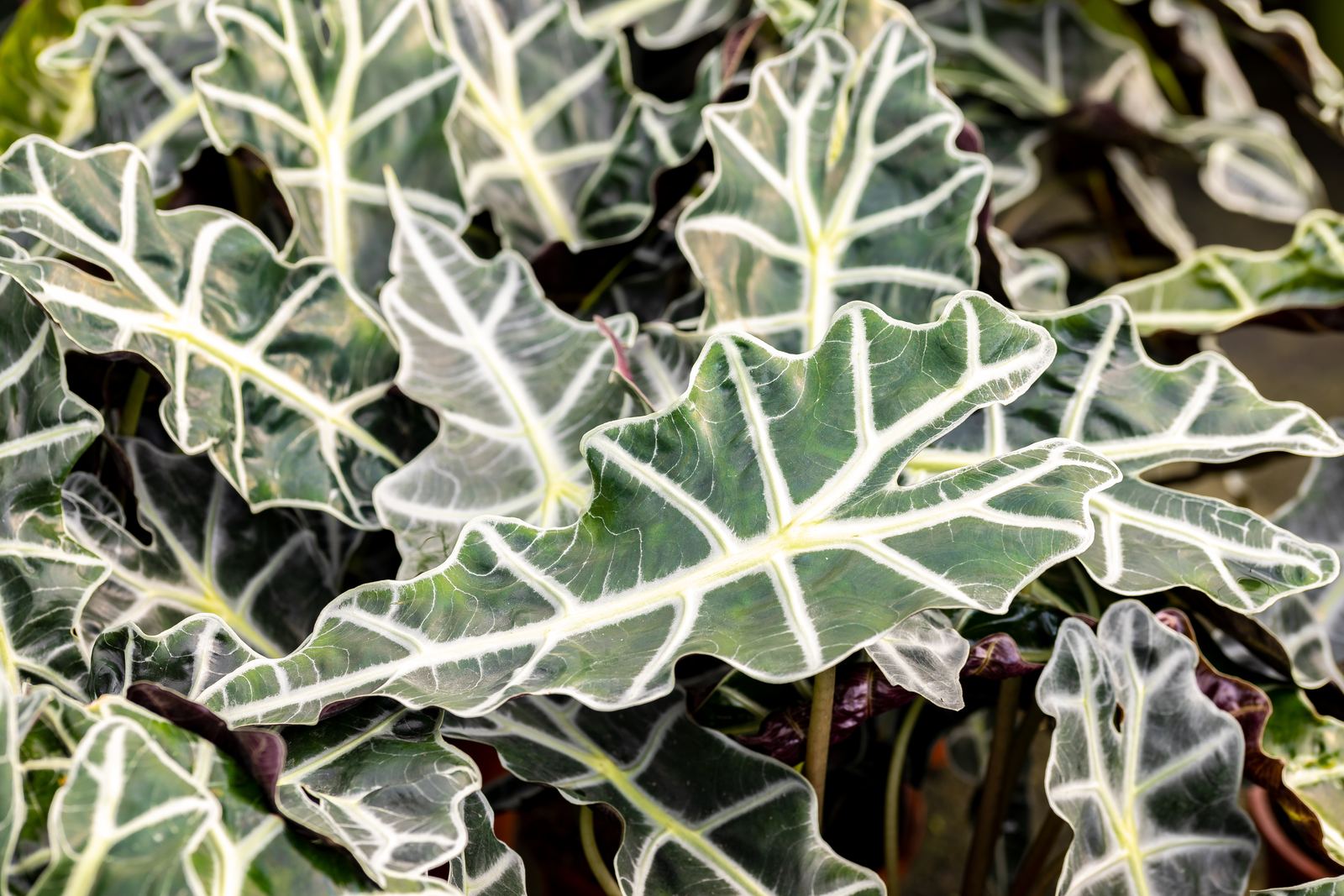 Leaves of the hybrid Alocasia × amazonica 'Polly'.
The Planters' Guild
Where they come from. Alocasia is a genus of about ninety aroids native to tropical and subtropical Asia, from India and southern China through Southeast Asia and New Guinea to the Solomon Islands and eastern Australia (Plants of the World Online, n.d.). They grow from a fleshy rhizome, a thick underground stem (Royal Horticultural Society, n.d.), and carry large shield- or arrow-shaped leaves on long stalks.
Alocasias come from tropical forests. As houseplants they want warmth, humidity and bright, indirect light, and the air in our homes is often too dry for them (Royal Horticultural Society, n.d.). Given what they need, they can grow very fast in summer, often putting out a new leaf each week (Royal Horticultural Society, n.d.).
Leaf color, size and shape vary with the species or cultivar, and so does plant size (North Carolina State Extension, n.d.). The species cards below note what differs.
Light and warmth. Bright, indirect light is the target; strong sun can scorch the leaves, and in lower light they grow much more slowly (Royal Horticultural Society, n.d.). Keep them at least 60°F (16°C) while they grow and never below 50°F (10°C), and away from cold drafts, heating vents and cold windows (Royal Horticultural Society, n.d.; New York Botanical Garden, n.d.).
Water and humidity. Through the growing season, water once the top 2 inches (5 cm) of mix is dry; overwatering can rot the roots (Royal Horticultural Society, n.d.). In the one controlled study we found, a greenhouse trial of the cultivar 'Bambino', plants grew best in mix that stayed consistently moist, but their roots avoided the soggy bottom layer of the pot (Hsieh & Yeh, 2025). Alocasias like medium to high humidity (Royal Horticultural Society, n.d.), and the New York Botanical Garden suggests about 70% (New York Botanical Garden, n.d.). Low humidity can brown the leaf edges and may attract spider mites (Royal Horticultural Society, n.d.), which show as fine pale speckling; a close look may also show very fine webbing (Iowa State University Extension, 2007). Misting raises humidity only until the water evaporates, often within minutes, so a humidifier does more (Miklas, n.d.).
Potting mix and feeding. Pot in a free-draining mix. The Royal Horticultural Society suggests peat-free compost with about one part horticultural grit (small, coarse stone chips) to three parts compost (Royal Horticultural Society, n.d.). For African mask (Alocasia × amazonica, of which 'Polly' is the main variety) one university greenhouse notes that "orchid bark or perlite may be added for additional porosity", meaning more air space in the mix (Brigham Young University Life Science Greenhouse, n.d.). The Guild grows many of its own Alocasia in its Alocasia Bark-Free Mix. Feed with a general liquid fertilizer from April to October, at the rate on the label (Royal Horticultural Society, n.d.). In the 'Bambino' greenhouse trial, growth leveled off at modest feeding rates, and the authors suggest Alocasia is salt-sensitive (Hsieh & Yeh, 2025).
In winter, many Alocasia slow down and may lose some of their leaves (Royal Horticultural Society, n.d.). Water much less, keep them out of cold drafts and never below 50°F (10°C), and feed only from April to October (Royal Horticultural Society, n.d.). Sources differ on how warm to keep them: the Royal Horticultural Society keeps them cooler so they can rest, while the New York Botanical Garden keeps them warm (Royal Horticultural Society, n.d.; New York Botanical Garden, n.d.). If a plant keeps losing leaves, be patient, keep it on the dry side and watch for regrowth in spring (New York Botanical Garden, n.d.).
| What you see | Likely cause | What to do |
|---|---|---|
| Fine pale speckling, sometimes fine webbing | Spider mites, which thrive in dry air | Isolate it and follow the routine in our Field Manual's spider mite guide. |
| Brown leaf edges | Often low humidity | Raise humidity; a humidifier does more than misting. |
| Some leaf loss in winter | The winter slowdown | Water much less; see Winter slowdown above. |
| Yellowing leaves in the growing season | Over- or underwatering, or too little light | Check the mix before watering, and move it to brighter, indirect light. |
| Yellowing leaves, mix that stays wet | Overwatering, which can rot the roots | Water less, especially in winter, and let the top 2 in (5 cm) dry first. |
The Planters' GuildEvery part of an Alocasia holds calcium oxalate crystals (National Capital Poison Center, n.d.). In people, chewing any part can quickly irritate the lips, mouth, tongue and throat (National Capital Poison Center, n.d.). Alocasia is toxic to dogs, cats and horses; signs include oral pain, swelling of the mouth, tongue and lips, heavy drooling, difficulty swallowing and, in dogs and cats, vomiting (ASPCA, n.d.). Keep them away from children and pets. If a person chews one and has symptoms, call Poison Control (1-800-222-1222 in the US). If you think a pet has eaten any, call your vet or the ASPCA Animal Poison Control Center as soon as you suspect it, without waiting for symptoms (ASPCA, n.d.).
ASPCA. (n.d.). Alocasia. Toxic and non-toxic plants. Retrieved October 13, 2026. aspca.org/pet-care/aspca-poison-control/toxic-and-non-toxic-plants/alocasia
Brigham Young University Life Science Greenhouse. (n.d.). African mask. Retrieved October 13, 2026. pws.byu.edu/greenhouse/african-mask
Hay, A. (1998). The genus Alocasia (Araceae-Colocasieae) in West Malesia and Sulawesi. Gardens' Bulletin Singapore, 50(2), 221–334.
Hay, A. (1999). The genus Alocasia (Araceae-Colocasieae) in the Philippines. Gardens' Bulletin Singapore, 51(1), 1–41.
Hsieh, C.-W., & Yeh, D.-M. (2025). Effects of substrate volumetric water content, nutrient solution concentration, and irrigation method on growth and photosynthesis of Alocasia. HortScience, 60(8), 1372–1378. https://doi.org/10.21273/HORTSCI18701-25
Iowa State University Extension. (2007). Spider mites on houseplants. Yard and Garden. yardandgarden.extension.iastate.edu
Miklas, L. (n.d.). Humidity and houseplants. Penn State Extension. Retrieved October 13, 2026. extension.psu.edu/humidity-and-houseplants
National Capital Poison Center. (n.d.). Are plants in the Alocasia genus poisonous? Poison Control. Retrieved October 13, 2026. poison.org
New York Botanical Garden. (n.d.). My Alocasia looks like it's dying this winter! Leaves are turning soft and brown. Mertz Library Plant Information Service. Retrieved October 13, 2026. libanswers.nybg.org/faq/337826
North Carolina State Extension. (n.d.). Alocasia. North Carolina Extension Gardener Plant Toolbox. Retrieved October 13, 2026. plants.ces.ncsu.edu/plants/alocasia
Plants of the World Online. (n.d.). Alocasia (Schott) G.Don. Royal Botanic Gardens, Kew. Retrieved October 13, 2026. powo.science.kew.org
Royal Horticultural Society. (n.d.). How to grow alocasias. Retrieved October 13, 2026. rhs.org.uk/plants/alocasia/growing-guide
Genus-level care and range follow botanical and horticultural references; the species cards note only what differs. Species details follow the Alocasia monographs (Hay, 1998; Hay, 1999) and horticultural references (Royal Horticultural Society, n.d.; Brigham Young University Life Science Greenhouse, n.d.; North Carolina State Extension, n.d.).